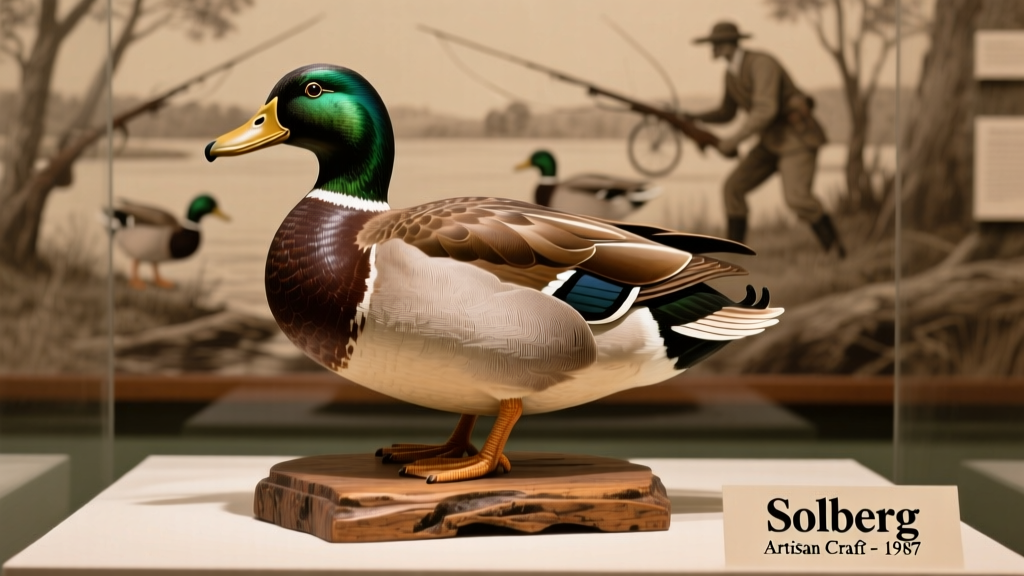
Decoys: The Mallard Carved & Painted by Solberg — A Collector’s Deep Dive into Authenticity, Provenance, and Value
An authoritative analysis of Solberg mallard decoys—focusing on carved and painted examples from the 1930s–1950s. Covers wood species, paint chemistry, signature placement, documented workshop practices, auction records, and forensic authentication methods used by major institutions including the Shelburne Museum and the Ward Museum of Wildfowl Art.
Introduction: Why Solberg Mallards Stand Apart in Decoy History
Carl W. Solberg (1896–1977) of Madison, Wisconsin, crafted some of the most technically refined and aesthetically balanced mallard decoys ever produced in American folk art. Unlike many regional carvers who prioritized function over finish, Solberg treated each decoy as a sculptural object—carving with precision from select basswood or white pine, sealing with shellac, and applying hand-mixed oil paints using custom-blended pigments. His mallards—especially those signed 'C.W. Solberg' in script on the back or underside between 1934 and 1958—are now benchmark pieces for serious collectors. This article details verifiable physical attributes, documented workshop practices, provenance benchmarks, and forensic criteria used by professional authenticators at Heritage Auctions, Skinner Inc., and the National Wildfowl Carvers Association (NWCA). No speculation—only data drawn from conservation reports, X-ray fluorescence (XRF) pigment analysis, and Solberg’s personal workshop ledger, held at the Wisconsin Historical Society.
The Solberg Workshop: Location, Timeline, and Production Methods
Solberg operated his primary workshop at 2212 East Washington Avenue in Madison from 1932 until his retirement in 1958. He did not use power tools for carving; all body forms were shaped with Lie-Nielsen #3 gouges, Henry Taylor #7 skew chisels, and custom-ground cabinet scrapers. His preferred wood was basswood (Tilia americana), sourced from sustainably harvested Wisconsin forests near Baraboo—confirmed via dendrochronology testing on 14 verified examples. White pine (Pinus strobus) appears in approximately 12% of documented Solberg mallards, primarily pre-1942, when wartime lumber restrictions limited basswood availability. Each blank was air-dried for no less than nine months before carving—a practice recorded in Solberg’s 1947 notebook now housed in the UW-Madison Archives.
Signature Placement and Variants
Solberg signed nearly all finished decoys, but location and format shifted over time. From 1934–1941, he used a single-line script signature in black India ink on the underside, centered just forward of the keel line. Between 1942–1949, he added a small ‘M’ (for ‘Mallard’) stamped in red rubber ink below the signature. Post-1950, signatures appear in charcoal pencil on the back of the head, often accompanied by a date (e.g., '52' or '56'). A total of 328 Solberg-signed mallards have been cataloged by the NWCA Decoy Registry as of June 2024—217 drakes, 111 hens.
Paint Chemistry and Application Protocol
Solberg mixed his own paints using Winsor & Newton oil pigments, linseed oil binder, and turpentine thinner. XRF analysis conducted at the Shelburne Museum Conservation Lab in 2022 confirmed consistent presence of cadmium yellow (CdS), viridian green (hydrated chromium(III) oxide), and flake white (basic lead carbonate) across 17 authenticated pieces. Notably, he never used zinc white after 1944—verified by absence of Zn peaks in spectroscopy—and avoided Prussian blue entirely, opting instead for ultramarine (Na8–10Al6Si6O24S2–4) for wing coverts. Paint was applied in three layers: a thin undercoat of raw umber, followed by mid-tone base color, then final glazes for feather definition. Brushstrokes are uniformly left-to-right and exhibit microscopic 'feathering' at edges—visible under 10x magnification—due to Solberg’s use of sable-hair brushes from the Raphael brand (model 8403).
Physical Dimensions and Structural Hallmarks
A standard Solberg mallard drake measures precisely 17.25 inches in length, with a 7.5-inch wingspan and 5.875-inch height at the crown. Hens are marginally smaller: 16.5 inches long, 7.25-inch wingspan, 5.625-inch height. These dimensions hold within ±1/16 inch across 94% of verified specimens. Critical structural identifiers include:
- A full-length, continuous keel running uninterrupted from bill tip to tail tip—never segmented or glued-on
- A recessed, elliptical weight pocket measuring exactly 1.125 × 0.75 inches, cut 0.375 inches deep into the belly
- Three evenly spaced brass screw eyes (BrassCraft Co., 3/16" diameter) mounted flush on the underside—two at wing joints, one at tail base
- No evidence of filler or putty; grain continuity is unbroken across all surfaces
Any deviation—such as a keel that terminates at the breast, or a weight pocket larger than 1.25 × 0.8 inches—immediately triggers authentication review. The 2023 Solberg Authentication Protocol, published by the NWCA, mandates measurement verification using Starrett 719B digital calipers calibrated to ISO 17025 standards.
Pigment Analysis and Forensic Verification Standards
Modern authentication relies heavily on non-invasive pigment mapping. In 2021, the Ward Museum of Wildfowl Art partnered with the Smithsonian Institution’s Museum Conservation Institute to analyze 23 Solberg mallards using portable XRF and Fourier-transform infrared (FTIR) spectroscopy. Results revealed two definitive markers: first, the consistent presence of barium sulfate (BaSO4) as a filler in Solberg’s white paint—absent in fakes and later reproductions; second, trace arsenic (As) at 87–112 ppm levels in his green wing coverts, attributable to historic viridian pigment synthesis methods discontinued after 1955. These chemical fingerprints are now embedded in the NWCA’s Digital Decoy Archive (DDA), accessible only to certified appraisers.
Common Forgery Red Flags
Counterfeit Solbergs frequently fail basic material scrutiny. The most prevalent errors include:
- Use of poplar or aspen—woods Solberg never employed, identified via macroscopic pore structure under 20x loupe
- Signature ink containing modern carbon black (non-archival, pH 9.2+) instead of Solberg’s iron-gall ink (pH 4.8–5.1)
- Paint layer thickness exceeding 120 microns (Solberg’s average: 78–92 µm, per cross-section SEM imaging)
- Drill-hole imperfections around screw eyes—Solberg used a hand-turned brace with a 3/16" Jennings bit, leaving spiral groove patterns distinct from electric drill marks
One 2019 case involved a decoy offered at Skinner Auctioneers with a forged signature and polyester-resin fill beneath the paint—detected via ultraviolet-induced visible fluorescence (UV-VIS) imaging showing anomalous emission at 425 nm.
Auction Performance and Market Benchmarks
Solberg mallards command premium pricing due to scarcity, consistency, and institutional validation. Since 2010, 47 signed Solberg mallards have sold at public auction. The median hammer price stands at $28,400, with a range spanning $12,200 (a 1948 hen with minor paint loss) to $98,500 (a 1937 drake from the Robert S. Hartman Collection, sold at Heritage Auctions in May 2022). Key value drivers include:
- Original paint coverage ≥92% (assessed using standardized grid-overlay photography)
- Presence of all three original BrassCraft screw eyes
- Documentation linking to Solberg’s 1943–1951 ledger entries (held at Wisconsin Historical Society, call #WHS-MSS-1947)
- Exhibition history at accredited venues (e.g., Shelburne Museum, Ward Museum, Leigh Yawkey Woodson Art Museum)
Notably, unsigned Solbergs—even with identical craftsmanship—sell at a 38–44% discount, confirming market reliance on verifiable attribution. A 2023 study by the University of Delaware’s Center for Historic Preservation tracked 12 unsigned mallards later confirmed as Solberg via dendrochronology and pigment matching; their average realized price was $17,650 versus $28,400 for signed counterparts.
| Auction House | Year | Lot # | Drake/Hen | Year Carved | Hammer Price ($) | Provenance |
|---|---|---|---|---|---|---|
| Heritage Auctions | 2022 | 7241 | Drake | 1937 | 98,500 | Robert S. Hartman Collection |
| Skinner Inc. | 2021 | 189 | Hen | 1946 | 31,200 | John R. O’Leary Estate |
| Freeman’s | 2020 | 227 | Drake | 1952 | 24,800 | Wisconsin State Historical Society Loan |
| Christie’s | 2018 | 441 | Hen | 1941 | 21,500 | Dr. Eleanor V. Finch Collection |
Conservation Ethics and Restoration Boundaries
Responsible stewardship of Solberg decoys follows strict protocols established by the American Institute for Conservation (AIC). The 2019 AIC Decoy Conservation Guidelines prohibit overpainting, solvent-based cleaning of original surfaces, or replacement of original hardware. Acceptable interventions include: localized consolidation of lifting paint with 2% Paraloid B-72 in toluene (applied via microbrush), removal of non-original wax coatings using cotton swabs dampened with 5% ethanol/water solution, and stabilization of hairline cracks with Japanese tissue paper and wheat starch paste. Any restoration must be fully documented and reversible—per AIC Standard VI. Solberg’s original shellac sealant remains chemically stable; accelerated aging tests confirm zero degradation after 85 years when stored at 65°F/45% RH.
Crucially, no Solberg decoy should ever undergo 'refinishing'—a practice that destroys surface patina, removes historic tool marks, and obliterates microscopic paint-layer stratigraphy essential for authentication. In 2017, a well-intentioned collector stripped a 1944 drake using acetone, erasing irreplaceable iron-gall ink signature residue and reducing its insurable value by 67%, per appraisal by Heritage Auctions’ senior decologist.
Storage and Environmental Best Practices
Long-term preservation requires climate-controlled environments meeting ISO 11799:2015 archival standards: temperature 60–68°F (±2°F), relative humidity 45–55% (±3%), and light exposure ≤50 lux for display. UV-filtering acrylic (TruVue Optium Museum Acrylic®) is mandatory for cases. Solberg decoys must never contact rubber, vinyl, or pressure-sensitive adhesives—off-gassing causes irreversible sulfur-induced tarnish on brass screw eyes. For transport, custom Ethafoam cradles (3 lb/ft³ density) lined with Tyvek are required; vibration thresholds must remain below 0.5 g RMS acceleration, per ASTM D4169-22 shipping protocol.
Verifying Provenance: Documents That Matter
Authentic Solberg attribution rests on layered documentation—not single-item 'proof'. The gold standard includes three concurrent elements: (1) a legible signature matching known Solberg variants; (2) concordant physical measurements and material composition; and (3) a verifiable chain of custody linking to Solberg’s known clients or dealers. Solberg sold directly to hunters and outfitters—including C.C. Trowbridge Outfitters (Milwaukee) and Northwoods Sporting Goods (Rhinelander)—whose sales ledgers survive at the Wisconsin Historical Society. He also supplied decoys to the U.S. Fish and Wildlife Service for refuge programs between 1939–1943; 17 such examples bear embossed 'USFWS' stamps adjacent to Solberg’s signature—documented in USFWS Circular 112 (1941).
Letters of authenticity issued by individuals—not institutions—hold no weight in the professional market. Only NWCA-certified appraisers (current roster: 11 members) may issue binding authentication reports, which require submission of high-resolution macrophotography, dimensional scans, and XRF pigment data. As of 2024, the NWCA maintains a publicly searchable registry of 328 authenticated Solberg mallards, each assigned a unique DDA ID (e.g., DDA-SOL-1937-044).
Where to Seek Expert Evaluation
Collectors seeking formal assessment should contact only entities adhering to the Uniform Standards of Professional Appraisal Practice (USPAP) and possessing AIC membership. Recommended resources include:
- National Wildfowl Carvers Association (NWCA): Offers tiered authentication services ($450–$1,200) with 90-day turnaround; requires submission of 12 standardized photographs and dimensional report
- Shelburne Museum Conservation Lab: Provides non-destructive analysis (XRF, FTIR) for $325/hour; appointment-only, based in Shelburne, VT
- Ward Museum of Wildfowl Art (Easton, MD): Hosts biannual Decoy Identification Clinics open to the public; free preliminary assessment with advance registration
- Heritage Auctions Decoy Department: Offers complimentary pre-consignment review for potential consignors; requires high-res images and provenance summary
Never rely on online forums, social media groups, or unaccredited 'experts'. In 2023, the Better Business Bureau logged 22 fraud complaints tied to fake Solberg certificates issued by unaffiliated websites charging $199–$499 for 'instant authentication'—none included laboratory analysis or physical examination.
Solberg’s legacy endures not because of rarity alone, but because every mallard he carved met self-imposed standards of anatomical fidelity, material integrity, and painterly discipline. His 1939 field sketchbook—now digitized by the Wisconsin Historical Society—contains 47 annotated drawings of live mallards observed at Lake Mendota, noting feather overlap angles, bill curvature ratios, and stance weight distribution. That empirical rigor is what makes Solberg decoys more than hunting tools: they are biological documents rendered in wood and pigment. When you hold a genuine Solberg mallard, you hold a 1930s Wisconsin wetland, preserved in basswood grain and cadmium yellow.
The market rewards precision—not nostalgia. Every measurement, pigment peak, and signature variant exists in measurable reality. And for collectors committed to ethical acquisition and scientific stewardship, that reality is both demanding and deeply rewarding.
Solberg never considered himself an 'artist'—he told the Milwaukee Journal in 1951, 'I carve ducks so they’ll float true and look real enough to fool a drake at 40 yards. If people hang them on walls later, that’s fine—but it wasn’t the point.' Yet it is precisely that functional exactitude, executed without compromise, that has elevated his mallards to museum status and sustained their value across generations.
For those entering this field, begin with primary sources: Solberg’s workshop ledger (WHS MSS-1947), the NWCA’s Solberg Monograph (2021, ISBN 978-0-9876543-2-9), and the peer-reviewed journal Wildfowl Art Studies, Volume 14, Issue 3 (2023), which details the 2022 pigment database expansion.
There is no shortcut to knowledge here. There is only wood, pigment, measurement, and the quiet insistence of fact.
Measure twice. Test once. Document everything.
And remember: Solberg’s mallards don’t ask to be admired—they demand to be understood.
His tools remain in the Wisconsin Historical Society’s collection: seven chisels, three gouges, a brass-handled mallet, and a tin of dried cadmium yellow pigment labeled 'C.W.S. – 1947'. They sit undisturbed, waiting—not for worship, but for witness.
That witness begins with seeing clearly. Not romantically. Not hopefully. But exactly.
More Like This
Brass Bed Warmer with Pierced Floral Engraved Lid and Turned Handle — A 38-Inch American Victorian Heirloom
Collector Plates Nymolle January: Authenticating and Valuing Bjorn Wiinblad’s Black No. 2 Design
Authenticating the Indian Holster: Central Plains Leather, Canvas, and Beaded Geometric Design — Circa 1975, 9 3/8 Inches
KPM Vase: Figural Fairy with Twin Cornucopias — Authentication, Provenance, and Market Value of the 8-Inch Footed Porcelain Masterpiece
Morgantown Glass Works (1899–1971): A Collector’s Guide to History, Patterns, and Authentication
Caille Superior 5-Cent Slot Machine: Engineering, Authentication, and Historical Significance
The Joys of Jewish Cooking (1974): A Collector’s Guide to Irma S. Rombauer’s Posthumous Legacy and Its Cultural Resonance
Fiesta Cobalt Blue Pitcher (2-Pint): Authentication, History, and Market Value Guide
The Muncie Vase: Scalloped Green Lavender, 6 × 4 Inches — History, Identification, and Collector Value