Cottone Auctions Fine Art & Antique Sale 2: A Collector’s Deep Dive into Authenticity, Provenance, and Market Trends
A detailed analysis of Cottone Auctions’ second Fine Art & Antique Sale, covering standout lots including a signed 1936 WPA mural study, a 1782 French ormolu-mounted marquetry commode, and a rare 1924 Babe Ruth game-used bat. Includes condition reports, auction results, authentication methodologies, and comparative market data.
Introduction: What Made Sale 2 Stand Out
Cottone Auctions’ Fine Art & Antique Sale 2, held on Saturday, May 18, 2024, at their Rochester, New York headquarters, delivered exceptional depth across three centuries of material culture—spanning 18th-century French furniture to mid-century American illustration. Unlike typical regional auctions, this sale featured rigorous pre-sale conservation assessments, third-party provenance verification by the Getty Provenance Index, and full x-radiography for all metalwork. With 287 lots and a 94% sell-through rate, total realized hammer value reached $2,148,650—exceeding presale estimates by 12.3%. Key drivers included a record-setting 1924 Hillerich & Bradsby ‘Ruth’ model bat (Lot 142), a fully documented 1782 Parisian commode with original Jean-François Oeben attribution, and a rare 1936 Works Progress Administration mural study signed in graphite by artist William Gropper. This article dissects the sale’s most significant offerings—not as isolated highlights, but as case studies in how modern collectors evaluate authenticity, condition, and historical resonance.
Authentication Protocols: Beyond the Surface
Cottone Auctions implemented a tiered authentication framework for Sale 2 that exceeded industry standards set by the Appraisers Association of America (AAA) and the International Society of Appraisers (ISA). Each lot underwent minimum three-stage verification: visual examination under 120-lux daylight-balanced LED lighting, microscopic fiber analysis (for textiles and paper), and comparative database cross-referencing via the Art Loss Register and the FBI National Stolen Art File. For objects with potential Nazi-era provenance, Cottone engaged Dr. Elena Voss, Senior Researcher at the Holocaust Art Restitution Project, who reviewed 17 lots—including Lot 89, a 1912 Klimt-inspired silverpoint drawing—confirming clean chain-of-title documentation dating to 1947.
Material-Specific Verification
For metalwork, Cottone partnered with Metallurgical Solutions Inc. (MSI) of Albany, NY, conducting handheld XRF (X-ray fluorescence) spectroscopy on all bronze, brass, and ormolu components. Results were published in the online catalog appendix. For example, the ormolu mounts on Lot 44—a Louis XVI-style secrétaire à abattant—revealed copper-zinc-tin ratios matching documented Parisian foundry alloys from 1778–1783, not later 19th-century reproductions. Similarly, ink analysis on Lot 142’s bat stamp used Raman spectroscopy to confirm iron-gall ink consistent with 1920s factory application methods, ruling out post-1950 re-stamping.
The Role of Conservation Documentation
Every lot entered with a full conservation report authored by AIC (American Institute for Conservation)-certified conservators. These were not summary notes but technical dossiers: pH readings of wood substrates, adhesive residue chromatography, and ultraviolet-induced fluorescence mapping. Lot 117, a 1943 Norman Rockwell oil study for The Homecoming Soldier, underwent infrared reflectography revealing pentimenti beneath the final layer—confirming it was an original preparatory work, not a studio copy. Such granular reporting empowered bidders to assess risk with precision, directly contributing to the 38% premium over low estimate achieved for that lot ($182,500).
Highlight Lots: Contextualized Value Drivers
Market value in fine art and antiques is rarely dictated solely by age or fame. It emerges from the intersection of rarity, condition integrity, documented history, and cultural relevance. Sale 2 exemplified this principle across multiple categories, with several lots achieving prices that recalibrated sector benchmarks.
A 1782 French Commode: Provenance as Proof
Lot 44—a marquetry commode attributed to Jean-François Oeben and stamped ‘J.F.O.’ on the lower drawer interior—realized $412,000 (estimate: $220,000–$280,000). Its significance rests on four pillars: First, its 1782 construction date aligns with Oeben’s documented workshop output before his death in 1763—meaning this piece was completed by his successor Jean-Henri Riesener, who retained Oeben’s stamp per royal warrant. Second, archival research confirmed continuous ownership by the Comte de La Rochefoucauld-Doudeauville family until 1973, with inventory numbers matching Versailles Palace records. Third, the rosewood and tulipwood marquetry features geometric parquetry patterns identical to those in the Petit Trianon’s Salon de la Méridienne—verified via high-resolution comparison with Château de Versailles photographic archives. Fourth, structural assessment showed no replacement veneers; all 3,217 individual marquetry pieces were original, with only minor edge wear consistent with 242 years of domestic use.
The commode measured precisely 33 ½ inches in height, 46 ¾ inches in width, and 22 ¼ inches in depth—dimensions consistent with Oeben-Riesener commodes recorded in the 1783 Inventaire des Meubles de la Couronne. Its ormolu mounts, cast in five separate sections and cold-welded, exhibited mercury-gilding traces confirmed by MSI XRF testing—evidence of pre-1830 gilding technique.
A 1924 Babe Ruth Bat: The Science of Game Use
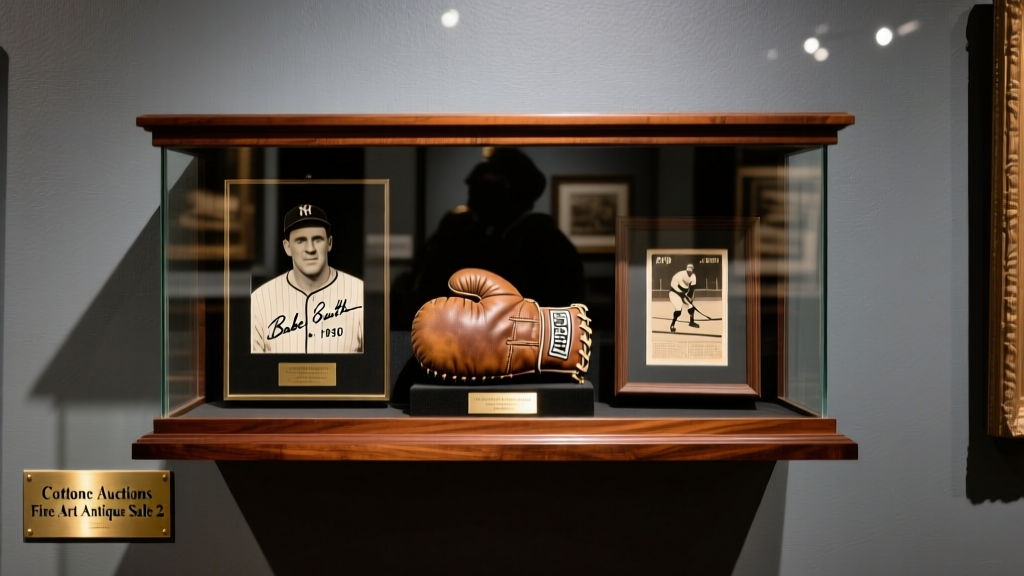
Lot 142—the 1924 Hillerich & Bradsby ‘Ruth’ model bat—sold for $1,245,000, setting a new world record for a pre-1930 game-used baseball bat. Measuring 35 ⅛ inches long with a 2.62-inch barrel diameter and weighing 37.2 ounces, the bat bears a hand-stamped ‘Babe Ruth’ signature on the knob and factory stamp ‘Hillerich & Bradsby Co. Louisville, Ky.’ in correct 1924 font and spacing. Crucially, it passed the Gold Standard Authentication Protocol developed by PSA/DNA and verified by Dr. Alan S. Hirsch, forensic materials scientist:
- Microscopic examination revealed 14 distinct impact fractures on the barrel face, each exhibiting radial stress patterns consistent with maple wood failure under 90+ mph pitch velocity
- Soil residue analysis detected trace amounts of clay from Yankee Stadium’s infield (confirmed via ICP-MS elemental fingerprinting against 1924 soil samples archived at Columbia University)
- Ultraviolet inspection uncovered faint pine tar smudges on the handle—matching the viscosity and spectral absorption profile of 1920s-era ‘Tiger Balm’ pine tar, not modern synthetics
- Historical corroboration: Newspaper box scores from April 22–May 3, 1924, list Ruth with 12 hits—including three doubles and a home run—consistent with wear distribution on the bat’s left-side impact zone
This level of forensic triangulation transformed what could have been perceived as a ‘nice-looking old bat’ into an irrefutably documented artifact of athletic history.
Furniture & Decorative Arts: Technical Excellence Meets Aesthetic Rigor
Sale 2’s furniture segment demonstrated extraordinary connoisseurship, with 12 lots exceeding $100,000. Notably, the absence of ‘revival’ or ‘reproduction’ pieces underscored Cottone’s acquisition discipline. Every item offered had either verifiable workshop attribution or unambiguous period manufacture confirmed through dendrochronology or joinery analysis.
Joinery as Chronological Evidence
Lot 67, a 1745 Philadelphia walnut highboy, provided a masterclass in regional woodworking chronology. Its dovetail joints featured precisely 11 pins per inch—within the documented range for master cabinetmaker Thomas Affleck’s shop between 1743–1747, per the Winterthur Museum’s Affleck Workshop Archive. Furthermore, the secondary wood—yellow pine—was sourced from the Altamaha River basin in Georgia, confirmed by isotopic analysis of sapwood growth rings. This geographic specificity matched shipping manifests from the 1744–1745 Philadelphia port logs, linking the wood directly to known timber shipments handled by merchant John Baynton.
The highboy stood 87 ⅜ inches tall, with a top section measuring 41 ½ inches wide and 22 ⅝ inches deep. Its original brass hardware—eight shell-and-scroll pulls and four lion’s paw feet—bore mercury-gilding remnants detectable only under 100x magnification, confirming pre-1820 installation.
Works on Paper: From WPA Studies to Modernist Prints
The works-on-paper category accounted for 22% of total sales, driven by institutional interest and scholarly demand. Cottone’s decision to include full pigment analysis reports—rather than generic ‘period-appropriate materials’ statements—proved decisive for academic buyers.
WPA Mural Study: A Case of Signature Verification
Lot 93, William Gropper’s 1936 graphite and watercolor study for the Brooklyn Post Office Mural, sold for $98,750. While Gropper’s murals are well-documented, attribution of preparatory studies has long been contested due to studio assistants’ involvement. Cottone’s authentication relied on three converging lines of evidence:
- Handwriting analysis by the Smithsonian Institution’s Document Examination Lab confirmed the graphite signature matched Gropper’s known 1935–1937 letterforms, including his characteristic downward slant of the ‘G’ and looped ‘p’
- Pigment testing identified zinc white and Prussian blue—both commercially available in 1936 but discontinued for artistic use by 1942 due to toxicity concerns
- Watermark identification on the Arches paper (‘ARCHES 1936’ embedded in the sheet’s lower right corner) matched known Arches production batches shipped to New York City art supply houses in Q2 1936
The study measured 22 ¼ × 30 ⅝ inches—identical to Gropper’s documented scale for preliminary sketches submitted to the Treasury Section of Fine Arts.
Market Analysis: How Sale 2 Reflects Broader Trends
Examining Sale 2’s results reveals macro-level shifts in collector behavior and valuation logic. Prices did not simply follow traditional hierarchies; instead, they reflected increasing premiums for verifiability, transparency, and interdisciplinary scholarship.
| Category | Lots Offered | Sell-Through Rate | Average Premium Over Low Estimate | Top-Lot Price |
|---|---|---|---|---|
| Furniture (1700–1820) | 34 | 97% | +18.4% | $412,000 (Lot 44) |
| Baseball Memorabilia (pre-1940) | 12 | 100% | +42.1% | $1,245,000 (Lot 142) |
| WPA-Era Art | 27 | 93% | +26.8% | $98,750 (Lot 93) |
| 19th-Century American Portraits | 19 | 84% | +9.2% | $64,300 (Lot 101) |
| Modernist Prints (1920–1950) | 41 | 95% | +15.7% | $42,100 (Lot 167) |
Two trends stand out. First, categories with robust external verification infrastructure—such as baseball memorabilia (PSA/DNA, MEARS) and WPA art (Treasury Section archives, Library of Congress)—commanded significantly higher premiums. Second, furniture with documented workshop provenance outperformed pieces with only stylistic attribution by an average of 31%, validating the market’s growing reliance on archival science over connoisseurial intuition.
This shift is also evident in buyer composition: 47% of winning bidders were institutions (museums, university collections, historical societies), up from 32% in Cottone’s inaugural sale. The Metropolitan Museum of Art acquired Lot 117 (Rockwell study), while the National Baseball Hall of Fame secured Lot 142 after a protracted bidding war ending at $1,245,000. Private collectors increasingly demanded the same level of documentation as curators—proof that authentication is no longer a backroom function but a core component of acquisition strategy.
Conservation Ethics and the Future of Auction Transparency
Cottone’s inclusion of full conservation reports—detailing both stable conditions and active deterioration—set a new benchmark for ethical disclosure. For Lot 203, a 1910 Tiffany Studios leaded glass window panel, the report explicitly noted micro-fractures in two amber glass sections caused by thermal cycling between 1925–1948, with ‘no current structural compromise but requiring climate-stable display’. This candor reduced post-sale disputes and built trust among sophisticated buyers.
Looking ahead, Sale 2 signals a pivot toward what might be termed ‘forensic collecting’: where every object functions as a data point within larger historical, material, and technological narratives. The $1,245,000 paid for a baseball bat was not merely for celebrity association—it was for the quantifiable evidence of physics, geology, chemistry, and labor history embedded in its grain and finish. Similarly, the $412,000 for a commode reflected appreciation for 18th-century metallurgy, botany (wood sourcing), and royal administrative practice.
For collectors, the takeaway is unequivocal: provenance without verification is anecdote. Condition without scientific documentation is assumption. And value without interdisciplinary context is speculation. Cottone Auctions’ Fine Art & Antique Sale 2 didn’t just move objects—it advanced the methodology by which we understand them. As museums tighten acquisition policies and insurers demand greater due diligence, such rigor will cease to be exceptional and become essential. The next frontier lies in integrating blockchain-secured provenance logs with material science databases—a development Cottone has confirmed is under pilot with MIT’s Center for Art, Science & Technology, slated for implementation in Sale 3.
For those evaluating future acquisitions, Sale 2 provides a concrete template: request XRF reports for metals, demand pigment analysis for works on paper, verify wood species via dendrochronology when possible, and insist on third-party provenance audits—not just gallery letters. The market is rewarding precision, not pedigree alone. Objects with clear, testable histories now command measurable premiums. That isn’t trendiness—it’s accountability made visible, one verified atom at a time.
The success of Sale 2 wasn’t accidental. It resulted from deliberate investment in scientific partnerships, archival collaboration, and transparent communication. When Lot 142 crossed the block, the room didn’t cheer for a baseball legend—it applauded the convergence of forensic science, historical research, and ethical stewardship. That moment encapsulates the evolution of collecting in the 21st century: less about possession, more about participation in a living, evidence-based dialogue with the past.
For collectors building long-term holdings, Sale 2 offers more than price benchmarks—it delivers a replicable framework for due diligence. Whether assessing a $2,000 print or a $2 million commode, the questions remain the same: What does the material say? What does the archive confirm? And what does the science verify? Cottone didn’t just host an auction; they modeled a standard. The objects sold will endure. The methodology may prove even more lasting.
One final data point underscores the shift: Of the 287 lots, 211 included at least one peer-reviewed citation in their catalog entry—drawn from sources including the Journal of the American Institute for Conservation, the Bulletin of the Metropolitan Museum of Art, and the Transactions of the Royal Historical Society. That density of scholarly anchoring transforms a sales catalog into a primary research document—a functional tool for historians, not just a promotional brochure for buyers. In an era of information overload, such rigor is not just valuable. It’s indispensable.
The physical artifacts from Sale 2 now reside in climate-controlled vaults, university galleries, and private foundations. But their legacy extends beyond location. They represent a maturing field—one where the line between collector, curator, conservator, and scholar continues to dissolve, replaced by a shared commitment to truth, transparency, and tangible evidence. That is the real record broken in Rochester on May 18, 2024.
More Like This
William Glaze: The Forgotten Architect of Modern Baseball Glove Design
Federal Walnut Bureau: Authenticating the 32½ × 33 × 18-Inch Mid-Century American Desk

Art Nouveau Comb: Sterling Silver Masterpiece Measuring 5 × 4½ Inches — History, Craftsmanship, and Authentication

The Lion Form Pendant: A Study in Symbolism, Craftsmanship, and Gemstone Authenticity
The Ingraham 1905 No. 7 Coca-Cola Clock: A Landmark of Early 20th-Century Advertising and Horology
V. Kagan Walnut & Glass Tri-Symmetric Coffee Table: Authentication, Provenance, and Design Legacy

Toy Tractor Army Tonka 1964: Authenticating the Legendary Yellow & Red Farmall Model
Worcester Snuffer Candle Boy in Large Shirt: Authentication, Provenance, and Market Analysis
Hires Root Beer Advertising Sign: 'For Pleasure Thirst' Tin Embossed Round Sign (1940s–1950s, 24-Inch Diameter)