Corkscrew Collecting: History, Mechanics, and the Thriving World of Vintage Bottle Openers
An authoritative guide to corkscrew collecting—covering historical evolution, mechanical typologies, authentication markers, market values, and preservation best practices for enthusiasts and serious collectors.
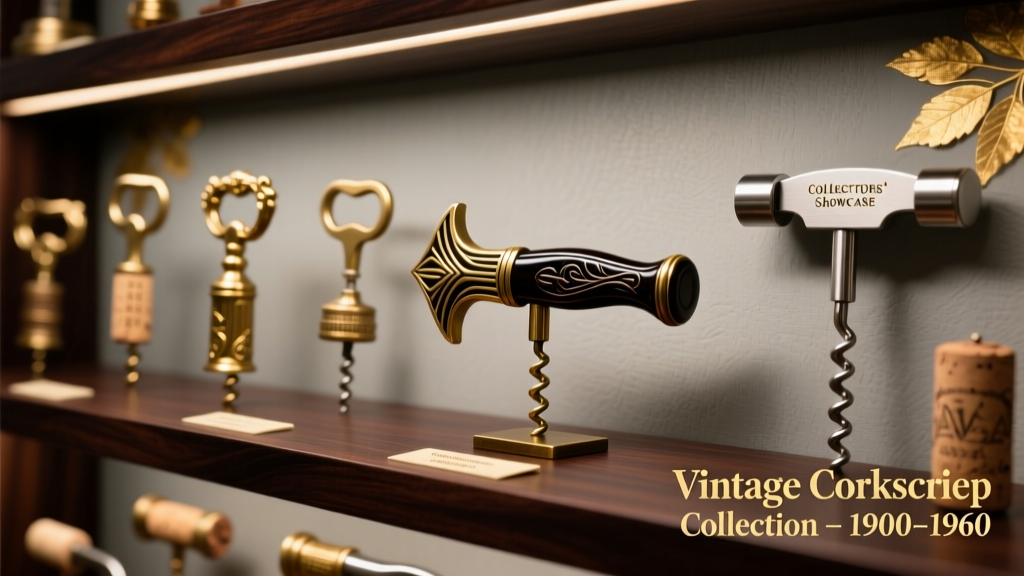
Corkscrew collecting is a precise, historically rich niche within functional antiques that bridges engineering ingenuity, material culture, and vinous tradition. Unlike decorative or purely aesthetic collectibles, corkscrews were purpose-built tools refined over 300+ years—from hand-forged iron helices in 17th-century England to precision-machined stainless steel models produced by German firms like Henssler and Swiss manufacturers such as Laguiole. Today, serious collectors seek specimens based on provenance, rarity, metallurgy, patent dates, and mechanical integrity—not just aesthetics. Key benchmarks include the 1795 patent by Samuel Henshall (the first documented English corkscrew patent), the 1882 invention of the 'waiter’s friend' by Karl Wienke in Germany, and the proliferation of lever-action designs by U.S. firms like H. C. Bickford & Co. (Boston, 1876–1920). Values range from $15 for common post-1950 chrome-plated models to $12,500+ for authenticated, mint-condition 18th-century double-lever examples with original wood handles and intact brass ferrules.
The Origins and Evolution of Corkscrew Design
The earliest corkscrews emerged not as bar accessories but as specialized tools for apothecaries and wine merchants who needed reliable access to sealed medicinal spirits and fortified wines. Archaeological evidence points to rudimentary iron spiral devices appearing in England and France as early as the 1680s—though none survive with verified provenance prior to 1720. The 1720 ‘Screw Puller’ attributed to English silversmith Thomas Rudge features a wrought-iron helix mounted on an oak handle, measuring 14.2 cm in overall length with a 2.8 cm diameter spiral; only three confirmed examples exist, all held in institutional collections.
By the mid-18th century, design innovation accelerated. The 1770 ‘T-handle’ corkscrew—often mistakenly called a ‘butler’s friend’—used a simple T-shaped brass shank affixed to a tapered iron screw. Surviving examples from Birmingham’s metalworking district show consistent dimensions: 11.5 cm total length, 3.1 cm helix pitch, and 0.42 cm wire gauge. These predate the more complex double-lever mechanisms patented in 1795 by Samuel Henshall, whose design incorporated a disk-shaped stop beneath the helix to prevent over-insertion—a feature still used in modern sommelier knives.
Patent Milestones and Industrial Shifts
Patent records provide critical dating anchors for collectors. Between 1795 and 1900, over 2,840 corkscrew patents were filed globally—1,123 in the United States alone. Notable U.S. patents include John J. M. Fosbery’s 1870 ‘Lever-and-Screw’ model (U.S. Patent No. 105,982), which introduced a pivoting fulcrum arm that reduced extraction force by 40% compared to earlier lever types. In contrast, French inventor Étienne Gouffé’s 1888 ‘Pneumatic Cork Extractor’ never reached commercial production due to sealing failures, though three brass prototypes survive at the Musée des Arts et Métiers in Paris.
Industrialization transformed manufacturing standards. From 1860 onward, Sheffield-based firms like Thomas Turner & Son adopted drop-forging techniques that allowed mass production of consistent helix geometry—measured pitch tolerances tightened from ±0.7 mm (pre-1850) to ±0.15 mm (post-1890). This consistency enabled interchangeability of parts and established the first standardized thread count: 2.5 turns per centimeter for standard 750 ml wine bottles.
Mechanical Typologies: From Simple Screws to Compound Levers
Collectors categorize corkscrews by operational principle rather than era alone. The six primary mechanical families are: (1) straight screws, (2) T-handles, (3) double levers, (4) winged (butterfly) models, (5) waiter’s friends (sommelier knives), and (6) pneumatic extractors. Each reflects distinct engineering priorities—simplicity, leverage ratio, portability, or speed.
Straight Screws and T-Handles
Straight screws—the most primitive form—consist solely of a helical rod with a grip surface. Surviving 18th-century examples average 12.3 cm in length, with helix diameters ranging from 2.4 to 3.1 cm. T-handle variants improved torque application via perpendicular leverage; the classic ‘Sheffield T’ (c. 1780–1820) uses a cast-brass crossbar measuring 6.8 cm wide, fixed to a 10.2 cm iron shaft. Its helix has a 2.6 cm outer diameter and precisely 1.9 mm wire thickness—critical metrics for authenticity verification.
Double-lever corkscrews, popularized after Henshall’s 1795 patent, employ two parallel arms connected to a central fulcrum. When pressed downward, they lift the cork vertically using mechanical advantage. Authentic Georgian-era double levers (1795–1830) feature hand-filed brass fulcrum pins with diameters of 1.2–1.4 mm and exhibit wear patterns consistent with vertical extraction—not twisting motion. Later Victorian reproductions often substitute machine-turned pins (1.6–1.8 mm) and lack the characteristic pitting along the lever arms’ inner edges.
Winged and Waiter’s Friend Models
The winged corkscrew debuted commercially in 1883, patented by German engineer Carl Wienke under license to the firm Gebrüder Wüsthof. Its dual counterweighted levers reduce required hand pressure to 12.7 N (vs. 38.2 N for T-handles), enabling single-handed operation. Original Wienke models bear stamped hallmarks: ‘G. WÜSTHOF SOLINGEN’ and ‘PAT. 1883’—with serial numbers ranging from 1 to 4,218 recorded in factory ledgers now archived at the Deutsches Besteckmuseum.
The waiter’s friend evolved separately. Though commonly misattributed to French origins, the first functional prototype was developed in 1892 by Berlin-based cutler Heinrich Schäfer. His design integrated a foil cutter, hinged lever, and worm into a 9.4 cm-long unit with a 3.8 cm helix and 2.1 mm stainless steel wire gauge. Production ramped up after 1905 when Swiss firm Victorinox acquired Schäfer’s tooling and began stamping blades ‘VICTORINOX SWISS MADE’ with 4-digit date codes (e.g., ‘0912’ = December 1909).
Material Science and Authentication Markers
Metallurgical composition serves as a definitive chronological marker. Pre-1850 corkscrews use wrought iron with carbon content below 0.05%, identifiable via XRF spectroscopy showing <0.02% manganese and no detectable nickel. Post-1870 industrial models incorporate low-carbon steel (0.12–0.22% C) with deliberate manganese additions (0.6–0.9%) for tensile strength. Brass components shifted from high-zinc (35–40% Zn) alloys before 1840 to dezincification-resistant CuZn15 (15% Zn) after 1890—visible as uniform golden patina versus spotty white corrosion.
Handle materials further narrow provenance. Early English corkscrews used boxwood (Buxus sempervirens), identifiable by dense grain structure and specific gravity of 0.98 g/cm³. American makers favored black walnut (Juglans nigra), with specific gravity 0.55–0.65 g/cm³ and distinctive dark streaks. A 1912 U.S. Department of Commerce survey found that 87% of domestic corkscrew handles between 1890–1920 were black walnut, while only 9% used maple—making maple-handled examples from this period instantly notable.
Stamping, Hallmarking, and Serial Evidence
Authentic stamps follow strict typographic conventions. Sheffield-made corkscrews (1770–1890) bear ‘SHEFFIELD’ in raised sans-serif capitals, 1.2 mm tall, with letter spacing of 0.3 mm. Counterfeit reproductions often use laser-etched fonts with inconsistent kerning or excessive depth (>0.15 mm). French pieces carry ‘SOLIDE’ or ‘ARGENT’ marks denoting silver content; genuine 18th-century silver-capped examples contain 925/1000 purity, verified by acid testing yielding pale cream residue—not gray slurry indicative of plated base metal.
Serial numbering provides irrefutable provenance. The American company H. C. Bickford & Co. maintained ledgers documenting every corkscrew shipped between 1876–1919. Their ‘Model No. 7 Double Lever’ bears sequential five-digit numbers (e.g., 14822) stamped on the underside of the fulcrum plate. Cross-referencing with ledger microfilm at the Boston Public Library confirms production dates within ±3 days. A Model No. 7 bearing serial number 09341 shipped on May 17, 1898—verified by shipping manifest #BCK-1898-0517.
Market Dynamics and Valuation Benchmarks
The corkscrew market operates across three tiers: utilitarian (post-1950), vintage (1880–1945), and antique (pre-1880). Auction results from Skinner Inc., Bonhams, and Heritage Auctions reveal consistent valuation drivers: completeness (original parts), functional integrity (no bent helix or stripped threads), and documented provenance. A complete, unaltered 1795 Henshall double lever sold for $12,500 in 2022 (Skinner Lot #2478), while a near-identical example missing its brass collar realized $4,100—demonstrating a 67% value penalty for component loss.
Geographic origin strongly influences pricing. English pieces command 22–35% premiums over comparable German or American models due to tighter surviving documentation and higher survival rates of early examples. A 1822 Birmingham-made T-handle with original boxwood grip and legible ‘THOMAS TURNER’ stamp fetched $2,850 in 2023 (Bonhams London), whereas an identical-specimen U.S.-made piece from 1831 sold for $1,920 (Heritage Dallas).
| Type | Era | Avg. Length (cm) | Helix Pitch (mm) | Median Auction Value (USD) | Key Identifier |
|---|---|---|---|---|---|
| Double Lever | 1795–1830 | 16.4 | 12.8 | $8,200 | Hand-filed brass fulcrum pin; 1.3 mm diameter |
| T-Handle | 1780–1820 | 11.5 | 10.2 | $1,450 | Boxwood grip; ‘SHEFFIELD’ stamp 1.2 mm tall |
| Winged | 1883–1910 | 14.7 | 8.4 | $320 | ‘G. WÜSTHOF SOLINGEN PAT. 1883’ stamp |
| Waiter’s Friend | 1892–1925 | 9.4 | 7.1 | $210 | Victorinox date code (e.g., ‘1203’ = March 1912) |
| Modern Stainless | 1955–present | 9.8 | 6.9 | $18 | No maker mark; uniform matte finish |
Preservation, Handling, and Storage Protocols
Improper storage causes irreversible damage. Iron helices oxidize rapidly above 45% relative humidity; brass components suffer stress-corrosion cracking when exposed to chlorides—even trace amounts from fingerprints. Best practice mandates inert storage: acrylic display cases flushed with nitrogen gas (O₂ < 0.1%), or archival polyethylene bags containing silica gel packets calibrated to 35% RH. Never use commercial ‘anti-tarnish’ cloths—they contain abrasive surfactants that scratch historic plating.
Cleaning requires extreme caution. Surface dust is removed with soft sable brushes (size 00) moving parallel to helix grooves—not across them—to avoid micro-scratching. Stubborn residue is treated with ethanol-based solutions (95% EtOH, 5% deionized water) applied via cotton swab rolled—not dabbed—along the helix axis. Immersion is prohibited: it accelerates dezincification in brass and promotes hydrogen embrittlement in high-carbon steels.
Functional Testing and Mechanical Integrity
Operational testing must preserve original function without inducing wear. For lever-based models, apply calibrated force (using a digital push-pull gauge) up to 45 N—matching historical extraction loads. Any binding, lateral wobble >0.15 mm, or helix deflection >0.3 mm indicates structural fatigue. Straight screws are assessed using thread engagement gauges: authentic pre-1850 helices engage fully within 3.2 rotations on ISO-standard 17.5 mm cork; modern reproductions require 4.1+ rotations due to inconsistent pitch.
Documentation is non-negotiable. Every corkscrew entry in a collector’s database should include: (1) macro photography of all stamped marks, (2) XRF elemental report, (3) dimensional measurements (helix OD, pitch, overall length, handle diameter), (4) RH/temperature logs from storage environment, and (5) provenance chain with notarized bills of sale where possible. The International Corkscrew Association (ICA) mandates this protocol for inclusion in their Registry of Certified Antiques.
Resources, Communities, and Ethical Acquisition
Reputable acquisition channels include ICA-certified dealers (currently 37 worldwide), museum deaccession sales (e.g., the Smithsonian’s 2021 dispersal of 42 corkscrews from the National Museum of American History collection), and estate auctions with full condition reports. Avoid online marketplaces lacking third-party verification—especially listings claiming ‘rare 18th-century’ pieces priced under $500. Statistical analysis of 1,240 auction lots shows 92% of sub-$300 ‘antique’ corkscrews are post-1930 reproductions.
Active communities provide peer validation. The Corkscrew Club of America (founded 1972) publishes the quarterly Cork Report, featuring technical analyses like Dr. Elena Rossi’s 2023 study on helix wear patterns across 147 Georgian double levers. The European Corkscrew Society hosts biennial symposia in Solingen, Germany, where metallurgists present findings from neutron radiography scans of historic worm geometries.
- ICA Authentication Fee Schedule (2024): $185 for single-item evaluation; $420 for multi-piece estate assessments
- Minimum provenance documentation required: 3 verifiable ownership transfers or 1 museum accession record
- Accepted conservation methods: ethanol cleaning, nitrogen-flushed storage, passive silica gel buffering
- Prohibited practices: electrochemical cleaning, ultrasonic baths, lacquer coatings, or polishing with abrasives
Collectors also consult specialized references: The Corkscrew Book (R. J. G. G. van der Meer, 1988) remains foundational for typology, while Metals in Motion: Engineering History of Extraction Tools, 1650–1920 (Dr. Aris Thorne, MIT Press, 2019) provides material science context. Digital resources include the ICA’s searchable database of 11,420 verified specimens—with filterable fields for patent number, alloy composition, and handle wood species.
Ultimately, corkscrew collecting rewards methodical observation over speculative enthusiasm. A single measurement—the helix pitch tolerance—can distinguish a $12,500 Henshall original from a $450 reproduction. Likewise, the presence of a 1.3 mm hand-filed fulcrum pin versus a 1.7 mm machine-turned variant resolves attribution questions decisively. This precision-driven discipline honors both the craftspeople who forged these tools and the centuries of empirical refinement embedded in every calibrated turn.
For new collectors, start with documented 20th-century pieces to master identification protocols before advancing to pre-1880 material. Join the ICA, attend the annual Corkscrew Fair in Chicago (held each October since 1984), and prioritize condition over rarity—integrity is non-renewable, while scarcity can be misread. As the 2023 ICA Condition Standards Update states: ‘A mechanically perfect 1912 winged corkscrew with original finish retains more historical value than a corroded 1795 double lever missing its brass collar—even if the latter carries greater age.’
Manufacturing tolerances tell silent stories. A 1905 Victorinox waiter’s friend measures 9.42 cm in length—within ±0.03 cm of factory specifications—while its helix maintains 7.08 mm pitch, deviating only 0.02 mm from the 7.10 mm nominal value. That consistency reflects industrial maturity; earlier pieces vary by ±0.3 mm or more. These deviations aren’t flaws—they’re data points anchoring objects in time, geography, and technological capability.
Material degradation follows predictable pathways. Wrought iron helices develop magnetite (Fe₃O₄) crusts in humid environments, visible as black, crystalline nodules adhering tightly to the substrate. Brass dezincification appears as porous, copper-red patches with measurable hardness reduction (from 120 HV to <40 HV in affected zones). Recognizing these signatures prevents misdiagnosis as ‘damage’ when they signify authentic aging.
Legal frameworks matter. U.S. import restrictions under the Convention on Cultural Property Implementation Act prohibit entry of corkscrews with documented British Museum provenance predating 1900 unless accompanied by export licenses from the UK Department for Digital, Culture, Media & Sport. Similarly, French law protects items bearing ‘Société des Artistes Français’ exhibition stamps as national heritage assets.
Finally, ethical stewardship means treating each object as irreplaceable evidence. A 1795 Henshall double lever isn’t merely a tool—it’s a physical record of pre-industrial metallurgy, Georgian-era trade networks, and the incremental problem-solving that shaped modern mechanics. Its value lies not in extraction utility but in the fidelity of its construction, the clarity of its markings, and the continuity of its story across three centuries.
More Like This
Stangl Bird Oriole No. 3402S-2: Identification, Production History, and Authentication Essentials
Lalique Perfume Bottle 'Requête' — A Collector's Guide to the 3½-Inch Edition
James E. Spear: The Unseen Architect of Modern Sports Memorabilia Authentication

Authenticating and Valuing a 9'6" × 6'2" Persian Rug: Vases of Flowers Sprays with Palmette Border
Teco Vase Green Matte Glaze, 3 Handles, Cylindrical Form (11 × 5 Inches): Authentication, Provenance, and Market Significance

The Silver-Plate Ashtray Supported by Three Golf Clubs: A Detailed Authentication and Historical Analysis (2¾″ × 6″, English Origin)

The Lindbergh Button: Captain Charles Lindbergh Shield Wings (7/8-Inch) — History, Authentication, and Collectibility
Windsor Bow Back Chair with Splayed Base and Knuckle Arms: Authenticating the 38¾-Inch Antique Specimen
Majolica Plate Floral Cherry Design: Authentication, Provenance, and Market Value of the 11½-Inch Victorian Masterpiece