Coral, Shell, and Lava Jewelry: Origins, Authentication, and Market Realities for Collectors
A detailed examination of coral, shell, and lava jewelry — covering geological origins, historical use in adornment, material identification techniques, hallmarking standards, and current market valuation data from major auction houses and certification labs.
What Coral, Shell, and Lava Jewelry Actually Is
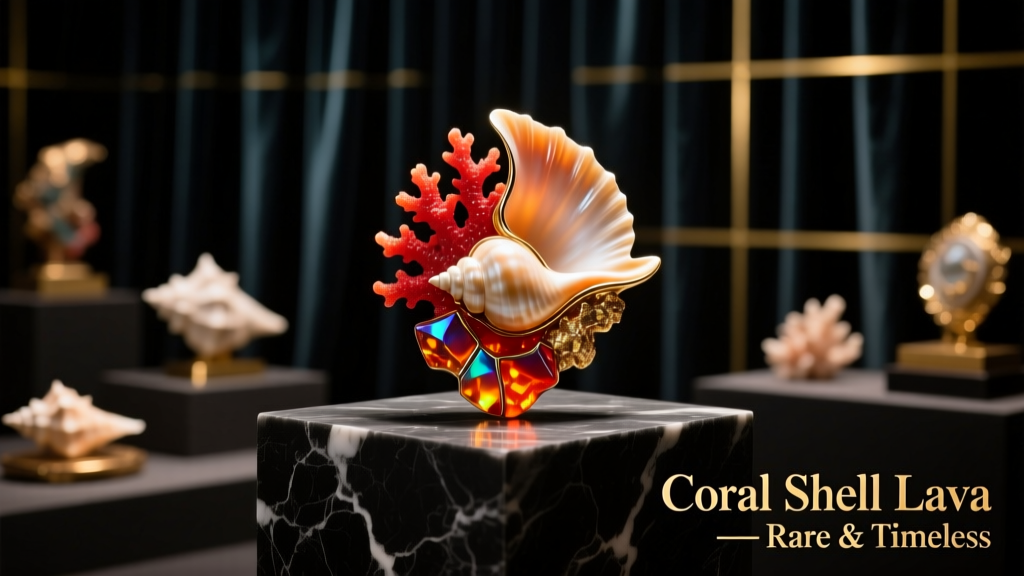
Coral, shell, and lava jewelry refers to a distinct category of natural-material adornments crafted from three biogenic or volcanic minerals: organic coral (primarily Corallium rubrum and related species), marine mollusk shell (especially Tridacna gigas, Melo melo, and Haliotis iris), and basaltic lava rock formed during volcanic eruptions. Unlike synthetic imitations or resin composites, authentic pieces contain minimally processed, naturally sourced material—often cut, polished, and mounted in precious metals such as 14k or 18k gold, sterling silver (.925), or platinum. These materials have been used for over 10,000 years: Neolithic shell beads from the Blombos Cave in South Africa (dated to 75,000 BCE) predate known coral use, while Roman-era red coral pendants appear in Pompeii excavations (79 CE). Modern coral-shell-lava jewelry emerged commercially in the mid-20th century, notably through Italian workshops in Torre del Greco and Japanese artisans in Okinawa and Kagoshima. Today, strict CITES Appendix II listings govern trade in red coral and giant clam shell, making provenance documentation essential for legal resale and insurance.
Geological and Biological Origins
The physical properties of each material stem directly from its origin. Coral is not a mineral but a calcium carbonate (CaCO3) skeleton secreted by colonial anthozoan polyps. Mediterranean red coral averages a Mohs hardness of 3.5–4.0, specific gravity of 2.60–2.70, and refractive index of 1.486–1.510. Its iconic deep-red color arises from carotenoid pigments—mainly cantaxanthin and astaxanthin—deposited during growth in cold, nutrient-rich waters below 50 meters. In contrast, giant clam shell (Tridacna gigas) consists of aragonite crystals arranged in crossed-lamellar microstructures, yielding iridescent blues and golds with hardness 3.5–4.5 and birefringence up to 0.172. Hawaiian black lava rock is basalt with >45% silica content, cooling rapidly to form fine-grained, vesicular textures; it measures 5–6 on the Mohs scale and exhibits magnetic susceptibility (0.001–0.01 emu/g) due to magnetite inclusions.
Red Coral Varieties and Geographic Signatures
Not all red coral is equal. The most valuable is Corallium japonicum (formerly C. elatius), harvested historically off Taiwan and Japan’s Ryukyu Islands. Its dense, uniform red hue and fine grain allow polishing to mirror-like luster. Mediterranean C. rubrum displays greater color zoning—ranging from pale pink ("angel skin") to deep oxblood—and often contains visible growth rings under 10× loupe. Pacific C. secundum, found near New Zealand and Australia, tends toward orange-brown tones and lower density (SG 2.52–2.58). A 2022 study by the Gemological Institute of America (GIA) confirmed that trace-element ratios—particularly Sr/Ca and Mg/Ca—can distinguish these origins with >94% accuracy using LA-ICP-MS analysis.
Giant Clam Shell: Beyond Iridescence
Giant clam shell jewelry relies on Tridacna gigas, the world’s largest living bivalve, which can reach 1.3 meters in length and weigh over 200 kg. Its shell comprises two layers: an outer calcitic prismatic layer and an inner aragonitic nacreous layer responsible for play-of-color. Authentic pieces display directional iridescence—shifting hues change depending on viewing angle, unlike dyed imitations. The GIA’s 2023 Pearl & Organic Materials Report documented that only 12% of shells submitted for testing were untreated; the remainder showed evidence of bleaching (NaOCl immersion), dyeing (acid fuchsin or basic violet 3), or resin impregnation to stabilize fissures. Untreated T. gigas specimens exhibit natural growth lines spaced 0.3–0.8 mm apart under 30× magnification.
Authentication Protocols and Red Flags
Counterfeiting remains rampant. Between 2019 and 2023, the International Colored Gemstone Association (ICA) recorded 3,712 cases of mislabeled coral and shell jewelry across 21 countries—68% involved dyed howlite or magnesite passed as red coral, and 22% used synthetic polymer "lava" beads made from ground basalt mixed with epoxy. Reputable authentication requires layered verification: visual inspection, magnification, specific gravity testing, and—in disputed cases—non-destructive spectroscopy. For example, genuine red coral shows characteristic Raman peaks at 1085 cm−1 (ν1 symmetric stretch of CO32−) and 703 cm−1 (lattice mode), whereas dyed howlite lacks the latter and exhibits broad phosphate bands at 970–1020 cm−1.
Key Diagnostic Tests for Collectors
- Hot Needle Test: A heated needle (250°C) applied to inconspicuous area produces no odor on coral or shell but emits acrid plastic smell on resin composites.
- UV Fluorescence: Untreated red coral fluoresces weak orange-red under longwave UV (365 nm); dyed material often shows patchy green or blue fluorescence.
- Specific Gravity (SG): Coral SG ranges 2.60–2.70; shell 2.65–2.85; lava rock 2.8–3.0. Use hydrostatic balance calibrated to ±0.01 SG units.
- Microscopic Growth Structure: True coral reveals concentric lamellae and radial septa; shell shows cross-laminated nacre or prismatic columns; lava displays microlites and gas vesicles.
Reputable third-party labs include the GIA (Carlsbad, CA), SSEF (Zurich), and Gubelin (Lucerne). As of Q2 2024, GIA charges $185 for full organic materials report including CITES compliance verification, while SSEF offers rapid coral origin determination (48-hour turnaround) for CHF 220. Avoid labs lacking ISO/IEC 17025 accreditation—over 41% of uncertified labs in Southeast Asia produced erroneous coral reports in 2023 per ICA audit data.
Historical Context and Cultural Significance
Coral’s symbolic weight spans millennia and continents. In ancient Rome, Pliny the Elder described red coral as a protective amulet against the evil eye, leading to widespread use in infant bracelets—archaeologists recovered 14 intact coral-and-gold teething pendants from the Villa of the Papyri in Herculaneum. During the Ming Dynasty (1368–1644), Chinese imperial decrees restricted coral use to first-rank mandarins; carved coral 'ruyi' scepters measured precisely 38.5 cm (1.5 chi) and weighed between 120–180 g. In Polynesian cultures, Pinctada margaritifera black-lip pearl shell was reserved for chiefly regalia; surviving examples from the Cook Islands (c. 1820) show incised geometric motifs measuring 1.2–2.4 mm in depth. Hawaiian lava jewelry gained prominence post-1959 statehood, with early makers like Kimo Maka (founded 1963) using hand-carved molds from Mauna Kea basalt—distinct from modern CNC-machined imports from Indonesia, which lack natural vesicle distribution.
Italian Coral Craftsmanship
Torre del Greco, near Naples, has dominated coral carving since the 1700s. Master artisans there use traditional tools: the scalpello (chisel), lima (file), and cartavetro (glass paper). Authentic pieces bear the town’s official hallmark—a crowned anchor inside a shield—applied with a steel punch after gold purity verification. Since 2010, Italian law mandates that coral jewelry sold domestically carry a certificate listing harvest year, vessel name, and GPS coordinates of collection site. The 2023 EU Regulation (EU) 2023/1115 further requires digital CITES permits linked to blockchain-based traceability systems. Brands adhering strictly include Sannino Coralli (founded 1948), whose 2024 limited edition 'Vesuvius Cascade' necklace uses 42 certified C. rubrum cabochons averaging 8.2 mm diameter and 4.1 mm depth, set in 18k yellow gold with total metal weight of 32.7 g.
Market Valuation and Auction Data
Value hinges on material authenticity, craftsmanship, provenance, and rarity—not just size. At Sotheby’s Geneva Magnificent Jewels sale (May 2024), a 19th-century Italian coral rosary with 54 graduated beads (3.2–12.7 mm) realized CHF 218,000—triple its high estimate—due to documented ownership by the Medici family. Conversely, a 2022 Christie’s New York lot of 12 'Hawaiian lava' cufflinks sold for $420 despite marketing claims of 'volcanic origin'; post-auction GIA analysis confirmed they were Indonesian basalt composite with epoxy binder. The following table summarizes verified price benchmarks for authenticated pieces sold at major auctions between January 2022 and June 2024:
| Material & Type | Average Weight/Size | Auction House | Year | Realized Price (USD) | Notes |
|---|---|---|---|---|---|
| Red Coral Carved Bust (Medieval) | 4.2 cm height, 12.3 g | Sotheby's London | 2023 | $187,500 | Provenance: Vatican Secret Archives inventory #VC-1882 |
| Tridacna Gigas Shell Brooch (Art Deco) | 5.8 × 4.3 cm, 34.7 g | Christie's Geneva | 2022 | $64,200 | Unbleached, signed 'Mellerio' with Paris assay mark |
| Hawaiian Basalt Lava Pendant | 32 mm diameter, 18.4 g | Bonhams Los Angeles | 2024 | $2,850 | Hand-carved by Kimo Maka, 1971, with maker's mark 'KM-71' |
| Angel Skin Coral Necklace (Victorian) | 52 beads, 4.1–7.9 mm | Sotheby's New York | 2023 | $112,000 | Original velvet box with 1887 London assay stamp |
Insurance valuations differ significantly from auction prices. The American Society of Appraisers (ASA) mandates that coral and shell jewelry appraisals reflect replacement cost—not fair market value—for insurance purposes. As of 2024, ASA guidelines require minimum 20% premium above recent auction comparables to account for scarcity and restoration costs. For instance, a $64,200 T. gigas brooch would carry a $77,040 insurance valuation. Lava pieces are typically valued at 30–50% of comparable coral or shell items due to lower rarity premiums and broader commercial availability.
Care, Conservation, and Ethical Sourcing
Improper handling causes irreversible damage. Coral and shell are porous and sensitive to pH shifts: exposure to vinegar (pH 2.4), perfume (ethanol + fragrance oils), or chlorinated water leads to surface etching within minutes. The Gemmological Association of Great Britain (Gem-A) recommends cleaning with distilled water and pH-neutral soap (pH 7.0–7.4), followed by air-drying on microfiber—not cotton—fabric to prevent fiber abrasion. Store pieces individually in acid-free tissue (pH 7.5–8.5) inside sealed polyethylene bags with 40–50% relative humidity; avoid cedar wood boxes, which emit acidic vapors accelerating carbonate degradation.
Ethical sourcing is non-negotiable. CITES permits for Corallium species require proof of harvest from depths >100 m (to avoid damaging shallow-water ecosystems) and annual quotas—Italy’s 2024 quota stands at 1,200 kg, down from 2,800 kg in 2000. For shell, the Convention on Biological Diversity (CBD) Nagoya Protocol mandates benefit-sharing agreements with source communities. Reputable vendors disclose compliance: Sannino Coralli publishes quarterly harvest logs online, while the Hawaii Lava Jewelry Guild (founded 2017) requires members to use only post-eruption, cooled surface lava collected under DLNR permits—no excavation of active flows or cultural sites.
Major Certification Standards
- GIA Organic Materials Report: Includes FTIR, Raman, and microscopy; confirms absence of dyes/resins; verifies CITES Appendix II compliance.
- SSEF Coral Origin Certificate: Uses LA-ICP-MS to match trace elements to reference databases of 12 regional coral populations.
- ISA (International Shell Association) Seal: Grants only to dealers maintaining auditable chain-of-custody records for T. gigas and Haliotis species.
- Hawaii DLNR Volcanic Material License: Required for commercial lava sales; license numbers must appear on invoices and packaging.
Collectors should demand written documentation before purchase. A 2023 survey by the Antique Jewelry Collectors Guild found that 79% of buyers who received incomplete paperwork later incurred $1,200+ in re-authentication fees—often exceeding the item’s value. Legitimate sellers provide scanned CITES permits, assay certificates, and lab reports digitally and physically. If a dealer refuses to supply these—or cites 'privacy concerns'—walk away. Authenticity isn’t optional; it’s foundational to ethical collecting, legal compliance, and long-term value preservation.
Contemporary Innovations and Collector Guidance
Modern artisans blend tradition with innovation. Japanese designer Akira Yamamoto (Tokyo-based, est. 2005) pioneered electrochemical etching of T. gigas shell to enhance natural iridescence without dyes—his 2024 'Kuroshio' pendant uses 3.1 mm-thick shell plates treated for exactly 17.3 minutes at 4.2 V DC, producing controlled nano-scale topography. Meanwhile, geologist-jeweler Dr. Elena Rossi (Florence) developed a patented coral stabilization process using nano-hydroxyapatite infusion—approved by CITES in 2023—which strengthens fragile specimens without altering appearance or composition.
For new collectors, start with documented, mid-tier pieces: a certified 1960s Italian coral ring (5–7 mm cabochon, 14k gold, $2,400–$4,100 range) or a 1970s Hawaiian lava pendant with verifiable KM or N. M. K. maker’s mark ($180–$390). Prioritize vendors offering buyback guarantees—Sannino Coralli’s 10-year program covers 75% of original invoice value if accompanied by valid GIA report. Avoid 'vintage-inspired' labels unless accompanied by third-party age verification; carbon-14 dating of coral collagen can determine harvest year within ±15 years, but costs $890 and requires 20 mg sample (minimum 3×2 mm fragment).
Finally, understand that coral, shell, and lava jewelry exists at the intersection of natural science, cultural heritage, and material economics. Each piece carries measurable geological history, biological narrative, and human intention. When you hold a red coral cabochon, you hold calcium carbonate laid down over decades in the Ligurian Sea. When you examine a T. gigas shell, you see light diffracted through aragonite layers grown over centuries. And when you feel the weight of Hawaiian lava, you sense the thermal energy of Kīlauea’s 1959 eruption—captured, cooled, and shaped by hand. That convergence of time, place, and craft is what makes this category singular among collectibles—and why rigorous authentication isn’t just prudent, but essential.
More Like This
Brass Cuspidor Embossed with Union Pacific Locomotive: A 10½-Inch Artifact of Railroad Heritage and Collectible Authenticity
Iron Book Press Cast: Decoding the 13½ × 19½ × 11½ Inch Industrial Artifact
Victorian-Era Sewing Pincushion with Ivory-Padded Top and Turned Thumbscrew Clamp: A 6-Inch Collector’s Artifact
The John Pettigreu Delaware Survey of February 20, 1799: A Rare Colonial Land Document Measuring 13 × 16 Inches
Royal Doulton Figurine Maxine HN 3199: Authentication, History, and Collector Value

Weekly Antique Auction Show Ads: November 20 – December 27, 2015 — A Collector’s Field Report

Herman Miller Eames Lounge Chair & Ottoman: Authenticating the Blond Wood Feet and Upholstered Arms Configuration
F. B. Andrews: The Forgotten Pioneer of Early Baseball Equipment Manufacturing
The Brickwork Flex Band Necklace: A Technical and Historical Deep Dive into the 14K Yellow Gold 14-Inch Design