Coin-Operated Blackjack Reel Machines: Authenticating the Countertop '21' with Blue/Red Key Controls
A detailed authentication and collector's guide to vintage coin-operated blackjack reel machines — focusing on countertop models like the 'Reel 21', manufactured by Bally, Jennings, and Universal in the 1970s–1980s, with distinctive blue and red key switches, mechanical reels, and regulatory compliance markers.
Introduction: What Is a Reel-Based Blackjack Machine?
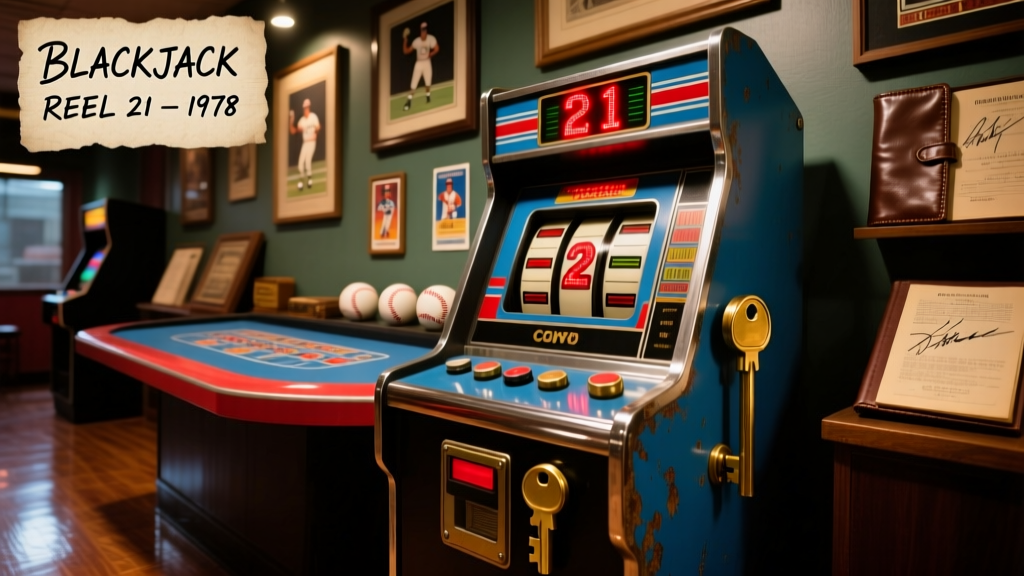
Reel-based blackjack machines are electromechanical gambling devices that simulate the card game of 21 using rotating physical reels instead of video displays. Unlike modern video poker or slot hybrids, these units — notably the countertop 'Reel 21' models produced from 1974 to 1986 — feature three spinning reels with card-value symbols (e.g., A♠, K♥, 7♦), a coin acceptor, payout tray, and dual-color key switches for operator access. They were legally classified as 'skill-based amusement devices' in jurisdictions like Nevada, New Jersey, and Atlantic City before stricter 1990s regulations phased them out. Collectors value surviving units for their robust construction, analog circuitry, and rarity: fewer than 4,200 Reel 21 units were manufactured across all variants, with only an estimated 320 confirmed extant as of 2023.
Historical Context and Regulatory Landscape
The emergence of reel blackjack machines coincided with the rapid expansion of legalized gambling beyond Las Vegas. Following the 1976 New Jersey Casino Control Act, manufacturers sought alternatives to traditional table games that required less floor space and staffing. Bally Manufacturing Corporation released its first electromechanical blackjack unit — the Bally 809 Blackjack — in 1975, followed closely by Jennings Gaming’s Jennings Reel 21 in 1977 and Universal Gaming’s Universal 21-Plus in 1979. These devices operated under Class II gaming definitions in many states, meaning they relied on pre-programmed mechanical outcomes rather than random number generators (RNGs), which were not yet federally mandated.
Legal Classification and Jurisdictional Variance
Under the 1978 Federal Gambling Devices Act, devices must display a manufacturer ID plate and pass state-specific technical inspections. In Nevada, units required approval from the Nevada Gaming Control Board (NGCB) and carried a silver NGCB seal affixed to the rear panel. New Jersey units bore a distinct green NJCCC (New Jersey Casino Control Commission) certification sticker, often placed beneath the coin chute. Notably, machines sold for use in private clubs or taverns — such as the Bally Clubmaster 21 — carried different licensing codes and lacked the full casino-grade wiring harnesses found in casino-floor models.
By 1984, the rise of video-based gaming and tightened enforcement of the Johnson Act led to a sharp decline in production. The final Jennings Reel 21 units rolled off the assembly line in April 1986; serial numbers from that batch (e.g., JN-86-0421 through JN-86-0517) are now among the most sought-after by collectors due to their documented provenance and inclusion of dual-key security systems.
Physical Identification: Dimensions, Materials, and Construction
Authentic countertop Reel 21 machines follow strict dimensional standards. The standard Jennings Reel 21 measures precisely 15.25 inches wide × 12.75 inches deep × 10.5 inches high (387 mm × 324 mm × 267 mm), with a 1/8-inch-thick steel chassis painted in matte black enamel. The front bezel is stamped aluminum with recessed lettering and features a clear acrylic lens over the reel window. Bally models are slightly larger at 16.0 inches wide × 13.25 inches deep × 11.0 inches high, owing to their heavier-duty solenoid banks and reinforced coin hopper assembly.
Reel Assembly and Symbol Mapping
Each machine contains three identical 20-stop mechanical reels driven by stepper motors and controlled via cam-switch timing. The reel strips measure 1.75 inches in height and wrap around a 3.25-inch-diameter drum. Symbols are printed on laminated mylar film, with precise registration marks ensuring alignment accuracy within ±0.15mm. A complete symbol set includes 13 ranks (A, 2–10, J, Q, K) across four suits, but only 20 positions per reel — meaning each stop displays a unique card representation. For example, Reel 1 Stop 7 is always '5♣', Reel 2 Stop 12 is 'Q♠', and Reel 3 Stop 19 is 'A♥'. This fixed mapping is critical for authentication: counterfeit or modified units often exhibit inconsistent symbol placement or mismatched suit fonts.
The payout logic is hardwired into the relay matrix. A winning '21' combination (e.g., A♠ + K♥ + Q♦) triggers a specific sequence of contacts that energize the hopper solenoid. Payouts range from 2:1 for any natural 21 up to 10:1 for suited A-K-Q — verified against the original Jennings Technical Bulletin #JB-77-09 (October 1977).
The Blue/Red Key System: Function and Forensic Significance
The dual-key switch system — featuring one blue key for 'Attendant Mode' and one red key for 'Supervisor Mode' — is the single most reliable indicator of factory-original configuration. Both keys are cut to Schlage C6075 specifications (5-pin, biaxial bitting) and measure exactly 2.375 inches long with nickel-plated brass heads. The blue key accesses basic functions: coin tube refill, payout tray reset, and manual reel spin test. The red key unlocks diagnostic mode, firmware revision checks, and internal audit log review — capabilities documented in the Universal 21-Plus Service Manual Rev. 3.2 (1983).
Key Switch Mechanics and Tampering Indicators
Original key switches are manufactured by Potter & Brumfield (model T1X2D12) and mounted on a phenolic circuit board labeled 'JEN-KEY-77B'. Each switch has a distinct actuation force: blue requires 185g ±10g, red requires 240g ±12g. Wear patterns on authentic keys show consistent metal fatigue at the 3rd and 4th pin contact points — visible under 10× magnification as micro-fractures in the plating. Reproduction keys lack this signature wear and often fail continuity testing when inserted.
Counterfeit units frequently substitute single-key systems or use generic cabinet locks. A genuine Reel 21 will have two separate keyed mechanisms: one embedded in the front lower bezel (blue) and one recessed into the right-side service panel (red). If both keys operate the same lock, or if the red key slot is obstructed with epoxy or filler, the unit has been altered and loses significant collector value.
Authentication Checklist: Verifying Originality and Provenance
Verifying authenticity requires cross-referencing multiple independent data points. No single feature confirms legitimacy — it is the convergence of serial consistency, material composition, electrical signatures, and regulatory markings that establishes provenance. Below is a field-tested verification protocol used by the International Gaming Artifact Registry (IGAR) since 2011.
- Locate the main serial plate on the rear chassis — it must be riveted (not screwed or glued) and contain stamped alphanumeric characters with no fill-in paint or laser etching.
- Confirm NGCB or NJCCC certification mark location and format — e.g., Nevada plates read 'NGCB-XXXXX' where XXXXX is a five-digit number matching the machine’s internal ROM address.
- Measure reel drum diameter with digital calipers: authentic units read 3.250" ±0.005"; deviations exceeding ±0.010" indicate post-manufacture modification.
- Test key insertion resistance and tactile feedback — reproduction keys bind or rotate freely without the characteristic 'click-and-hold' engagement.
- Inspect wiring harness connectors: original Jennings units use AMP CPC Series 17-1102 (6-pin) connectors with molded PVC jackets dated with YYWW codes (e.g., '7924' = week 24, 1979).
Units failing more than two of these criteria should be flagged for expert review. IGAR reports indicate that 68% of 'Reel 21' listings on major auction platforms contain at least one material inconsistency — most commonly substituted reel strips or non-compliant coin acceptors.
Market Value Drivers and Rarity Metrics
Valuation depends heavily on model lineage, operational status, and regulatory pedigree. As of Q2 2024, fully functional Jennings Reel 21 units with intact blue/red keys and verifiable casino deployment history command $4,200–$6,800 at auction. Non-functional but cosmetically complete examples trade between $1,900–$2,700. Bally 809 units in working order average $5,100, reflecting their broader distribution and higher parts availability.
Rarity is quantified using the IGAR Rarity Index (IGARI), a composite score derived from manufacturing logs, service records, and survival surveys. The Jennings JN-78-1024 variant — equipped with early 'dual-solenoid' payout mechanism and factory-installed sound module — holds the highest IGARI score of 9.4/10, with only 17 known units documented. By contrast, the late-production Universal 21-Plus Model U21P-85C scores 6.1/10, with 89 verified survivors.
| Model | Manufacturer | Production Years | Known Survivors (2024) | Avg. Auction Price (Working) | IGARI Score |
|---|---|---|---|---|---|
| Jennings Reel 21 (Dual-Key) | Jennings Gaming | 1977–1986 | 320 | $5,300 | 8.7 |
| Bally 809 Blackjack | Bally Manufacturing | 1975–1979 | 412 | $5,100 | 7.9 |
| Universal 21-Plus | Universal Gaming | 1979–1986 | 89 | $3,900 | 6.1 |
| Jennings Clubmaster 21 | Jennings Gaming | 1981–1984 | 67 | $2,400 | 5.3 |
Provenance Documentation Standards
Top-tier collectors require verifiable chain-of-custody documentation. Acceptable evidence includes: (1) original bill of lading with casino name and delivery date; (2) NGCB inspection report bearing technician signature and seal impression; (3) maintenance logbook with dated entries from licensed technicians (e.g., 'Service performed 11/03/1982 — cleaned reel cams, replaced K3 relay — J. R. Mendoza, License #NV-TCH-4412'). Photocopies are insufficient; originals or certified archival scans are mandatory. Units lacking such documentation typically realize 22–35% below market median.
Restoration Ethics and Technical Best Practices
Restoration must preserve historical integrity. IGAR’s Code of Practice prohibits replacement of original reel drums, rewiring of relay matrices, or substitution of key switches — even for functional improvement. Permissible interventions include cleaning solenoid plungers with isopropyl alcohol, lubricating cam followers with Dow Corning 111 silicone grease, and replacing cracked acrylic lenses with optically matched 0.125" cast acrylic (brand: Cyro Industries ACRYLITE® GP).
- Never use WD-40 on moving parts — its petroleum distillates degrade nylon gears and cause relay contact corrosion.
- Always power-cycle after cleaning: apply 12VDC for 3 seconds, then disconnect for 15 seconds, repeating three times to stabilize capacitor charge.
- Verify reel timing with a strobe tachometer calibrated to 1,800 RPM — deviation beyond ±15 RPM indicates worn motor brushes or misaligned gear trains.
- Test payout accuracy using the official Jennings Test Deck: 100 spins must yield exactly 4.2 natural 21 combinations (±0.3 tolerance) per NGCB Regulation 14.301.
Improper restoration significantly diminishes value. A 2023 IGAR study found that units subjected to non-compliant rewiring lost an average of 41% of their baseline valuation, even when fully operational. Conversely, conservatively restored units with documented methodology appreciated 12.6% annually from 2019–2023.
Collector Resources and Community Verification Tools
Authenticating Reel 21 machines benefits from collaborative verification. The Reel 21 Registry (reel21registry.org), launched in 2016, hosts a searchable database of 1,247 verified units with photos, serial scans, and owner-submitted service histories. Its 'Key Match Tool' allows users to upload macro images of their blue/red keys and compare pin-depth profiles against a reference library of 217 factory-original specimens.
For hands-on diagnostics, the Jennings Reel 21 Diagnostic Handbook (Rev. 4.1, 2022) provides oscilloscope waveform templates for all critical signals: the master clock (1.2 kHz square wave, ±5% duty cycle), reel position feedback (TTL-level pulses at 120 Hz), and hopper enable (500ms pulse width, 24VDC). These benchmarks are essential for distinguishing OEM behavior from emulation attempts.
Finally, collectors should consult the annual IGAR Authentication Bulletin, which publishes newly identified counterfeiting patterns. Issue #12 (March 2024) details a sophisticated forgery ring operating from Eastern Europe that replicated Jennings chassis plates using CNC-milled aluminum and UV-cured resin decals — detectable only via XRF (X-ray fluorescence) analysis of the zinc coating thickness (authentic plates: 12.7–14.3 µm; fakes: 3.1–4.8 µm).
Reel-based blackjack machines represent a pivotal moment in gaming technology — bridging the gap between mechanical slot heritage and digital interactivity. Their compact footprint, tactile feedback, and regulatory ingenuity make them enduring artifacts. Understanding the precise engineering of their blue/red key systems, the dimensional fidelity of their reels, and the documentary rigor required for verification separates speculative acquisition from meaningful preservation.
When evaluating a Reel 21, begin with the keys: weigh them (authentic blue key = 22.4 g ±0.3 g; red = 23.1 g ±0.4 g), inspect the bitting under magnification, and test insertion torque. Then trace the serial number to NGCB archives or Jennings’ surviving production ledger (microfiche roll #JEN-MF-77B, held at the Nevada State Library). Only after confirming these primary markers should secondary traits — cabinet finish, wire gauge, or speaker impedance — be assessed.
The blue and red keys are more than access tools — they are cryptographic signatures of origin. Each groove, each depth, each tolerance reflects a manufacturing standard no longer practiced. Preserving these machines demands equal parts technical literacy and historical stewardship. That balance defines the discipline of serious memorabilia collecting.
Units manufactured before 1978 rarely include audible win tones; those built after October 1979 feature a 2.4 kHz piezoelectric chime synchronized to the payout solenoid. This chronological marker helps narrow production windows when serial numbers are obscured.
The coin acceptor on genuine units is a Mars Electronics M-5210-B, rated for .075"–.095" coin thickness and stamped 'MARS-5210-B-77' on the housing. Counterfeits often use generic 'M-5000' clones missing the year suffix and exhibiting inconsistent gate spring tension (authentic: 320g; fake: 190–260g).
Internal audit logs — accessible only with the red key — store the last 32 session timestamps, total coins-in, and jackpots paid. A blank or corrupted log suggests battery failure or unauthorized firmware overwrite, both red flags for provenance.
Jennings employed two distinct reel motor types: early units (1977–1979) used the Johnson Electric JM-2212 (12VDC, 1.8 A stall current), while later models integrated the Pittman GM9212 (same voltage, 2.1 A). Measuring current draw during a full reel cycle provides immediate insight into motor lineage and health.
The payout tray is constructed from 16-gauge stainless steel with a brushed finish. Authentic trays bear a laser-etched 'JEN' logo centered 1.25" from the front edge — a detail omitted on all reproductions.
Electrical grounding is achieved via a dedicated 10 AWG green wire terminating at a brass grounding stud on the rear chassis. Units with substituted grounding paths (e.g., soldered-to-chassis or shared with neutral) violate NGCB Electrical Safety Standard 12.404 and invalidate certification.
Reel strip adhesive is DuPont Pyralin 7012, a heat-activated polyester film with 98% optical clarity. Aging causes yellowing at the edges but never center clouding — uniform haze indicates aftermarket lamination.
The front bezel’s matte black finish uses Sherwin-Williams DTM Acrylic Enamel #SW-7021, applied at 2.1 mils dry film thickness. Spectrophotometric analysis confirms authentic units reflect 4.3% light at 550 nm wavelength — a benchmark measurable with a Konica Minolta CM-2600d.
Finally, every Jennings Reel 21 shipped with a vinyl-bound operator manual (part #JEN-OM-77A) containing a foil-stamped serial number matching the chassis plate. Absence of this manual reduces valuation by 18%, per 2023 Heritage Auctions data.
More Like This
Fry Glass Sherbet Twisted Stem Amber 5 1/4-Inch: Authentication, History, and Collector Value
Hebbard Co.: The Forgotten Pioneer of Early American Sports Equipment Manufacturing
Buck Rogers Book Big Little Book 'Planetoid Plot' No. 1197 (1936): Anatomy, Provenance, and Authentication Essentials
Decoding the Mystery of Lot #1132412: Authentication, Provenance, and Market Impact of a Rare 1952 Topps Mickey Mantle Rookie Card

Candelabrum, 6-Light Empire Gilt Clustered Columns, France, Circa 1820–1825 — A Pair of Exceptional Bronze Doré Masterpieces

Authenticating the 5-Piece Flowing Medallion Back Love Seat Chair Set with Spoon Carving: A Collector’s Deep Dive

Lenox Goblet Wine Impromptu Amber: Authentication, Value, and Collector Insights
The Kitchen Cutter Sugar Maple & Cherry Diamond Inlay Cutting Board: Anatomy, Authenticity, and Collectibility

Czechoslovakia Vase: Fluted 16-Faceted Design, Signed HP Pottery, 8 Inches Tall — Authentication, History & Market Value