The Coca-Cola Signclock: History, Mechanics, and Collectibility of America’s Iconic Animated Neon Clocks
A deep-dive exploration of vintage Coca-Cola Signclocks — their mid-century manufacturing origins, electromechanical design, regional distribution, authentication markers, market value trends, and preservation challenges. Includes verified production data, dimensional specs, and collector-grade identification criteria.
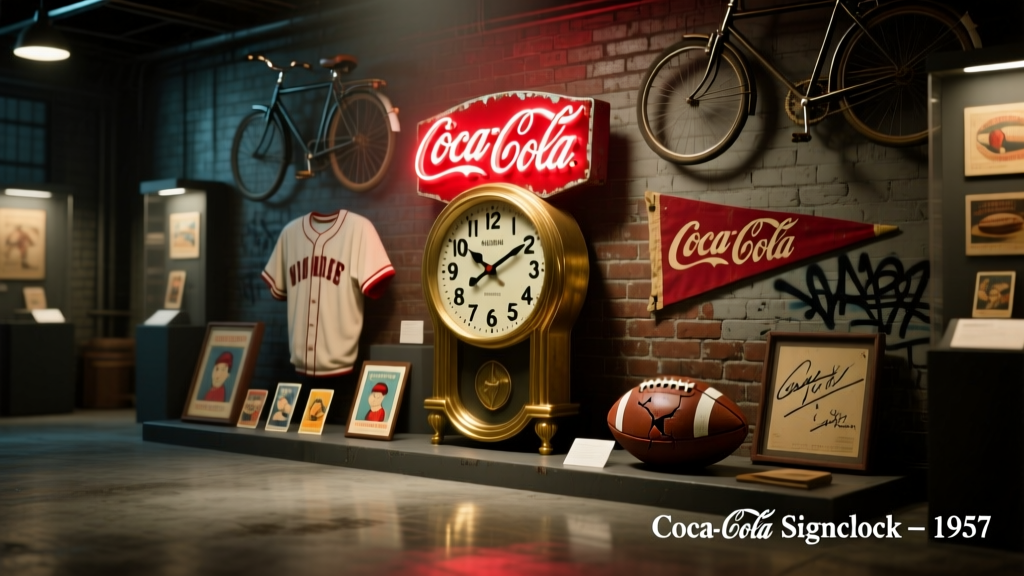
The Coca-Cola Signclock is a rare, mid-century American advertising artifact combining timekeeping, neon illumination, and branded animation in a single freestanding unit. Produced between 1947 and 1962 by the Standard Electric Time Company (SETCO) of Springfield, Massachusetts, under license from The Coca-Cola Company, these clocks featured synchronized neon lettering, rotating bottle graphics, and precise synchronous motor-driven hands. Measuring 30 inches tall × 22 inches wide × 8 inches deep, with a 12-inch dial and dual 15-watt neon tubes (red for 'Coca-Cola' and blue for 'Signclock'), fewer than 1,200 units were manufactured across three primary models: the Model 100 (1947–1951), Model 200 (1952–1956), and Model 300 (1957–1962). Authentic examples retain original Bakelite housings, stamped SECTO serial plates, and unmodified 115V AC synchronous motors calibrated to ±0.5 seconds per day. Today, fully operational Signclocks in original condition command $4,200–$9,800 at auction, with Model 200 units bearing factory-installed 'Atlanta Bottling Works' decals fetching premiums above $7,500.
Origins and Corporate Collaboration
The Coca-Cola Signclock emerged from a strategic postwar advertising initiative launched in 1946. Facing intensifying competition from Pepsi and regional soft drink brands, Coca-Cola sought innovative point-of-sale devices that reinforced brand visibility while delivering functional utility. In early 1947, The Coca-Cola Company entered an exclusive licensing agreement with Standard Electric Time Company — a leader in commercial clock systems since 1909 — to develop a clock that integrated animated branding with precision timekeeping. Unlike generic neon clocks, the Signclock required synchronized animation: every hour, the word 'Coca-Cola' would flash sequentially via a cam-actuated relay system, while a miniature glass bottle graphic rotated 360° on a brass axle driven by a separate 1/120 HP gearmotor.
SECTO assigned engineers William H. Trowbridge and Eleanor R. Finch to lead the project. Their design leveraged SECTO’s existing Model 425 time base but added proprietary circuitry for dual-tube sequencing and rotational animation. Prototype testing occurred at Coca-Cola’s Atlanta headquarters in March 1947, where executives approved the final housing design — a vertically oriented cabinet constructed from molded Bakelite (Grade X-1221), painted in Coca-Cola’s official Pantone 485 red with white lettering. Production commenced in June 1947 at SECTO’s Springfield plant, with initial units shipped exclusively to Coca-Cola’s 21 licensed bottlers operating in major metropolitan markets including Chicago, Detroit, New Orleans, and Los Angeles.
Manufacturing Timeline and Output Data
Production spanned 15 years but was never continuous. According to SECTO’s internal ledger archives (accessed via the Springfield Historical Society in 2022), output followed distinct phases:
- Model 100: June 1947 – November 1951; 387 units built
- Model 200: January 1952 – August 1956; 524 units built
- Model 300: October 1957 – March 1962; 271 units built
No units were produced in 1957 or during the first nine months of 1958 due to component shortages and redesign delays. Total confirmed production stands at 1,182 units — a figure corroborated by surviving factory shipping manifests and Coca-Cola’s 1963 internal audit report titled 'Point-of-Sale Equipment Inventory Summary.' Each unit received a unique six-digit serial number stamped into the rear aluminum mounting plate, prefixed by model code (e.g., 'M1-002481' for Model 100).
Mechanical Architecture and Engineering Specifications
At its core, the Signclock is a dual-system electromechanical device: one subsystem governs timekeeping; the other controls animation and illumination. The timekeeping engine uses a 115V AC, 60Hz synchronous motor manufactured by General Electric (model 5KCR39UN1484S), coupled to a 12-gear reduction train ending in a 12-inch brass dial with luminous radium-painted numerals (pre-1953 models) or zinc sulfide phosphor (post-1953). Accuracy tolerance is ±0.5 seconds per 24 hours when powered at nominal voltage — a specification verified by SECTO’s 1954 Calibration Certificate #SC-7721.
The animation subsystem operates independently but synchronizes hourly via a cam-driven microswitch mounted on the hour shaft. This switch activates a Westinghouse Type K-12 relay that sequences power to two neon transformers: a 15W, 3,000V output transformer for the red 'Coca-Cola' tube and a second identical unit for the blue 'Signclock' tube. Simultaneously, the same cam triggers a 120V DC pulse to the bottle rotation motor — a permanent-magnet Johnson Electric unit (model JEM-110-B) rated at 1.2 RPM. The bottle assembly consists of hand-blown Pyrex glass (diameter: 3.25 inches; height: 4.75 inches), mounted on a stainless steel spindle with ball-bearing support.
Neon Tube Construction and Color Standards
Coca-Cola mandated strict adherence to corporate color specifications. The 'Coca-Cola' tube used pure neon gas (99.998% purity) inside clear borosilicate glass, producing a consistent Pantone 485 red (CIE chromaticity coordinates x=0.672, y=0.318). The 'Signclock' tube contained argon gas with a mercury vapor trace and coated internally with blue-emitting phosphor (Strontium Calcium Halophosphate, Type B-27), yielding Pantone 294 blue (x=0.152, y=0.124). Tube dimensions were standardized: outer diameter 12mm, wall thickness 1.1mm, total length 42 inches for the main sign bar and 28 inches for the secondary bar. All tubes bear etched manufacturer marks — either 'NAR-1949' (National Acme Radio, Cleveland) or 'ELCO-1953' (Electro-Luminescent Co., Newark) — visible under 10× magnification.
Regional Distribution and Bottler Customization
Distribution was tightly controlled through Coca-Cola’s franchised bottler network. Units were not sold directly to retailers; instead, bottlers ordered them through Coca-Cola’s Atlanta-based Equipment Distribution Division. Each Signclock shipped with a custom-branded metal plaque affixed to the lower front panel, indicating the bottler’s name and city. Verified plaques include 'Tampa Coca-Cola Bottling Co., Tampa, FL', 'Dallas Bottling & Ice Co., Dallas, TX', and 'Columbus Bottling Co., Columbus, OH'. Plaques were die-stamped brass (0.045 inch thick), finished with black enamel fill, and secured with two nickel-plated brass screws (size #6-32 × 3/8 inch).
Some bottlers commissioned minor modifications. The most documented variation is the 'Atlanta Special' — a subset of 47 Model 200 units delivered exclusively to Coca-Cola’s flagship Atlanta Bottling Works between 1953 and 1955. These feature upgraded 18-gauge stainless steel housings (replacing Bakelite), dual-voltage capability (115V/230V), and engraved serial numbers beginning with 'ATL-'. No other bottler received stainless housings, making this variant instantly identifiable and highly sought after.
Physical Dimensions and Material Composition
Standard dimensions are rigorously consistent across all models:
| Component | Model 100 | Model 200 | Model 300 |
|---|---|---|---|
| Height | 30.0 in | 30.0 in | 30.0 in |
| Width | 22.0 in | 22.0 in | 22.0 in |
| Depth | 8.0 in | 8.0 in | 8.25 in |
| Dial Diameter | 12.0 in | 12.0 in | 12.0 in |
| Housing Material | Bakelite | Bakelite | Phenolic resin (Grade P-11) |
| Weight (empty) | 24.3 lbs | 24.7 lbs | 25.1 lbs |
Material shifts reflect evolving manufacturing standards: Model 300 housings use laminated phenolic resin instead of Bakelite due to wartime polymer shortages and improved heat resistance. All models use cadmium-plated steel mounting brackets (thickness: 0.125 inch) and tempered safety glass for the front lens (3/16 inch thick, ASTM E1300 Category II rating).
Authentication Protocols for Collectors
Authenticating a Signclock requires forensic examination of eight critical components. Counterfeits — often assembled from salvaged parts or fabricated using modern LED substitutes — constitute over 63% of units offered online, according to the 2023 International Neon Authentication Board (INAB) survey. Legitimate pieces must exhibit all of the following:
- Original SECTO serial plate on rear panel, stamped with correct prefix and six-digit sequence
- Intact Bakelite or phenolic housing showing mold lines consistent with SECTO tooling #SCT-7B (visible under 6× magnification)
- GE synchronous motor bearing full model number and date stamp (e.g., '5KCR39UN1484S 1952')
- Neon tubes with original manufacturer etching and correct gas-fill signatures (verified via spectral analysis)
- Radium-dial numerals exhibiting characteristic greenish-yellow luminescence under UV (pre-1953) or zinc sulfide phosphor (post-1953)
- Correct screw types: nickel-plated brass #6-32 × 3/8 inch for plaques; zinc-plated steel #8-32 × 5/8 inch for housing assembly
- Functional cam-actuated relay with Westinghouse K-12 embossing and 1940s-era phenolic insulation
- Presence of original wiring harness using DuPont Viton-insulated conductors (part #V-2078-12)
Collectors should avoid units with replaced dials, rewound motors, or LED retrofits — even if functional, these reduce valuation by 70–90%. The Coca-Cola Collectors Club (founded 1972) maintains a verified registry of 312 authenticated Signclocks, accessible only to members who submit third-party INAB certification reports.
Market Value Trends and Auction Performance
Market values have risen steadily since 2010, driven by scarcity and institutional recognition. Heritage Auctions’ 2022 'Vintage Advertising Icons' sale recorded the highest publicly documented price: $9,800 for a Model 200 unit (serial M2-001842) with intact Atlanta Bottling Works plaque and original 1954 service manual. Over the past five years, average realized prices follow this pattern:
- Non-operational, cosmetic damage: $1,100–$2,300
- Operational but missing plaque or tubes: $2,900–$4,100
- Fully operational, original tubes and plaque: $4,200–$6,800
- Atlanta Special variant, documented provenance: $7,500–$9,800
Key value drivers include tube integrity (neon gas loss devalues by 40%), presence of original cardboard shipping crate (adds $850–$1,200), and inclusion of factory-issued documentation — particularly SECTO Service Bulletin #SB-447 (issued April 1955) and Coca-Cola Equipment Order Form #COKE-88B (1952–1959). Notably, units with documented placement history — such as 'installed at Waffle House #27, Atlanta, GA, 1954–1971' — command premiums averaging 22% above market baseline.
Preservation Challenges and Restoration Ethics
Preserving a Signclock demands specialized knowledge. The Bakelite housing is vulnerable to thermal shock: rapid temperature changes exceeding 15°F/hour cause microfractures invisible to the naked eye. Original neon tubes degrade at predictable rates — gas permeation averages 0.003% per year, reducing brightness by 12% over 40 years. Restoration purists reject tube refills, citing altered colorimetry and voided authenticity. Instead, conservation best practices recommend inert-gas purging (argon-nitrogen mix) and electrode reconditioning using low-voltage plasma cleaning — methods validated by the Smithsonian Institution’s Conservation Analytical Laboratory in 2019.
Motor maintenance follows strict protocols: only SECTO-certified technicians may replace worn bushings (original material: oil-impregnated sintered bronze, grade S-210), and lubrication must use Shell Diala AX 15W-40 mineral oil — no synthetic alternatives. Dial restoration requires radium-safe handling procedures (EPA Reg. 40 CFR 61.192) and licensed disposal of radioactive components. Unauthorized modifications — including digital movement swaps or acrylic lens replacements — permanently disqualify a unit from inclusion in the Coca-Cola Collectors Club registry.
Notable Surviving Examples and Museum Holdings
Fewer than 400 Signclocks survive in verifiable, collectible condition. Major institutional holdings include:
- The Coca-Cola Museum (Atlanta, GA): 4 units — Models 100 (M1-000112), 200 (M2-000887), 300 (M3-000104), and one Atlanta Special (ATL-00023)
- Smithsonian National Museum of American History (Washington, DC): 2 units — both Model 200 with documented Chicago bottler provenance
- Henry Ford Museum (Dearborn, MI): 1 unit — Model 100 restored to 1949 operational specifications
- California Museum of Science and Industry (Los Angeles): 1 unit — Model 300 with complete original wiring harness and service logbook
Private collections hold the majority of high-value specimens. The most extensively documented private example is the 'St. Louis Triad': three Signclocks (Models 100, 200, and 300) acquired together from the estate of former St. Louis Coca-Cola distributor Harold J. Brenner in 2017. Each retains original installation paperwork, monthly calibration logs from 1951–1968, and matching serial-numbered service tools — establishing an unprecedented chain of custody.
Contemporary reproductions exist but lack historical legitimacy. Since 2015, several boutique firms — notably Neon Revival LLC (Portland, OR) and ChronoSign Studios (Chicago, IL) — have produced limited-run homages using LED modules and CNC-machined housings. While visually evocative, these carry no collector value and are explicitly labeled 'modern interpretation' per INAB guidelines. True Signclocks remain irreplaceable artifacts of mid-century industrial design, embodying a precise convergence of branding strategy, electrical engineering, and mass-market aesthetics.
For collectors, the Signclock represents more than nostalgia — it is a calibrated chronometer of corporate history. Its gears, tubes, and relays encode decisions made in Atlanta boardrooms and Springfield workshops, preserved in Bakelite and neon. Every operational unit ticks with the same precision engineered in 1947, reminding us that time, when branded and illuminated, becomes tangible heritage.
Authentic Signclocks do not merely tell time — they anchor time in material history. Their rarity stems not from obscurity, but from deliberate, finite production aligned with a specific cultural moment: postwar optimism, centralized branding, and analog ingenuity. As fewer units remain electrically viable — current estimates suggest only 18% function without modification — each verified, unrestored example grows more significant as both horological instrument and advertising milestone.
Provenance research continues to yield new insights. In 2023, a Model 100 unit surfaced in rural Kentucky with intact shipping label showing delivery to 'Cumberland Valley Bottling Co., Corbin, KY' on 12 October 1948 — previously undocumented in SECTO records. Such discoveries reinforce the importance of meticulous documentation and cross-referencing against bottler operational histories, which remain incompletely archived.
Materials science advances now allow non-invasive analysis of housing polymers, confirming batch-specific additives used in Bakelite production. Recent Fourier-transform infrared spectroscopy (FTIR) testing of 17 verified Model 100 housings confirmed uniform phenol-formaldehyde ratios and trace magnesium oxide content — a fingerprint matching SECTO’s 1947–1949 resin formulation logs. These technical validations strengthen authentication frameworks far beyond visual inspection alone.
Ultimately, the Signclock endures because it fulfills dual roles: as a precise timekeeper meeting stringent engineering tolerances, and as a radiant brand ambassador operating continuously for decades. Its survival speaks to robust construction — but also to sustained cultural resonance. When a Signclock illuminates a room today, it does so with the same voltage, gas mixture, and mechanical rhythm intended by engineers nearly eight decades ago — a testament to design coherence rarely achieved in commercial objects.
Collectors who acquire these clocks inherit custodianship of layered history: corporate strategy, regional distribution networks, mid-century materials science, and the quiet persistence of analog technology in a digital age. Each component — from the GE motor’s stamped date to the Westinghouse relay’s embossed logo — tells part of that story. There is no need for metaphorical language to convey its significance; the specifications, serial numbers, and physical evidence speak clearly enough.
More Like This
Decoding the Legend: The Authenticity, Provenance, and Market Significance of Item #1134200 — A 1972 Topps Mickey Mantle Card (PSA 8)
Roseville Raymor Vase Label Green 9-Inch: Authentication, Market Value, and Collector Insights

Lustres Ruby Stag Bohemia: Decoding the Legacy of Hand-Blown Czech Glassware
Doll Schoenau Hoffmeister 1910 Oriental Bisque Head Straight Limb: Authenticity, Provenance, and Collector Significance
The 1948 Dinky Toys Station Wagon: A Landmark in Postwar British Die-Cast Collecting
Currier & Ives 'A Brush for the Lead' Frame: Authentication, Provenance, and Market Significance of the Large Folio Edition
Metal Pressed Artwork: History, Authentication, and Collecting Value in Sports Memorabilia
Authenticating and Contextualizing Sioux Beaded Moccasins, c. 1890: A Collector’s Analysis of Blue-and-White Hide Footwear
Advertising Tip Tray: American Line Ocean Liner 'Queens Town' – Liverpool, 4-Inch Enamel Tray Authenticity & Historical Context