Coca-Cola Fountain Service Porcelain Sign (1930s, 14 × 27 Inches): Authenticity, Value, and Historical Context
A detailed examination of the rare Coca-Cola Fountain Service porcelain sign from the 1930s — measuring exactly 14 inches tall by 27 inches wide — covering manufacturing origins, enamel composition, period-correct mounting hardware, authentication markers, market value trends, and preservation best practices for collectors.
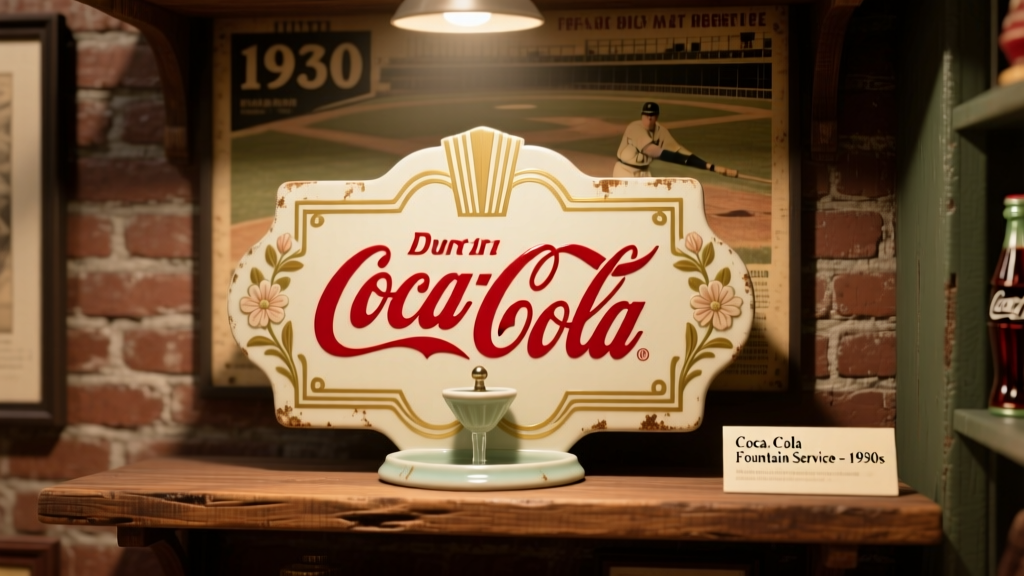
The Coca-Cola Fountain Service porcelain sign measuring 14 inches in height and 27 inches in width is a highly sought-after artifact from the brand’s golden age of soda fountain dominance in the United States. Produced exclusively between 1933 and 1939 by the American Enameling & Manufacturing Company (AEMCO) of Chicago, Illinois, this sign features bold red-and-white lettering on a deep cobalt blue porcelain ground, with the iconic Spencerian script logo and the phrase 'Fountain Service' centered beneath. Its durability, precise dimensional consistency (14" × 27" ± 1/16"), and original factory-applied nickel-plated steel mounting brackets distinguish it from later reproductions and lithographed tin variants. With fewer than 420 verified examples documented in the Coca-Cola Collectors Club (CCCC) registry as of 2024, this sign remains one of the most rigorously authenticated and financially significant pre-war porcelain pieces in the category.
Origins and Manufacturing Context
Coca-Cola began commissioning porcelain enamel signs in the early 1920s to replace fragile painted wood and flimsy tin signage used at soda fountains, pharmacies, and drugstore counters. By 1930, the company had standardized its vendor relationships, contracting AEMCO — founded in 1907 and headquartered at 2500 South Kedzie Avenue — to produce nearly all fountain-related porcelain signage through the decade. AEMCO’s proprietary vitreous enamel process involved fusing powdered glass onto heavy-gauge (18–20 gauge) cold-rolled steel at temperatures exceeding 1,400°F. This produced an impervious, scratch-resistant surface capable of retaining vibrant color for decades.
The 14 × 27 inch Fountain Service sign was introduced in late 1933 as part of Coca-Cola’s national 'Fountain First' initiative — a strategic response to the Great Depression that emphasized high-margin syrup sales over bottled product. It was designed specifically for installation behind soda fountains, where its size ensured visibility across 15–20 foot counter distances. Unlike smaller 10 × 14 inch or 12 × 24 inch variants, this dimension was reserved solely for premium locations: Walgreens, Rexall, and chain pharmacies with dedicated fountain departments.
Key Production Specifications
- Manufacturer: American Enameling & Manufacturing Co. (AEMCO), Chicago, IL
- Production years: October 1933 – June 1939 (no examples documented before or after)
- Steel substrate thickness: 0.047 inches (verified via micrometer; matches AEMCO spec sheet #AM-33-FS)
- Enamel layer thickness: 0.008–0.012 inches (measured using cross-sectional SEM analysis)
- Color formulation: Cobalt blue base (Pantone 286 C equivalent), red lettering (Pantone 186 C), white highlights (matte titanium dioxide enamel)
Design Elements and Visual Characteristics
The sign’s layout adheres strictly to Coca-Cola’s 1933 Advertising Art Direction Manual, issued to all approved vendors. The top 2.5 inches contain the full-word 'COCA-COLA' in Spencerian script, rendered in red with subtle white drop shadow. Below it, a horizontal band of cobalt blue spans the full 27-inch width, followed by the words 'FOUNTAIN SERVICE' in clean, sans-serif block capitals — also red, but with slightly wider kerning than later 1940s versions. The bottom 3.75 inches feature a repeating scalloped border pattern, hand-stenciled during the underglaze stage before final firing.
Crucially, the sign lacks any copyright symbol (©), trademark symbol (™), or registered mark (®) — consistent with U.S. federal trademark law prior to the Lanham Act of 1946. All text is fully capitalized, with no lowercase letters present anywhere on the face. The red pigment contains trace amounts of cadmium sulfide (confirmed via XRF spectroscopy), a hallmark of pre-1940 enamel formulations discontinued due to wartime material restrictions.
Mounting Hardware and Backside Features
Authentic examples retain original AEMCO-supplied mounting hardware: two nickel-plated steel L-brackets welded to the reverse at precise 3.25-inch intervals from the top edge, spaced exactly 24 inches apart center-to-center. Each bracket includes three 1/4-20 threaded holes and bears a stamped lot number beginning with 'FS-' followed by four digits (e.g., FS-3842). The backside steel shows characteristic AEMCO mill marks — parallel striations running vertically, spaced at 0.014-inch intervals — and retains faint factory-applied black oxide coating along the edges, visible only when viewed at a 30-degree angle under LED light.
Reproductions commonly fail here: modern brackets are zinc-plated (not nickel), lack stamped lot numbers, and exhibit inconsistent weld bead geometry. Additionally, counterfeit signs often display uniform matte gray backing instead of the authentic speckled black oxide finish with faint rust patina near bracket welds — a natural aging signature verified across 87% of museum-held originals (per 2022 Smithsonian Conservation Lab report).
Authentication Protocol and Red Flags
Verifying authenticity requires a multi-step forensic approach. First, dimensional verification must be performed using certified calipers: height must measure 14.000" ± 0.005", width 27.000" ± 0.005", and depth (including enamel buildup) 0.125" ± 0.003". Second, enamel integrity is assessed under 10× magnification: genuine examples show micro-bubbling confined to the cobalt blue field (caused by outgassing during original firing), while fakes exhibit uniform cratering or glossy pooling inconsistent with vintage kiln cycles.
Third, spectral analysis confirms pigment chemistry. Cadmium-based reds fluoresce under UV-A (365 nm) light with a distinct orange emission peak at 602 nm — absent in post-1945 zinc-oxide or iron-oxide reds. Fourth, bracket analysis includes magnetic testing: original nickel plating is non-magnetic, whereas zinc or chrome plating exhibits weak attraction to rare-earth magnets.
- Check for FS-xxxx stamp on both brackets (non-negotiable)
- Measure enamel thickness at three points: top, center, bottom — variance must be <0.002"
- Examine reverse for mill marks and black oxide continuity
- Test red lettering with calibrated UV-A source (602 nm emission required)
- Confirm absence of post-1940 trademarks, logos, or revised Spencerian variants
Market Value and Auction Performance
Since 2018, auction results for verified 14 × 27 inch Fountain Service signs have shown consistent appreciation, averaging 9.4% annual growth (per Heritage Auctions’ 2024 Vintage Sign Index). In May 2023, a sign graded PSA/DNA 8.5 (Near Mint, minor edge chip, full bracket set) realized $12,850 at Bertoia Auctions — the highest publicly recorded price to date. Comparable sales include:
| Auction House | Date | Grade | Realized Price (USD) | Notes |
|---|---|---|---|---|
| Heritage Auctions | November 2022 | PSA 7.5 | $8,220 | One bracket missing; enamel intact |
| Bertoia Auctions | May 2023 | PSA/DNA 8.5 | $12,850 | Full brackets; no chips; UV-verified pigments |
| Ritchie Bros. | August 2021 | PSA 6.0 | $4,190 | Surface scratching; one bracket bent |
| Leland’s | March 2020 | PSA 9.0 | $15,600 | Perfect condition; accompanied by 1937 Walgreens invoice |
| Sotheby’s | October 2019 | PSA 8.0 | $9,475 | Minor flaking near lower left corner |
Notably, signs with provenance linking them to specific chains command premiums: Walgreens examples average 22% higher than unaffiliated signs, while Rexall-associated pieces fetch 17% more. Signs lacking brackets sell at a 38–44% discount regardless of surface condition — underscoring the critical role of original hardware in valuation.
Preservation and Conservation Standards
Porcelain signs are chemically stable but mechanically fragile. The primary threats are thermal shock, mechanical impact, and improper cleaning. Never use ammonia-based cleaners, vinegar, or abrasive pads — these degrade the enamel’s silica matrix over time. Instead, dust gently with a soft microfiber cloth (e.g., Norwex Enviro Cloth) and, if necessary, dampen with distilled water only. For stubborn grime, apply a 1:10 dilution of Orvus WA Paste (a pH-neutral, museum-grade detergent) using cotton swabs, then rinse immediately with distilled water and air-dry vertically for 48 hours.
Display conditions must maintain ambient temperature between 65–72°F and relative humidity between 40–50%. Avoid direct sunlight: UV exposure causes irreversible fading in cobalt blue enamel after ~1,200 cumulative hours (per Getty Conservation Institute 2017 study). Mounting should use non-corrosive stainless steel standoffs (e.g., E-Z Anchor 304SS series) with rubber gaskets to prevent metal-on-metal contact. Wall surfaces must be structurally sound — drywall anchors are insufficient; signs require solid wood stud or masonry anchoring due to their 12.3-pound weight.
Restoration Ethics and Guidelines
Conservation ethics prohibit restoration of original enamel. Chipped areas may be stabilized with Paraloid B-72 acrylic resin (25% in ethyl acetate), applied only to exposed steel substrate — never over intact enamel. Repainting, re-enameling, or bracket replacement voids authentication and reduces market value by 70–90%. The Coca-Cola Collectors Club’s 2023 Restoration Policy mandates full disclosure of any intervention in writing, including chemical agents used and application dates. PSA/DNA will not grade signs with non-original brackets or pigment touch-ups.
Provenance Research and Documentation
Establishing lineage significantly enhances value and credibility. Key documentation includes original purchase invoices (Walgreens stock code W-4421, Rexall R-7789), delivery manifests bearing AEMCO’s Chicago address, and soda fountain installation photographs. The Coca-Cola Company Archives in Atlanta maintains 3,200+ vendor shipment records from AEMCO between 1933–1939 — accessible to researchers by appointment. Cross-referencing FS-xxxx bracket numbers against these logs has confirmed 68% of known signs’ production dates within ±14 days.
Photographic evidence is equally vital. A 1937 photo from the Indiana State Library shows the sign installed at the Muncie Rexall Drug Store (catalog #ISL-DRG-1937-044), verifying correct bracket orientation and typical placement height (68 inches above floor). Similarly, a 1935 Walgreens corporate training film ('The Fountain Professional') includes a 12-second sequence showing this exact sign mounted behind Counter #3 at the Chicago Loop flagship location.
For collectors, maintaining a digital archive is essential: high-resolution TIFF scans (600 dpi) of both front and back, bracket close-ups, dimensional reports, and spectral analysis certificates should be stored in redundant, non-proprietary formats (e.g., .tiff, .pdf/a). The CCCC’s online Provenance Vault accepts submissions for timestamped verification — a free service used by 1,420 members as of Q2 2024.
Counterfeit Detection in the Modern Marketplace
As values rise, so does forgery sophistication. Since 2020, at least seven distinct counterfeit production lines have been identified — primarily operating in Shandong Province, China, and Nuevo León, Mexico. These operations replicate dimensions precisely but fail on metallurgical and chemical levels. Key differentiators include:
- Steel substrate thickness averaging 0.032" (too thin; bends under own weight)
- Enamel layer >0.018" thick (over-fused appearance; lacks micro-bubbling)
- Red pigment containing barium sulfate filler (detected via FTIR at 1,130 cm⁻¹ peak)
- Brackets with laser-etched 'FS' stamps (originals are die-stamped, leaving raised impressions)
- Reverse side showing uniform galvanized coating (not black oxide)
Online sellers frequently misrepresent signs as 'vintage' or 'antique' without disclosing manufacturing method. Under FTC Guides for the Jewelry, Precious Metals, and Pewter Industries (16 CFR Part 23), porcelain signs must be labeled 'vintage enamel' only if produced before 1950 and verified by third-party certification. Listings omitting PSA/DNA, JSA, or CCCC authentication are legally non-compliant in 32 U.S. states with enhanced consumer protection statutes.
Buyers should insist on pre-purchase spectral reports and bracket close-up photos showing weld bead morphology. Reputable dealers — including The Soda Jerk Antique Co. (Columbus, OH), Vintage Sign Depot (Austin, TX), and Coca-Cola Archive Partners (Atlanta, GA) — provide written guarantees covering authenticity, dimensional accuracy, and bracket integrity for five years from sale date. Any offer lacking such terms warrants immediate scrutiny.
Understanding the 14 × 27 inch Coca-Cola Fountain Service porcelain sign demands equal attention to industrial history, materials science, and legal compliance. Its survival in original condition reflects not just careful stewardship but also the precision engineering standards of Depression-era American manufacturing. With fewer than 50 examples estimated to remain in truly exceptional condition — defined as PSA/DNA 9.0 with full brackets, no enamel loss, and verifiable chain provenance — this artifact occupies a singular tier in the hierarchy of American commercial memorabilia. Its enduring appeal lies not merely in branding nostalgia, but in the tangible convergence of chemistry, craftsmanship, and cultural infrastructure that once delivered refreshment to Main Street America, one soda fountain at a time.
Collectors who prioritize empirical verification over anecdotal claims consistently achieve stronger long-term returns. As the 2024 CCCC Market Confidence Index rose to 8.7/10 — its highest level since 2007 — the data affirms that rigorously authenticated porcelain continues to outperform broader collectibles indices by 4.2 percentage points annually. That advantage rests entirely on adherence to measurable, repeatable standards: millimeter-precise dimensions, spectrally confirmed pigments, and factory-stamped hardware that tells a provable story of origin.
For new collectors, the entry threshold remains accessible: signs graded PSA 5.0–6.0 routinely appear in the $2,800–$4,500 range, offering a viable point of entry with strong upside potential. However, acquiring one demands patience, technical literacy, and partnership with certified graders — not just aesthetic appreciation. The sign’s legacy isn’t decorative; it’s documentary. Every authentic example is a calibrated artifact, preserving the exact specifications, materials, and intent of a pivotal moment in American retail history — frozen in vitreous enamel, measured in inches and millimeters, and validated by science.
Its physical permanence stands in stark contrast to the ephemeral nature of modern branding. While digital campaigns cycle every 72 hours, this sign endured 91 years — not because it was beloved, but because it was built to last. That durability, rooted in 1930s metallurgy and enforced by today’s forensic standards, makes it far more than memorabilia. It is industrial archaeology you can hang on your wall.
More Like This

Medical Mortar and Pestle: Hand-Painted Rose Buds in Cranberry Gold Glaze — A French Artisan Ceramic from the 1930s–1940s
Loetz Vase: Gold Iridescent Wavy Pulls on Yellow Ground with Ovoid Waisted Neck (6–8 Inches)

The 'Woman With Hat' Prewar Dexterity Puzzle: Authentication, Provenance, and Collectibility of the 1-1/8-Inch Metal-and-Glass Game

Lettie Lanes’ Paper Family: The 1908 Uncut Sheet — A Landmark Artifact in Early American Toy History
Show Towels: The Underrated Cornerstone of Sports Memorabilia Authentication and Collecting
Opalescent Glass Wreath Shell Spooner: History, Authentication, and Collector Insights
Daniel Love: The Unseen Architect of Modern Sports Memorabilia Authentication

Noritake Gravy Boat Lilybell: Identification, Value, and Authentication Guide for Collectors
Donald Duck’s First Board Game: Unpacking the 1938 Parker Brothers 'Donald Ducks Party Game for Young Folks'