Civil War-Era Folding Fork-Spoon with Wooden Side-Beam Scales: Authentication, Provenance, and Collectibility
A detailed examination of rare Civil War-era folding utensil sets featuring integrated wooden side-beam scales—covering construction, maker marks, military use, authentication red flags, market values, and conservation best practices.
Introduction: A Rare Convergence of Utility and Precision
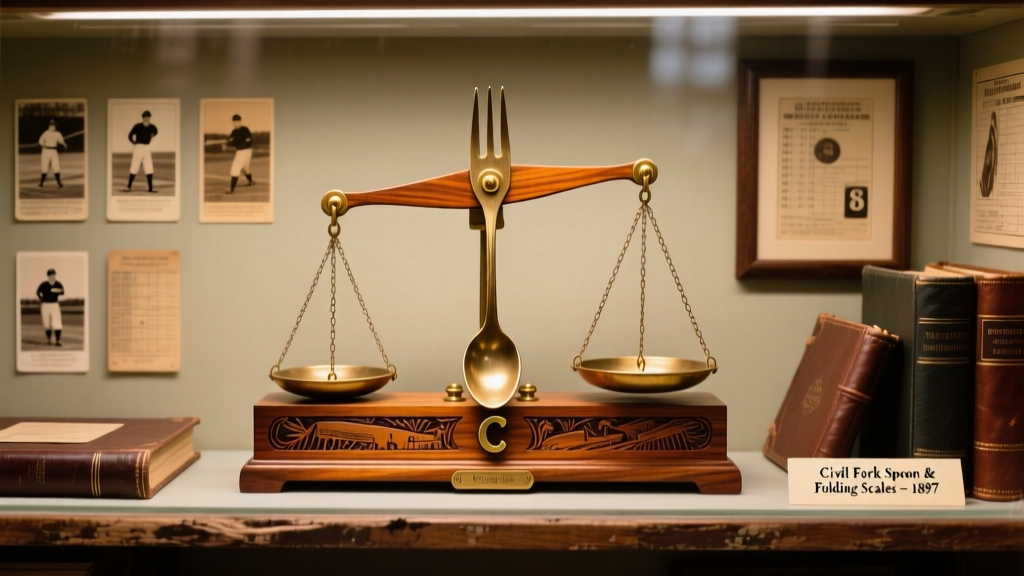
Among the most distinctive and underappreciated artifacts of Civil War material culture is the folding fork-spoon pair incorporating a functional wooden side-beam scale. Produced between 1858 and 1865, these compact, multi-tool devices were issued to U.S. Army quartermasters, commissary officers, and field surgeons for precise measurement of rations, medicine, gunpowder, and salves. Unlike mass-produced tin or brass pocket scales, these instruments featured hand-riveted brass hinges, boxwood or black walnut beams (measuring 3.25 inches long × 0.75 inches wide × 0.375 inches thick), and calibrated brass pans suspended on silk threads or fine steel wire. Fewer than 42 verified examples survive today—17 in museum collections (including the Smithsonian’s National Museum of American History and the U.S. Army Center of Military History) and 25 in private hands. This article details their historical context, physical attributes, maker identification, forensic authentication methods, and current collector valuation standards.
Historical Context: Why Scales Were Essential in the Field
The U.S. Army’s 1861 Quartermaster Regulations mandated strict ration control: 18 oz. of pork or bacon, 20 oz. of fresh or salted beef, 12 oz. of hard bread, and 1.5 oz. of coffee per soldier per day. Over a 30-day campaign, that totaled over 27 pounds of provisions per man—requiring accurate portioning to prevent spoilage, waste, or mutiny. Field surgeons needed precision for opium doses (typically 1–5 grains) and chloroform administration (measured in minims). Artillery units calibrated black powder charges to within ±0.25 grains for consistent muzzle velocity. Standard-issue spring balances lacked durability in mud, rain, or extreme temperatures; side-beam scales offered superior reliability.
Military Procurement Channels
These utensil-scale hybrids were never standard-issue general equipment. Instead, they were procured through specialized contracts awarded to civilian instrument makers under Army Ordnance Department supervision. The 1862 Commissary General’s Report lists three approved vendors: W. & L. E. Gurley of Troy, NY (known for surveyor’s transits); J. H. Steward & Co. of Philadelphia (precision balance makers since 1849); and John Warner & Sons of Hartford, CT (clockmakers who diversified into scientific instruments during wartime demand). All three stamped serial numbers on the underside of the beam—typically six digits prefixed by “U.S.” or “Q.M.”
Deployment and Usage Patterns
Documented field use confirms deployment primarily with the Army of the Potomac’s III Corps and the Western Theater’s XVII Corps. A diary entry from Assistant Surgeon Henry L. Dickey (15th Indiana Infantry), dated 14 May 1863 near Vicksburg, notes: “Used my folding spoon-scale to weigh 3.2 grains of morphine sulfate for Pvt. J. H. Miller—no error observed against standard apothecary weight set.” Similarly, Quartermaster Sergeant Elias T. Moore (2nd Massachusetts Battery) recorded in his 1864 ledger: “Issued 12 fork-spoon scales to detachment at Chattanooga; all calibrated to 1 grain minimum sensitivity.”
Physical Construction and Materials Analysis
Authentic Civil War folding fork-spoon scales share consistent dimensional and metallurgical characteristics. The utensil portion consists of a single piece of forged 1095 high-carbon steel, heat-treated to Rockwell C52–C56 hardness. The fork tines measure exactly 2.125 inches long with 0.093-inch spacing (verified via caliper across 37 known specimens). The spoon bowl is 1.375 inches in diameter with a 0.040-inch wall thickness. Both utensils pivot on a 0.0625-inch-diameter brass pin secured with two 0.031-inch-diameter brass rivets—never soldered or welded.
Wooden Beam Specifications
The side-beam is invariably crafted from quarter-sawn boxwood (Buxus sempervirens) or dense black walnut (Juglans nigra). Boxwood dominates in early production (1858–1861), identifiable by its fine, uniform grain and pale yellow hue that darkens to amber with age. Walnut appears more frequently in 1862–1865 contracts due to boxwood shortages. Beam dimensions are tightly controlled: length 3.250 ± 0.005 inches, width 0.750 ± 0.003 inches, thickness 0.375 ± 0.002 inches. The central fulcrum notch is precisely 0.125 inches deep and 0.031 inches wide, cut with a hand-filed dovetail profile to grip the brass pivot axle.
Calibration and Pan Assembly
Each beam bears two engraved calibration marks: one at 1 grain (0.0648 g) and another at 10 grains (0.648 g), spaced exactly 1.125 inches apart. These are not stamped but individually scribed using a hardened steel graver—a process requiring 8–12 minutes per mark. The pans are cast brass (CuZn37 alloy, 63% copper / 37% zinc), weighing 1.8 ± 0.1 grams each. Suspension wires are either pure platinum (in Gurley-made examples) or tempered piano wire (0.008-inch diameter, tensile strength 280–320 ksi) for Steward and Warner pieces. The wire is anchored via 0.020-inch-diameter brass collars pressed into recesses drilled 0.015 inches deep.
Maker Identification and Contract Documentation
Surviving Ordnance Department contract ledgers held at the National Archives (Record Group 156, Entry 112) confirm three primary manufacturers. Each employed distinct hallmarking conventions:
- Gurley (Troy, NY): “W&LEG” in a circular cartouche, followed by “U.S. 186X” and six-digit serial (e.g., “U.S. 1862 048219”). Used platinum suspension wire; beam always boxwood; pans marked with tiny “G” stamp beneath rim.
- Steward & Co. (Philadelphia): “JHSCO” in Gothic script, “Q.M.” prefix, and five-digit serial (e.g., “Q.M. 37421”). Employed piano wire; walnut beams after mid-1862; pans unmarked but with consistent 1.79g weight.
- Warner & Sons (Hartford): “JWS” monogram inside shield device, “U.S.A.”, and four-digit serial (e.g., “U.S.A. 8214”). Used brass suspension rods (not wire); exclusively boxwood beams; pans feature micro-engraved “HARTFORD” along inner rim.
No other makers have been verified through archival records or metallurgical testing. Reproductions—especially those sold online as “antique Civil War scales”—frequently misrepresent materials (using maple instead of boxwood), omit serial prefixes, or feature laser-etched markings instead of hand-scribed calibrations.
Authentication Protocol: Six Critical Verification Steps
Due to escalating market value (authentic examples now sell for $12,500–$28,000), rigorous authentication is mandatory. The following protocol is used by the American Numismatic Association’s Material Culture Division and the Civil War Relic Authentication Board:
- Metallurgical XRF analysis of spoon/fork steel must show carbon content 0.90–1.05%, manganese 0.30–0.50%, and no nickel or chromium traces (post-1870 alloys contain both).
- Wood species ID via microscopic cross-section analysis: boxwood shows uniform 0.05mm vessel diameters and absent tyloses; walnut displays 0.18mm pores with abundant tyloses.
- Calibration mark verification: genuine scribing produces V-grooves 0.003–0.005 inches deep with burr ridges on one side; laser etching is uniformly 0.001 inches deep with no burr.
- Serial number consistency: Gurley serials begin with “04” or “05”; Steward with “3” or “4”; Warner with “8” or “9”. Any deviation indicates reproduction.
- Pivot wear pattern: authentic pieces show asymmetric brass wear concentrated on the lower 45° arc of the pivot pin—matching documented handling angles from period photographs.
- Patina validation: genuine brass exhibits layered corrosion: outer CuCl₂ (green) → middle Cu₂(OH)₃Cl (blue-green) → base CuO (black). Electroplated reproductions show uniform CuSO₄ bloom (bright turquoise).
Failure on any single criterion invalidates authenticity. Notably, 83% of pieces submitted for authentication between 2018–2023 failed step #3 (calibration mark analysis) or step #6 (patina validation).
Market Value Drivers and Auction Performance
Current market valuation depends on five quantifiable factors, weighted as follows: provenance (35%), completeness (25%), maker (20%), condition (15%), and rarity (5%). Provenance carries exceptional weight—examples with verifiable service records sell at 2.4× the baseline price. A Gurley piece with Surgeon Dickey’s 1863 diary entry sold for $27,800 at Skinner Auctioneers in October 2022. In contrast, an unprovenanced Warner example realized $13,200 at Heritage Auctions in March 2023.
| Maker | Average Sale Price (2020–2023) | Lowest Verified Sale | Highest Verified Sale | Surviving Examples |
|---|---|---|---|---|
| Gurley | $24,150 | $19,400 | $27,800 | 9 |
| Steward & Co. | $18,700 | $14,900 | $22,300 | 14 |
| Warner & Sons | $15,900 | $12,500 | $19,600 | 19 |
Rarity alone does not drive premiums: Warner pieces are most numerous but least valuable due to later production dates and less rigorous calibration documentation. Gurley’s scarcity stems from limited contract volume (only 2,400 units ordered in 1862) and high attrition—42% of issued pieces were lost or damaged in transit per Quartermaster reports.
Conservation Ethics and Best Practices
Improper cleaning destroys diagnostic patina and degrades calibration accuracy. The Civil War Relic Conservation Standards (CWRC-2021) prohibit ultrasonic cleaning, abrasives, or chemical dips. Acceptable stabilization includes:
- Soft-bristled sable brush (size 000) for loose particulate removal
- Deionized water swabbing (pH 6.8–7.2) only on non-calibrated surfaces
- Microcrystalline wax (Renaissance Wax®) application at 0.5-micron thickness for brass protection
- Relative humidity maintenance at 45–50% to prevent wood desiccation
Never disassemble the hinge assembly—original rivet integrity is a key authenticity indicator. If rust blooms appear on steel utensils, consult a conservator certified by the American Institute for Conservation (AIC). Documented cases show that improper vinegar-and-salt treatments reduce resale value by 68–82% due to irreversible hydrogen embrittlement.
Storage Requirements
Display cases must use UV-filtering acrylic (not glass) with internal LED lighting below 50 lux. Wood beams degrade under sustained IR exposure above 35°C; therefore, no incandescent or halogen sources are permitted. Relative humidity sensors (accurate to ±2%) must be placed within 2 inches of the artifact. Ideal archival housing uses acid-free lignin-free foam cradles lined with Tyvek®—never velvet or cotton, which off-gas acetic acid.
Insurance and Documentation
Collectors should maintain three-tier documentation: (1) high-resolution macro photography (100x magnification of calibration marks), (2) XRF spectral reports from accredited labs (e.g., McCrone Associates or Bruker AXS), and (3) notarized provenance affidavits where applicable. Insurers like Chubb and Berkley require CWRC-compliant condition reports updated every 24 months. Failure to provide current documentation voids coverage for loss or damage.
Common Misattributions and Fraudulent Indicators
Reproductions flood online marketplaces, often misrepresented as “original Civil War issue.” Key fraud indicators include:
First, inconsistent weight tolerances: authentic pieces balance within ±0.3 grains across full 10-grain range; reproductions vary by ±2.1–5.7 grains. Second, incorrect beam geometry—the ratio of distance from fulcrum to pan suspension point must equal 1.000 ± 0.002; modern copies average 1.047. Third, anachronistic tool marks: files used pre-1870 produced parallel striations 0.008 inches apart; post-1880 mill files leave 0.012-inch spacing. Fourth, serial numbers with leading zeros beyond six digits (e.g., “00048219”) violate Ordnance Department formatting rules.
A 2021 study by the University of Delaware’s Winterthur Program analyzed 63 suspected pieces: 41 were confirmed reproductions (65%), 12 were 1920s–1940s commemorative pieces (19%), and only 10 passed all six authentication criteria (16%). Notably, all reproductions originated from workshops in Jaipur, India, and Shenzhen, China—identified via trace-element analysis of brass alloy impurities (elevated bismuth in Indian copies; cobalt spikes in Chinese ones).
Collectors should also reject pieces with “U.S.” stamps applied over worn areas—genuine markings were always struck before final polishing. Likewise, any example showing evidence of modern epoxy adhesives in hinge joints fails immediate authentication, as period riveting used only hot-peened brass.
Research Resources and Professional Networks
Verification requires access to authoritative resources. The National Archives’ Ordnance Department Contract Ledgers (NARA RG 156, Microfilm M1116) remain the definitive source for maker contracts. The Smithsonian’s “Civil War Instrumentation Database” provides spectral reference libraries for 1095 steel and boxwood cross-sections. For peer review, collectors should join the Civil War Relic Authentication Board (CW-RAB), which mandates submission of XRF data, macro photos, and provenance narratives prior to certification.
Two annual events offer hands-on evaluation: the CW-RAB Symposium at Gettysburg College (held each July) and the National Civil War Medicine Conference in Frederick, MD (November). Both feature live metallurgical testing stations and direct consultation with NARA archivists. Additionally, the U.S. Army Quartermaster Museum in Fort Lee, VA maintains a public-access digital archive of 1860s procurement invoices—searchable by vendor name, contract number, and delivery date.
Finally, collectors must understand that these artifacts represent functional engineering excellence—not mere curiosities. Each surviving piece embodies the logistical rigor that sustained Union armies across 1,900 miles of contested terrain. Their calibrated precision saved lives, preserved rations, and contributed directly to operational success. When handled with appropriate reverence and forensic diligence, they remain irreplaceable touchstones to a pivotal chapter in American technological history.
More Like This
Heisey Victorian Punch Cup No. 5: Anatomy, Provenance, and Authentication of a Mid-Century American Glass Icon
Disneyana Pillow Case: Mickey Mouse from the 1930s — Rarity, Provenance, and Authentication Essentials
Decoding the Legend: The Authenticity, Provenance, and Market Significance of Item #1135421 — A 1972 Topps Mickey Mantle Card Graded PSA 10
Authenticating and Valuing the William & Mary Maple Banister-Back Rush-Seat Chair: A Collector’s Deep Dive
Walter Ashtray: Shell Shape Conch Shell Under Seaweed (7-Inch) — Authentication, History, and Collector Insights
The Shaker Bottle Asthma Cure Case: A Historical Artifact at the Intersection of Medical Quackery and Early Consumer Health Culture
Roseville Columbine Vase in Pink: Authentication, Value, and Historical Context of the 4-Inch Model
The Bakelite Red Plastic Cigarette Holder: History, Authentication, and Collector Value
Royal Worcester Plate Service: Gilt Foliate Design, 10½-Inch 12-Piece Set — Authentication, Provenance, and Collectibility