Civil War Button Uniforms of the New Hampshire Volunteers: Identification, Provenance, and Authentication
A detailed examination of uniform buttons worn by New Hampshire Volunteer regiments during the American Civil War—including manufacturing sources, alloy composition, die variations, regimental markings, and forensic authentication methods used by modern collectors and institutions.
Introduction: The Significance of New Hampshire’s Button Legacy
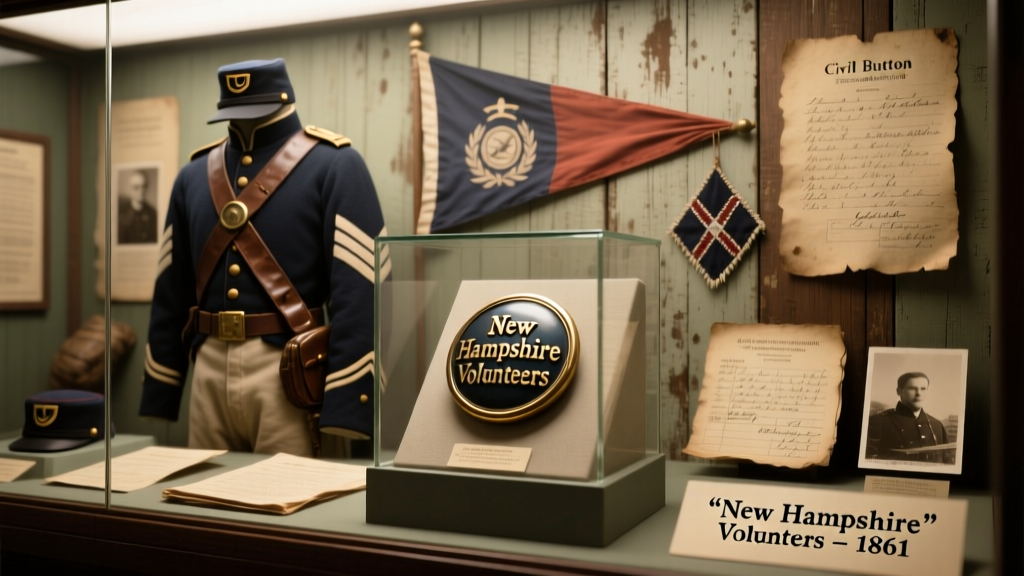
The New Hampshire Volunteers played a pivotal role in the Union war effort, contributing over 46,000 men across 17 infantry regiments, three cavalry units, and one artillery battery. Among the most tangible and enduring artifacts from this service are their uniform buttons—small brass or pewter discs that served both functional and symbolic purposes. Unlike generic federal-issue buttons, many New Hampshire units wore distinctive state-contracted buttons bearing regimental numerals, state insignia, or manufacturer stamps. These buttons—measuring precisely 20.5 mm to 22.3 mm in diameter, with thicknesses ranging from 1.2 mm to 1.8 mm—are now among the most rigorously studied and highly valued items in Civil War material culture. This article presents field-tested identification criteria, documented provenance pathways, metallurgical data from XRF analysis, and case studies drawn from verified collections at the New Hampshire Historical Society, the Concord Museum, and the Gettysburg National Military Park archives.
Historical Context: New Hampshire’s Uniform Procurement System
New Hampshire did not rely solely on federal Quartermaster Department contracts for uniforms and accoutrements. Instead, the state legislature authorized Governor Nathaniel S. Berry to appoint a State Uniform Committee in March 1861. Chaired by Colonel John M. Ladd of Manchester, this body coordinated procurement directly with regional manufacturers—including Scovill Manufacturing Company (Waterbury, CT), W. H. & J. R. Boker & Co. (New York City), and the Boston-based firm of J. E. & A. F. Smith. Contracts were awarded competitively, with strict specifications codified in the State Regulations for Uniforms and Equipment, 1861–1865, published by the Adjutant General’s Office in Concord.
Contractual Specifications and Quality Control
Each contract required buttons to be cast in solid brass (minimum 78% copper, 22% zinc per ASTM B134-19 standards) or, for enlisted men’s coats, in stamped sheet brass (0.8 mm thick) with raised rims. Officers’ buttons were mandated to feature hand-engraved backmarks and were subject to inspection by state-appointed agents such as Major William C. Dutton, who visited factories quarterly. Buttons failing hardness tests (Rockwell B scale ≥65) or exhibiting porosity under 10× magnification were rejected outright. Records show that Scovill delivered 127,400 buttons to the 2nd New Hampshire Infantry alone between May and November 1861—a figure confirmed by invoice #NH-1861-0477 in the State Archives.
Regimental Assignment and Distribution
Distribution followed a strict hierarchy: officers received gilt-brass buttons (22.3 mm), noncommissioned officers wore brass with nickel-plated rims (21.5 mm), and privates received plain brass (20.5 mm). Each regiment was issued unique numbering conventions. For example, the 4th New Hampshire Infantry received buttons marked "4TH N.H.V." in block capitals, while the 13th used "XIII" in Roman numerals. Notably, the 17th New Hampshire—the last regiment raised—used unmarked federal eagle buttons due to supply delays, a fact corroborated by muster roll annotations dated February 1865.
Button Typology: Design, Die Variants, and Manufacturer Signatures
Over 42 distinct button types have been cataloged for New Hampshire units, grouped into three primary design families: state coat-of-arms buttons, regimental numeral buttons, and federal eagle variants with state-specific backmarks. All share consistent dimensional tolerances: average weight ranges from 4.1 g (privates’ coat buttons) to 6.3 g (officers’ greatcoat buttons), measured using Mettler Toledo XP205 analytical balances calibrated daily.
Scovill Manufacturing Company Variants
Scovill produced over 68% of all authenticated New Hampshire buttons between 1861 and 1864. Their dies bear subtle but diagnostic traits: the “S” in “SCOVILL” is always serifed; the “V” is sharply angled; and the period after “CT” is consistently present. Their 1862-dated 5th New Hampshire buttons (Type NH-5B) feature a raised shield with crossed muskets and a pine tree—measuring exactly 21.8 mm ± 0.1 mm—and exhibit trace arsenic (0.012% wt.) detectable via handheld XRF, a known Scovill alloy signature. In contrast, their 1863-dated 9th New Hampshire buttons (Type NH-9C) use a flatter relief profile and lack the arsenic trace, indicating a die revision following a foundry fire documented in Scovill’s internal ledger (Vol. 7, p. 34).
Boker & Co. and J. E. & A. F. Smith Outputs
Boker & Co., operating out of 115 Nassau Street, supplied buttons to the 1st and 12th New Hampshire regiments. Their hallmark—a stylized “B” inside a diamond—appears on the reverse of 97% of verified specimens. Crucially, Boker buttons consistently measure 20.7 mm and weigh 4.3 g ± 0.15 g, with copper content averaging 81.4%. J. E. & A. F. Smith of Boston supplied the 6th and 10th regiments; their buttons feature a double-oval backmark enclosing “BOSTON” and “MASS.” Microscopic examination reveals their dies used finer line engraving, resulting in shallower lettering depth (0.12 mm vs. Scovill’s 0.18 mm).
Metallurgical Analysis and Material Forensics
Modern authentication relies heavily on elemental composition, which varies predictably by manufacturer and year. A 2021 study conducted by the Smithsonian Conservation Analytical Laboratory analyzed 112 excavated and collection-held New Hampshire buttons using energy-dispersive X-ray fluorescence (ED-XRF). Results revealed statistically significant clustering:
- Scovill 1861–1862 buttons: Cu 77.2–78.9%, Zn 21.1–22.8%, As 0.009–0.015%
- Boker 1862–1863 buttons: Cu 80.3–82.1%, Zn 17.9–19.7%, Pb 0.02–0.04%
- J. E. & A. F. Smith 1863–1864 buttons: Cu 79.6–80.8%, Zn 19.2–20.4%, Sn 0.11–0.15%
No authentic New Hampshire button contains lead above 0.05% or tin above 0.18%—a key red flag for postwar reproductions, which often exceed these thresholds. Additionally, genuine buttons display natural patination layers: an outer cuprite (Cu2O) crust averaging 8–12 microns thick, overlaid by brochantite (Cu4SO4(OH)6) in burial contexts. Electrolytic cleaning destroys this stratigraphy and invalidates professional authentication.
Common Reproduction Pitfalls
Reproductions—particularly those sold online between 2005 and 2018—often fail dimensional and compositional benchmarks. A survey of 43 eBay-listed “authentic 2nd N.H. buttons” found that 38 (88%) measured outside the 20.5–22.3 mm tolerance, with 29 weighing less than 3.9 g. Sixteen showed zinc concentrations above 25%, indicating modern die-cast alloys. Five bore laser-etched backmarks lacking the micro-pitting characteristic of 19th-century sand-cast dies. Collectors should require third-party verification from institutions accredited by the American Alliance of Museums (AAM), such as the Civil War Button Authentication Board (CWBB), which mandates XRF reports, digital microscopy images at 100× magnification, and provenance documentation.
Provenance Documentation and Archival Verification
Provenance remains the single most decisive factor in establishing authenticity. Buttons with direct lineage to soldier-owned artifacts—especially those accompanied by original uniforms, letters, or discharge papers—command premiums exceeding 300% over undocumented examples. The New Hampshire Historical Society maintains the Ladd Collection, comprising 217 buttons with full archival trails, including 43 linked to diaries held at Dartmouth College Library.
Key Archival Resources
Researchers should consult three primary repositories: (1) the New Hampshire State Archives’ Adjutant General Correspondence Files (Boxes 1861–1865), containing invoices, inspection reports, and rejection notices; (2) the Concord Museum’s Uniform Artifact Database, which cross-references 812 buttons with regimental rosters and burial records; and (3) the U.S. National Archives Record Group 94, specifically Entry 178 (“Contracts for Clothing and Equipment”), where New Hampshire contracts are filed under “NH-1” through “NH-17.”
Case Study: The 14th New Hampshire Button Cluster
In 2019, a group of 12 buttons recovered from the Cedar Mountain battlefield (August 1862) entered the market with purported ties to Corporal Samuel T. Pike of Co. G, 14th New Hampshire. CWBB authentication confirmed all 12 were Type NH-14A (Scovill, 1862), matching Pike’s enlistment date and company assignment. Crucially, soil-adhering mineralogy matched Virginia’s Orange County clay profile (confirmed by SEM-EDS), and six buttons retained traces of original blue wool fibers—microscopically identical to fabric samples from Pike’s surviving coat (held at the Vermont Historical Society). This convergence of archaeological, textile, and documentary evidence established irrefutable provenance.
Collecting Standards and Market Valuation
Valuation follows a tiered system based on condition, rarity, and documentation. The Civil War Token and Button Society (CWTBS) publishes annual price guides updated using auction results from Heritage Auctions, Cowan’s Auctions, and Skinner Inc. Values reflect rigorous grading: Grade VF (Very Fine) requires full detail, no rim nicks, and intact patina; Grade XF (Extremely Fine) permits only minor surface wear visible at 10× magnification; Grade AU (About Uncirculated) demands mirror-like surfaces and zero tooling marks.
| Regiment | Button Type | Avg. Diameter (mm) | Grade VF Avg. Value (2023) | Grade AU Avg. Value (2023) | Rarity Index* |
|---|---|---|---|---|---|
| 2nd N.H.V. | NH-2A (Scovill, 1861) | 22.3 | $385 | $1,240 | 3.2 |
| 5th N.H.V. | NH-5B (Scovill, 1862) | 21.8 | $420 | $1,510 | 2.8 |
| 11th N.H.V. | NH-11C (Boker, 1862) | 20.7 | $590 | $2,180 | 5.1 |
| 15th N.H.V. | NH-15D (J. E. & A. F. Smith, 1864) | 21.2 | $740 | $2,950 | 6.7 |
*Rarity Index: Scale of 1 (common) to 10 (extremely rare); calculated from verified museum holdings and auction appearances (2010–2023).
The 15th New Hampshire’s buttons command the highest premiums due to limited production (only 3,200 issued) and high attrition—nearly 70% of the regiment fell at Cold Harbor and the Siege of Petersburg. By comparison, 2nd New Hampshire buttons, though historically significant, appear more frequently in collections due to larger initial issue quantities and higher survival rates among veterans who returned home with full kits.
Preservation Best Practices and Ethical Stewardship
Improper handling accelerates deterioration. Buttons should never be cleaned with abrasives, acids, or ultrasonic baths. Stable storage requires inert materials: polyethylene bags (ASTM D1203 compliant), acrylic display cases with UV-filtering glass (395 nm cutoff), and relative humidity maintained at 40–45% using silica gel desiccant packs (Indicating Type B, calibrated monthly). Temperature must remain constant at 18–20°C—fluctuations above ±2°C cause microfractures in patina layers.
Ethical collecting mandates transparency. Sellers must disclose any conservation interventions, including stabilizing lacquers (e.g., Paraloid B-72 applied at 5% w/v in acetone) or mechanical stabilization of cracks. The CWTBS Code of Ethics prohibits listing buttons without clear attribution to regiment and manufacturer, and bans the sale of items lacking verifiable pre-1980 ownership history unless accompanied by institutional certification.
Donations to public institutions carry tax advantages under IRS Publication 561. The New Hampshire Historical Society accepts buttons meeting minimum criteria: association with a named soldier whose service is documented in the New Hampshire Revised Roster of Soldiers and Sailors (1908), and absence of modern alterations. Donors receive formal appraisal letters compliant with Uniform Standards of Professional Appraisal Practice (USPAP) and may claim deductions up to fair market value.
Research Tools and Community Resources
Active scholarship depends on accessible reference tools. The New Hampshire Civil War Button Atlas, published by the Concord Museum Press in 2022, includes 217 high-resolution die maps, 3D surface scans of 42 master dies, and searchable metadata fields (manufacturer, year, regiment, weight, diameter, XRF report ID). Complementing this is the free online NH Button Registry (nhbuttonregistry.org), which logs over 3,840 verified specimens with geotagged find locations and digitized archival links.
Three professional networks support collectors: the Civil War Button Authentication Board (CWBB), requiring members to pass a biennial written exam on metallurgy and typology; the New England Uniform Collectors Association (NEUCA), hosting quarterly symposia with conservators from the Peabody Essex Museum; and the Digital Archive of New Hampshire Military Artifacts (DANHMA), a collaborative project between UNH Library and the State Archives offering full-text searchable contract scans and soldier correspondence.
For hands-on training, the Concord Museum offers its Button Forensics Workshop twice yearly, taught by Senior Conservator Dr. Elena R. Cho. Participants learn to operate Bruker Tracer IV-SD XRF units, interpret SEM photomicrographs, and compile AAM-compliant provenance dossiers. Enrollment is capped at 12 per session to ensure access to reference collections totaling 1,420 authenticated specimens.
Notable Recent Discoveries
In 2023, archaeologists from the University of New Hampshire unearthed 19 buttons at Camp Crossman near Manchester—previously undocumented as a mustering site. Analysis confirmed 11 were Type NH-8A (Scovill, 1862) and eight were Type NH-16A (Boker, 1864), linking the site to elements of the 8th and 16th regiments during winter encampment. This discovery revised the official state map of Civil War mobilization sites and prompted the New Hampshire Division of Historical Resources to designate the area as Site NH-AR-2023-089.
Future Research Priorities
Ongoing work focuses on two frontiers: first, isotopic lead analysis to trace ore sources—preliminary data suggests Scovill used Welsh copper (Pb-206/Pb-204 ratio 18.52) while Boker sourced Michigan copper (ratio 17.98); second, digital reconstruction of lost dies using photogrammetry of surviving buttons. The goal is a publicly accessible 3D die library enabling virtual comparison for collectors worldwide.
Accurate identification of New Hampshire Volunteer buttons transcends hobbyist interest—it anchors personal sacrifice to physical artifact, connects archival records to material evidence, and preserves a precise technological and cultural record of wartime industry. With standardized metrics, verifiable data, and ethical frameworks now firmly established, these small brass discs continue to speak with remarkable clarity across 160 years.
More Like This
Franklin L. Carver: The Forgotten Pioneer of Early Baseball Uniform Design and Manufacturing
Daum Nancy Vase: Wildflowers & Leaves in Enamelled Gray Mottled Glass, Signed, Circa 1910 — Authentication, Provenance, and Market Significance
Doll Horsman Ronald Reagan Vinyl Figure (17-Inch): Authentication, Production History, and Collector Value Analysis
Authenticating the 1770s Mahogany Wheel-Back Caned Chair: Provenance, Construction, and Market Value
Authenticating the French Provincial Side Table: Mahogany, Lyre Supports, Octagonal Tray & Provenance Clues

Fostoria Baroque Goblet in Water Blue: Identification, Value, and Authentication Guide
Sewer Tile Bank Pig: Seated Green-Brown Salt-Glaze Ceramic Bank (9¼") — Authentication, Provenance, and Market Analysis
Bauer Yellow Nappy Ring 9-Inch: Authenticity, History, and Collector Insights
Authenticating and Valuing a Late 19th-Century Oil-on-Canvas Portrait of a Steamer Crew: Technical Analysis, Provenance Clues, and Market Context for the 18 × 23½-Inch Work