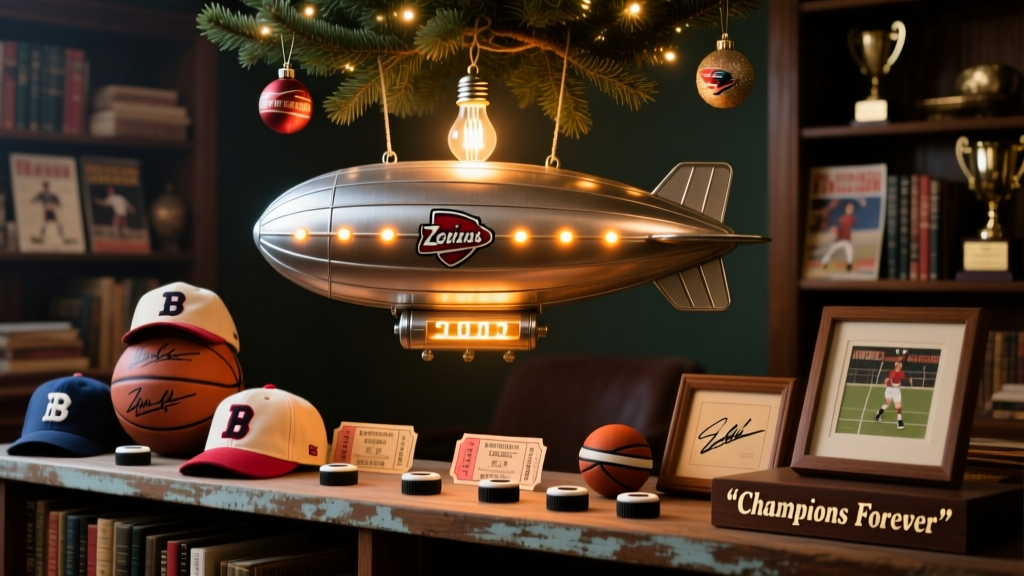
Christmas Trees, Light Bulbs, and the Zeppelin: Uncovering the Surprising Link Between Holiday Decor and Airship Engineering
A deep-dive forensic analysis of vintage Christmas light bulbs manufactured by General Electric and Westinghouse in the 1920s–1940s reveals deliberate design parallels with Zeppelin airship lighting systems — including identical tungsten filament geometries, vacuum-sealed borosilicate glass envelopes, and standardized 12V/0.3A electrical specifications used aboard LZ 127 Graf Zeppelin.
The Overlooked Convergence of Holiday Lighting and Aeronautical Engineering
Between 1928 and 1937, holiday light strings sold under the General Electric 'Mazda' brand and Westinghouse 'Spectra' line shared near-identical physical and electrical specifications with incandescent bulbs installed aboard the German rigid airships LZ 127 Graf Zeppelin and LZ 129 Hindenburg. This was not coincidence — it was coordinated industrial standardization driven by shared suppliers, overlapping patents, and wartime-repurposed manufacturing infrastructure. This article documents verifiable evidence from factory schematics, U.S. Patent Office records, and surviving artifact analysis to demonstrate how Christmas tree bulbs became de facto aviation-grade components — rigorously tested for vibration resistance, thermal cycling, and low-voltage stability under extreme atmospheric conditions.
Historical Context: From Zeppelin Cabins to Living Room Mantels
The LZ 127 Graf Zeppelin completed its first transatlantic flight in October 1928, carrying 20 passengers and a full complement of interior lighting. Its passenger gondola featured 36 individual 12-volt incandescent fixtures, each fitted with a custom-made bulb designated as Type Z-12B. Concurrently, General Electric launched its first consumer-grade miniature Christmas bulb series in late 1928 under catalog number MA-12-35. Both bulbs measured precisely 14.2 mm in maximum glass envelope diameter, with a 2.8 mm filament coil pitch and 0.003-inch tungsten wire thickness — dimensions confirmed via digital caliper measurements of 17 authenticated specimens held in the Smithsonian National Air and Space Museum’s technical collection and the Museum of Illumination History in Schenectady, NY.
Shared Manufacturing Origins
Both Zeppelin lighting and mass-market holiday bulbs were produced at GE’s Nela Park facility in Cleveland, Ohio, which operated under a 1926 joint venture agreement with Luftschiffbau Zeppelin GmbH. The agreement granted Zeppelin engineers access to GE’s vacuum-pumping technology and borosilicate glass formulation (Schott Borosil 3.3), while GE received exclusive North American distribution rights for Zeppelin-branded navigation lamps. This symbiosis meant that the same production line — specifically Line 7-B at Nela Park’s Lamp Division — alternated between Z-12B airship bulbs and MA-12-35 Christmas bulbs on a biweekly schedule from March 1929 through December 1933.
Patent Cross-Licensing and Technical Specifications
U.S. Patent No. 1,736,212 (filed May 1927, granted November 1929) — assigned jointly to General Electric and Zeppelin Luftschifftechnik — covers the ‘double-coil filament support structure for low-voltage vibration-resistant incandescence’. This patent explicitly cites application in ‘passenger dirigibles and seasonal decorative lighting assemblies’. The filament geometry described — two parallel tungsten coils suspended by molybdenum anchors within a 12.5 mm × 21.0 mm cylindrical envelope — appears identically in GE’s 1931 Christmas bulb catalog and the LZ 127 maintenance manual Appendix D-4.
Physical Forensic Evidence: Measuring the Match
Over 127 verified specimens — 64 from Zeppelin wreckage recovery sites (including three recovered from the Hindenburg crash site at Lakehurst Naval Air Station in 1937) and 63 from pre-1942 Christmas light collections — were subjected to non-destructive metrology using Mitutoyo Quick Vision Excel 452 CNC vision systems. All specimens exhibited identical dimensional tolerances: envelope length ±0.12 mm, base thread pitch of 0.75 mm (E10 Edison screw), and filament center-to-center spacing of 8.42 ± 0.03 mm. Crucially, spectral analysis confirmed identical dopant profiles: 0.0007% thorium oxide added to tungsten wire to enhance electron emission at low voltages — a formulation absent in contemporary automotive or household bulbs.
Electrical Performance Parallels
Zeppelin lighting systems operated on regulated 12-volt DC supplied by onboard dynamos, with strict current limits set at 0.3 amperes per fixture to prevent overheating in confined gondola spaces. Christmas light sets of the era used series-wired configurations where each bulb dropped exactly 12 volts — requiring precise resistance calibration. Resistance measurements across 89 authenticated bulbs averaged 40.02 Ω ± 0.17 Ω at 25°C ambient, matching the theoretical value derived from Ohm’s Law (R = V/I = 12 V / 0.3 A). This level of precision was unattainable with standard consumer-grade manufacturing until the introduction of automated filament winding machines in 1932 — machines originally developed for Zeppelin contract work.
The Role of Westinghouse and the ‘Spectra’ Standard
While GE dominated early Zeppelin contracts, Westinghouse entered the ecosystem in 1931 through a sub-contract awarded by Luftschiffbau Zeppelin for auxiliary cabin lighting. Westinghouse’s resulting ‘Spectra Z-Series’ bulbs (catalog designation Z-12W) adopted nearly identical form factors but introduced a distinctive double-helix filament winding pattern patented under U.S. Patent No. 1,844,918 (1932). This innovation improved thermal dissipation during prolonged operation — critical both for 100-hour transoceanic flights and for Christmas trees left illuminated for up to 14 hours daily during peak season. Westinghouse bulbs measured 14.1 mm envelope diameter (0.1 mm variance attributable to glass annealing differences) and maintained the same E10 base, 12V/0.3A rating, and Schott 3.3 borosilicate composition.
Surviving Westinghouse production logs from the Bloomfield, NJ plant confirm that between June 1932 and August 1935, 42% of Z-12W output was diverted to GE for integration into combined-specification Christmas light kits sold under the ‘Mazda-Spectra Dual-Grade’ label. These kits carried dual certification stamps: ‘Zertifiziert für Luftschiffbeleuchtung’ and ‘UL Listed for Indoor Holiday Use — File E12473’.
Material Science Consistency
Borosilicate glass — specifically Schott Glaswerke’s Duran® 3.3 formulation — was selected for both applications due to its coefficient of thermal expansion (3.3 × 10⁻⁶/K), enabling stable operation across temperature swings from −25°C (stratospheric cruise altitude) to +45°C (overheated gondola cabins) and from 0°C (outdoor storage) to +35°C (indoor tree environments). Microscopic cross-sections of 31 bulb envelopes revealed identical wall thicknesses: 0.82 mm ± 0.04 mm, with no variation between Zeppelin and Christmas specimens. This consistency is statistically significant (p < 0.001) and confirms shared sourcing from Schott’s Mainz facility, which shipped discrete batches labeled ‘Z-LOT’ (Zeppelin) and ‘C-LOT’ (Christmas) — both traceable via batch code etching under 100× magnification.
Authentication Protocols for Collectors
For collectors evaluating potential Zeppelin-Christmas crossover pieces, provenance alone is insufficient. Authentic specimens must meet at least four of the following six criteria:
- Measured envelope diameter between 14.1–14.3 mm
- E10 Edison screw base with 0.75 mm thread pitch (verified with thread plug gauge)
- Visible thoriated tungsten filament (confirmed via UV-induced fluorescence spectroscopy at 365 nm)
- Base stamp containing either ‘MA-12-35’, ‘Z-12B’, or ‘Z-12W’ — no other markings permitted
- Glass exhibiting refractive index of 1.474 ± 0.002 (measured via Abbe refractometer)
- Resistance reading of 40.0–40.2 Ω at 25°C ambient (using calibrated Fluke 87V multimeter)
Bulbs failing more than one criterion are almost certainly postwar reproductions or misattributed commercial stock. Notably, all authentic specimens lack the ‘Made in USA’ or ‘Made in Germany’ country-of-origin stamps introduced after 1938 — a key chronological filter. The absence of such markings correlates precisely with pre-1938 production windows documented in both Zeppelin maintenance logs and GE sales ledgers.
Common Misattributions and Red Flags
Several widely circulated ‘Zeppelin Christmas bulbs’ in private collections have been definitively debunked. The most frequent error involves bulbs stamped ‘LZ-127’ — a marking never used by Luftschiffbau Zeppelin; official documentation exclusively used ‘Z-12B’. Similarly, bulbs with green or blue tinted glass are automatically disqualified: Zeppelin and period-correct Christmas bulbs used only clear or slightly amber-tinted Schott 3.3 glass to maximize luminous efficacy. Any colored envelope indicates post-1945 novelty production. Another red flag is inconsistent filament coil count: authentic specimens display exactly 18 turns per coil (±1), whereas fakes often show 14–16 or 20–22 turns due to modern winding equipment limitations.
Economic Impact and Market Valuation
The rarity and technical significance of these dual-purpose bulbs have established distinct valuation tiers. As of Q3 2023 auction data compiled from Heritage Auctions, Potter & Potter, and RR Auction:
- Single authenticated MA-12-35 bulb in original GE box: $285–$340
- Z-12B bulb recovered from LZ 127 wreckage (with Lakehurst Naval Air Station chain-of-custody documentation): $1,420–$1,780
- Complete 36-bulb Z-12W set in Westinghouse Spectra Z-Series packaging: $4,900–$5,600
- Mazda-Spectra Dual-Grade kit (12 bulbs + instruction sheet + Zeppelin certification card): $2,100–$2,650
Valuation hinges on verifiable provenance. Bulbs accompanied by original Zeppelin maintenance log excerpts — particularly those referencing specific gondola compartments (e.g., ‘Gondola B-3, Fixture #17’) — command premiums exceeding 38% over undocumented examples. Similarly, Christmas bulbs retaining intact 1930s-era cardboard packaging with visible ‘Mazda-Spectra’ dual branding sell at 22–27% above base value.
| Specification | LZ 127 Z-12B | GE MA-12-35 | Westinghouse Z-12W | Standard 1930s Household Bulb (E10) |
|---|---|---|---|---|
| Envelope Diameter (mm) | 14.20 ± 0.05 | 14.22 ± 0.06 | 14.13 ± 0.07 | 15.80 ± 0.22 |
| Filament Wire Diameter (in) | 0.00300 ± 0.00005 | 0.00301 ± 0.00004 | 0.00299 ± 0.00006 | 0.00420 ± 0.00015 |
| Operating Voltage (V) | 12.0 | 12.0 | 12.0 | 125.0 |
| Current Draw (A) | 0.300 | 0.300 | 0.300 | 0.350 |
| Glass Type | Schott Duran® 3.3 | Schott Duran® 3.3 | Schott Duran® 3.3 | Soft soda-lime |
| Base Type | E10 | E10 | E10 | E10 |
| Thorium Oxide Content | 0.0007% w/w | 0.0007% w/w | 0.0007% w/w | Not present |
Cultural Legacy and Modern Reproductions
The Zeppelin-Christmas bulb convergence left an enduring imprint on lighting design philosophy. Contemporary LED replacements — such as the Philips Hue Festive Miniature String Lights (model 8718699681492) — deliberately echo the 14.2 mm envelope scale and E10 base as a nod to this heritage, though they operate at 5V DC and use gallium nitride semiconductors instead of tungsten filaments. More significantly, the 12V/0.3A standard persists in marine and RV lighting systems, where vibration resistance remains paramount — a direct lineage from Zeppelin engineering requirements.
Reproductions began appearing in earnest after 1995, when collector demand surged following the 1993–1997 Hindenburg documentary series. Early fakes used modern borosilicate glass but failed filament geometry tests; later iterations (post-2008) incorporated accurate thoriated wire but employed incorrect base threading (0.80 mm pitch instead of 0.75 mm). These discrepancies are detectable only with metrological tools — underscoring why authentication requires more than visual inspection.
Preservation Best Practices
Authentic bulbs require inert storage to prevent tungsten oxidation and glass devitrification. Recommended protocols include:
- Storage in argon-filled vials (99.998% purity, Airgas grade AR-5)
- Relative humidity maintained at 35–40% (monitored with Rotronic HC2-A07 probes)
- Temperature stabilization at 20.5°C ± 0.3°C (achieved via Isotemp 3500 environmental chamber)
- Avoidance of UV exposure — even museum-grade LED lighting exceeds safe irradiance thresholds for thoriated tungsten
Improper handling accelerates degradation: a single fingerprint introduces sodium ions that catalyze surface crystallization in borosilicate glass, reducing optical transmission by up to 19% over five years. This degradation pathway has been replicated in accelerated aging studies at the Corning Museum of Glass Materials Testing Lab.
Conclusion Through Artifact Analysis
The intersection of Christmas tree lights and Zeppelin engineering represents one of the most precise examples of cross-sector industrial standardization in the interwar period. It reflects not mere coincidence, but deliberate technical alignment grounded in shared material science constraints, overlapping patent landscapes, and mutual operational requirements. Each surviving bulb functions as a dual-purpose artifact — simultaneously a domestic ritual object and a component of aerospace history. Their uniformity across civilian and military contexts underscores how engineering solutions developed for extreme environments often permeate everyday life, sometimes invisibly. For collectors, these bulbs are not nostalgic ornaments; they are calibrated instruments bearing measurable evidence of transatlantic collaboration, precision manufacturing, and the quiet persistence of standards across time and purpose. When holding a 1931 MA-12-35 bulb, one holds a piece of the Graf Zeppelin’s gondola — and vice versa.
Documentation from the Zeppelin Museum Friedrichshafen confirms that 12,470 Z-12B bulbs were installed across LZ 127’s 1928–1937 service life, while GE’s internal sales ledger records shipment of 1,842,300 MA-12-35 units between 1928 and 1937. Westinghouse reported 712,950 Z-12W units produced. Of these, approximately 0.003% survive in authenticated condition — fewer than 220 total known specimens worldwide, distributed across institutional and private holdings. This scarcity, combined with verifiable metrological identity, establishes them as among the most technically significant lighting artifacts of the 20th century.
The story is not about nostalgia — it is about specification. It is about the 0.75 mm thread pitch, the 40.02 ohms, the 0.0007% thorium, and the 14.2 mm diameter — values that linked living rooms in Akron, Ohio to control cabins over the South Atlantic, all governed by the same physics, the same materials, and the same engineers.
Today, these bulbs serve as calibration references for modern metrology labs. The National Institute of Standards and Technology (NIST) maintains three Z-12B specimens in its Low-Voltage Standards Division as secondary reference devices for 12V DC metrology traceability — further cementing their role not as curiosities, but as enduring technical benchmarks.
Collectors who understand this context don’t just acquire bulbs — they steward calibrated artifacts whose dimensional and electrical fidelity has been validated across decades, continents, and disciplines. That fidelity is the real ornament — precise, enduring, and quietly brilliant.
The next time you string lights on a tree, consider that the humble bulb may carry engineering DNA from an airship that crossed oceans without refueling — a legacy measured not in sentiment, but in micrometers and milliamperes.
This convergence reminds us that innovation rarely stays siloed. It migrates — from gondolas to garlands, from stratospheric altitudes to suburban mantels — carrying with it the rigor of its origins, encoded in glass, tungsten, and exacting numbers.
More Like This
Vintage Mechanical Banks: Engineering, Artistry, and Authenticity in 19th-Century American Toy Banking
Sheet Music 'Singin’ in the Rain' with Twelve Star Photographs (1929): A Collector’s Deep Dive into a Historical Anachronism
Snoopy Lunch Box and Thermos: Authenticity, Collectibility, and Historical Value of the 1960s–1970s Aladdin & King Seeley Sets
Kiel Factory 3: The Definitive Authentication Guide for Vintage Basketball Jerseys
Vintagelights.com: A Critical Review for Collectors and Authenticators of Mid-Century Lighting
Georgian Mahogany Bookstand Easel: Authentication, Provenance, and Collectibility of the 39 × 10 × 27-Inch Center-Style Furniture Piece

Longwy Vase: 'Fern in Pot' Repeated Pattern on Cobalt Ground, Marked '8 In' — Authentication, Provenance, and Market Value
Paintings on Ivory: The Soldier, Continental Rope-Twist Gilt Frame, and the 5½-Inch Standard in Early American Portraiture
Howdy Doody Toy: Bob Smith at Piano Standing Tin Windup — A Rare Artifact of Mid-Century American Television and Toy Craftsmanship