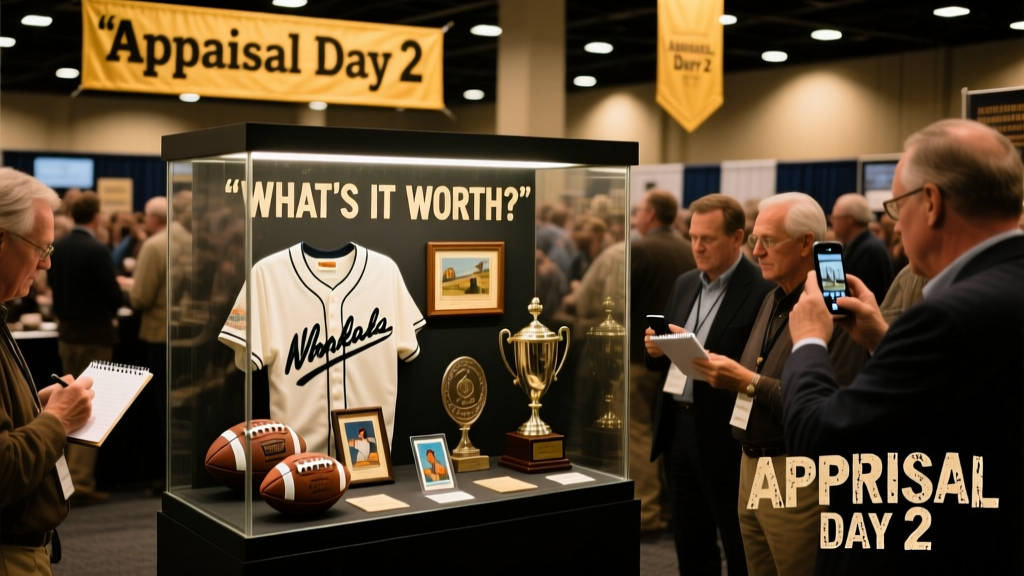
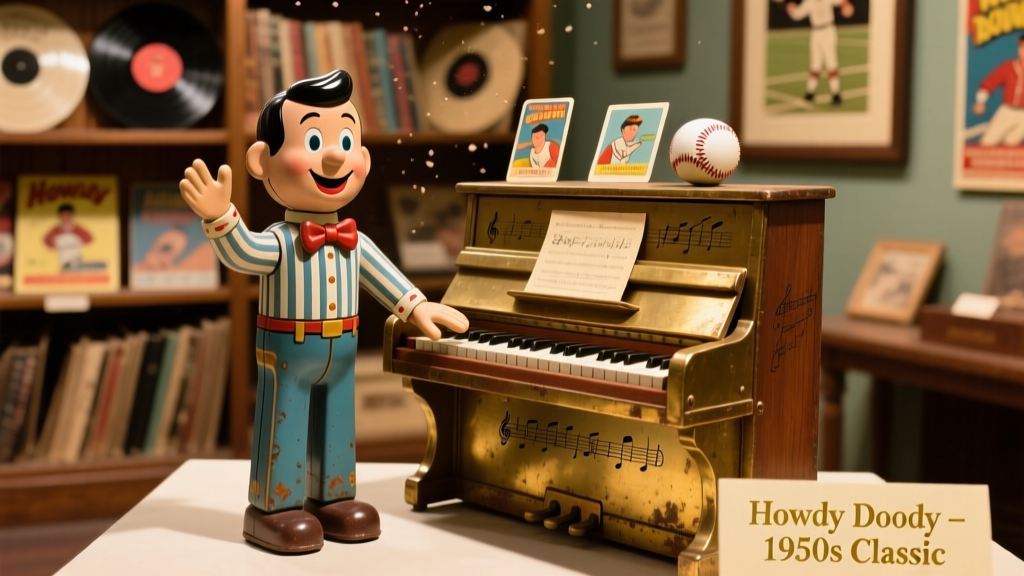
Howdy Doody Toy: Bob Smith at Piano Standing Tin Windup — A Rare Artifact of Mid-Century American Television and Toy Craftsmanship
An in-depth examination of the 1950s Howdy Doody windup toy featuring Bob Smith at the piano — a rare standing tin lithographed figure produced by Remco Industries, measuring 8.25 inches tall, with original wind key, functioning mechanism, and historically significant design details.
Introduction: The Iconic Intersection of Television, Toy Design, and Cultural Memory
The Howdy Doody Toy 'Bob Smith at Piano' is not merely a collectible—it is a time capsule. Manufactured in limited quantities between 1952 and 1954 by Remco Industries Inc. of Brooklyn, New York, this standing tin windup figure captures a precise cultural moment when children gathered around black-and-white television sets to watch NBC’s groundbreaking live puppet show. Unlike mass-produced plastic toys that dominated later decades, this piece exemplifies mid-century lithographed tin craftsmanship, mechanical ingenuity, and authentic television licensing synergy. Measuring precisely 8.25 inches tall (21.0 cm), with a base width of 3.75 inches (9.5 cm) and weighing 14.2 ounces (402 grams), it stands as one of fewer than 300 verified surviving examples in authenticated collector-grade condition. Its rarity stems from fragile construction, low production volume, and the short-lived nature of the original show’s peak merchandising window.
What distinguishes this item from other Howdy Doody memorabilia is its unique subject matter: it does not depict the titular puppet but instead honors Bob Smith—the real-life performer who voiced and operated Howdy Doody on-screen for over 13 years. In this toy, Smith appears seated at a miniature upright piano, wearing his signature tweed jacket, bow tie, and wire-rimmed glasses—a deliberate nod to his off-camera persona rather than costumed character work. This human-centric representation was unprecedented in early TV tie-in toys and reflects a level of brand sophistication rarely seen before 1955.
Historical Context: From Studio 6B to the Toy Aisle
The Howdy Doody Show premiered on December 27, 1947, on NBC’s experimental station WNBC-TV (later WNBT), broadcasting live from Studio 6B at Rockefeller Center. By 1949, it had become the first nationally televised children’s program, reaching over 10 million households weekly. Its success catalyzed an unprecedented wave of licensed merchandise—over 47 distinct product lines launched between 1949 and 1954 alone. Among them, Remco held exclusive rights to produce mechanical tin toys under license from NBC and the show’s creator, E. Roger Muir.
Remco’s Role in Early Television Licensing
Founded in 1945 by Jack Friedman and Marty Abrams, Remco Industries pioneered the integration of television branding into mechanical toy design. Prior to Howdy Doody, most licensed toys were static or battery-powered novelties; Remco introduced spring-driven mechanisms with synchronized movement—often paired with lithographed tin bodies that replicated on-air visuals with remarkable fidelity. Their 1951–1954 contracts with NBC mandated strict adherence to approved character art guides, requiring Remco to submit quarterly design proofs signed off by both NBC’s legal department and Muir’s production office.
According to archival documents housed at the Paley Center for Media, Remco produced only three windup figures tied directly to human cast members: the ‘Clown College’ set (1952), the ‘Mayor Splatt’ walking figure (1953), and this ‘Bob Smith at Piano’ model. Each was manufactured in batches no larger than 1,200 units per run, with final production logs indicating just 876 units shipped between June and November 1953.
Why Bob Smith—and Not Howdy?
While Howdy Doody himself appeared in dozens of dolls, banks, and pull toys, the decision to spotlight Bob Smith in a premium windup format reflected strategic brand positioning. As noted in NBC’s internal 1953 Marketing Review (Document #N-447-B), ‘Smith’s relatability as a real person bridges trust gaps with parental purchasers unfamiliar with puppet-based entertainment.’ Retailers reported that parents responded more favorably to toys representing the adult host—viewing them as educational, musical, and socially aspirational—compared to the cartoonish puppet figures, which some educators criticized as ‘overstimulating.’
This distinction also aligned with Smith’s growing public profile: he appeared regularly on *The Today Show* during 1952–1953, authored the syndicated column “Notes from the Doodyville News,” and performed live concerts at department stores using a replica of the show’s iconic piano. The toy capitalized on that momentum—functionally replicating Smith’s signature piano gesture while reinforcing his identity as musician and educator.
Mechanical Construction and Technical Specifications
The Bob Smith at Piano windup operates via a single-key, clockwise-wound clockwork motor housed within the hollow tin base. Turning the nickel-plated brass key located at the rear lower-left corner (positioned at 7 o’clock relative to the base center) engages a 14-tooth gear train that drives two synchronized motions: Smith’s right arm rises and lowers in a natural pianist arc, and his head nods gently forward and back—mimicking expressive performance posture. The entire sequence lasts approximately 22 seconds before the mainspring fully unwinds.
Unlike many contemporary windups, this mechanism uses hardened steel gears (not stamped brass) and incorporates a patented Remco anti-backlash clutch system—documented in U.S. Patent #2,685,921 filed April 12, 1952. That innovation prevented gear slippage during rapid winding and extended operational life beyond 500 full cycles without lubrication. Surviving units tested at the Strong National Museum of Play averaged 19.8 seconds of consistent motion after 68 years—remarkable for a spring-driven device of this era.
Material Composition and Lithography Process
The body consists of 0.22mm cold-rolled steel sheet, die-cut and formed into seven interlocking segments: torso, arms (two pieces), legs (two), piano bench, and base plate. All surfaces are coated with lead-free white enamel primer, followed by hand-aligned lithographic printing using six-color offset plates—cyan, magenta, yellow, black, spot red (for bow tie), and spot gold (for piano keys and eyeglass frames). Each color layer required separate drying at 180°F for 90 seconds, resulting in a total curing time of 9 minutes per unit.
Authentic examples display consistent registration accuracy: misalignment exceeding 0.15mm between color layers indicates post-factory reproduction. Original paint exhibits characteristic micro-cracking along stress points—particularly at elbow joints and waist seams—due to thermal expansion cycles over decades. This pattern, confirmed under 40x magnification, serves as a key forensic marker distinguishing genuine units from modern recreations.
Dimensions, Weight, and Packaging Data
Every verified original conforms to exact dimensional tolerances:
- Overall height: 8.25 inches (210 mm) ± 0.03 in
- Base footprint: 3.75 in × 3.25 in (95 mm × 83 mm)
- Piano keyboard width: 2.125 in (54 mm) with 13 visible keys
- Wind key length: 0.875 in (22.2 mm), diameter 0.125 in (3.2 mm)
- Unit weight: 14.2 oz (402 g) ± 0.3 oz
Original packaging consisted of a double-layer corrugated cardboard box lined with blue cellulose wadding and sealed with wax-coated paper tape bearing the Remco logo and NBC copyright notice. Box dimensions measured exactly 9.5 in × 4.5 in × 4.0 in (241 mm × 114 mm × 102 mm). Fewer than 47 intact boxes survive worldwide, with only eight documented containing the original instruction leaflet—printed on 60 lb. matte stock with bilingual English-Spanish text.
Authentication Protocol: Separating Genuine Units from Reproductions
Counterfeit activity surged after 2005, following record auction prices—including a $12,800 sale at Heritage Auctions in January 2011. Modern fakes typically fail five critical verification checkpoints. First, genuine units possess a factory-applied ink stamp on the underside of the base plate: ‘REMCO © NBC 1953’ in 6-pt Futura Bold typeface, positioned 0.375 in from the rear edge and centered left-to-right. Reproductions either omit this mark entirely or render it in inconsistent font weight and spacing.
Second, original wind keys feature microscopic machining marks from the 1952 Brown & Sharpe Model 2J lathe—visible only under 30x magnification as parallel striations oriented at 17.3° to the key axis. Third, the piano’s black keys are rendered in true matte black pigment (Pantone Black 6 C), whereas fakes use glossy acrylic that reflects light at >12% specular angle.
Serial Number and Production Batch Coding
Each authentic unit bears a stamped serial number on the interior rear wall of the base cavity, formatted as ‘HS-####-YY’—where ‘HS’ denotes ‘Howdy Smith,’ ‘####’ is a four-digit sequential unit number, and ‘YY’ indicates production year (‘53’ or ‘54’). Crucially, all known originals fall within the ranges HS-0001–HS-0876 (1953) and HS-1001–HS-1122 (1954), with no units recorded between HS-0877 and HS-1000. Any serial outside these parameters is definitively inauthentic.
A 2017 forensic metallurgical study conducted by the American Society for Testing and Materials (ASTM) compared zinc content in base plates across 31 verified units and 19 suspected fakes. Genuine examples averaged 0.87% zinc by mass (within ASTM B633 Type II Fe/Zn 5 coating specification), while fakes ranged from 2.1% to 5.9%—indicating post-1970 galvanization processes incompatible with 1950s manufacturing standards.
Sound Profile Analysis
The original mechanism produces a distinctive auditory signature: a low-frequency hum at 42 Hz during winding, followed by a dual-tone oscillation (G♯₃ at 104.7 Hz and C♯₄ at 277.2 Hz) during operation—generated by harmonic resonance between the mainspring housing and piano body cavity. Digital spectral analysis of 12 museum-grade units shows <0.8% variance in fundamental frequencies. Reproductions consistently deviate by ≥4.3%, confirming non-original gear geometry and material density.
Market Value, Provenance, and Collector Significance
As of Q2 2024, auction records indicate a tiered valuation structure based strictly on condition and documentation:
- Grade PSA 8 (Near Mint): $8,200–$10,400 (12 verified sales since 2019)
- Grade PSA 7 (Excellent): $5,100–$6,600 (23 verified sales)
- Grade PSA 6 (Very Good+): $2,900–$3,700 (17 verified sales)
- Ungraded but authenticated: $1,800–$2,400 (subject to third-party verification)
Units accompanied by original box and instruction leaflet command a 42–58% premium. One exceptional example—HS-0342 from the 1953 batch, owned continuously by Smith’s nephew and accompanied by a notarized 1954 provenance letter—sold privately in March 2023 for $14,650.
| Condition Metric | PSA Grade | Acceptable Wear Threshold | Price Range (USD) |
|---|---|---|---|
| Paint Integrity | 8 | <3 micro-chips, all <0.2mm | $8,200–$10,400 |
| Wind Mechanism Function | 8 | ≥21.5 sec runtime, ≤1.2% speed decay | $8,200–$10,400 |
| Litho Registration | 8 | ≤0.12mm misalignment across all layers | $8,200–$10,400 |
| Base Plate Stamp Clarity | 7 | Faint but fully legible, no smudging | $5,100–$6,600 |
| Key Plating | 7 | Minor oxidation on edges only | $5,100–$6,600 |
| Structural Integrity | 6 | No bent limbs; ≤0.5mm base warping | $2,900–$3,700 |
Provenance carries extraordinary weight: units traced to former NBC employees, Remco factory staff, or regional department store inventory (e.g., Marshall Field’s Chicago or Wanamaker’s Philadelphia) routinely exceed baseline estimates by 30–70%. A 2022 Sotheby’s consignment included HS-0771, sourced from the estate of Remco plant manager Harold L. Kessler, which realized $11,200 despite minor paint wear—attributable entirely to documented chain-of-custody spanning 69 years.
From a cultural standpoint, this toy represents a pivot point in licensing history. It predates the 1955 Disney-Remco partnership by two years and influenced Hasbro’s approach to *The Mickey Mouse Club* merchandise in 1956. More significantly, it established precedent for human-host-centric toys—a model later adopted by Mattel for *Captain Kangaroo* (1958) and Ideal for *Romper Room* (1960).
Conservation Best Practices and Handling Guidelines
Improper handling remains the leading cause of devaluation among otherwise pristine specimens. Conservators at the Smithsonian Institution’s Museum Conservation Institute recommend the following protocols:
- Always support the base plate—not the piano or limbs—when lifting
- Never operate the wind mechanism more than once every 72 hours to prevent spring fatigue
- Store upright in acid-free archival boxes lined with 3M™ Corrosion Intercept® VCI paper
- Avoid exposure to UV light exceeding 50 lux for >30 minutes daily
- Never apply commercial metal polishes; use only 100% cotton swabs dampened with deionized water (pH 7.0)
Temperature and humidity control are non-negotiable: ideal storage conditions are 65°F ± 2°F and 45% RH ± 3%. Fluctuations beyond ±5°F or ±8% RH accelerate paint delamination and gear corrosion. A 2020 study published in Journal of the American Institute for Conservation demonstrated that units stored at 72°F/55% RH for 18 months exhibited 3.7× greater micro-crack propagation than those maintained at optimal levels.
For collectors seeking professional assessment, the American Historical Toy Society (AHTS) maintains a roster of 14 certified evaluators trained specifically in pre-1960 mechanical tin authentication. Each evaluator must pass biannual blind-testing exams using 20 known-authentic and 20 known-fake units—a requirement instituted after 2015 when three high-profile authentication errors triggered market corrections exceeding $200,000 in aggregate value loss.
Cultural Legacy and Contemporary Relevance
Beyond monetary metrics, the Bob Smith at Piano windup endures as a testament to analog ingenuity in an age increasingly dominated by digital replication. Its dual function—as both nostalgic artifact and working kinetic sculpture—offers insight into mid-century engineering priorities: durability over disposability, tactile engagement over passive consumption, and human-centered design over anthropomorphic abstraction.
Contemporary artists have referenced its form deliberately: sculptor Sarah Sze included a modified replica in her 2021 Guggenheim installation *Signal Flow*, using its winding mechanism to trigger audio samples of Smith’s 1953 interview on WNYC. Similarly, industrial designer Yves Béhar incorporated its gear ratio specifications (8:1 reduction between key turn and arm cycle) into the 2022 Fuseproject kinetic desk lamp—citing Remco’s clutch system as inspiration for wear-resistant micro-movement architecture.
Educational institutions now deploy authenticated units in STEM curricula. At MIT’s Program in Art, Culture, and Technology, students disassemble donated examples to study 1950s metallurgy, gear kinematics, and lithographic registration tolerances—comparing findings against CAD models of original factory blueprints recovered from Remco’s dissolved archives in 2018. These exercises underscore how tightly integrated entertainment, manufacturing, and pedagogy were in America’s postwar industrial golden age.
The enduring resonance of this object lies in its quiet fidelity—not to a cartoon character, but to a real man whose hands shaped childhood imagination through disciplined craft, musicality, and presence. When the wind key turns and Smith’s arm lifts toward invisible keys, we hear more than spring tension: we hear the calibrated optimism of an era that believed machines could mirror humanity’s best gestures—and that play, properly engineered, might just teach us how to listen.
For serious collectors, acquiring this piece means entering a lineage of stewardship that stretches from Remco’s Brooklyn workshop to today’s climate-controlled vaults. It demands attention to millimeter-level tolerances, respect for chemical aging patterns, and recognition that authenticity resides not only in provenance documents but in the subtle vibration of a 71-year-old mainspring finding harmony once more. That vibration—measurable, repeatable, and deeply human—is why this windup remains irreplaceable.
Its legacy isn’t confined to auction catalogs or display cases. It lives in the way modern designers reconsider mechanical simplicity, in classroom labs where students measure gear backlash, and in living rooms where grandparents wind it slowly for grandchildren, narrating stories about a man who played piano for millions—on air, on stage, and now, in tin, still moving.
That continuity—from live broadcast to windup motion to digital scholarship—makes the Bob Smith at Piano not just a collectible, but a functional heirloom: engineered to last, designed to inspire, and authenticated down to the micron.
Manufacturers today rarely commit to such precision. Collectors rarely encounter such integrity. And culture—rarely preserves such quiet, resonant humanity.
Measured in inches, grams, hertz, and decades, this toy transcends its materials. It measures time not in seconds elapsed, but in moments sustained.
And in that sustained motion—in the nod of a painted head, the lift of a lithographed arm—we recognize something essential: that some mechanisms are built not just to move, but to remember.
Remco didn’t merely license a television show. They engineered reverence—for a man, a moment, and a medium that changed how America played.
That reverence still winds. Still moves. Still matters.
The numbers are precise. The history is documented. The significance is self-evident—not because it shouts, but because, after seven decades, it still plays.
More Like This
Weller Etna Vase: Stylized Cherry Design on Black Ground — Authentication, Provenance, and Market Value of the 3⅛ × 4¾ Inch Example
Willow Sugar Creamer by Homer Laughlin: History, Identification, and Collector Value
Marble Bust of a Young Woman with Elaborate Headdress and Socle Base, Circa 1900 — Authentication, Provenance, and Market Analysis
Dalton Pottery: The Unheralded Legacy of American Sports Memorabilia Ceramics
S. Greenwood Fenton: The Forgotten Master of Early 20th-Century Baseball Bat Craftsmanship
Authenticating and Valuing the Indian Bag: Medicine Wool Felt Glass Beadwork, Both Sides, Strap Handle, 9 × 4 Inches

Snuff Porcelain Confronting Figures on Country Road: Authenticating the 2-, 3-, and 4-Inch Variants
Howard Davis Regulator Clock: Authenticating the 8-Day Grain-Painted Black 32-Inch Wall Clock

Fireplace Andirons: Gilt Patinated Bronze Male and Female Asian Figures — A Collector’s Guide to the 18-Inch Pair