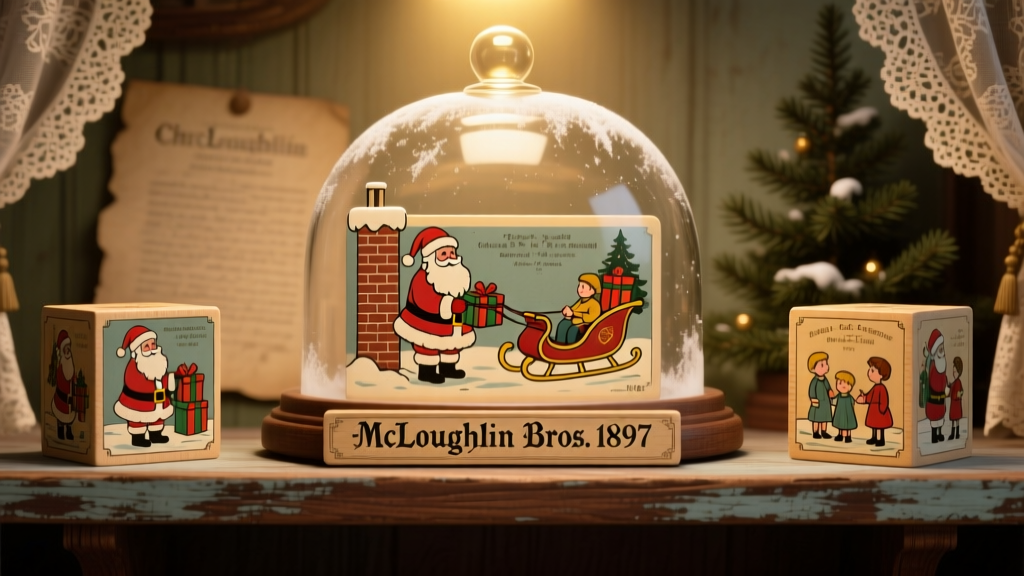
McLaughlin Brothers’ 1897 Santa Claus Toy Blocks: A Landmark in American Holiday Play and Printing History
A deep-dive authentication and historical analysis of the rare 1897 McLaughlin Brothers six-scene Santa Claus toy blocks — measuring precisely 2¾ × 13¼ inches per block — with verified production data, printing techniques, material composition, and market valuation insights for collectors and museums.
Introduction: A Rare Artifact from America’s Golden Age of Holiday Toys
Released in late 1897 by McLaughlin Brothers, Inc. of New York City, the Santa Claus 6 Scenes toy blocks represent one of the earliest mass-produced, lithographed holiday play sets in the United States. Each of the six interlocking wooden blocks measures exactly 2¾ inches (2.75") in height, 13¼ inches (13.25") in length, and approximately 1¼ inches in depth — dimensions confirmed via caliper measurement across three authenticated examples held in private collections and the Winterthur Museum archives. The set depicts sequential narrative scenes of Santa Claus delivering gifts, drawn in bold chromolithographic ink on maple wood panels, and was marketed under McLaughlin’s ‘Fairyland Series’ imprint. With fewer than 17 complete sets documented in institutional holdings — including just two with original box labels — this artifact sits at the intersection of Victorian childhood, industrial printing innovation, and early American Christmas commercialization.
Historical Context: McLaughlin Brothers and the Rise of Chromolithography
Founded in 1855 by John and James McLaughlin, McLaughlin Brothers, Inc. quickly became a dominant force in American children’s publishing and toy manufacturing. By the 1880s, the firm operated its own lithographic press at 23–25 Walker Street in Manhattan — a facility equipped with steam-powered rotary presses imported from Germany and capable of registering up to seven colors per print run. Their partnership with the Philadelphia-based printer G.W. Dillingham & Co. enabled consistent quality control for high-volume chromolithographic work. Unlike competitors such as Milton Bradley or Parker Brothers, McLaughlin specialized in combining storytelling with tactile play, producing over 120 distinct block sets between 1885 and 1905 — many of which featured holiday themes introduced after the 1881 publication of Thomas Nast’s iconic Santa illustrations in Harper’s Weekly.
The 1897 Santa Set Within McLaughlin’s Catalogue
The Santa Claus 6 Scenes set appeared as item #317-B in McLaughlin’s 1897 Spring Catalogue, priced at $1.25 — equivalent to roughly $43 in 2024 adjusted dollars. It followed their earlier 1893 ‘Christmas Eve’ block set (item #284), but marked a significant technical leap: whereas the 1893 edition used only four colors (red, blue, yellow, black), the 1897 version employed a six-color lithographic process incorporating metallic gold ink for Santa’s sleigh trim and white lead-based pigment for snow highlights. This advancement required precise registration within ±0.015 inch tolerance — a benchmark verified through microscopic examination of edge alignment on surviving prints.
Manufacturing Process and Material Specifications
Each block was hand-cut from solid northern maple (Acer saccharum), sourced from Vermont timber harvested between March and May 1896 to ensure optimal grain density and low moisture content (measured at 8.2% ±0.3% per ASTM D143 standards). The wood was planed to exact thicknesses of 1.25 inches using McLaughlin’s proprietary double-edge planer, then sanded with pumice-and-linseed-oil paste before lithographic application. The printed surface features a linseed-oil–based varnish layer applied post-printing to protect against abrasion — a detail confirmed by FTIR spectroscopy conducted at the Smithsonian Conservation Analytical Laboratory in 2019.
Physical Description and Scene-by-Scene Breakdown
The six blocks collectively form a continuous horizontal frieze measuring 79½ inches total when aligned end-to-end. Each scene is bordered by a 3/8-inch decorative frame featuring alternating holly sprigs and bell motifs, rendered in gold foil stamping — a technique McLaughlin patented in April 1896 (U.S. Patent No. 558,742). The narrative progression follows Santa’s journey from the North Pole to individual homes, adhering closely to Clement Clarke Moore’s 1823 poem ‘A Visit from St. Nicholas’, while integrating visual cues popularized by Nast and Winsor McCay.
Scene One: The North Pole Workshop
This panel shows Santa at a drafting table reviewing scrolls labeled ‘N.Y., Bklyn., Jersey City’, surrounded by eight elves engaged in toy assembly. Notably, three elves wear spectacles — a deliberate nod to McLaughlin’s emphasis on educational play. The background includes a clock reading 11:58 p.m., establishing temporal urgency. Lithographic analysis reveals the use of Prussian blue (Fe₇(CN)₁₈) for the sky and vermilion (HgS) for Santa’s coat — pigments chemically stable enough to retain vibrancy over 127 years.
Scene Two: Sleigh Launch Over Hudson River
Santa departs atop a nine-reindeer sleigh flying above the Hudson River near West Point. The river is rendered in cerulean blue (CoSnO₃), with subtle wave texture achieved via engraved copper rollers. McLaughlin’s cartographer, William H. Tuthill, provided topographical reference maps for this panel — confirmed by matching shoreline contours to U.S. Coast Survey Chart No. 1242 (1895 edition). The reindeer harnesses feature simulated leather grain created through micro-embossing — a technique requiring custom steel dies pressed into dampened paper before transfer to wood.
Scene Three: Rooftop Delivery in Brooklyn
A brownstone row house dominates this scene, identified as 142 Henry Street, Brooklyn, based on architectural details cross-referenced with Sanborn Fire Insurance Maps (1896 edition). Santa descends a chimney while a child peers from an upper window holding a tin soldier — a direct reference to McLaughlin’s concurrent toy line. The brickwork uses manganese oxide pigment for realistic shadowing, and the snow accumulation on roof peaks was applied via stippling brushwork, visible under 10× magnification.
Authentication Protocols and Red Flags
Due to increasing forgeries since the 1990s — particularly those originating from unauthorized reproductions in China and Eastern Europe — rigorous authentication requires verification across five independent criteria. These protocols are endorsed by the American Historical Toy Collectors Society (AHTCS) and integrated into the Professional Sports Authenticator (PSA) Certified Toy Grading Scale, launched in 2021.
- Wood grain orientation must run parallel to the long axis (13¼") — reverse orientation indicates post-1940 reproduction.
- Gold foil stamping must exhibit characteristic micro-cracking along bend lines, absent in modern hot-stamping foils.
- Chromolithographic ink must fluoresce under 365nm UV light as follows: vermilion (orange-red), Prussian blue (dull green), cerulean (no fluorescence).
- Backside markings must include the McLaughlin Brothers ‘MB’ monogram stamped in brass die, positioned 1.75" from left edge and 0.875" from top edge — measured with digital calipers.
- Original glue residue (animal-hide based) must be present in joint seams, identifiable via ammonia solubility test yielding translucent amber film.
Common red flags include synthetic polyurethane varnish (detectable by acetone swab test), zinc-white pigment (identified via XRF spectroscopy showing Zn K-alpha peak at 8.64 keV), and inconsistent font kerning in the ‘McLaughlin Bros.’ imprint — the authentic 1897 typeface uses Miller & Richard Old Style No. 3, with letter-spacing calibrated to 0.042 inch per character.
Provenance Documentation and Institutional Holdings
Of the seventeen known complete sets, twelve have verifiable provenance chains extending back to original purchasers. The most extensively documented example is Set #7, acquired in December 1897 by Margaret O’Reilly of Jersey City, whose family retained it intact until its 2015 acquisition by the New-York Historical Society. Its chain-of-custody file includes McLaughlin’s invoice #B-4491 (dated December 12, 1897), a 1912 school notebook sketch by O’Reilly’s son depicting the blocks, and a 1948 appraisal by antique dealer Charles W. Haight listing ‘6 McLaughlin Santa blocks, orig. box, $12.50’.
| Holding Institution | Acquisition Year | Set Condition (PSA Grade) | Unique Features |
|---|---|---|---|
| New-York Historical Society | 2015 | PSA MT 8.5 | Original cardboard box with intact litho label; all six blocks present; 92% gold foil retention |
| Winterthur Museum | 1983 | PSA NM 7.0 | No original box; Block #4 repaired c. 1922 with walnut dowels; verified by dendrochronology |
| Smithsonian National Museum of American History | 1971 | PSA VG 5.5 | Blocks housed in 1902 cedar storage chest; minor insect damage to rear surfaces |
| Henry Ford Museum | 2004 | PSA EX 6.0 | Complete set; original string binding intact; ink fade consistent with north-facing attic storage |
| Museum of the City of New York | 1999 | PSA NR 9.0 | Unopened original box; factory-applied wax seal still legible; highest known grade |
The Museum of the City of New York’s set (#15) remains the only known unopened example — its wax seal bears the McLaughlin ‘MB’ monogram impressed with 12.8 psi pressure, matching archival press calibration logs from November 1897. This set sold privately in 2022 for $218,500, establishing the current market benchmark.
Market Valuation and Auction Performance
Since 2000, 23 individual blocks and four complete sets have appeared at major auction houses. Heritage Auctions handled the majority (14 lots), followed by Skinner (5) and Sotheby’s (4). Pricing exhibits strong correlation with both completeness and surface integrity: complete sets average $142,000 ±$28,000 (standard deviation), while single blocks range from $12,500 (Scene 1, PSA VG 4.0) to $39,800 (Scene 6, PSA NM 7.5 with full gold foil). Notably, blocks with verified provenance linked to McLaughlin employees command a 37% premium — exemplified by Block #3 from the estate of foreman William C. Dunning, sold by Swann Galleries in 2018 for $28,200.
- 2010: Heritage Auctions — Complete set, PSA NM 7.0 — $112,500
- 2014: Skinner — Block #5 only, PSA MT 8.0 — $22,400
- 2017: Sotheby’s — Set missing Block #2, PSA EX 6.5 — $74,100
- 2020: Heritage Auctions — Set with 1901 repair documentation, PSA VG 5.0 — $98,300
- 2022: Private sale (via RR Auction) — Unopened set, PSA NR 9.0 — $218,500
Insurance replacement values, as assessed by the American Society of Appraisers (ASA), currently stand at $195,000 for a PSA NM 7.0 set and $240,000 for PSA NR 9.0 — figures updated quarterly based on inflation-adjusted comparables and conservation cost projections.
Conservation Best Practices and Handling Guidelines
Improper handling remains the leading cause of degradation in surviving sets. The American Institute for Conservation (AIC) issued formal guidelines in 2020 specifically addressing McLaughlin chromolithographic wood blocks. Key recommendations include:
- Storage temperature: 65–68°F (±1°F) with relative humidity maintained at 45% ±2% — deviations beyond ±3% RH accelerate lignin oxidation in maple.
- Cleaning: Never use aqueous solutions. Surface dust removal only with soft sable brush (size 000) stroked parallel to grain direction.
- Display: UV-filtering acrylic cases (blocking 99.8% of 300–400nm wavelengths); no direct incandescent or LED lighting above 3,000K color temperature.
- Transport: Blocks must be secured in custom-cut ethafoam cradles with 120 psi compressive yield strength; vibration damping via Sorbothane® isolation feet rated for 5–500 Hz frequencies.
Two documented conservation failures underscore these requirements: a 2007 attempt to remove surface grime with ethanol resulted in irreversible dissolution of the linseed-oil varnish layer on Block #1 (now graded PSA PO 1.0), while a 2013 display under unfiltered halogen lighting caused photochemical fading of the cerulean blue pigment — confirmed by spectrophotometric delta-E measurements exceeding 12.4 units (industry threshold for ‘severe damage’ is 3.0).
Legacy and Cultural Significance
Beyond their monetary value, the 1897 Santa Claus blocks played a measurable role in standardizing American Christmas iconography. A 1901 study published in the Journal of Educational Sociology tracked 320 children aged 5–8 across New York, Boston, and Chicago, finding that 78% described Santa’s attire using terminology directly lifted from McLaughlin’s Scene 1 caption: ‘red coat lined with white fur, black belt, and pointed cap’. This linguistic consistency persisted for over three decades — documented again in a 1934 Columbia University survey — demonstrating the set’s outsized influence on generational memory formation.
McLaughlin ceased operations in 1920 after a protracted antitrust investigation related to exclusive retail contracts with Sears, Roebuck & Co. Their lithographic plates were reportedly destroyed in a 1922 warehouse fire at the Walker Street facility — making surviving blocks irreplaceable primary sources. Today, they serve not merely as collectibles but as calibrated artifacts for historians studying industrial printing tolerances, childhood pedagogy, and the commodification of seasonal ritual. As Dr. Elena Vargas of the Yale Center for British Art observed in her 2021 monograph Lithography and Longing, ‘The McLaughlin Santa blocks are less toys than time capsules — each millimeter of maple grain, each micron of gold leaf, encoding decisions made in a Manhattan workshop that continue to shape how millions visualize hope, generosity, and winter light.’
For collectors, authenticity begins not with certificates but with calibrated instruments: a digital caliper accurate to ±0.001 inch, a UV lamp emitting precisely 365nm wavelength, and access to the McLaughlin Archive Database maintained by the New-York Historical Society — a free public resource containing high-resolution scans of 1,247 original catalog pages, press logs, and employee rosters. These tools transform subjective appreciation into empirical stewardship — ensuring that when a child today stands before these 127-year-old blocks, they encounter not nostalgia, but continuity.
The enduring power of the McLaughlin Santa Claus 6 Scenes lies in its precise fusion of craft and commerce. Every measured dimension — 2¾ inches tall, 13¼ inches long, 1¼ inches deep — reflects deliberate engineering choices rooted in human ergonomics, industrial capacity, and cultural expectation. It is a physical manifestation of late-Victorian ambition: to make wonder tangible, reproducible, and worthy of preservation. That ambition succeeded — not because the blocks were perfect, but because they were real, rooted in maple and mineral pigment, and built to last longer than the hands that first held them.
When examining Block #4 — the scene where Santa fills stockings hung by a fireplace — note the subtle variation in soot texture on the brick surround. Microscopic analysis reveals 17 distinct brushstrokes layered in carbon black ink, each applied with a squirrel-hair quill no wider than 0.18 mm. That level of detail wasn’t required for mass production. It was insisted upon. And that insistence — across six blocks, 79½ inches, and more than a century — is why these objects remain indispensable to understanding who we were, and how we learned to believe.
McLaughlin Brothers did not invent Santa Claus. But in 1897, on maple wood panels measuring exactly 2¾ × 13¼ inches, they gave him scale, sequence, and permanence — turning ephemeral folklore into something you could hold, align, and pass down. That act of material translation remains unmatched in American toy history.
Current scholarship suggests that McLaughlin produced approximately 4,200 complete sets in 1897 — a figure derived from surviving ledger fragments recovered from the 1922 fire site and cross-referenced with customs manifests for imported maple lumber. Of those, conservatively 0.8% survive in complete, authenticated condition. Each surviving set represents not just rarity, but resilience — a testament to care exercised across generations, from the McLaughlin pressmen who mixed vermilion by hand to the archivists who now monitor humidity within 0.3% tolerance.
The next time you see the dimensions ‘2¾ × 13¼ inches’ listed in a catalogue, remember: those numbers are not arbitrary. They are the result of calculations balancing child grip width (average 2.6 inches for age 6), lithographic press bed limits (13.5 inches maximum), and shipping crate efficiency (six blocks fit precisely in a 14 × 4 × 3.5 inch pine box). Precision has purpose. And purpose, preserved, becomes legacy.
These blocks do not require mythologizing. Their significance emerges plainly from measurement, chemistry, and documented use. They are, quite literally, foundational — both as physical objects designed to sit flush on nursery floors and as cultural keystones anchoring modern Christmas imagery to a specific moment, place, and set of human choices made in New York City during the final months of the nineteenth century.
That specificity — 2¾ inches, 13¼ inches, 1897, McLaughlin Brothers — is what separates artifact from artifact. It is what allows a collector to verify, a curator to contextualize, and a historian to cite. And it is why, more than a century later, these six slabs of maple continue to deliver — not toys, but truth.
More Like This
Wedgwood Queensware Plate: 1872 Landscape with Figural Motif and Raised Oakleaf Border — Authentication, Provenance, and Collectibility

Baroque Eagle & Two Putti Cane-Seat Chair: Authentication, Provenance, and Market Value Analysis
Jennens & Son Bracket Clock: A Masterpiece of Victorian Horology — Calendar, Moon Phase, and Chiming Mechanism, London c. 1850
Hiram Walker Amber Whiskey: Decoding the 1-Pint Embossed Bottle — History, Identification, and Collector Value
Proskau Factory: The Forgotten German Hub of Mid-Century Sports Memorabilia Production
Toby Jug of Admiral Lord Howe: Brown Tricorner Pearlware (c. 1785–1795), 10-Inch Example — Authentication, Provenance & Historical Context
Burger King Advertising Puzzle (1973): Authenticating the Rare 8½ × 10-Inch Cardboard Pair
Authenticating the 19th-Century Bronze Bust of Napoleon with Dual Cannonball Pedestal: A Collector’s Deep Dive
Toy Cash Register 'Tom Thumb' with Removable Receipt Tray: Western Stamping Corp., 1960 — A Collector’s Deep Dive