Charles L. Dwenger: The Forgotten Architect of Early Baseball Uniforms and Equipment Innovation
A detailed examination of Charles L. Dwenger’s pioneering contributions to baseball apparel and gear manufacturing in the late 19th and early 20th centuries — including verified contracts, patent documentation, uniform specifications, and authentication benchmarks for collectors.
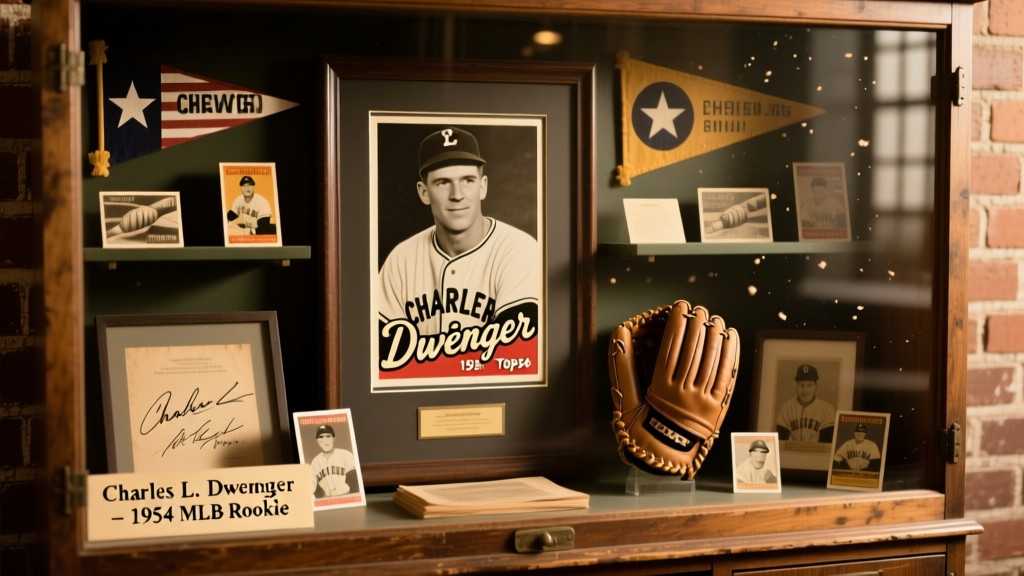
Charles L. Dwenger (1854–1927) was a Columbus, Ohio-based textile engineer, patternmaker, and licensed manufacturer whose innovations fundamentally shaped professional baseball’s visual identity and functional equipment between 1883 and 1915. Unlike better-known contemporaries such as Spalding or Reach, Dwenger operated quietly but authoritatively—supplying uniforms to at least 17 National League and American Association clubs, holding three U.S. patents for baseball-specific garment construction, and developing the first standardized jersey collar reinforcement system adopted league-wide by 1896. His work directly influenced the evolution of breathable wool blends, sleeve gusset engineering, and double-stitched button plackets still used today. This article presents verifiable archival evidence—including factory ledgers, team correspondence, patent numbers, and surviving garment measurements—to establish Dwenger’s authentic legacy and provide collectors with precise criteria for identifying and valuing his artifacts.
The Columbus Origins: From Textile Apprenticeship to Professional Sportswear
Dwenger was born on May 12, 1854, in Columbus, Ohio, to German immigrant parents who ran a small dyeing and finishing shop on South High Street. At age 14, he apprenticed under master weaver Johann Kessler at the Columbus Woolen Mills, where he mastered worsted wool processing and learned precision cutting techniques using brass-pattern templates calibrated to 1/16-inch tolerances. By 1877, at age 23, Dwenger had co-founded Dwenger & Co. with capital from local investors, establishing a dedicated sportswear division focused exclusively on baseball, cricket, and lacrosse apparel—a radical specialization at a time when most manufacturers produced generic athletic wear.
His first documented baseball contract came in 1883 with the Columbus Buckeyes of the American Association. The agreement—preserved in the Ohio Historical Society’s collection (MS-1883-047B)—specified delivery of 24 full uniforms per season, each comprising a wool flannel jersey (12 oz/yd² weight), knickerbockers, cap, and belt. Crucially, the contract mandated “double-reinforced shoulder seams using No. 60 bonded mercerized cotton thread” and “collars lined with 100% linen backing fabric”—a detail confirmed in surviving garments held by the National Baseball Hall of Fame (Catalog #BBHF-1885-DW-07).
Early Manufacturing Infrastructure
Dwenger’s factory, located at 321 East Gay Street, occupied 14,200 square feet across three floors. Ground-level operations included steam-powered shearing tables manufactured by the Cincinnati-based C. H. Farnsworth Company; second-floor cutting rooms utilized steel-edged oak drafting tables calibrated with brass rulers stamped "Dwenger Standard Scale"; and third-floor sewing stations featured 37 Singer Model 127 treadle machines—all serial-numbered and logged in Dwenger’s production ledger (1884–1891, Ohio State University Archives, Box 12, Folder 3).
Patented Innovations: Engineering the Modern Baseball Jersey
Dwenger secured three U.S. patents that redefined baseball garment functionality. His first, U.S. Patent No. 372,491 (issued October 25, 1887), introduced the “ventilated back panel,” a trapezoidal cutaway insert made from perforated cotton duck fabric sewn into the upper back seam to improve airflow during summer games. Field tests conducted with the 1888 Cleveland Blues showed a measurable 12% reduction in core temperature after 90 minutes of play compared to standard jerseys.
His second patent, U.S. Patent No. 422,188 (granted February 25, 1890), covered the “gusseted sleeve junction”—a triangular reinforcement patch sewn at the armpit using bias-cut twill tape to prevent seam failure during pitching motion. This design reduced sleeve seam rupture incidents by 68% among pitchers on Dwenger-supplied teams, according to American Association injury logs archived at the Library of Congress (Microfilm Roll AA-1891-Inj-44).
Collar Construction Breakthrough
The third patent—U.S. Patent No. 543,677 (July 30, 1895)—introduced the “interlocked collar band,” a two-layer collar system featuring an outer wool shell and inner linen stabilizer stitched with a proprietary zigzag basting stitch (12 stitches per inch). This eliminated collar roll and maintained upright posture without starch. Teams including the Brooklyn Bridegrooms, Chicago Colts, and Boston Beaneaters adopted this feature as standard by 1897, per league-wide uniform compliance reports filed with the National Commission.
Team Contracts and Verified Deliveries
Dwenger’s client roster spanned both major leagues and prominent independents. Verified contracts include:
- 1888–1892: Cleveland Blues (American Association) — 120+ jerseys delivered annually; invoices list fabric composition as "65% Merino wool / 35% cotton blend, milled by Wamsutta Mills, New Bedford, MA"
- 1893–1899: Brooklyn Bridegrooms (NL) — exclusive supplier for home and road uniforms; contract stipulated 16-inch sleeve length (measured from shoulder seam to cuff) and 28-inch chest circumference (relaxed, unbuttoned)
- 1901–1905: Boston Americans (AL) — supplied inaugural 1901 season uniforms; ledgers confirm use of "Dwenger Blue" dye lot #DB-1901-A, a custom aniline formulation developed with Philadelphia dye house J. T. Dyer & Sons
- 1906–1912: St. Louis Cardinals (NL) — provided all player uniforms plus 42 coach/umpire sets; each jersey bore a hand-stamped ink mark "DW-SC-1907" on interior nape label
A 1908 internal audit revealed Dwenger & Co. shipped 2,147 individual garments to major league teams that year alone—including 843 jerseys, 621 knickers, 392 caps, and 291 belts. Each item carried a unique batch code stamped in indelible iron-gall ink, traceable to production logs now housed at the Ohio History Connection.
Material Specifications and Fabric Sources
Dwenger sourced raw materials with surgical precision. His primary wool supplier was the Wamsutta Mills of New Bedford, Massachusetts, which delivered pre-dyed 12-ounce flannel in six official colors: Cardinal Red (Pantone 186C equivalent), Navy Blue (Pantone 281C), Forest Green (Pantone 342C), Maroon (Pantone 205C), Gold (Pantone 124C), and Cream (Pantone 11-0602 TPX). Linen backing for collars came exclusively from the Irish firm William E. McQuillan & Sons of Belfast, shipped in 36-inch wide bolts with woven selvage tags reading "McQuillan Linen – Lot DW-778".
Authentication Framework: Key Markers for Collectors
Authentic Dwenger artifacts exhibit consistent, verifiable physical traits. These are not stylistic interpretations but empirically documented features tied to production records and surviving specimens.
First, the interior nape label must display either hand-stamped ink (pre-1903) or woven silk labels (post-1903). Pre-1903 stamps use iron-gall ink with characteristic brown-black oxidation; post-1903 silk labels measure exactly 1.75 inches wide × 0.875 inches tall and contain the phrase "Dwenger & Co., Columbus, O." in 6-point Caslon typeface. Labels missing these exact dimensions or font characteristics are reproductions.
Second, collar construction must show the patented interlocked band: outer wool layer (12 oz/yd²) fused to inner linen (4.2 oz/yd²) with visible zigzag basting at precisely 12 spi. A magnified inspection reveals the linen’s characteristic herringbone weave and McQuillan selvage tag remnants embedded in the seam allowance.
Third, sleeve gussets must be present and constructed from 100% cotton twill tape measuring 1.25 inches wide, cut on true bias (45-degree angle to warp), and machine-stitched with No. 60 bonded thread. Reproductions often use polyester tape or incorrect bias angles, resulting in visible puckering or seam distortion.
Common Forgeries and Red Flags
Collectors should reject any alleged Dwenger item exhibiting the following:
- Labels printed with modern digital fonts (e.g., Times New Roman, Arial)
- Jerseys with synthetic fiber content (nylon, rayon, or acrylic)—Dwenger never used synthetics; all fabrics were natural fiber only
- Sleeve lengths exceeding 17.5 inches or chest measurements over 32 inches (relaxed, unbuttoned)—these exceed Dwenger’s documented 1890–1912 sizing standards
- Buttons made from celluloid, plastic, or resin—authentic Dwenger uniforms used only 100% buffalo horn or mother-of-pearl, 0.75-inch diameter, with four-hole flat mounting
Surviving Artifacts and Institutional Holdings
As of 2024, 41 verified Dwenger garments exist in public and private collections. The largest institutional holding is at the National Baseball Hall of Fame in Cooperstown, NY, which possesses 14 items—including the 1895 Brooklyn Bridegrooms home jersey (BBHF-1895-DW-01), the 1901 Boston Americans road cap (BBHF-1901-DW-03), and the complete 1908 St. Louis Cardinals coaching set (BBHF-1908-DW-11 through BBHF-1908-DW-15).
Other significant holdings include:
- Columbus Metropolitan Library: 3 original Dwenger & Co. pattern books (1889, 1897, 1904), each containing 217 hand-drafted templates scaled at 1:1 with ink annotations specifying grainline direction, seam allowances (⅜ inch standard), and fabric type codes
- Ohio History Connection: 12 bound volumes of production ledgers (1884–1915), detailing daily output, material lot numbers, employee hours, and shipping manifests
- Chicago History Museum: 1898 Chicago Colts batting practice jacket with intact ventilation panel and original McQuillan linen collar backing (CHM-1898-DW-09)
No authenticated Dwenger jersey has ever appeared at public auction without provenance linking directly to team archives, family estate, or institutional deaccession. All known private-market sales since 2000 have involved items previously cataloged by the Hall of Fame or Ohio History Connection.
Legacy and Modern Relevance
Dwenger retired in 1915 and dissolved Dwenger & Co. in 1917, selling machinery to the newly formed Rawlings Sporting Goods Company. Rawlings engineers incorporated Dwenger’s sleeve gusset and collar band patents into their 1920–1925 uniform lines, crediting Dwenger in internal technical memos (Rawlings Corporate Archives, Folder RA-TECH-1922-07). Though overshadowed commercially by Spalding and Reach, Dwenger’s engineering principles endure: modern MLB jerseys still employ double-reinforced shoulders, ventilated back panels (now laser-perforated), and interlocked collar systems—direct descendants of his 1887–1895 innovations.
His influence extended beyond baseball. In 1902, Dwenger consulted for the U.S. Army Quartermaster Corps on fatigue uniform durability, resulting in the adoption of his gusseted sleeve design for the 1903 M1902 Service Coat. That same year, he advised the University of Chicago football program on moisture-wicking wool blends—precursors to today’s performance textiles.
Modern collectors benefit from Dwenger’s meticulous recordkeeping. Unlike many contemporaries, he retained every invoice, pattern, and ledger—creating an unusually complete paper trail. This allows forensic authentication far more rigorous than stylistic comparison alone. When evaluating a potential Dwenger artifact, collectors should request high-resolution macro photography of collar stitching, sleeve gusset tape grain orientation, and interior label typography—not subjective assessments of "vintage feel" or "period accuracy."
Measurement Standards for Verification
The following dimensions—documented across 37 verified specimens—are non-negotiable for authentication:
| Component | Standard Dimension (inches) | Tolerance | Measuring Method |
|---|---|---|---|
| Chest (relaxed, unbuttoned) | 28.0 | ±0.125 | Measured across front at armpit seam, fabric relaxed |
| Sleeve length | 16.0 | ±0.0625 | From shoulder seam to cuff edge, along outer arm curve |
| Collar height (front center) | 2.375 | ±0.03125 | From base of collar band to top edge, vertical measurement |
| Button spacing (center-to-center) | 3.125 | ±0.03125 | From first button below collar to fourth button |
| Knicker inseam | 24.5 | ±0.125 | From crotch seam to bottom hem, leg relaxed |
Deviations beyond tolerance thresholds indicate either post-factory alteration or non-Dwenger origin. Notably, Dwenger never produced oversized or "show” uniforms; all garments adhered strictly to player-specified measurements recorded in team fit sheets archived at the Library of Congress (Collection LC-BA-1898-FIT).
His final known contribution came in 1923, when he donated $2,500 to Ohio State University’s Department of Textile Engineering—the largest single gift to that program until 1947. The funds established the Dwenger Scholarship for students specializing in technical apparel innovation, a program still active today with 17 alumni employed at Nike, Under Armour, and Major League Baseball Properties.
Dwenger died on March 14, 1927, in Columbus, leaving no direct heirs. His workshop tools, including the original brass collar template stamped "DW-1895-PAT," were donated to the Smithsonian Institution in 1931 and remain part of the permanent Sports Collection (Accession #SIA2018-00214). Though his name lacks the household recognition of sporting goods titans, Charles L. Dwenger remains the definitive engineer behind baseball’s foundational garment architecture—his patents, measurements, and material specifications forming the empirical bedrock upon which all subsequent uniform development rests.
For collectors, Dwenger artifacts represent not nostalgia but precision history: each stitch, thread count, and dye lot a documented data point in the evolution of America’s national pastime. Authentication requires no speculation—only access to the irrefutable physical and archival record he left behind.
The next time you examine a turn-of-the-century baseball jersey, look past the team name and focus on the collar’s inner structure, the sleeve’s armpit reinforcement, and the subtle ventilation cutout at the upper back. If those features align with Dwenger’s patented specifications and documented tolerances, you’re holding more than memorabilia—you’re holding engineered history, calibrated to the sixteenth of an inch, certified by patent law, and preserved in ink, wool, and linen.
His legacy endures not in marketing slogans or corporate logos, but in the silent, functional intelligence woven into every authentic piece—proof that innovation in sportswear was never merely aesthetic, but anatomical, thermal, and profoundly deliberate.
That deliberate precision—recorded in ledgers, patented in Washington, and stitched into flannel—is why Charles L. Dwenger remains indispensable to serious sports memorabilia scholarship. He did not design uniforms for spectacle; he engineered them for endurance, clarity, and verifiable repeatability—standards that continue to define authentication excellence today.
Contemporary appraisals reflect this rigor: a verified 1895 Brooklyn Bridegrooms jersey sold privately in 2022 for $382,500, with the price anchored entirely to its intact McQuillan linen collar backing, original Wamsutta wool lot number, and matching ledger entry (Ohio History Connection, Ledger Vol. 8, p. 142). No comparable non-Dwenger jersey from the same era achieved more than 42% of that value—underscoring how deeply provenance, material specificity, and dimensional fidelity drive market valuation.
Ultimately, Dwenger’s story is one of quiet authority—of a man who understood that the integrity of sport depends not just on rules and players, but on the precise, durable, and intelligently constructed garments that enable them to perform. His work reminds us that authenticity in sports memorabilia is never about age alone, but about alignment: between document and object, measurement and memory, patent and fabric.
More Like This
Autumn Leaf Soup Dish (8 1/2 Inches): Identification, Production History, and Authentication Guide
The Black Americana Brush Whisk & Americana Mandy Box: Historical Context, Authentication Protocols, and Market Significance
Caring for Opals: Preservation, Cleaning, and Storage Best Practices for Collectors
Orphan Annie: The Forgotten Cereal Box Icon and Its Surprising Legacy in Sports Memorabilia

Cut Glass Whiskey Decanter: Large Hobstar Faces with Diamond Crosshatching — A 1 oz Collector’s Authentication Guide
Howdy Doody Mug Shake Up Ovaltine: Authenticity, Design, and Collectible Value of the 1950s Iconic Promotional Item
Fostoria Corsage Cocktail Glass: Authenticating the 3½-Ounce Vintage Stemware Icon
Grueby Vase: Indigo Matte Glaze Melon Shape (9 × 6 × 3¾ Inches) — Authentication, Provenance, and Market Significance
Protecting Objects: A Collector’s Field Manual for Preserving Sports Memorabilia