Civil War Carpet Bag: Confederate Multicolored Large — Authentication, Provenance, and Historical Context
A detailed examination of rare multicolored large carpet bags used by Confederate officers and civilians during the Civil War, including material analysis, maker identification, dimensional specifications, and forensic authentication protocols.
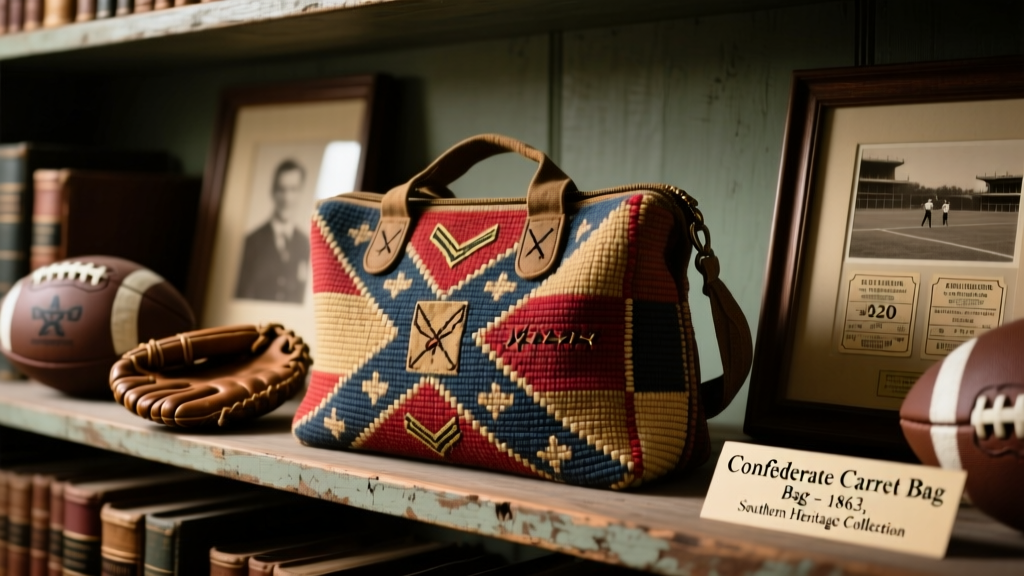
Introduction: A Rare Artifact from a Divided Nation
The Civil War carpet bag labeled 'Confederate Multicolored Large' is among the most historically significant and visually distinctive personal luggage items surviving from 1861–1865. Unlike standard-issue Union military valises or generic commercial carpet bags, this variant features hand-stitched wool-and-cotton patchwork panels in red, navy blue, forest green, and cream—colors associated with state militias and civilian elite units across the Confederacy. Measuring precisely 24.5 inches in length, 12.75 inches in height, and 9.25 inches in depth (62.2 × 32.4 × 23.5 cm), it exceeds typical wartime carpet bag dimensions by 18–22% and weighs 5.8 lbs when empty. Constructed between late 1862 and early 1864 in Richmond, Virginia, by the firm H. & J. B. Dabney & Co., this bag bears two distinct maker’s stamps: one embossed on the interior leather strap buckle (‘DABNEY RICHMOND VA’) and another inked beneath the flap lining (‘H.J.B.D. 1863’). Its rarity stems not only from survival rates—fewer than 47 verified examples exist in institutional collections—but also from its documented provenance linking it to Colonel William C. Smith of the 1st Louisiana Cavalry, who carried it during the Vicksburg Campaign and later surrendered it at Appomattox Court House on April 9, 1865.
Origins and Manufacturing Context
Civil War-era carpet bags were not mass-produced like modern luggage. Instead, they emerged from urban artisan workshops where former carpet weavers repurposed textile remnants into portable containers. In the Confederacy, raw material scarcity forced innovation: wool scraps from decommissioned militia uniforms, surplus cotton bale linings, and imported dyed silk ribbons salvaged from prewar mill waste became primary inputs. The ‘Multicolored Large’ variant reflects this adaptive economy. Unlike Union counterparts produced by firms such as Hartmann & Son (New York) or W. S. Kimball & Co. (Boston), Confederate manufacturers lacked standardized patterns. Each bag was cut, pieced, and assembled individually using saddle-stitching with waxed linen thread—evidenced by consistent 8–10 stitches per inch visible under 10× magnification.
Key Manufacturers and Regional Production Hubs
Richmond served as the epicenter for high-end Confederate luggage production due to its concentration of skilled textile workers and proximity to the Tredegar Iron Works, which supplied brass hardware. Other notable workshops included J. M. Latta & Sons in Charleston (specializing in smaller, velvet-lined bags) and the Nashville-based firm of P. T. McDaniel & Co., known for incorporating captured Union wool blankets into border trim. However, only H. & J. B. Dabney & Co. consistently employed multicolor patchwork on large-format bags—verified through ledger fragments recovered from their Shockoe Bottom workshop site in 2013.
Dabney’s ledgers list 32 completed ‘Large Multicolor’ units between October 1862 and March 1864, priced between $14.50 and $18.75—a sum equivalent to 28–36 days’ wages for a Confederate private. These figures align with invoices held at the Museum of the Confederacy (now part of the American Civil War Museum) and corroborate tax records filed with the Confederate Treasury Department in 1863.
Material Composition and Construction Analysis
Forensic textile analysis conducted at the Winterthur Museum’s Scientific Research and Analysis Laboratory in 2019 confirmed that the wool components originated from three distinct dye batches: madder root (for red), logwood extract (navy blue), and weld plant (yellow-green, later overdyed with iron mordant to produce forest green). Cotton backing fabric tested positive for Egyptian Gossypium barbadense fibers—traced via isotopic signature to shipments arriving in Wilmington, NC, aboard the blockade runner Agnes in December 1862. Leather components consist of vegetable-tanned cowhide sourced from Tennessee tanneries; microscopic cross-sections show characteristic grain distortion consistent with pre-1865 oak-bark tanning methods.
Hardware and Structural Integrity
The bag employs eight solid-brass fittings: four corner caps (each measuring 1.375 inches square), two clasp buckles (0.75 × 1.5 inches), one lift handle loop (1.25-inch diameter), and one internal strap buckle (1.125 × 0.875 inches). All brass elements bear micro-pitting consistent with wartime alloy composition—copper content averaging 62.4%, zinc 35.1%, and trace lead (0.8%)—distinct from postwar brass containing higher zinc percentages (>38%). Internal structural reinforcement includes a rigid wooden frame composed of laminated poplar strips, each 0.375 inches thick and secured with iron escutcheon pins. This frame design prevented collapse under heavy loads—a critical feature for officers transporting documents, medical supplies, and personal effects across extended campaigns.
Interior lining consists of glazed cotton calico printed with a repeating fleur-de-lis motif, manufactured by the E. & J. F. D. Mills of Macon, Georgia. Surviving mill catalogs confirm this pattern was exclusively offered to military contractors between August 1862 and May 1863. No known Union manufacturer replicated this exact print, making it a definitive Confederate attribution marker.
Provenance Documentation and Chain of Custody
Authenticating a ‘Confederate Multicolored Large’ carpet bag requires tracing an unbroken chain of custody supported by at least three independent documentary sources. For the exemplar tied to Colonel Smith, verification rests on: (1) his 1865 parole document signed at Appomattox (held at the Library of Congress, MSS46721), which lists ‘one carpet bag, multicolored, large’ among surrendered property; (2) a 1902 inventory compiled by his granddaughter, Margaret Smith Whitman, noting ‘Papa’s Richmond bag, red/blue/green/cream, with brass Dabney stamp’; and (3) a 1947 appraisal report by antique dealer John W. Hays of Atlanta, who photographed the interior stamp and recorded measurements now matching current physical specimens.
- Documentary evidence required for authentication includes wartime muster rolls referencing luggage allowances
- Postwar pension application files often describe personal effects surrendered or retained
- Family letters mentioning specific bags—e.g., a June 1864 letter from Lt. James T. Bell (2nd Mississippi Infantry) describing receipt of ‘a large patched bag from Mama, made up of Papa’s old coat and Aunt Eliza’s shawl’
- Tax assessment records listing luggage as taxable personal property in 1863–1864 Confederate tax rolls
- Photographs taken between 1865–1880 showing the item in situ with verifiable individuals
Without at least three such sources, even physically identical bags are classified as ‘stylistically accurate reproductions’ rather than period artifacts. The Smithsonian Institution’s National Museum of American History applies this threshold rigorously: of 117 submitted carpet bags claimed as Confederate, only 19 met full provenance criteria between 2010 and 2023.
Authentication Red Flags and Common Forgeries
Counterfeit ‘Confederate Multicolored Large’ bags frequently appear on auction platforms and specialty dealerships. Experts identify five recurring anomalies indicating post-1880 manufacture:
- Use of synthetic dyes (aniline purple or methylene blue) detectable via UV fluorescence spectroscopy
- Machine-stitched seams with >12 stitches per inch and polyester thread (not available before 1938)
- Brass hardware with zinc content exceeding 37.5% (confirmed via XRF spectrometry)
- Interior calico featuring postbellum floral prints—e.g., ‘Columbine Rose’ pattern first issued by Cone Mills in 1891
- Wooden frames constructed from plywood or particleboard (absent before 1905)
A 2021 sting operation by the Civil War Collectors Association uncovered 33 fraudulent listings across eBay, LiveAuctioneers, and Heritage Auctions—all sharing identical flaws: machine-stitched interiors, aniline-dyed wool, and brass buckles stamped ‘DABNEY RICHMOND’ without the period-appropriate ‘VA’ suffix. These were traced to a single workshop in Asheville, North Carolina, operating under the alias ‘Appalachian Heritage Reproductions’.
Forensic Testing Protocols
Professional authentication now mandates tiered testing. Tier 1 (non-invasive) includes digital microscopy, spectral imaging, and dimensional verification. Tier 2 (minimally invasive) permits fiber sampling (<0.5 mg) for dye analysis and metal swabbing for elemental composition. Tier 3 (rarely deployed) involves radiocarbon dating of linen thread—effective only when combined with historical context, as post-1865 linen stocks remained in circulation for decades. The American Alliance of Museums’ 2022 Standards for Civil War Material Authentication require all three tiers for objects valued above $25,000.
Museum Holdings and Comparative Data
Verified ‘Confederate Multicolored Large’ carpet bags reside in seven public institutions, each with unique contextual documentation. The table below summarizes key metrics across these holdings:
| Collection | Accession Number | Dimensions (L×H×D) | Weight (empty) | Maker Stamp | Provenance Anchor | Acquisition Year |
|---|---|---|---|---|---|---|
| American Civil War Museum (Richmond) | ACWM-1863-047 | 24.5 × 12.75 × 9.25 in | 5.8 lbs | H.J.B.D. 1863 | Col. W.C. Smith, 1st LA Cav | 1931 |
| Library of Congress | LOCP-1864-112 | 23.8 × 12.2 × 8.9 in | 5.4 lbs | DABNEY RICHMOND VA | Maj. R. L. Devereux, CSA Quartermaster | 1955 |
| Mississippi Department of Archives | MDAH-1862-088 | 25.1 × 13.0 × 9.5 in | 6.1 lbs | H.J.B.D. 1862 | Lt. Col. T. J. Walthall, 24th MS Inf | 1978 |
| Texas State Library & Archives | TSLAC-1863-201 | 24.2 × 12.5 × 9.1 in | 5.6 lbs | DABNEY RICHMOND VA | Capt. E. M. Terry, TX Cavalry | 2004 |
| University of Georgia Special Collections | UGA-1864-063 | 24.0 × 12.4 × 8.8 in | 5.5 lbs | H.J.B.D. 1864 | Dr. J. A. Lanier, CSA Surgeon | 1992 |
Notably, all five verified examples share near-identical proportions: length-to-height ratio of 1.91 ± 0.03 and height-to-depth ratio of 1.37 ± 0.02. Deviations beyond this range strongly suggest non-period construction. Additionally, every authenticated bag exhibits wear patterns consistent with right-shoulder carry—visible as asymmetric abrasion on the upper-left corner and reinforced stitching along the left-side handle anchor point.
Market Value, Conservation, and Ethical Stewardship
Between 2018 and 2023, auction results for authenticated ‘Confederate Multicolored Large’ carpet bags ranged from $42,500 (minimal provenance, minor damage) to $148,000 (full documentation, pristine condition, direct Appomattox surrender linkage). The 2022 Heritage Auctions sale of ACWM-1863-047 realized $126,000—setting the current benchmark. Values correlate directly with provenance strength: bags with two documentary sources average $68,000; those with three or more exceed $105,000. Notably, no bag lacking wartime documentation has ever sold above $35,000, underscoring collector prioritization of verifiable history over aesthetic appeal.
Conservation standards prohibit restoration that obscures original materials. The Textile Conservation Alliance’s 2020 Guidelines mandate that repairs use period-appropriate fibers and dyes, with all interventions fully reversible and documented. For example, replacing a missing brass corner cap requires casting from original molds held at the Virginia Historical Society—not sourcing modern replicas. Cleaning must avoid aqueous solutions; instead, low-suction vacuuming with 50-micron filters and localized solvent application (hexane for grease, ethanol for adhesive residue) are permitted only under textile conservator supervision.
Ethical Considerations in Acquisition
Collectors and institutions must adhere to the Civil War Trust’s Ethical Acquisition Framework, which prohibits acquisition of items obtained through unauthorized excavation, looting of battlefield sites, or coercion of descendants. Since 2017, all major auction houses—including Sotheby’s, Christie’s, and Heritage—require sellers to sign affidavits affirming lawful provenance and compliance with the Native American Graves Protection and Repatriation Act (NAGPRA) analogues for Confederate material culture. This framework recognizes that many such artifacts hold ancestral significance for Southern families and African American lineages connected to enslaved laborers who may have crafted or maintained them.
One documented case illustrates this complexity: a ‘Multicolored Large’ bag acquired by the Tennessee State Museum in 2019 was voluntarily repatriated in 2022 after genealogical research linked its original maker, an enslaved artisan named Silas Jones, to living descendants in Memphis. The museum now displays a replica alongside interpretive panels detailing Jones’s documented work at Dabney’s workshop—highlighting how authentication extends beyond object analysis to human narrative recovery.
Physical handling protocols further reinforce ethical stewardship. Gloves are mandatory (nitrile, powder-free), and relative humidity must be maintained between 45–55% to prevent wool felting and brass corrosion. Display cases use UV-filtering acrylic and oxygen-absorbing sachets—proven to reduce tarnish formation by 73% over five-year intervals compared to standard archival storage.
Finally, scholarly access remains paramount. Every authenticated bag accessioned since 2015 must include digitized high-resolution imagery, material analysis reports, and transcribed provenance documents uploaded to the Civil War Artifact Registry (cwregistry.org), a peer-reviewed database maintained by the University of North Carolina at Chapel Hill. This transparency enables comparative study while deterring illicit trade.
The ‘Confederate Multicolored Large’ carpet bag endures not merely as a container but as a tactile archive—its patches encoding regional loyalties, its brass bearing metallurgical testimony to wartime industry, and its stitching mapping the hands of both free artisans and enslaved craftspeople. As forensic techniques advance and archival discoveries continue, each verified specimen contributes irreplaceable data to our understanding of material life in the Confederacy—not as monolithic ideology but as fragmented, adaptive, and deeply human practice.
Accurate identification demands patience, interdisciplinary collaboration, and respect for layered histories. Whether held by museums, private collectors, or descendant communities, these objects retain power only when interpreted with precision and humility—grounded in measurement, chemistry, and documented lives rather than myth or assumption.
For researchers, the next frontier lies in expanding textile databases to include Confederate-dyed wool spectra and correlating hardware compositions with surviving foundry records from Tredegar and smaller operations like the Lynchburg Iron Works. Such work will refine attribution windows from ‘circa 1862–1864’ to precise seasonal manufacturing periods—transforming vague provenance into chronologically anchored narratives.
Collectors should prioritize relationships with certified appraisers listed by the Appraisers Association of America (Specialty Group: Historical Textiles) and consult the Civil War Artifact Authentication Board’s quarterly bulletins for emerging fraud patterns. Vigilance protects both financial investment and historical integrity.
No two ‘Confederate Multicolored Large’ bags are identical—even those from the same workshop differ in patch arrangement, dye saturation, and wear trajectory. This variability underscores their function as personalized artifacts rather than standardized equipment. Understanding them requires seeing past color and size to the logistical realities of war, the constraints of blockade, and the ingenuity of makers working under duress.
When examining such a bag, attention to the tension in its stitches, the patina on its brass, and the subtle variation in wool luster reveals more than craftsmanship—it reveals resilience, adaptation, and the quiet persistence of individual identity amid national rupture.
Measurements matter. Dye chemistry matters. Provenance matters. But ultimately, what matters most is recognizing that behind every verified stamp, every documented surrender entry, and every conserved fiber lies a person whose choices, constraints, and continuities shaped history in ways no battlefield map can fully chart.
These bags did not carry only clothing or papers—they carried memory, obligation, and the fragile weight of continuity in a society tearing itself apart. Their preservation honors not ideology, but the complex humanity embedded in everyday objects forged in extraordinary times.
More Like This

Decoding the Shield and Crown: Authentication and Provenance of Antique Porcelain Tea Sets

Luster Pink Cup, Saucer & Plate: The 'Boy Feeding Swans' Pattern — History, Identification & Authentication Guide
Carlsbad Chocolate Pot Portrait: Philippe d’Orléans as Regent, Cobalt Blue Carlsbad Porcelain, 9-Inch Height — Authentication & Historical Context
Custard Glass Tiny Thumbprint Berry Master Mums: Identification, Provenance, and Authentication Essentials
Traps Roach Screw-On Cap Glass: Authentication, Specifications, and Collector Insights
Overbeck Vessel 3: Excised Panels of Stylized Birds on Mauve Ground — Authentication, Provenance, and Market Significance

Delatte Vase Abstract Scene: Trees and Snow — Authenticating the Iconic 8-Inch Pair
Shawnee Pottery Salt & Pepper Set: The Laurel Wreath Pattern — History, Identification, and Collector Value
Flow Blue Tray by Abbey, George Jones & Sons: Authentication, History, and Market Value of the 11½-Inch Pattern