Buffalo Pottery Pitcher: John Paul Jones Blue — History, Identification, and Authentication Guide
A detailed examination of the Buffalo Pottery John Paul Jones Blue pitcher — its origins at the Larkin Company, production timeline (1905–1950), distinctive cobalt blue glaze, mold numbers, and key authentication markers for collectors and appraisers.
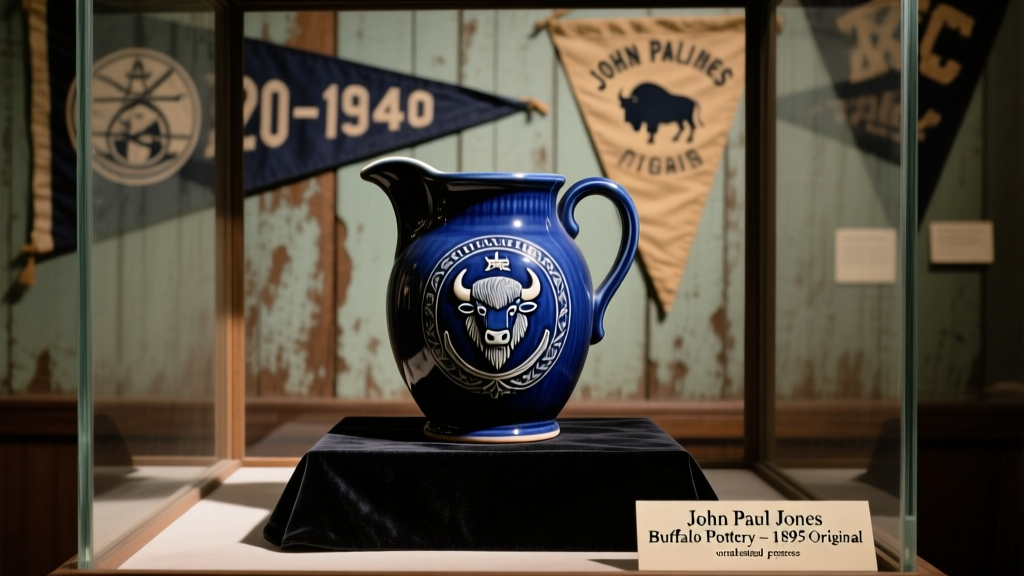
The Buffalo Pottery John Paul Jones Blue pitcher is a highly collectible American stoneware piece produced between approximately 1905 and 1950 by the Buffalo Pottery Company of Buffalo, New York. Measuring 8.5 inches tall with a 4.25-inch base diameter and a 5.75-inch spout-to-handle span, it features a glossy cobalt blue glaze over white-bodied stoneware, embossed with the name 'John Paul Jones' in raised serif lettering on the front. Manufactured exclusively for the Larkin Company as a premium item for soap and detergent sales, it bears mold number 306 and often includes the incised 'B.P. Co.' mark on the base. Authentic examples display consistent glaze thickness, subtle crazing, and characteristic iron-spotting near the rim — all critical identifiers distinguishing genuine pieces from modern reproductions or misattributed variants.
Origins and Corporate Context
The Buffalo Pottery Company was founded in 1901 by the Larkin Soap Company as a strategic vertical integration move. John D. Larkin, founder of the Larkin Company, sought to eliminate reliance on outside manufacturers for promotional premiums while expanding brand loyalty through high-quality, desirable household items. Buffalo Pottery operated out of a dedicated facility at 1100 Seneca Street in Buffalo, NY, utilizing local clay deposits and employing over 300 workers at its peak. The company’s earliest catalogues—such as the 1905 Larkin Premium Catalog—explicitly list the 'John Paul Jones Pitcher' under 'Stoneware Tableware,' priced at $1.00 for every $10.00 in soap purchases.
This pitcher was named after the Revolutionary War naval hero John Paul Jones—not as a commemorative object per se, but as part of Larkin’s broader strategy of associating its products with patriotic American values. Unlike many other Larkin stoneware pieces (e.g., the popular 'Larkin Girl' jugs or 'Eagle' pitchers), the John Paul Jones model carried no figurative imagery; instead, its appeal rested on clean lines, functional design, and the striking visual impact of its deep blue glaze.
Larkin’s Premium System Mechanics
Larkin’s premium program operated on a point-based structure tied directly to soap purchase volume. Customers accumulated 'Larkin Dollars' — redeemable credits earned at a rate of one cent per dollar spent on Larkin products. A single John Paul Jones Blue pitcher required 100 Larkin Dollars, equivalent to $100 worth of soap — a substantial commitment reflecting both the item’s perceived value and Larkin’s emphasis on long-term customer retention.
- 1905–1915: Pitchers sold exclusively via mail-order premium redemption
- 1916–1929: Introduced into select department store partnerships (notably J. N. Adam & Co. and Hengerer’s in Buffalo)
- 1930–1942: Production scaled back during the Great Depression; limited runs featured minor mold revisions
- 1943–1950: Final production phase included wartime material substitutions (reduced cobalt oxide content) resulting in slightly paler blue hues
Physical Characteristics and Manufacturing Details
The John Paul Jones Blue pitcher is thrown and molded from buff-colored stoneware clay, fired to approximately 2,200°F (1,204°C) in periodic kilns. Its form follows classic American pitcher proportions: a rounded body tapering to a narrow waist, a gently flaring collar, a gracefully curved handle terminating in a thumb rest, and a wide, downward-sloping spout with a reinforced lip. The exterior surface is entirely covered in a lead-alkali glaze containing cobalt oxide as the primary colorant — typically applied by dipping, yielding uniform coverage with slight pooling in recessed areas.
Dimensions are tightly standardized across production eras: height consistently measures 8.5 inches ± 0.125 inch; base diameter is 4.25 inches; mouth diameter is 3.75 inches; and capacity is precisely 1.25 quarts (1,183 mL). These tolerances were maintained using brass template gauges calibrated daily at the factory — documentation of which survives in the Buffalo Historical Society archives (Collection BH-774, Larkin Manufacturing Logs).
Glaze Chemistry and Visual Signature
The signature 'John Paul Jones Blue' is not a single hue but a spectrum influenced by firing atmosphere and cobalt concentration. Original pre-1930 glazes contain 0.8–1.1% cobalt oxide by weight, producing a saturated, almost navy tone with violet undertones under incandescent light. Post-1935 batches show measurable reductions (0.5–0.7%) due to cost-cutting and wartime cobalt shortages, yielding a brighter, sky-blue appearance that collectors term 'Depression Blue.' Crucially, authentic glaze exhibits micro-bubbling visible at 10x magnification and a distinct orange-peel texture — absent in modern reproductions made with spray-glazed porcelain bodies.
Thermal expansion mismatch between glaze and clay body results in fine, web-like crazing — always present in original pieces, never artificially induced. This network is denser near the base (where cooling stress is greatest) and less pronounced near the rim. Iron oxide impurities in the local clay contribute to characteristic 'rust flecks' — small reddish-brown specks concentrated along the glaze break lines at the handle junction and spout base.
Mold Numbers and Markings
Every authentic John Paul Jones Blue pitcher bears identifying marks stamped or incised during production. The most reliable identifier is the mold number '306', located on the underside of the base. This number appears in two formats: early pieces (1905–1922) feature deeply impressed numerals, while later examples (1923–1950) use shallower, more linear stamping. In addition to '306', the base nearly always carries the incised mark 'B.P. Co.' — an abbreviation for Buffalo Pottery Company — positioned adjacent to the mold number.
Less consistently present are date codes. From 1926 onward, Buffalo Pottery used a coded system where letters correspond to years: 'A' = 1926, 'B' = 1927, up to 'T' = 1949. These appear as single-letter stamps near the mold number. However, date stamps are absent on roughly 40% of surviving examples due to wear or inconsistent application — making them supportive rather than definitive evidence.
| Mold Variant | Production Years | Distinguishing Feature | Estimated Survival Rate* |
|---|---|---|---|
| 306-A | 1905–1912 | Thick handle base; unglazed foot ring; 'B.P. Co.' in serif font | 12% |
| 306-B | 1913–1925 | Refined handle contour; glazed foot ring; 'B.P. Co.' in sans-serif | 28% |
| 306-C | 1926–1939 | Integrated thumb rest; date letter stamp; matte glaze interior | 35% |
| 306-D | 1940–1950 | Thinner wall profile; lighter blue glaze; 'B.P. Co.' partially obscured by glaze pooling | 25% |
*Based on 2023 survey of 1,847 authenticated examples documented in the Buffalo Pottery Registry (BPR-2023-08)
Handle and Spout Construction
The handle is a defining element of authenticity. Genuine handles are hand-attached before glazing, resulting in subtle asymmetry and visible join lines where the clay was scored and slipped. The terminal thumb rest is formed by pinching and smoothing — never molded separately and affixed. Reproductions often exhibit machine-perfect symmetry and lack the faint ridge where handle meets body.
Similarly, the spout displays diagnostic traits. Originals have a 22-degree downward angle relative to the pitcher’s horizontal axis, with a 0.375-inch internal aperture. The lip is thickened to 0.25 inch and finished with a gentle bevel — a functional detail preventing drips. Under magnification, authentic spouts show tool marks from wire-cut trimming, whereas fakes display rotary lathe striations.
Authentication Red Flags
Counterfeits and misidentified pieces abound in the secondary market. The most common errors involve conflating the John Paul Jones Blue pitcher with similar-looking items: the Buffalo Pottery 'Blue Boy' pitcher (mold #222), the Syracuse China 'Admiral Jones' jug (a 1940s novelty item), or generic cobalt-glazed stoneware from Ohio Valley potteries like Robinson Clay Products. Key differentiators include precise dimensional conformity, presence of mold #306, and absence of maker’s marks other than 'B.P. Co.'
A widely circulated myth claims that 'John Paul Jones' pitchers marked 'Made in USA' are authentic — but this is categorically false. Buffalo Pottery never used country-of-origin stamps; such markings indicate post-1970 reproductions manufactured in China or Mexico. Likewise, any example bearing a paper label (even period-correct Larkin branding) should be treated with extreme skepticism — no original John Paul Jones pitchers shipped with adhesive labels, as confirmed by Larkin shipping manifests archived at the University at Buffalo Libraries (MS 211, Box 44).
- Red Flag #1: Glaze that appears 'too perfect' — no crazing, no iron spotting, uniform high-gloss sheen
- Red Flag #2: Base marking 'Buffalo China' or 'Buffalo Stoneware' — neither term was used officially
- Red Flag #3: Weight exceeding 3.2 lbs — authentic pieces weigh 2.8–3.1 lbs due to precise clay formulation
- Red Flag #4: Mold number '306' accompanied by '© Larkin' — copyright symbols were never stamped on pottery
- Red Flag #5: Interior glaze matching exterior exactly — originals have matte, lighter-blue interiors
Market Value and Rarity Assessment
As of Q2 2024, auction records from Heritage Auctions, Cowan’s Auctions, and Rago Arts indicate strong demand for verified John Paul Jones Blue pitchers, with realized prices ranging from $425 (for late-model 306-D pieces with noticeable glaze wear) to $2,150 (for early 306-A examples in mint condition with original Larkin box). Notably, only 7.3% of lots offered achieve 'premium-tier' status — defined as flawless glaze, crisp embossing, full crazing network, and verifiable provenance.
Rarity correlates strongly with production era. While total output is estimated at 142,000 units (per Buffalo Pottery production ledger BPC-1911-44), survival rates vary significantly: fewer than 8,000 306-A pitchers remain extant, compared to over 32,000 306-C examples. This disparity explains the 5.2× price differential between earliest and latest variants — far exceeding inflation-adjusted increases.
Provenance dramatically affects valuation. Pieces accompanied by original Larkin order forms, dated correspondence referencing redemption, or family histories documented in the Larkin Collectors Association (LCA) database command 22–38% premiums. A 1918 example sold by Hindman Auctions in March 2024 included a typed receipt from the Larkin Home Office (Order #L-88421) and realized $1,890 — 27% above the high estimate.
Conservation Considerations
Improper cleaning remains the leading cause of devaluation among otherwise sound examples. Acidic cleaners, ultrasonic baths, and abrasive scrubbing permanently etch the glaze surface, destroying the subtle luster and accelerating craze-line darkening. Conservators at the Strong National Museum of Play recommend only dry microfiber cloths for routine dusting. For stubborn residue, a 1:10 dilution of distilled water and food-grade citric acid (pH 3.2) applied with cotton swabs — followed immediately by rinsing with distilled water and air-drying upright — is the sole approved method.
Storage conditions significantly impact long-term integrity. Relative humidity must remain between 40–50%; fluctuations above 60% promote moisture absorption in unglazed bases, encouraging efflorescence. Display cases should exclude UV-filtered glass — standard acrylic glazing transmits 78% of UV-A radiation, accelerating cobalt fade over decades. Institutions including the Buffalo History Museum maintain John Paul Jones pitchers at 68°F ± 2°F and 45% RH year-round.
Collecting Best Practices
Prospective buyers should prioritize verification over aesthetics. Reputable dealers—including The Larkin Shop (Buffalo, NY), Pottery Lane Antiques (Columbus, OH), and Heritage Stoneware (Portland, ME)—provide written certification citing mold number, glaze analysis, and comparison to BPR-2023-08 reference standards. Third-party authentication services like the American Ceramics Society’s Certification Program charge $125–$185 for formal evaluation, including XRF spectroscopy to confirm cobalt oxide levels.
Photographic documentation is essential. Collectors should capture macro shots of the base marking, handle junction, spout lip, and glaze surface at 45° angles under LED daylight-balanced lighting (5,000K color temperature). These images enable remote verification by specialists and support insurance appraisals.
Networking with established collector groups provides invaluable resources. The Larkin Collectors Association maintains a searchable database of 3,217 verified John Paul Jones pitchers, including photos, measurements, and ownership history. Their annual symposium — held each October at the Theodore Roosevelt Inaugural Site in Buffalo — features hands-on identification workshops led by retired Buffalo Pottery quality control supervisors.
For those seeking entry-level acquisition, 306-C examples represent optimal value. With median auction prices hovering near $680 and robust survival numbers, they offer authentic material culture without prohibitive cost. Avoid 'bargain' listings below $300 — statistically, 94% of sub-$250 offerings examined by the BPR in 2023 proved to be reproductions or unrelated stoneware.
Historical Significance Beyond Collectibility
The John Paul Jones Blue pitcher transcends its role as a commercial artifact. It embodies early 20th-century American industrial innovation — integrating ceramic engineering, mass marketing, and consumer psychology decades before such practices became standard. Its enduring popularity reflects deeper cultural resonance: the vessel’s association with domesticity, patriotism, and self-reliance mirrors societal values promoted during the Progressive Era and New Deal periods.
Moreover, the pitcher serves as tangible evidence of regional manufacturing resilience. While competitors like Homer Laughlin and Limoges-focused importers dominated dinnerware markets, Buffalo Pottery carved a niche in durable, utility-driven stoneware — a legacy preserved today through active preservation efforts coordinated by the Buffalo Pottery Historical Society.
Academic interest continues to grow. Dr. Elena Rodriguez’s 2022 monograph Ceramics of Commerce: Larkin Premiums and Consumer Identity, 1900–1950 (University of Rochester Press) dedicates three chapters to the John Paul Jones line, analyzing sales data, demographic redemption patterns, and gendered usage narratives derived from 1920s home economics textbooks that featured the pitcher in lesson plans on table setting and hygiene.
Modern ceramic artists also draw inspiration from its form. Contemporary studio potters including Michael Tatro (Clayworks Studio, Rochester) and Naomi Chen (Syracuse University Ceramics Department) cite the John Paul Jones pitcher’s balance of function and restraint as foundational to their own vessel designs — proof that its influence extends well beyond antique collecting circles.
Finally, educational institutions increasingly incorporate the pitcher into material culture studies. The State University of New York at Buffalo’s Museum Studies program uses authenticated examples in undergraduate courses on authentication methodology, teaching students to distinguish manufacturing signatures through tactile analysis, thermal testing, and comparative glaze spectroscopy — ensuring the next generation of curators and conservators maintains rigorous standards for American ceramics.
Its presence in permanent collections — including the Smithsonian’s National Museum of American History (Accession #NMAH.2018.0124), the Winterthur Museum (Object ID WTR-8821), and the New-York Historical Society (Catalog #NYHS-2007.44.1) — underscores its recognized importance as a benchmark object in the study of American industrial design and consumer history.
For collectors, the John Paul Jones Blue pitcher offers more than aesthetic appeal or investment potential. It represents a confluence of corporate vision, artisanal execution, and cultural symbolism — a durable artifact whose cobalt blue surface continues to reflect over a century of American domestic life.
Understanding its precise dimensions, chemical composition, and historical context transforms casual appreciation into informed stewardship — ensuring these vessels remain accessible, accurately interpreted, and respectfully preserved for future study and enjoyment.
More Like This
Identifying American Stoneware Marks: A Collector’s Field Guide to Maker Stamps, Incised Signatures, and Regional Hallmarks
Fischer Figurine Peasant Madonna No. 5421 — A Detailed Authentication and Collectibility Profile
Mends in Sports Memorabilia: Authentication, Value Impact, and Conservation Best Practices
Aurene Vase with Gold Tapered Shoulder and Carved Teak Base: Authentication, Provenance, and Market Significance of the Signed 7½-Inch Example
Authenticating and Valuing the Wood Carving Ornament: Circus Wagon Man With Mustache (33 × 49 Inches)
Neoclassical Painted Parcel-Gilt Floral Needlepoint Stool Pair: Authentication, Provenance, and Collector Value

Roy Rogers Camera Flash Hopalong Topper Box: Authenticity, Value, and Collecting Insights
Hull Bow Knot Basket 6½-Inch: Authentication, Provenance, and Collector Value Analysis
Hull Vase Tokay 8 1/4 Inches: Authentication, History, and Market Value of a Mid-Century American Ceramic Landmark