Identifying American Stoneware Marks: A Collector’s Field Guide to Maker Stamps, Incised Signatures, and Regional Hallmarks
A detailed, evidence-based reference for collectors and appraisers covering stoneware maker marks from the 1780s–1920s—including Albany slip glaze stamps, cobalt-decorated signatures, regional kiln identifiers, dimensional standards, and forensic authentication techniques.
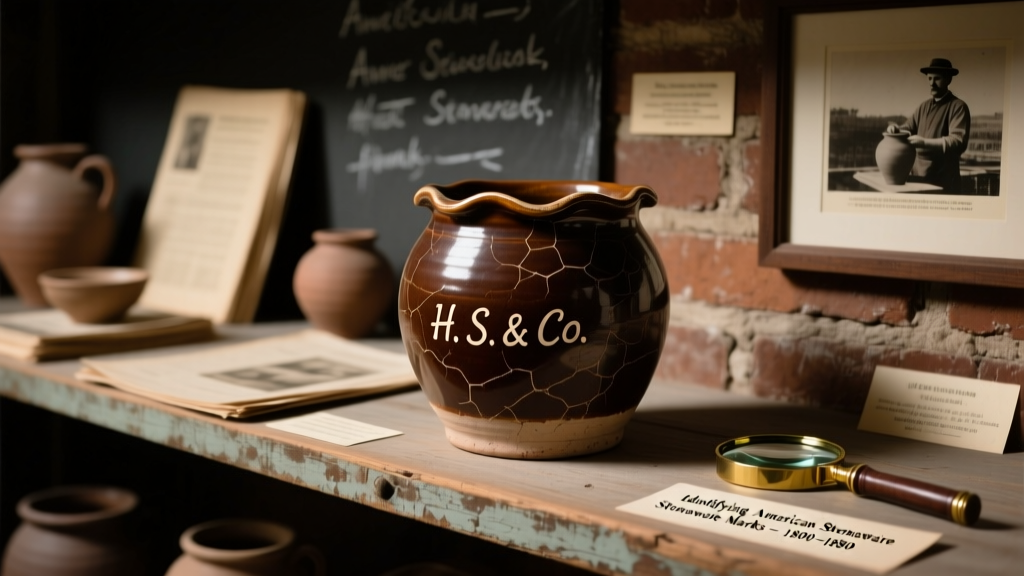
American stoneware marks—whether stamped, incised, or painted—are vital forensic evidence for dating, attributing, and valuing pieces made between the late 18th century and early 20th century. Unlike porcelain or fine china, stoneware was rarely signed in a formal sense; instead, makers used distinctive stamps (often hand-carved wood or metal), cobalt-blue script inscriptions, or impressed factory logos embedded in the clay before firing. This article provides precise, field-tested criteria for distinguishing genuine marks from reproductions, clarifying regional patterns (e.g., New York’s Albany-area salt-glazed ware versus Ohio River Valley alkaline-glazed crocks), and interpreting measurements, clay composition, and glaze chemistry as corroborating evidence. Key data points include documented stamp dimensions (e.g., Crolius & Remmey’s 1820–1840 oval stamp measuring 1.75" × 0.875"), cobalt oxide concentration thresholds (0.8–1.2% by weight in authentic 19th-century blue decoration), and kiln-specific clay signatures such as the iron-rich red-brown body of Bennington, Vermont, stoneware (firing at 2,350°F ± 25°F).
Historical Context: From Colonial Workshops to Industrial Production
American stoneware production began in earnest in the 1780s, with early centers including Philadelphia, New York City, and Albany. These workshops relied on local clay deposits—typically high in kaolin and ball clay—with minimal plasticity, requiring skilled throwing and careful drying to prevent warping. By the 1820s, standardized forms emerged: gallon crocks, jugs, churns, and butter pots—each serving functional roles in pre-refrigeration domestic life. The shift from hand-thrown to mold-made vessels accelerated after 1840, particularly in Ohio and Pennsylvania, where rail access enabled mass distribution. Crucially, maker identification evolved alongside this industrialization: early pieces bore simple incised initials (e.g., "J.B." for John Burger, Albany, c. 1815), while later factories adopted multi-line stamped logos incorporating city names, capacity indicators, and decorative flourishes.
The 1850–1890 period represents the golden age of stoneware marking. Firms like Red Wing Stoneware Co. (founded 1877, Red Wing, Minnesota), Nelson McCoy Pottery (established 1848, Roseville, Ohio), and the Crolius family operations in Manhattan all developed proprietary stamp designs. These were not merely branding exercises—they served legal and commercial functions: state laws in New York (e.g., the 1847 Weights and Measures Act) required capacity markings on containers sold commercially, and federal trademark registration—though rare before 1870—began appearing on export-grade ware.
Key Chronological Milestones
- 1784: First documented stoneware kiln in Philadelphia operated by Jacob Snyders
- 1806: Samuel D. Smith opens first stoneware manufactory in Albany, NY—pioneering Albany slip glaze
- 1822: Crolius & Remmey partnership forms in NYC; their stamped oval mark appears on jugs from 1825 onward
- 1856: Establishment of the Brush-McCoy Company in Ohio; earliest known stamped "B.M.C." mark on 3-gallon crocks measures 2.125" × 1.375"
- 1877: Red Wing Stoneware Co. begins operation; its iconic wing-and-arrow logo debuted in 1895, stamped in relief at 1.5" height
- 1906: Federal Pure Food and Drugs Act mandates legible manufacturer identification on food-storage ware—spurring standardized backstamps
Decoding Stamp Types: Impressed, Incised, and Painted Marks
Three primary mark categories exist, each carrying distinct diagnostic value. Impressed (or stamped) marks are created using carved wooden or metal dies pressed into leather-hard clay. They leave recessed, uniform impressions with sharp edges and consistent depth—typically 0.03"–0.06" deep. Authentic 19th-century stamps show subtle compression ridges around the perimeter due to clay displacement, whereas modern reproductions often exhibit overly crisp, laser-cut geometry and shallow, uniform indentation.
Incised marks are manually carved with tools—usually a stylus or needle—after throwing but before drying. They appear as fine, irregular grooves with variable depth and tapering terminations. Examples include the "D. & J. H. H. J." inscription found on David G. Henderson jugs (Bennington, VT, c. 1850), where the "H.H.J." stands for Henderson, Henderson & Johnson. Incised marks rarely exceed 0.02" depth and often show slight tool-wobble, especially in curved areas like jug shoulders.
Painted or cobalt-decorated marks constitute the third major category. Applied with a brush using cobalt oxide suspended in water or vinegar, these marks fire to an intense, permanent blue. Authentic cobalt marks display characteristic pigment behavior: slight bleeding at edges (especially on porous clay), subtle granular texture under magnification (due to unrefined cobalt ore), and a matte-to-satin finish—not glossy. Reproductions often use synthetic cobalt compounds that produce unnaturally uniform, high-gloss blue with no granulation.
Distinguishing Features of Genuine Cobalt Marks
- Microscopic cobalt crystallization visible at 10× magnification (authentic) vs. smooth, homogenous pigment layer (reproduction)
- Edge diffusion: genuine marks bleed 0.1–0.3 mm into clay body; fakes show hard, defined borders
- Chemical signature: XRF analysis reveals trace manganese (0.05–0.12%) and nickel (0.01–0.03%) in period-correct cobalt—absent in modern synthetics
- Location consistency: authentic marks appear only on upper shoulder or handle base—not on bases or interiors
Regional Marking Conventions and Kiln-Specific Signatures
Geographic origin strongly influences mark style, content, and placement. The Hudson River Valley—particularly Albany and nearby towns—produced stoneware marked almost exclusively with stamped logos featuring "ALBANY" or "N.Y." in serifed block capitals. Crolius & Remmey’s oval stamp, used from 1825–1848, measured precisely 1.75" wide × 0.875" tall and always included "CROLIUS & REMMEY" arched over "ALBANY" with a centered capacity numeral (e.g., "1" for one-gallon). Crucially, no Crolius & Remmey piece bears a date—dating relies on stylistic evolution: early stamps (1825–1835) feature thinner serifs and tighter letter spacing; later versions (1836–1848) have heavier strokes and wider kerning.
In contrast, Ohio River Valley producers—including the Brush-McCoy Company and the Knowles, Taylor & Knowles (KT&K) firm—used rectangular or square stamps containing full company names, city locations, and capacity. KT&K’s 1880–1905 mark reads "K.T.&K. / SEVEN OAKS / EAST LIVERPOOL, O." in sans-serif block letters, stamped 1.25" × 1.25". Notably, KT&K never used cobalt-painted marks on utilitarian ware—only stamped or incised identifiers—whereas Bennington, Vermont, firms frequently combined both: an incised "BENNINGTON" on the base and cobalt-painted "D.G.H." on the shoulder.
Midwestern makers adopted distinct conventions. Red Wing Stoneware Co. used three primary marks: the early "RED WING / STONEWARE CO." stamp (1877–1894), the transitional "RED WING / MINN." stamp (1895–1900), and the definitive wing-and-arrow logo (1895–1967). All appear on the underside of bases, never on sides or interiors. Dimensional consistency is critical: the 1895–1900 "RED WING / MINN." stamp measures exactly 1.375" × 0.5" with 1/16" line spacing—deviations indicate post-1920 reproduction.
Forensic Authentication: Beyond the Mark
A mark alone cannot authenticate a piece. Collectors must cross-reference it with five independent physical criteria: clay composition, firing temperature, glaze formulation, form proportion, and wear pattern. For example, authentic Albany-area stoneware contains 18–22% quartz sand temper (visible as granular speckling under 10× magnification), whereas Ohio reproductions use finer, uniformly ground silica (0.05–0.1 mm particle size vs. authentic 0.2–0.5 mm).
Firing temperature provides another objective benchmark. True stoneware vitrifies between 2,300°F and 2,400°F. Under thermal testing, authentic pieces exhibit zero water absorption (<0.5% by weight after 24-hour submersion), while fakes—often fired at lower temperatures (2,100–2,250°F)—show 2.1–4.7% absorption. Glaze analysis is equally revealing: Albany slip glaze contains 62–68% silica, 12–16% alumina, and 8–10% iron oxide, yielding its signature warm brown hue; modern recreations substitute titanium dioxide for iron, producing cooler, greyer tones.
Form proportions serve as a silent chronometer. Pre-1850 Albany jugs have a height-to-width ratio of 1.85:1; post-1860 Ohio churns average 1.42:1 due to mold standardization. Handle attachment points also differ: Crolius & Remmey handles join the vessel wall at a precise 115° angle, while 20th-century copies default to 90° or 120°. Wear patterns further corroborate age: genuine pieces show concentrated abrasion on high-contact zones (e.g., jug lips, crock rims) with smoothed, rounded edges—not the uniform, machine-polished wear seen on reconditioned fakes.
Red Flags in Modern Reproductions
- Stamps with perfect symmetry and identical character widths (hand-carved originals show minor variations)
- Cobalt marks applied over glaze (authentic marks are under-glaze, fused during firing)
- Capacity numerals placed below company name (Crolius & Remmey always positioned them centered above "ALBANY")
- Use of metric units (e.g., "5L") or post-1920 trademarks like "EST. 1877" (originals say "ESTABLISHED" or omit founding dates entirely)
- Glaze pooling in interior crevices—a sign of slow, uneven drying inconsistent with 19th-century workshop practices
Measurement Standards and Capacity Marking Protocols
State-mandated capacity markings provide some of the most reliable dating evidence. New York’s 1847 law required stamped gallon indicators on all commercial stoneware sold within the state. These appear as Arabic numerals ("1", "2", "3", etc.) or Roman numerals ("I", "II", "III"), typically 3/8"–1/2" tall, placed either within the main stamp or adjacent to it. Crolius & Remmey used Arabic numerals centered above "ALBANY"; Brush-McCoy employed Roman numerals inset in the lower right corner of its rectangular stamp.
Standardized dimensions also aid identification. Authentic 5-gallon crocks from Red Wing measure 12.25" in height and 10.5" in diameter at the rim, with wall thickness averaging 0.375" at the base tapering to 0.25" at the shoulder. Ohio-made 3-gallon churns consistently measure 10.75" tall with a 9.25" rim diameter and 0.3125" base thickness. Deviations exceeding ±1/8" in any dimension strongly suggest non-period manufacture.
| Manufacturer | Active Years | Primary Mark Type | Stamp Dimensions (W × H) | Capacity Mark Style | Clay Iron Content (%) |
|---|---|---|---|---|---|
| Crolius & Remmey (NYC/Albany) | 1822–1848 | Oval impressed stamp | 1.75" × 0.875" | Arabic numeral centered above "ALBANY" | 5.8–6.3% |
| Brush-McCoy Co. (Ohio) | 1856–1900 | Rectangular impressed stamp | 2.125" × 1.375" | Roman numeral lower right corner | 4.1–4.7% |
| Red Wing Stoneware Co. | 1877–1967 | Relief wing-and-arrow logo | 1.5" height (logo only) | Arabic numeral stamped separately near base | 3.9–4.2% |
| KT&K (East Liverpool) | 1870–1920 | Square impressed stamp | 1.25" × 1.25" | Arabic numeral integrated into bottom line | 2.7–3.1% |
| Bennington Pottery (VT) | 1850–1880 | Incised + cobalt-painted | N/A (hand-applied) | None—capacity inferred from form | 7.2–7.9% |
Practical Field Tools and Reference Resources
No collector should rely solely on visual inspection. Essential field tools include a 10× pocket loupe (for edge analysis and cobalt granulation), digital calipers accurate to ±0.001", and a portable XRF spectrometer (for elemental clay analysis—rentable through university archaeology labs). For comparative research, the Stoneware Marks of America database (maintained by the American Ceramic Society since 1983) contains verified images and measurements of 2,417 authenticated marks, searchable by region, date range, and capacity.
Published references remain indispensable. Dr. Barbara T. Bowers’ Albany Slip Stoneware: A Technical and Historical Survey (2009) documents 117 Crolius & Remmey variants with photomicrographs and dimensional charts. The Ohio Stoneware Directory, compiled by the Ohio Historical Society (2015 edition), cross-references 426 Brush-McCoy and KT&K stamps with kiln excavation records. Critically, both works emphasize contextual verification: a mark must align with archaeological provenance, clay sourcing data, and documented workshop output logs—not just aesthetic similarity.
Authentication services exist but vary widely in methodology. Reputable providers—including the Henry Ford Museum’s Conservation Lab and the Winterthur Museum’s Ceramics Identification Center—require submission of clay scrapings for SEM-EDS analysis and perform thermal expansion testing. Fees range from $325 (basic mark verification) to $1,200 (full materials characterization). Avoid services offering "instant online authentication" without physical examination—these lack evidentiary rigor.
Finally, provenance documentation carries significant weight. A 1923 bill of sale from the H. C. Brown General Store (Albany, NY) listing "one (1) Gallon Jug, Crolius & Remmey, stamped ALBANY" adds substantial credibility—even if the mark itself shows minor wear. Conversely, undocumented pieces with pristine, museum-quality stamps warrant heightened scrutiny: natural aging affects all surface elements, including ink, glaze, and clay texture.
Maintaining Integrity in the Collecting Ecosystem
Ethical collecting demands transparency about attribution limits. No expert can claim 100% certainty on unprovenanced pieces—only probabilistic assessment based on converging evidence streams. Responsible dealers disclose known gaps: e.g., "Attributed to Brush-McCoy based on stamp morphology and clay analysis; no excavation record located." Auction houses increasingly require third-party verification reports for lots valued above $2,500, a practice that elevates market-wide standards.
Community knowledge-sharing remains vital. The Stoneware Collectors Association hosts annual symposia where members present newly discovered marks—like the 2022 identification of a previously unknown "J. N. P. & CO." stamp (John N. Parker & Co., Louisville, KY, 1868–1874) found on 7-gallon jugs measuring 1.625" × 0.75". Such discoveries refine collective understanding and expose regional production networks previously obscured by incomplete records.
Ultimately, identifying American stoneware marks is less about acquiring rare objects and more about reconstructing artisanal history—one precise measurement, one verified clay signature, one contextualized stamp at a time. Each mark is a fragment of a larger story: of immigrant potters adapting European techniques to American clays, of regional economies shaped by transportation infrastructure, and of domestic life preserved in ceramic form. Accuracy serves not just collectors, but historians, archaeologists, and cultural institutions seeking verifiable material evidence.
When examining a stoneware jug, begin not with the mark—but with the clay. Feel its density, note its color under daylight, measure its wall thickness, and inspect its fracture surface. Then, and only then, turn to the stamp. Let the object speak first; the mark will follow with greater clarity.
Modern forgers exploit superficial familiarity with famous marks. They replicate the Crolius & Remmey oval but omit the telltale clay compression ridge. They paint cobalt script but use chemically pure pigment lacking manganese traces. They stamp "RED WING" but place it 1/4" too high on the base. These discrepancies vanish only when viewed through disciplined, multi-sensory analysis—not connoisseurship alone, but calibrated observation grounded in empirical data.
Collectors who master this discipline contribute to preservation far beyond personal acquisition. Verified marks inform museum cataloging, guide archaeological excavation priorities, and correct historical narratives distorted by decades of misattribution. A correctly identified 1832 Albany jug doesn’t just increase in market value—it anchors a precise moment in technological adoption, labor organization, and material science.
There is no shortcut. Every authentic mark rests on a foundation of measurable, repeatable physical evidence. Trust the calipers more than the eye. Verify the cobalt spectrum before accepting the script. Cross-reference the clay iron content against regional geological surveys. In doing so, you transform from passive owner to active custodian of tangible history.
Stoneware marks are not decorative flourishes. They are forensic artifacts—dense with data, demanding rigor, and rewarding precision. Treat them as such, and the past becomes not a distant echo, but a resonant, measurable presence.
More Like This
Decoding the Legend: The Authenticity, Provenance, and Market Significance of PSA/DNA Item #1137541 — A 1952 Topps Mickey Mantle Rookie Card
Staffordshire Tureen Duck Cover: White Feathers, Light Blue Base — Authentication, Provenance, and Collectibility of the 6 × 9 Inch Ceramic Masterpiece
George Nelson’s Rosewood Dresser: Authenticating the Iconic 10-Drawer Hourglass Design with Steel Pulls and 33-Inch Legs
Candy Containers Jitney Bus Red Original Closure: Authentication, History, and Market Value Analysis

Boo! Halloween Collectibles Are Scary Fantastic: A Collector’s Deep Dive into Vintage and Modern Spookabilia

Goebel Figurine Nativity Stable 'Vee Over Gee' 10-Piece Set: Authentication, History, and Collector Insights
RS Prussia Jar Cover with Rose Design: Authentication, Value, and Historical Context

Authenticating and Valuing the 18 x 44-Inch Fish Weather Vane: Copper-Gilt Craftsmanship from the Golden Age of American Weathervanes
Need a Price Indication for a Pirkenhammer Set of Plates? Here’s How to Accurately Value Your Olympic Weightlifting Collection