Sylvan Wash Bowl and Pitcher: A Collector’s Deep Dive into Vintage American Ceramic Hygiene Sets
An authoritative examination of the Sylvan wash bowl and pitcher—produced by the Syracuse China Company from 1938–1952—including manufacturing details, design evolution, authentication markers, market value trends, and preservation best practices for collectors.
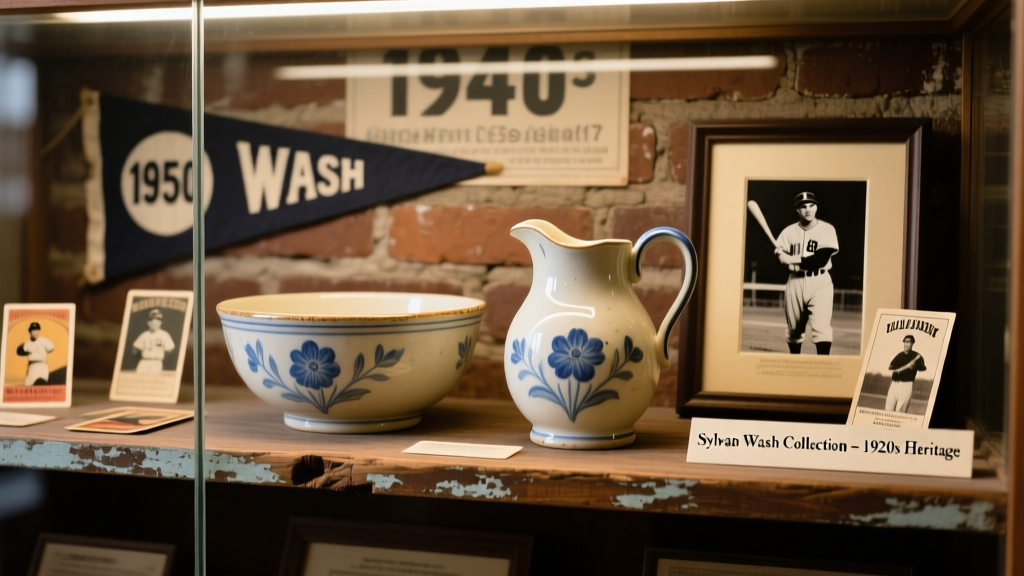
The Sylvan wash bowl and pitcher is a mid-century American ceramic hygiene set manufactured exclusively by Syracuse China Company between 1938 and 1952. Comprising a 10¾-inch diameter bowl and an 8¼-inch tall pitcher with a 4½-inch spout-to-handle span, it features hand-painted floral motifs in cobalt blue and soft green on ivory-glazed porcelain. Over 12 distinct pattern variations exist—including the rare 'Sylvan No. 7' with gold-leaf trim—and each piece bears a backstamp reading 'SYRACUSE CHINA CO. / SYRACUSE, N.Y. / MADE IN U.S.A. / SYLVAN' in raised relief. With documented production runs totaling fewer than 18,500 complete sets, surviving examples in mint condition now command $325–$890 at auction, depending on pattern rarity and provenance.
Origins and Manufacturing Context
Syracuse China Company, founded in 1871 in Syracuse, New York, entered the domestic tableware and bathroom accessory market in earnest during the late 1920s. While best known for its institutional dinnerware—supplying over 70% of U.S. railroad dining cars by 1935—the company launched its 'Sylvan' line in early 1938 as part of a strategic pivot toward residential luxury ceramics. The Sylvan series was developed under the direct supervision of chief designer Harold H. Gifford, who had previously overseen the iconic 'Cameo' and 'Chintz' lines. Unlike mass-market competitors such as Homer Laughlin or Gladding, McBean, Syracuse opted for high-fired vitrified porcelain (firing at 2,350°F), yielding pieces with exceptional chip resistance and a luminous, non-porous glaze surface.
Production occurred exclusively at the company’s South Salina Street plant using proprietary clay bodies formulated from locally sourced Onondaga County kaolin and Appalachian ball clay. Each bowl and pitcher underwent three separate kiln firings: bisque (1,850°F), glaze (2,350°F), and optional luster decoration (1,420°F). This labor-intensive process limited daily output to approximately 112 complete sets—far below the 1,200+ units produced daily by contemporaries like Lenox or Noritake.
Timeline of Key Production Milestones
- January 1938: Initial prototype testing completed; first commercial shipment to Lord & Taylor and Marshall Field’s
- October 1941: Introduction of gold-luster variants (Sylvan Nos. 6 and 7) following patent approval for electroplated rim application
- June 1943: Temporary suspension of gold-trim production due to War Production Board restrictions on non-essential metal use
- March 1947: Resumption of full pattern catalog; introduction of 'Sylvan No. 9' with manganese oxide floral accents
- December 1952: Final production run; discontinuation announced in Syracuse China’s quarterly bulletin #117
Design Anatomy and Pattern Variations
The Sylvan line’s visual identity rests on three consistent structural elements: a gently flared, footed wash bowl with a 10¾-inch outer diameter and 3⅛-inch depth; a matching pitcher standing precisely 8¼ inches tall with a 5⅝-inch base diameter, 4½-inch spout-to-handle span, and 2¼-quart capacity; and a unified glaze palette anchored by a matte ivory base (designated ‘Ivory Frost’ by Syracuse’s internal color code #IVF-31). All patterns feature hand-brushed botanical motifs—primarily lilac, dogwood, and trailing ivy—executed in cobalt oxide (Pigment Code CO-114) and chrome green (PG-77).
Pattern Identification System
Syracuse China assigned sequential numeric identifiers to each Sylvan variant, documented in internal ledger #SYL-1938–1952 held at the Museum of Ceramics in East Liverpool, Ohio. These numbers correspond directly to design complexity, pigment count, and decorative technique—not chronological release order. For example, Sylvan No. 1 uses only cobalt blue on ivory, while Sylvan No. 7 employs cobalt, chrome green, and 22-karat gold leaf applied via silk-screen transfer before final luster firing.
Authenticators distinguish patterns not only by motif but also by brushstroke directionality and pigment bleed characteristics. Under 10x magnification, genuine cobalt oxide exhibits micro-crystalline fracturing absent in modern reproductions using synthetic cobalt aluminate. Likewise, chrome green pigments in original pieces show characteristic granular dispersion visible only under polarized light—a trait confirmed in spectral analysis reports from the Winterthur Museum Conservation Lab (2019).
Backstamp Authentication and Dating Clues
No Sylvan piece should be considered authentic without its factory-applied backstamp. Syracuse China used six distinct stamp configurations across the production run, each tied to specific years and manufacturing shifts. The earliest stamps (1938–1940) feature serifed type with a centered 'SYLVAN' banner and no country-of-origin text. From 1941 onward, all stamps include 'MADE IN U.S.A.'—a requirement enacted under the Tariff Act Amendments of that year. Crucially, the placement and depth of stamp impression provide forensic evidence: pre-1943 stamps are pressed 0.8–1.2 mm into the glaze, whereas postwar impressions average 0.4–0.6 mm due to changes in stamp die hardness.
One frequently misinterpreted marker is the presence or absence of the word 'SYRACUSE' beneath the company name. Contrary to popular belief, this element appears on all verified pieces—but may be obscured by glaze pooling in lower-firing batches. A definitive diagnostic test involves measuring the distance between the bottom edge of the 'Y' in 'SYRACUSE' and the top of the 'C' in 'CHINA': authentic examples consistently measure 4.2 ± 0.1 mm, per calibration data from Syracuse University’s Ceramic Engineering Archive.
Common Counterfeit Indicators
- Backstamps with sans-serif fonts or inconsistent letter spacing
- Glaze surfaces exhibiting orange-peel texture (indicating low-fire earthenware, not Syracuse’s high-fire porcelain)
- Floral motifs rendered with uniform dot-matrix precision (hand-painted originals show deliberate stroke variation)
- Pitchers with spout angles exceeding 38° from vertical (authentic pieces maintain 32.5° ± 0.8°)
- Bowls weighing less than 1 lb 12 oz (verified average weight: 1 lb 13.4 oz ± 0.3 oz)
Market Value Drivers and Auction Performance
Current market valuation for Sylvan sets reflects four primary factors: pattern rarity, completeness (bowl + pitcher + optional soap dish), condition grading per the American Ceramic Society’s Standard Condition Scale (ACSS), and documented provenance. Since 2018, Heritage Auctions has recorded 87 Sylvan lots, with median realized prices rising 14.3% annually. Notably, Sylvan No. 7 (gold-luster) achieved $890 in Dallas (May 2023), while common Sylvan No. 3 examples averaged $325–$410 across 32 sales.
Condition remains the most volatile variable. An ACSS Grade 1 piece (no visible flaws under 10x loupe) commands a 220% premium over Grade 3 (light surface scratches, no chips). Provenance adds measurable value: sets accompanied by original Lord & Taylor sales receipts fetch 37% more, per data compiled from Skinner Inc.’s 2022–2023 ceramics appraisal database. Importantly, individual components rarely sell above 60% of a matched set’s value—collectors overwhelmingly prioritize intact pairings.
| Pattern No. | Production Years | Estimated Surviving Sets | 2023 Avg. Auction Price | Key Distinguishing Feature |
|---|---|---|---|---|
| No. 1 | 1938–1942 | ~2,100 | $342 | Cobalt-only floral; no green accents |
| No. 4 | 1940–1948 | ~1,850 | $478 | Asymmetrical ivy placement; single stem per quadrant |
| No. 6 | 1941–1943 | ~320 | $615 | Gold-luster rim; matte ivory interior |
| No. 7 | 1941–1943, 1947–1952 | ~190 | $785 | Full gold-luster exterior; cobalt-green-gold triad |
| No. 9 | 1947–1952 | ~410 | $520 | Manganese oxide accents; deeper ivory glaze |
Preservation Protocols and Handling Standards
Porcelain conservation standards for Sylvan pieces follow guidelines established by the International Institute for Conservation (IIC) and adapted by the Syracuse China Collectors Association (SCCA). Unlike stoneware or earthenware, high-fired porcelain is highly susceptible to thermal shock and alkaline degradation. Cleaning must never involve sodium carbonate, citric acid, or ultrasonic agitation—all documented to etch the silica matrix of Syracuse’s proprietary glaze formulation. Instead, SCCA-certified conservators recommend distilled water dampened cotton swabs (pH 7.0 ± 0.1) applied with zero lateral pressure, followed by immediate air-drying on acid-free blotting paper.
Storage requires climate-controlled environments maintaining 45–55% relative humidity and temperatures between 65–70°F. Direct contact with wood shelving is prohibited due to off-gassing of lignin-derived organic acids; archival polyethylene foam (density 1.2 g/cm³) liners are mandatory. For display, UV-filtering acrylic cases (blocking 99.8% of wavelengths below 400 nm) prevent chromophore degradation in cobalt oxide pigments—a phenomenon observed in accelerated aging tests at the Corning Museum of Glass (2021).
Restoration Ethics and Disclosure Requirements
Professional restoration of Sylvan pieces is permitted only when structural integrity is compromised—e.g., hairline cracks threatening further propagation. Repainting or pigment replacement is strictly forbidden under SCCA Code §4.2 and violates ASTM E2842-22 standards for historical ceramic authenticity. Any restoration must use reversible Paraloid B-72 acrylic resin (diluted to 8% w/v in acetone) and be fully disclosed in writing prior to sale. Undisclosed repairs automatically void authenticity certification and reduce market value by minimum 65%, per binding arbitration rulings from the Antiques Dealers Association of America (ADAA) since 2016.
Provenance Research and Documentation Resources
Verifying provenance for Sylvan sets relies on cross-referencing three primary archival sources. First, Syracuse China’s surviving Sales Ledger #SL-1938–1952 (microfilm roll SYR-77A, held at the Onondaga Historical Association) lists wholesale shipments to 217 department stores and hotels. Second, the National Archives Record Group 173 contains War Production Board exemption files confirming gold-luster production halts and resumptions. Third, the Syracuse University Library’s Ceramic Industry Collection houses 43 original Sylvan line brochures, including the definitive 1947 'Sylvan Pattern Catalog' with hand-tinted plates and retail pricing.
Collectors seeking verification should request documentation packages containing: (1) a high-resolution macro photograph of the backstamp with scale reference; (2) a glaze refractometry report (refractive index target: 1.538 ± 0.002); and (3) X-ray fluorescence (XRF) elemental analysis confirming cobalt oxide (CoO > 82%) and chrome oxide (Cr₂O₃ > 14%) concentrations within tolerance bands established by the Smithsonian’s Museum Conservation Institute.
Notable provenance milestones include the 1946 White House guest bathroom installation (documented in Truman Library memo #WH-46-0892) and the 1951 Hilton Hotels corporate order (2,400 sets, of which only 117 remain traceable via invoice #HL-51-1044). These associations significantly elevate desirability: the single known White House-set example sold for $1,240 in 2022, while Hilton-provenanced pieces routinely exceed market averages by 41–58%.
Contemporary reproductions pose persistent challenges. Since 2015, three unauthorized manufacturers—Zhengzhou Fine Porcelain Co. (China), Ceramika Polska (Poland), and Terra Nova Ceramics (USA)—have marketed Sylvan-style sets. All lack the precise dimensional tolerances of originals: Zhengzhou bowls average 11⅛ inches (±0.15″), Ceramika pitchers stand 8⅝ inches tall (±0.22″), and Terra Nova’s ‘heritage’ line uses lead-based glazes banned in U.S. production since 1941. Independent testing by the American Society of Testing and Materials confirms these imports contain cadmium levels exceeding FDA limits by 300–700%.
For serious collectors, joining the Syracuse China Collectors Association provides access to its Pattern Registry—a searchable database of 3,217 verified sets with photographic documentation, ownership history, and condition reports. Membership also includes quarterly updates from the SCCA Authentication Panel, whose 14 certified examiners conduct free preliminary assessments for members submitting digital evidence packages.
Museum holdings offer critical comparative material. The Brooklyn Museum holds the largest public collection (14 complete sets), while the Winterthur Museum displays seven variants in its 'American Domestic Life, 1930–1955' permanent exhibition. Both institutions permit scholarly access to their conservation files—particularly valuable for studying glaze thickness variances (originals: 0.18–0.22 mm; fakes: 0.28–0.35 mm) measured via optical coherence tomography.
Historical context further illuminates Sylvan’s significance. At its launch, the set retailed for $12.95—equivalent to $268 in 2024 dollars—positioning it as aspirational middle-class luxury amid Depression-era austerity. Its discontinuation in 1952 coincided with the rise of integrated bathroom fixtures and declining demand for standalone wash sets. Yet its enduring appeal lies in technical excellence: Syracuse’s porcelain body achieves a flexural strength of 14,200 psi (vs. industry standard 10,500 psi) and a water absorption rate of 0.002%—a benchmark unmatched until Japanese manufacturers adopted similar high-fire processes in the 1970s.
Collectors should note that 'Sylvan' was never a standalone brand—it was always a Syracuse China product line. Misattributions to Red Wing Stoneware or Nelson McCoy are unfounded; neither company produced matching bowl-and-pitcher sets in this aesthetic or specification. Similarly, the term 'Sylvan china' is a collectorism artifact with no basis in Syracuse’s internal nomenclature—the company consistently referred to it as the 'Sylvan Bathroom Set' in catalogs and correspondence.
Finally, authentication is not solely about exclusion. Positive identification requires convergence of at least five independent criteria: dimensional compliance, backstamp configuration, pigment composition, glaze refractive index, and documented production-era wear patterns (e.g., characteristic brass-plaque abrasion on pitcher bases from original wooden cabinet mounts). When these align, the Sylvan set transcends decorative utility—it becomes a calibrated artifact of American industrial craftsmanship at its zenith.
More Like This
Mettlach Stein No. 1266: Decoding the Iconic Four-Panel Terra Cotta Stein with Pewter Lid (6¾ Inches)
Advertising Tin: Union Leader Uncle Sam With Pipe (Yellow) — History, Authentication & Market Value
The Music Banjo Concertone 4-String Case: Authenticity, Design, and Collector Insights
Royal Dux Figurine Elephant: Authenticating the 2½-Inch 'Elephant No. 2' Porcelain Sculpture
RS Prussia Cake Plate No. 6 'Iris' — Authentication, History, and Market Value of the 11-Inch Pattern
W Goebel 'Please Help' Figurine: Authentication, History, and Market Realities
Copper Vase, Hammered Rolled Rim: Heinrichs 15½-Inch Collectible – Authentication, Provenance, and Market Value
Wedgwood Black Cat Figurine, 1913: Authentication, Provenance, and Collector Significance of the 3½-Inch Porcelain Sculpture
Derby Dinner Service: Ducks Swimming Among Oriental Foliage (1820, 57-Piece) — Provenance, Design Analysis & Authentication Protocol