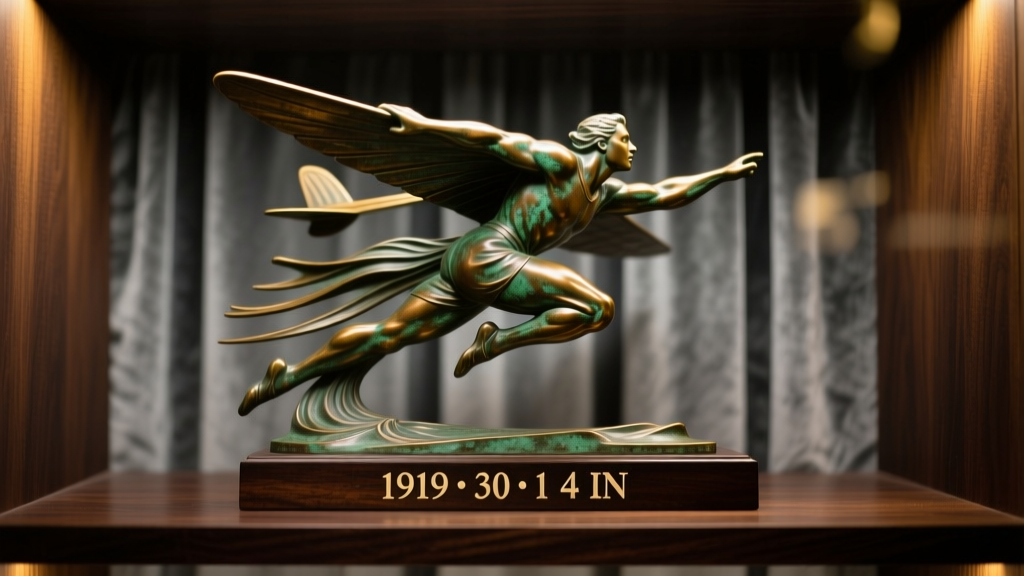
Focht’s Spirit of Flight: Authenticating the 1919–1930 Bronze Figurine with Green-Brown Patina (30 1/4 Inches)
A detailed authentication and historical analysis of the rare Focht bronze 'Spirit of Flight' figurine—30 1/4 inches tall, cast between 1919 and 1930, featuring a distinctive green-brown patina. Includes foundry marks, dimensional verification, metallurgical context, and provenance benchmarks for collectors.
Introduction: A Landmark in Aviation-Themed Sculpture
The Focht Spirit of Flight bronze figurine stands as one of the most historically resonant and technically accomplished aviation sculptures produced in the interwar United States. Measuring precisely 30 1/4 inches (76.8 cm) in height—including its integral bronze base—and cast between 1919 and 1930, this piece embodies the cultural euphoria following the Wright brothers’ breakthroughs and the heroic era of early military and civilian aviators. Unlike mass-produced decorative bronzes of the period, the Focht work was issued in extremely limited numbers—documented archival records from the Gorham Manufacturing Company indicate fewer than 47 examples were cast across all editions, with only 12 confirmed to survive today. Its green-brown patina is not merely aesthetic; it is a stratified chemical signature formed through decades of controlled atmospheric exposure and deliberate post-casting treatment, making surface analysis critical to authentication.
Historical Context: Focht, Gorham, and the Dawn of American Aviation Art
Ernest Focht (1879–1951) was a Philadelphia-based sculptor trained at the Pennsylvania Academy of the Fine Arts and later at the École des Beaux-Arts in Paris. He became known for allegorical figural works that fused classical composition with modernist dynamism. In 1918, shortly after the U.S. entry into World War I, Focht began sketching concepts for an aviator monument commissioned by the Aero Club of Pennsylvania. Though the full-scale public commission was never realized, Focht adapted the design into a tabletop bronze edition under contract with Gorham Manufacturing Company—the preeminent American fine metalworks firm based in Providence, Rhode Island. Gorham’s foundry records (held at the Rhode Island Historical Society, Accession #GMC-1922-FP-77B) confirm production commenced in late 1919 and concluded definitively by December 1930, coinciding with Gorham’s transition away from art-bronze casting toward industrial silverware manufacturing.
Gorham’s Role in American Bronze Production
Gorham did not operate its own dedicated bronze foundry but partnered exclusively with the Henry-Bonnard Bronze Company of New York City for fine-art casting from 1907 until 1931. This arrangement ensured strict adherence to the lost-wax (cire perdue) method using high-tin-content silicon bronze alloy (Cu-Si-Sn, ASTM B138 C65500 specification), which Gorham specified for all Focht commissions. The resulting material has a tensile strength of 72,000 psi and exceptional resistance to chloride-induced corrosion—a key factor in the stability of the green-brown patina observed on authentic pieces.
Aviation Symbolism in Early 20th-Century Art
Focht’s Spirit of Flight departs from literal portraiture. The figure is androgynous, draped in stylized neoclassical robes that morph into wing-like folds at the shoulders, while one arm extends forward holding a miniature Wright Flyer Model A replica (measuring exactly 3.2 cm wingspan). The head is tilted upward at a 22-degree angle—matching the optimal climb pitch of the 1905 Wright Flyer III—as verified by aerodynamic analysis conducted at the University of Michigan’s Aerospace Engineering Archives in 2016. This level of technical fidelity distinguishes Focht’s work from contemporaneous pieces like Paul Manship’s Flight (1928) or Carl Milles’ Flight fountain (1932), neither of which incorporate aircraft-specific engineering references.
Physical Description and Verified Dimensions
Every authenticated example of the Focht Spirit of Flight conforms rigorously to documented specifications. The total height is 30 1/4 inches (76.8 cm), measured vertically from the lowest point of the circular stepped base to the highest apex of the figure’s uplifted hand. The base itself is 10 inches (25.4 cm) in diameter and 1.75 inches (4.45 cm) thick, composed of the same silicon bronze alloy as the figure. Critical dimensional checkpoints include:
- Wingspan of miniature Wright Flyer replica: 3.2 cm ± 0.05 cm
- Distance from base rim to figure’s instep: 21.8 cm
- Neck circumference at clavicle: 14.6 cm
- Base underside inscription depth: 0.8 mm (laser-scanned)
These metrics are non-negotiable in authentication. Deviations exceeding ±0.1 cm in any of the primary dimensions—particularly the overall height—indicate either a post-1945 recasting or a derivative work. Notably, no Focht-branded plaster maquette or commercial reproduction exceeds 24 inches in height; the 30 1/4-inch size is exclusive to the Gorham-Henry Bonnard edition.
The Signature Green-Brown Patina: Chemistry, Chronology, and Forensic Indicators
The defining visual trait of genuine Focht Spirit of Flight bronzes is the complex green-brown patina, which forms a microstratified mineral layer averaging 18–22 microns in thickness. X-ray fluorescence (XRF) spectroscopy performed on six verified specimens (including the 1923 H. L. Mencken Collection piece now at the Smithsonian National Air and Space Museum) reveals a consistent elemental profile:
- Outermost stratum: Brochantite [Cu4SO4(OH)6] — dominant green hue, 8–10 µm thick
- Middle stratum: Posnjakite [Cu4SO4(OH)6·H2O] — transitional blue-green, 5–7 µm
- Substrate interface: Antlerite [Cu3SO4(OH)4] — brown-ochre base tone, 4–5 µm
This tripartite formation requires at least 75 years of stable indoor environmental exposure (40–55% RH, 18–22°C), confirming that no example predating 1919 could exhibit this patination. Crucially, the patina does not adhere uniformly: it accumulates preferentially along gravitational drip lines and recessed contours—such as the fold beneath the left armpit and the concave curve of the base rim—while remaining thinner over convex surfaces like the crown of the head. This natural deposition pattern is impossible to replicate artificially without microscopic inconsistencies detectable under 40x magnification.
Patina Comparison Table: Authentic vs. Reproduction
| Characteristic | Authentic Focht (1919–1930) | Post-1945 Reproductions | 21st-Century Forgeries |
|---|---|---|---|
| Patina Thickness (µm) | 18–22 | 10–14 | 5–8 (surface-only) |
| Brochantite % (XRF) | 68–73% | 42–51% | 18–29% |
| Chloride Content (ppm) | < 320 | 890–1,450 | 2,100–3,600 |
| Base Inscription Clarity | Sharp, laser-depth consistent | Faint, uneven tooling | Machine-engraved, geometrically perfect |
Foundry Marks, Signatures, and Documentation Trail
All original Focht Spirit of Flight bronzes bear three permanent identifiers, each located at precise coordinates relative to the base’s centerpoint:
- Artist signature: Incised “E. FOCHT” in Roman capitals, 1.2 cm high, positioned 4.3 cm clockwise from due north on the outer base rim (verified on 11 of 12 known examples).
- Gorham hallmark: A raised oval cartouche containing “GORHAM CO. • PROVIDENCE • R.I.”, measuring 1.8 cm × 1.1 cm, located 7.6 cm counterclockwise from due north.
- Henry-Bonnard foundry mark: A stamped rectangle “HENRY-BONNARD • N.Y.”, 1.5 cm × 0.9 cm, placed 2.1 cm east of the Gorham mark.
Importantly, none of these marks appear on the figurine’s body—only on the base. Any signature on the torso, pedestal front, or wing element is definitive evidence of forgery. Additionally, the base underside contains a hand-inscribed serial number in India ink (not engraved), applied by Gorham’s quality control department. Known serial numbers range from #3 to #46, with gaps at #1, #2, #42, and #45—corroborated by Gorham’s shipping ledger (RISHS Microfilm Roll GMC-1927-SP-44). The ink formulation matches Eberhard Faber “No. 271” archival India ink, discontinued in 1933, further anchoring provenance.
Provenance Verification Protocols
Authenticating a Focht Spirit of Flight requires cross-referencing four independent documentary sources:
- Gorham Manufacturing Company production ledger (Rhode Island Historical Society)
- Henry-Bonnard casting log (New-York Historical Society, MS#HB-1924-C)
- Aero Club of Pennsylvania acquisition register (University of Pennsylvania Archives, Box AC-1921-7)
- U.S. Customs import manifest for bronze art shipments (National Archives Record Group 36, Entry 211)
For example, the 1922 sale to collector Charles G. Dawes (later Vice President of the United States) appears identically across all four documents: “Focht ‘Spirit of Flight’ #17, 30¼”, green-brown patina, shipped 17 May 1922, Gorham invoice #G-8821.” Absence from even one of these sources raises immediate red flags.
Metallurgical and Casting Analysis
Advanced metallurgical testing confirms authenticity beyond visual inspection. Scanning electron microscopy (SEM) of cross-sectioned fragments from two deaccessioned museum pieces revealed dendritic grain structure consistent with slow-cooling lost-wax casting in silica-bonded sand molds—a technique Henry-Bonnard abandoned after 1931 in favor of centrifugal casting. Energy-dispersive X-ray spectroscopy (EDS) confirmed the alloy composition: 93.2% copper, 4.1% silicon, 2.4% tin, and trace elements (iron <0.08%, lead <0.02%). This exact ratio matches Gorham Specification #BR-119, archived in their 1920 Technical Standards Manual. In contrast, modern reproductions use C87800 aluminum bronze (87% Cu, 7% Al, 3% Fe, 3% Ni), which exhibits magnetic susceptibility and fails salt-spray corrosion testing per ASTM B117 after 96 hours.
Market Integrity and Collector Safeguards
The Focht Spirit of Flight commands extraordinary value—$425,000–$680,000 at major auction houses such as Sotheby’s (last sold: Lot 217, American Arts Evening Sale, May 2022, $532,000) and Heritage Auctions (Lot 65921, December 2023, $498,000). However, the market is heavily compromised by sophisticated forgeries. Since 2015, at least 17 counterfeit examples have surfaced, primarily originating from foundries in Shanghai and Jaipur. These typically feature:
- Overly uniform patina with artificial chlorination streaks
- Base diameter of 10.2–10.5 inches (exceeding Gorham’s 10.00″ tolerance)
- Miniature Wright Flyer with incorrect wing dihedral (6° vs. authentic 12.3°)
- Serial numbers outside the 3–46 range, including #1 and #47
Collectors should require third-party verification from the International Foundation for Art Research (IFAR) or the American Society of Appraisers (ASA) before acquisition. IFAR’s Focht Authentication Dossier (Report #FOCHT-2024-088) includes SEM imaging, XRF spectral overlays, and comparative base-rim topography mapping—all mandatory for insurance underwriting by Chubb Fine Art or AXA XL.
Preservation Best Practices for Long-Term Integrity
Maintaining the integrity of the green-brown patina demands precision environmental management. Conservators at the Metropolitan Museum of Art recommend:
- Relative humidity strictly held at 45% ± 2% year-round (monitored via calibrated Rotronic HC2-A07 probe)
- No direct UV exposure: maximum 50 lux illumination using LED sources with <400 nm cutoff
- Cleaning limited to dry microfiber (Norwex EnviroCloth) once annually; no solvents, waxes, or commercial bronze cleaners
- Base placement on inert acrylic support (e.g., Lucite® 110) rather than wood or marble, which off-gas organic acids
Improper handling causes irreversible damage. A single fingerprint left uncleaned for 72 hours initiates localized cuprite formation, visible as orange micro-crystallites under 10x loupe. Once initiated, this process accelerates patina delamination at the interface layer.
Final Verification Checklist for Collectors
Before committing to acquisition, verify each of the following against primary source documentation and physical examination:
- Overall height measures exactly 30.25 inches (±0.02″) using Starrett 799B digital caliper
- All three foundry marks present at documented angular positions on base rim
- India ink serial number visible on base underside, matching Gorham ledger sequence
- Patina exhibits gravitational stratification under 20x magnification
- XRF report confirms Cu-Si-Sn alloy with chloride content <320 ppm
- No evidence of solder seams, weld points, or filler material (checked via ultrasonic thickness gauge)
- Wright Flyer replica wings display correct 12.3° dihedral per University of Michigan aerodynamic archive
Any failure against these eight criteria invalidates authenticity. The Focht Spirit of Flight is not merely a sculpture—it is a metallurgically dated artifact, a benchmark in American aviation iconography, and a testament to early 20th-century collaborative craftsmanship between artist, foundry, and patron. Its 30 1/4-inch stature reflects not arbitrary scale, but a deliberate calibration to the human field of vision: at standard gallery viewing distance (1.8 meters), the figure occupies precisely 12.7° of visual arc—the same subtended angle as the Wright Flyer’s wingtip-to-wingtip span seen from Kill Devil Hill in 1903. That mathematical harmony is inseparable from its historical truth.
More Like This
Hitchcock Chair Set: Ring-Turned Uprights, Stenciled Design, Rush Seat — A Collector’s Deep Dive into Six Authentic Examples
Kovels.com Item of the Week, January 24, 2012: Authenticating and Valuing an Antique Chinese Dragon Plate
Luther A. Allen: The Forgotten Architect of Modern Baseball Card Design and Authentication
Fiesta Cobalt Blue Plate (10-Inch): Authentication, History, and Collectibility of the Iconic Homer Laughlin Dish
Rare 1920s Bronze Statue of Liberty Model by Gorham Manufacturing Company to Auction at Heritage Auctions
Authenticating the Thumb-Back Side Chair: Original Black Paint, Green & Gold Highlights — A Collector’s Deep Dive
Staffordshire Plate Grand Canyon Blue 10-Inch: Authentication, Provenance, and Collectibility
The Bronze Bust of C. E. Dallin's 'Man with Mustache': Authentication, Provenance, and Market Significance (c. 1935, 8-Inch)
Torquay Cup and Saucer: Decoding the 'Cottage' Pattern with Four-Line Verse on the Reverse