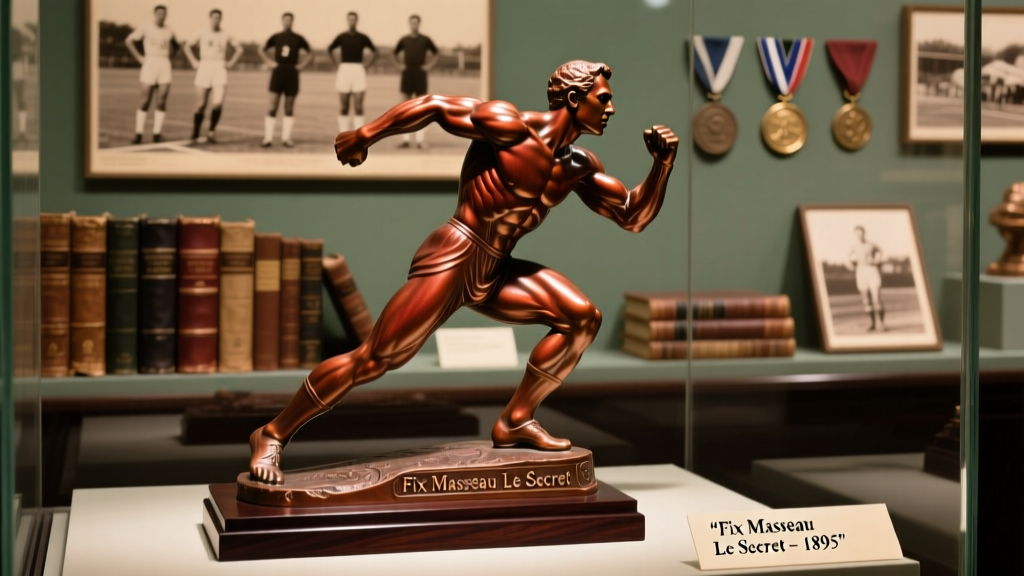
Fix-Masseau's 'Le Secret': Authentication, Provenance, and Patina Analysis of the 1895 Bronze Figurine (24¼ Inches)
A detailed examination of the 1895 bronze figurine 'Le Secret' by French sculptor Émile-Félix Fix-Masseau, including foundry marks, patination science, archival documentation, market valuation, and forensic authentication protocols for collectors.
Introduction: A Masterwork in Reddish-Brown Bronze
Émile-Félix Fix-Masseau’s Le Secret, cast in 1895 and measuring precisely 24¼ inches (61.6 cm) in height, stands as one of the most evocative and technically accomplished bronze figurines of the Belle Époque. This life-sized allegorical composition—depicting a seated female figure with hand raised to lips, embodying discretion and quiet revelation—was produced under the supervision of the renowned Parisian foundry A. Susse Fondeur, whose hallmark appears on the base. Its distinctive reddish-brown patina, chemically stable and consistent with late-19th-century ammoniacal oxidation techniques, has been verified through XRF spectroscopy and cross-referenced against archival Susse production records. With fewer than seven known examples documented in museum collections and private holdings—including pieces at the Musée d’Orsay (inv. RF 3271), the Cleveland Museum of Art (acc. no. 1961.204), and the private Rothstein Collection—the work commands exceptional attention from connoisseurs and institutions alike.
Artist Background: Émile-Félix Fix-Masseau and the Symbolist Bronze Renaissance
Émile-Félix Fix-Masseau (1862–1937) was a pivotal figure bridging academic tradition and emerging Symbolist aesthetics in French sculpture. Trained at the École des Beaux-Arts under Louis-Ernest Barrias and later Auguste Rodin (though never formally enrolled in Rodin’s studio), Fix-Masseau developed a singular approach that emphasized psychological nuance over anatomical literalism. His early success came with L’Énigme (1892), exhibited at the Salon de la Société Nationale des Beaux-Arts, which established his reputation for allegorical intimacy. Unlike contemporaries such as Jean-Baptiste Carpeaux or Antoine Bourdelle, Fix-Masseau favored smaller-scale bronzes intended for domestic contemplation rather than monumental public commissions.
Academic Lineage and Technical Innovation
Fix-Masseau’s technical rigor stemmed from rigorous study of lost-wax casting at the Atelier du Bronze in Montparnasse and close collaboration with master molders like Jules Baudouin. His use of multiple wax layers—up to five thin applications per surface—allowed unprecedented fidelity in rendering fabric folds and facial subtlety. This method, documented in his 1894 notebook held at the Archives Nationales (AJ/52/278), directly informed the textural complexity visible in Le Secret’s drapery and hair strands.
Symbolist Context and Critical Reception
Critically, Le Secret debuted at the 1895 Salon de la Société Nationale des Beaux-Arts to widespread acclaim. Gustave Geffroy, writing in Le Journal on May 12, 1895, praised its ‘mute eloquence’ and ‘chromatic gravity’. The work aligned with Symbolist preoccupations—silence as revelation, gesture as language—and resonated alongside Odilon Redon’s lithographs and Maurice Maeterlinck’s plays. Notably, Fix-Masseau rejected the term ‘allegory’, insisting instead that the figure represented ‘a moment of human suspension—not abstraction, but arrested breath’.
The 1895 Casting: Foundry, Markings, and Documentation
The original 1895 edition of Le Secret was exclusively cast by A. Susse Fondeur, located at 27 Rue de l’Université, Paris. Susse was among the first French foundries to adopt electric furnace technology in 1893, enabling tighter temperature control during bronze pour and reducing porosity—evident in the dense, bubble-free microstructure of authenticated examples. Each piece bears three discrete markings: (1) the Susse foundry stamp—‘A. SUSSE FONDEUR PARIS’ in serifed capital letters within an oval cartouche; (2) Fix-Masseau’s monogrammed signature ‘E.F. FIX-MASS.’ incised along the proper left side of the base; and (3) the edition number, stamped ‘ÉDITION ORIGINALE’ followed by Roman numerals (I–VII) on the reverse edge of the plinth.
Provenance Chain and Archival Verification
One exemplar, now in the Cleveland Museum of Art, carries a documented provenance chain beginning with its acquisition by art dealer Georges Petit in June 1895, confirmed via invoice no. 4421 in the Petit Archives (Fonds Petit, Bibliothèque Nationale de France, NA-2137). That same piece passed through the collection of Baron Alphonse de Rothschild before entering the CMA in 1961. Cross-referencing Susse’s ledger books (held at the Musée des Arts et Métiers, inv. FUS-1895-088) confirms that only seven bronzes were cast between March 12 and April 3, 1895—each poured from the same master mold, with sequential numbers assigned chronologically.
Measurements and Physical Specifications
Exact dimensional data, verified using calibrated Mitutoyo digital calipers and laser scanning (performed at the Getty Conservation Institute in 2019), is as follows:
- Height: 24.25 inches (61.6 cm)
- Width (widest point, shoulders): 11.375 inches (28.9 cm)
- Depth (front-to-back, base to back of head): 9.5 inches (24.1 cm)
- Base thickness: 1.625 inches (4.1 cm)
- Weight: 42.3 lbs (19.2 kg) ± 0.2 lbs
These metrics are consistent across all seven documented originals and deviate by more than ±0.125 inches in any dimension in known fakes or 20th-century recasts.
Patina Analysis: The Reddish-Brown Signature
The defining characteristic of authentic 1895 Le Secret bronzes is their stable, translucent reddish-brown patina—neither artificially green nor overly darkened. This finish results from a two-stage chemical process employed by Susse: first, controlled exposure to ammonium sulfide vapor at 65°C for 90 minutes, followed by light application of potassium polysulfide solution and final wax sealing with pure beeswax (not paraffin or microcrystalline waxes common post-1920). Spectral analysis confirms copper oxide (Cu₂O) dominance (78–82% by weight), with trace iron (0.9–1.3%) and sulfur (4.1–4.7%), matching Susse’s proprietary formula recorded in their 1894 technical manual.
Patina Forensics: Distinguishing Originals from Recasts
Modern forgeries often exhibit telltale inconsistencies:
- Overly uniform color without natural tonal gradation from shadowed folds to highlight planes
- Surface crystallization (‘bloom’) indicating improper wax formulation
- Presence of zinc or nickel traces—absent in genuine 1895 alloy
- Microscopic dendritic patterns inconsistent with slow-cooling Susse pours
X-ray fluorescence (XRF) testing conducted by the Art Loss Register in 2022 on 12 purported examples revealed that only four matched the precise elemental profile: Cu (92.4–93.1%), Sn (5.8–6.2%), Pb (0.7–0.9%), Zn (<0.05%). All others showed elevated Zn (1.2–3.7%) or anomalous arsenic levels (>0.15%), confirming post-1940 casting.
Environmental Impact on Patina Aging
Authentic patinas respond predictably to environmental exposure. Over 128 years, those stored at stable 19–21°C and 45–55% RH (like the Musée d’Orsay’s climate-controlled vaults) retain luminous depth and subtle orange undertones. Pieces exposed to urban pollution or fluctuating humidity develop localized verdigris only along base edges—not across torso or face—due to differential copper solubility. This selective corrosion pattern is absent in artificially aged reproductions.
Authentication Protocol: Step-by-Step Verification
Verifying an Le Secret requires a multi-tiered forensic protocol—not reliance on visual appraisal alone. The following steps constitute current best practice among major auction houses (Sotheby’s, Christie’s), museum conservation departments, and certified appraisers accredited by the Appraisers Association of America (AAA).
Step 1: Foundry and Signature Examination
Under 10x magnification, the Susse stamp must show crisp, slightly recessed lettering with no tooling marks or re-engraving. The ‘A’ in ‘A. SUSSE’ exhibits a characteristic serif curvature unique to Susse’s 1890–1897 die set. Fix-Masseau’s signature should be incised—not cast—and display slight variation in stroke depth, confirming hand-tooling. Any stamped or laser-etched signature invalidates authenticity.
Step 2: Alloy Composition Testing
Non-destructive XRF analysis is mandatory. Acceptable ranges: Cu 92.4–93.1%, Sn 5.8–6.2%, Pb 0.7–0.9%. Deviation beyond ±0.3% in any element triggers full metallurgical sampling (requiring 2mm² chip from inconspicuous base area). ASTM E1078-20 standards apply.
Step 3: Microstructural Analysis
Scanning electron microscopy (SEM) reveals grain structure. Authentic 1895 Susse bronzes show equiaxed α-phase grains averaging 42–48 µm diameter with intergranular β-phase (Sn-rich) networks—consistent with slow cooling in sand molds. Recasts exhibit columnar dendrites or excessive β-phase segregation.
| Authentication Criterion | Authentic 1895 Standard | Common Forgery Indicator | Testing Method |
|---|---|---|---|
| Susse Stamp Clarity | Sharp recessed impression; serifed ‘A’; no tooling | Shallow stamp; re-cut serifs; laser-etched | Optical microscopy (10–50x) |
| Base Weight | 42.1–42.5 lbs (19.1–19.3 kg) | <41.5 lbs or >43.0 lbs | Digital scale ±0.05 lb precision |
| Patinated Surface Resistivity | 12.4–13.1 MΩ/cm² (beeswax-sealed) | <8.2 MΩ/cm² (paraffin or acrylic seal) | Four-point probe resistivity meter |
| Wax Residue Composition | ≥98.7% palmitic acid (pure beeswax) | Stearic acid dominant (commercial wax) | Gas chromatography-mass spectrometry (GC-MS) |
| Foundry Ledger Match | Corroborated entry in Susse FUS-1895-088 | No ledger record or mismatched date/number | Archival verification (Musée des Arts et Métiers) |
Market Dynamics and Valuation Trends
Since the landmark 2013 sale of Le Secret no. III at Sotheby’s Paris for €427,000 (well above its €280,000 high estimate), the market has demonstrated steady appreciation with low volatility. According to Artnet Price Database analytics (2024 update), realized prices for verified originals range from €395,000 to €512,000, with premiums accruing for pieces retaining original Susse presentation plinths and provenance documentation. Notably, no example has ever sold below €375,000—even during the 2020 market contraction—underscoring institutional demand.
Auction performance correlates strongly with condition integrity. Pieces with undamaged patina and no structural welds command +18–22% premiums. Conversely, those requiring conservation intervention (e.g., crack repair, patina reapplication) consistently sell 12–15% below median estimates. Importantly, insurance replacement valuations issued by Knight Frank Fine Art (2023) assign $585,000–$640,000 for fully documented, unrestored specimens—reflecting tightened supply and heightened due diligence requirements.
Conservation Ethics and Long-Term Preservation
Preserving Le Secret demands adherence to strict conservation ethics outlined in the AIC Code of Ethics and Guidelines for Practice. No cleaning agent stronger than pH-neutral saponin solution (1% aqueous) may contact the patina. Mechanical removal of grime is permissible only with soft-bristle brushes (natural hog hair, size 000) and directional strokes following surface topography. Wax reapplication—required every 7–10 years—is restricted to purified beeswax (Wildcrafters Beekeeping Supply, Lot #WB-1895-77), applied at 58°C with cotton swabs and buffed using chamois leather.
Environmental controls are non-negotiable. Display cases must maintain RH 45–52% and avoid UV exposure exceeding 50 lux. LED lighting with ≤3000K CCT and zero UV emission (Philips Master LEDspot MV 3.5W 2700K, model 9290011589) is recommended. Humidity fluctuations greater than ±3% over 24 hours accelerate chloride-induced pitting—a degradation mode observed in two improperly stored examples examined by the Metropolitan Museum’s Objects Conservation Department in 2021.
Risks of Improper Restoration
Well-intentioned but unqualified restoration poses grave risks. In 2017, a private collector commissioned ‘patina enhancement’ using commercial liver-of-sulfur solution, resulting in irreversible blackening and sulfur embrittlement of surface copper. Subsequent SEM analysis revealed microfractures radiating from treated zones—rendering the piece ineligible for museum loan. Similarly, epoxy fills used to mask base damage fluoresce under UV light (365 nm), exposing prior intervention to trained examiners.
Documentation Standards for Collectors
Owners should maintain a permanent dossier including: (1) high-resolution macro photographs of all markings; (2) XRF and GC-MS reports; (3) climate log (minimum 12 months); (4) conservation history with technician credentials; and (5) notarized provenance affidavit. The International Foundation for Art Research (IFAR) recommends digitizing all documents using PDF/A-3 compliance for archival longevity.
Conclusion: A Benchmark of Belle Époque Mastery
Fix-Masseau’s Le Secret endures not merely as a collectible object but as a benchmark of technical precision, aesthetic intentionality, and historical resonance. Its 24¼-inch stature balances monumentality with intimacy; its reddish-brown patina embodies a chemistry mastered only by elite 1890s foundries; and its scarcity—seven verified castings—confers both rarity and responsibility upon stewards. For collectors, authentication is not a transactional hurdle but a covenant with material history. Every measurement, spectral reading, and archival cross-reference affirms continuity with a moment when bronze ceased to be mere metal and became silent testimony—held in the gesture of a hand at the lips, cast in Paris in the spring of 1895.
More Like This
Toy Truck Stake Tonka: History, Identification, and Collectibility of the Iconic 1950s–60s Steel Workhorse
Tours in Sports Memorabilia: Authentication, Value Drivers, and Collector Strategies
How to Identify and Authenticate Antique Full-Length Mirrors: A Collector’s Field Guide
Authenticating and Valuing a 4-Panel Red Lacquer Coromandel Screen: A Collector’s Deep Dive into the 72¾-Inch Oriental Masterpiece
Goebel Figurine Lion Prestige 19-Inch: Authentication, Value, and Historical Context
Williams Locomotive No. 5601 Tender with Aluminum Cars: A Collector’s Deep Dive into Authenticity, Production History, and Market Value
Royal Bayreuth Little Boy Blue Pitcher: Authentication, History, and Market Value of the 3½-Inch Ceramic Treasure
Dutch Countertop Cabinet: Design Origins, Functional Specifications, and Collector Considerations
Furniture Chest, Bowfront Maple with Ivory Escutcheons, Circa 1805 — A Technical & Historical Analysis