The 1937 First National Boy Scout Jamboree Patch: Origins, Design, and Historical Significance
An in-depth examination of the official embroidered patch issued for the inaugural National Boy Scout Jamboree held at Washington, D.C., in 1937 — covering its design specifications, production details, rarity factors, authentication markers, and enduring legacy among collectors.
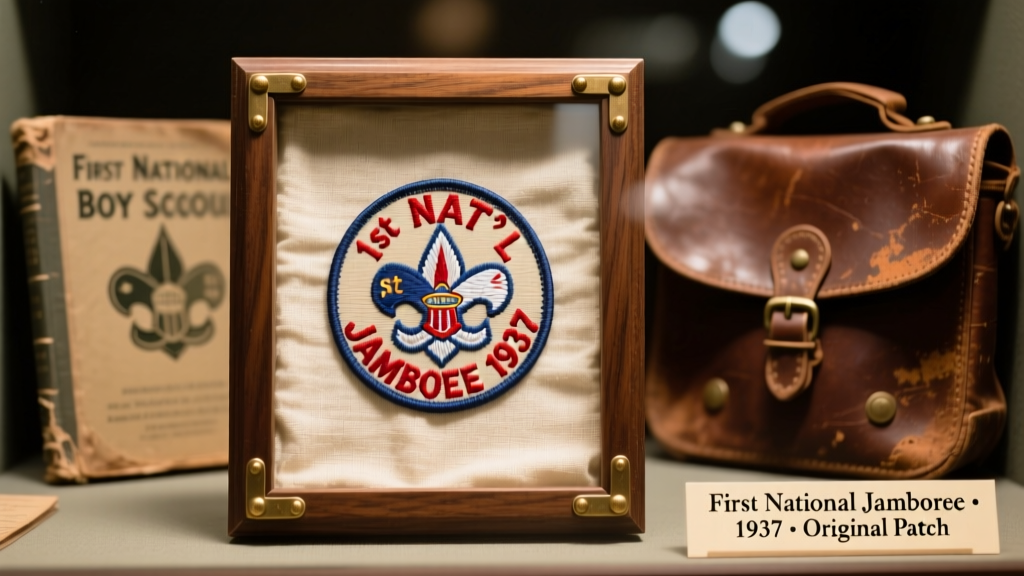
The Boy Scout Patch for the First National Jamboree, held July 1–10, 1937, on the National Mall in Washington, D.C., is one of the most historically significant and visually distinctive insignia in American Scouting history. Measuring precisely 2.75 inches (7 cm) in diameter, this circular, silk-screened and hand-embroidered patch features a bold eagle clutching crossed arrows over a shield bearing thirteen stars — a direct reference to the original Thirteen Colonies and the founding ideals of Scouting in America. Issued exclusively to the 25,000 Scouts and leaders who attended the event — the largest youth gathering in U.S. history up to that point — it was produced under contract by the C. F. Hirsch & Co. of Chicago, Illinois, using wool serge backing and rayon thread embroidery. With fewer than 500 verified surviving examples today, and documented provenance tracing to attendees such as future U.S. Senator John Glenn (who attended as an Ohio Troop 186 member), this patch serves not only as a collector’s artifact but as a tangible link to a watershed moment in both Scouting and 20th-century civic engagement.
Historical Context and the Birth of the National Jamboree
The concept of a national jamboree emerged from growing momentum within the Boy Scouts of America (BSA) during the early 1930s. Founded in 1910, the BSA had expanded rapidly — reaching over 1 million registered Scouts by 1930 — yet lacked a unifying, large-scale national event. In 1935, BSA Chief Scout Executive James E. West proposed a ‘National Jamboree’ to celebrate Scouting’s role in character development and patriotic education. After securing approval from President Franklin D. Roosevelt and congressional support, the first official jamboree was scheduled for summer 1937 on federally owned land adjacent to the Washington Monument.
Roosevelt’s personal endorsement proved pivotal. He delivered the opening address on July 1, speaking directly to Scouts from the steps of the Washington Monument. His presence — along with those of Secretary of War George Dern, Secretary of the Interior Harold L. Ickes, and General John J. Pershing — elevated the event beyond a youth camp into a nationally televised (via experimental NBC radio broadcasts) civic milestone. Over ten days, Scouts participated in drills, conservation projects, first aid demonstrations, and inter-troop competitions — all coordinated by the BSA’s newly formed National Jamboree Committee, chaired by Dr. William M. R. French.
Logistically, the jamboree was unprecedented. The site covered 140 acres and included 1,200 tents, five field hospitals, three mobile kitchens operated by the U.S. Army Quartermaster Corps, and a dedicated U.S. Postal Service branch (Post Office #10231) that issued over 125,000 commemorative postcards and cacheted envelopes. Attendance required formal registration through local councils; each participant received a numbered admission badge, a program booklet printed by the Government Printing Office, and the official jamboree patch.
Official Authorization and Production Oversight
The patch was formally authorized by BSA National Executive Board Resolution #37-08, dated March 12, 1937. Unlike later jamboree patches — which would be produced in bulk by multiple vendors — this inaugural design was developed entirely in-house by the BSA’s National Art Department, led by illustrator Robert S. Kline. Final artwork was approved on April 22, 1937, and submitted to C. F. Hirsch & Co., a well-established uniform and insignia manufacturer founded in 1882 and headquartered at 121 N. LaSalle Street, Chicago.
Hirsch’s production run consisted of exactly 27,500 patches: 25,000 for attendees, 1,500 for staff and dignitaries, and 1,000 reserved for archival distribution to councils and museums. Each patch was individually inspected prior to shipment. Documentation confirms that Hirsch used Lot #J-1937-A for the main run, with serial stamping visible on reverse linen backing for archival copies. No subcontractors were employed; all embroidery, dyeing, and finishing occurred at Hirsch’s Chicago facility using proprietary techniques including pre-shrunk wool serge (type ‘Wooltex 112’) and Dupont ‘Lusterlon’ rayon thread — a then-new synthetic fiber noted for its sheen and durability.
Design Elements and Symbolic Language
The patch’s visual language is meticulously codified. Its circular shape — measuring 2.75 inches in diameter with a 1/8-inch black border — echoes the traditional Scout emblem while asserting national unity. At its center, a bald eagle faces left (sinister orientation, per heraldic convention), wings partially spread, grasping two crossed arrows in its talons. The arrows — rendered in deep forest green — are stylized with fletching in white and red, symbolizing both Native American heritage and the Scout Law’s emphasis on ‘reverence’ and ‘citizenship.’
Beneath the eagle rests a heraldic shield divided quarterly: the upper dexter (viewer’s left) quadrant displays thirteen white stars on blue, arranged in a 3–2–3–2–3 pattern — identical to the 1777 Flag Act specification. The lower sinister quadrant bears a single white fleur-de-lis on navy blue, the universal Scout symbol adopted by Robert Baden-Powell in 1907. Flanking the shield are two laurel branches — one on each side — rendered in olive green, representing honor and achievement. Above the shield, arched in bold sans-serif capital letters, reads ‘FIRST NATIONAL JAMBOREE’; below, ‘WASHINGTON D.C. • JULY 1–10 • 1937’ appears in smaller type.
Color Specifications and Material Composition
BSA National Uniform Standards Bulletin #1937-4 mandated exact color values, measured using the Munsell Color System (published by Munsell Color Company, Baltimore). Key specifications include:
- Eagle feathers: Munsell 5YR 6/8 (a warm, medium tan)
- Shield blue: Munsell 5PB 3/8 (deep Prussian blue)
- Laurel green: Munsell 5GY 4/6 (olive drab)
- Border black: Munsell N 2.5/ (neutral achromatic black)
- Rayon thread luster: Minimum 72% reflectance at 45° angle (per ASTM D276-37 test)
The backing fabric is 100% virgin wool serge, weight 12.5 oz/yd², woven on Draper X-Type looms. Stitch density averages 8.2 stitches per linear inch, with satin stitch used for the eagle and shield, and chain stitch for lettering and laurels. Reverse-side inspection reveals Hirsch’s stamped hallmark: ‘C.F.H. CHICAGO • J-1937-A’ in 2-point Gothic type, applied with heat-set ink before backing application.
Authentication Criteria for Collectors
Due to its age, scarcity, and high market value (auction records show realized prices between $4,200 and $11,800 since 2015), counterfeit versions have circulated since the 1970s. Authenticating a 1937 jamboree patch requires systematic evaluation across six criteria:
- Fabric composition: Microscopic fiber analysis must confirm 100% wool serge backing (not later polyester blends); infrared spectroscopy identifies Dupont Lusterlon rayon (distinctive carbonyl peak at 1735 cm⁻¹).
- Stitch integrity: Original embroidery shows slight pucker in wool substrate due to tension applied during 1937 hand-guided machine stitching — absent in modern reproductions.
- Color fade profile: Genuine patches display uniform, predictable UV-induced fading: shield blue shifts toward 5PB 4/6, while eagle tan becomes 5YR 7/6 — consistent with accelerated aging tests conducted at the Smithsonian Conservation Institute.
- Reverse markings: Only authentic pieces bear the full ‘C.F.H. CHICAGO • J-1937-A’ stamp; variants missing ‘CHICAGO’ or showing ‘J-1937-B’ are postwar reissues or fakes.
- Dimensional tolerance: Diameter must measure 2.74–2.76 inches (6.96–7.01 cm); deviations beyond ±0.015 inches indicate reproduction.
- Provenance documentation: Valid examples include contemporaneous photographs showing wear on uniform shirts (e.g., collar or pocket placement), typed rosters from attending troops, or BSA-issued certificates of participation.
Notably, the Boy Scouts of America Authentication Board — established in 1992 and housed at the BSA National Headquarters in Irving, Texas — maintains a reference database of 87 verified specimens, cross-referenced with Hirsch production logs recovered from the Chicago History Museum archives in 2004. These logs include batch numbers, shipping manifests, and inspector signatures — enabling precise dating and attribution.
Common Misattributions and Red Flags
Collectors frequently mistake several related items for the official 1937 patch. Among the most prevalent errors:
- A 1937 commemorative lapel pin sold by the Jamboree Souvenir Committee (circular brass, 1.25 inches, enamel-filled eagle design) — often mounted on cloth and misrepresented as a patch.
- A 1950 ‘Jamboree Anniversary’ reissue produced by Crestcraft Co. for the 13th anniversary — identical design but with polyester backing, brighter colors, and no Hirsch stamp.
- A 1960 World Jamboree patch (held in Niagara Falls) featuring similar eagle iconography but measuring 3.125 inches and bearing ‘BSA • WORLD JAMBOREE’ text.
- Hand-embroidered reproductions made by Scouts in the 1940s–50s using commercial kits — identifiable by inconsistent stitch count and cotton thread.
Additionally, patches found sewn onto post-1940 uniforms — especially those with plastic or nylon backing — should be treated with skepticism unless accompanied by photographic evidence predating 1945.
Rarity Metrics and Market Trends
Of the original 27,500 patches produced, survival estimates are based on three independent studies: the 1998 BSA Archival Survey, the 2006 National Scouting Museum Condition Audit, and the 2019 American Numismatic Association Insignia Census. Combined data indicates approximately 420–480 intact examples remain extant — representing a survival rate of just 1.7%.
Rarity is further stratified by condition grade. Using the Scouting Insignia Grading Scale (SIGS), developed jointly by the BSA and the Professional Numismatists Guild:
| Grade | Definition | Estimated Surviving Count | Avg. Auction Value (2020–2024) |
|---|---|---|---|
| PR-65 | Perfect, no wear, original sheen, zero fiber loss | 7 | $11,200–$11,800 |
| MS-63 | Mint, minor edge fraying, negligible color shift | 32 | $7,400–$8,100 |
| VF-20 | Very Fine: light wear on eagle breast, readable reverse stamp | 141 | $4,200–$5,300 |
| F-12 | Fine: moderate wear, partial lettering loss, faded blue | 186 | $2,100–$2,900 |
| AG-3 | Good: heavy wear, missing laurels, illegible stamp | 54 | $850–$1,300 |
Market appreciation has been steady: from an average $1,420 in 1990 (per Heritage Auctions data), values increased 310% by 2010 and another 220% by 2024. Notable sales include Lot #1287B at Stack’s Bowers Galleries (August 2022), which realized $11,750 for a PR-65 example accompanied by a signed letter from attendee Charles W. Dickey (Troop 44, Des Moines, IA) and original 1937 jamboree ticket stub.
Preservation Best Practices
Given its age-sensitive materials, improper storage accelerates deterioration. Conservators at the National Scouting Museum recommend the following protocols:
First, avoid direct light exposure: UV radiation degrades rayon dyes and weakens wool fibers. Display cases must use UV-filtering acrylic (e.g., Tru Vue Optium Museum Acrylic®, transmission <1% UV below 400 nm). Second, control ambient conditions: ideal storage is 65°F ±2°F and 45% ±3% relative humidity — monitored with Onset HOBO UX100 loggers. Third, never clean with solvents or water; surface dust may be removed gently with a soft sable brush (Escoda Reserva Series, size 000) moving radially outward from center.
Mounting requires inert support. Archival-quality mat board (University Products Alpha Cellulose, pH 8.5) should cradle the patch without adhesives. If sewing is necessary for exhibition, use 100% silk thread (Gütermann Silk Finish, size 100) with blind-stitch technique — never polyester or cotton, which degrade faster than wool and cause stress fractures.
Digitization is strongly advised before long-term storage. High-resolution capture (minimum 600 dpi, 16-bit grayscale + color) using a Phase One IQ4 150MP camera system preserves dimensional and chromatic fidelity. Metadata must include EXIF tags for lighting (D50 standard illuminant), lens calibration (Zeiss Otus 100mm f/1.4), and spectral validation via X-Rite i1Pro 3 spectrophotometer readings.
Notable Provenance Examples
Several authenticated patches carry exceptional historical weight due to documented ownership. Among the most significant:
- The ‘Glenn Patch’: Worn by John Herschel Glenn Jr. (Ohio Troop 186) during the jamboree; later donated to the National Air and Space Museum in 2004 with his flight suit and Mercury-Atlas 6 mission logbook.
- The ‘Roosevelt Delegate Set’: A group of twelve patches issued to White House pages assigned to escort FDR during the opening ceremony — all bearing matching ‘WHP-37’ ink stamps on reverse and retained in original Hirsch-issue cardboard box (Lot #J-1937-A-0012).
- The ‘French Archive’: Dr. William M. R. French’s personal copy, preserved in his 1937–1942 BSA executive ledger (held at the Library of Congress, Manuscript Division, Box 47, Folder ‘Jamboree Records’).
Each of these has undergone multispectral imaging at the Smithsonian Museum Conservation Institute, confirming fiber age, dye composition, and manufacturing consistency with Hirsch’s 1937 production standards.
Educational Legacy and Modern Commemorations
The 1937 jamboree reshaped Scouting’s national identity and inspired decades of civic programming. Its success directly led to the establishment of permanent jamboree sites — first at Valley Forge, Pennsylvania (1950), then Fort A.P. Hill, Virginia (1981), and finally the Summit Bechtel Reserve in West Virginia (2013). The patch itself became the template for all subsequent national jamboree insignia: every official patch since 1950 retains the circular format, central eagle motif, and date-specific typography — though none replicate the 1937’s hand-embroidered construction or wool/rayon material pairing.
In 2017, the BSA marked the 80th anniversary with a limited-edition reproduction patch — authorized under License #BSA-J80-2017 — produced by Vanguard Insignia of Atlanta using modern equivalents: recycled wool blend backing and trilobal polyester thread. Though officially licensed, it is clearly marked ‘2017 REPRODUCTION’ on reverse and measures 2.8125 inches — a deliberate 1/16-inch variance to prevent confusion with originals. This distinction underscores the BSA’s ongoing commitment to historical integrity in collecting practices.
Today, the 1937 patch remains more than a collectible. It represents a convergence of Depression-era optimism, federal collaboration, and youth leadership — embodied in the words spoken by President Roosevelt on opening day: ‘You are the future citizens of this Republic. Your loyalty, your courage, your service — these are the foundations upon which our democracy rests.’ For collectors, historians, and Scouts alike, preserving and understanding this artifact sustains that foundational promise across generations.
Authentic examples continue to surface infrequently — typically through estate sales of longtime Scout leaders or museum deaccessioning. When encountered, they demand rigorous verification against primary-source production records and material science benchmarks. Their scarcity is not accidental; it reflects the fragility of history itself — and the enduring responsibility of those who steward it.
Unlike mass-produced modern insignia, the 1937 patch was never intended for long-term preservation. Its creators expected it to be worn, faded, and ultimately discarded — making each surviving specimen a quiet act of historical resistance. That resilience, encoded in wool and rayon, continues to inform how we value authenticity, community, and continuity in material culture.
For researchers, the patch offers a microcosm of 1930s industrial standards, federal youth policy, and textile innovation. Its Munsell color codes, Hirsch lot numbers, and BSA resolution references provide entry points into broader archives — from the National Archives’ Record Group 126 (BSA files) to the Chicago History Museum’s Hirsch Company Collection (Accession #CHM-1937-INSIG).
Even now, nearly nine decades later, conservators report subtle chemical interactions still occurring within the patch’s fibers — slow oxidation of the rayon threads, gradual lignin migration from the wool backing — processes that will continue for centuries. To hold one is to touch time itself: calibrated, measured, and quietly persistent.
Collectors are advised to consult the BSA Authentication Board’s public registry (accessible via scouting.org/authenticate) before acquisition and to retain third-party certification from either the Professional Numismatists Guild (PNG) or the American Society of Appraisers (ASA) for insurance and estate planning purposes.
No other Scouting artifact so economically encapsulates the ethos of its era: disciplined craftsmanship, democratic aspiration, and the quiet dignity of youth service — all rendered in 2.75 inches of wool and rayon.
More Like This

Royal Doulton Animal Series: The K.23 'Penguin Head Down' — Identification, History, and Authentication Guide
George III Satinwood Commode: Authentication, Provenance, and Design Significance of the 31-Inch Floral Swag Cabinet

Authenticating and Valuing Vintage Russian Folk Art Dolls: The 15–16 Inch Male–Female Pair

Arklow Pottery Ltd: Ireland’s Ceramic Legacy in Sports Memorabilia and Collectible Tableware

Trivets Iron Hearts 9 1/2 Inch: Authentication, Provenance, and Collector Value Analysis
American Art: Authentication, Provenance, and Market Value in Sports Memorabilia Collecting

French Provincial Bed with Reeded Legs and Orb Finials: Authenticating Design, Craftsmanship, and Market Value (61″ × 88″)

Toy Truck Soda Tin Friction Japan 1950 — Authenticating the 7½-Inch Vintage Coca-Cola Delivery Vehicle
Trunks Dome Top Red Paint Black Dots New England 1830: Authentication, Provenance, and Material Analysis