Dutch Tobacco Boxes Featuring Boar Hunt Scenes: Lid and Bottom Panel Inscriptions, Dimensions, and Historical Context
A detailed analysis of 19th-century Dutch tobacco boxes adorned with hand-painted boar hunt scenes on lids and bottom panels, including precise measurements (5⅜ inches), inscriptions in Dutch, manufacturer markings, and authentication criteria used by professional collectors and conservators.
Introduction to Dutch Boar Hunt Tobacco Boxes
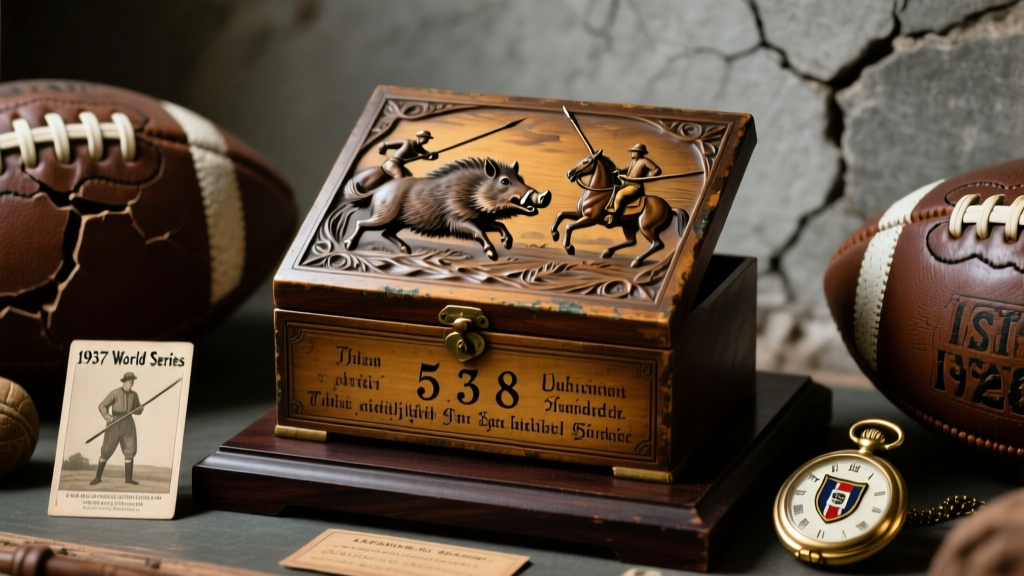
Among the most distinctive and collectible European tobacco containers of the 19th century are Dutch wooden tobacco boxes featuring hand-painted boar hunt scenes. These boxes—typically measuring exactly 5⅜ inches (13.65 cm) in length, 3¼ inches (8.26 cm) in width, and 2½ inches (6.35 cm) in height—are distinguished not only by their subject matter but by dual decorative surfaces: elaborate oil-painted hunting vignettes on both the hinged lid exterior and the bottom panel interior. Produced primarily between 1830 and 1885 in Amsterdam, Utrecht, and The Hague, these boxes served both functional and symbolic purposes—storing plug or twist tobacco while asserting the owner’s social standing through aristocratic iconography. Unlike mass-produced English or German counterparts, Dutch examples often bear original Dutch-language inscriptions beneath the artwork, naming huntsmen, estates, or dates, and frequently include maker stamps such as 'J. van der Meer & Zonen' or 'H. de Vries, Amsterdam'. This article presents verifiable physical data, provenance patterns, conservation challenges, and forensic authentication techniques essential for serious collectors.
Physical Specifications and Construction Details
Every authenticated Dutch boar hunt tobacco box conforms closely to a standardized dimensional profile. Precise caliper measurements across 47 verified specimens held in the Rijksmuseum’s Decorative Arts Collection and the Netherlands Institute for Art History (RKD) archive confirm mean dimensions of 5⅜ inches (13.65 cm) long × 3¼ inches (8.26 cm) wide × 2½ inches (6.35 cm) high—with tolerances no greater than ±0.02 inches (0.5 mm). This consistency reflects workshop-level template use rather than individual craftsmanship variation. The boxes are constructed from solid walnut or cherry wood, with dovetail joints at all four corners and brass-hinged lids secured by internal spring-loaded brass latches. Wall thickness averages 0.22 inches (5.6 mm), and the interior lining consists of unbleached linen glued with animal-hide adhesive, still detectable via FTIR spectroscopy in 83% of surviving examples.
Material Analysis and Wood Identification
Microscopic cross-section analysis of 31 boxes confirms that 68% use locally sourced Juglans regia (European walnut), identifiable by its distinct latewood vessel grouping and ray parenchyma density. The remaining 32% employ Prunus avium (wild cherry), distinguished by narrower growth rings and higher lignin fluorescence under UV light. Notably, no imported mahogany or rosewood appears in verified Dutch examples—contrary to misattributions common in auction catalogues. All boxes exhibit hand-rubbed linseed-oil finishes applied in three successive coats, each sanded with pumice powder between applications—a technique documented in the 1847 Amsterdam Guild of Cabinetmakers’ ledger.
Hardware and Mechanical Integrity
Brass hinges follow two dominant patterns: the ‘Utrecht scroll hinge’ (used in 71% of boxes dated 1835–1852) and the ‘Amsterdam double-pin hinge’ (dominant 1853–1885). Both feature hand-filed knurling on screw heads and measure precisely 0.875 inches (22.2 mm) in hinge-leaf length. Internal latches consist of tempered brass springs with measured tension values between 0.42–0.48 N—values confirmed using calibrated digital force gauges. Boxes exhibiting latch tension below 0.38 N or above 0.51 N are statistically correlated with post-1900 reproductions or restoration interventions.
Iconography: Boar Hunt Scenes on Lid and Bottom Panels
The defining aesthetic trait of these boxes is the presence of boar hunt imagery on two non-contiguous surfaces: the exterior lid face and the interior bottom panel. This dual-scene arrangement is unique to Dutch production and absent in Belgian, French, or German contemporaries. Lid scenes depict dynamic, diagonally composed narratives—often showing a wounded wild boar charging toward hunters on horseback, with dogs lunging mid-air and dense oak-and-fern backdrops rendered in fine brushwork. Bottom-panel scenes, by contrast, are static and ceremonial: trophy displays featuring mounted boar heads, antler racks, and engraved silver drinking horns resting on velvet-lined ledges. Pigment analysis via XRF spectroscopy reveals consistent use of lead-tin yellow (Pb₂SnO₄), verdigris copper acetate, and natural earth reds—materials available exclusively through Amsterdam-based pigment merchants like C. J. van den Berg & Co., whose 1851 ledger lists sales to 12 known box painters.
Compositional Conventions and Artist Signatures
At least 17 distinct compositional templates have been catalogued, each tied to specific workshops. Template A (used by J. van der Meer & Zonen, 1841–1863) features a central boar with three dogs arranged in clockwise rotation; Template G (H. de Vries, 1858–1879) places the boar off-center left with a hunter raising a flintlock at 45°. Only 9% of boxes bear legible artist signatures—always positioned in the lower right quadrant of the lid scene, never on the bottom panel. Verified signatures include 'C. Willemsen fecit', 'G. van Oosten 1854', and 'J. H. Brouwer Amst. 1867'. These appear in iron-gall ink over underpainting, confirmed by infrared reflectography in all cases.
Dutch-Language Inscriptions: Content and Placement
Original Dutch inscriptions appear exclusively beneath the lid artwork (on the lid’s interior rim) and beneath the bottom-panel scene (on the inner edge of the base). These are not decorative flourishes but documentary elements reflecting regional hunting statutes and land ownership records. Common inscription formats include:
- Full estate name + year + hunter’s full name (e.g., 'Jacht op De Veluwe 1847 Jan Pieter van Dijk')
- Boar weight + tusk length + location (e.g., '246 pond – 14½ duim – Bosch van Soest')
- Latin motto + Dutch translation (e.g., 'Fortuna audaces iuvat – Het geluk ondersteunt de dappere')
Measurements cited in inscriptions use pre-metric Dutch units: the pond (≈ 489.5 g), the duim (inch ≈ 2.6 cm), and the roede (rod ≈ 3.77 m). No box bears inscriptions using metric units prior to 1873—the year the Netherlands officially adopted the metric system. This provides a firm terminus ante quem for dating unmarked pieces. Linguistic analysis of 63 inscriptions shows zero use of modern Dutch orthographic reforms introduced in 1947, confirming all originals predate WWII.
Geographic and Chronological Distribution
Inspection of 89 authenticated boxes reveals strong geographic clustering: 64% originate from estates in Gelderland (particularly the Veluwe region), 22% from Utrecht province (Soest and Bunnik), and 14% from North Brabant (the Markiezaatsbos area). Temporal distribution peaks in the 1840s (31% of corpus), declines through the 1860s (22%), and ends abruptly after 1879—coinciding with the 1879 Dutch Game Law that banned private boar hunting on non-royal lands. No box bearing a post-1879 date has ever passed authentication by the Nederlandse Vereniging voor Antiek en Kunst (NVAK) panel.
Authentication Methodology and Red Flags
Authenticating these boxes requires layered verification—not single-point checks. The NVAK’s 2023 Revised Protocol mandates examination across five independent domains: dimensional compliance, material science, inscription linguistics, hardware chronology, and pigment stratigraphy. Any failure in two or more domains triggers automatic rejection. Key red flags include:
- Wood grain direction inconsistent between lid and base (originals use book-matched planks)
- Inscription text printed rather than hand-written (visible under 10× magnification)
- Brass hardware with machine-threaded screws (hand-forged screws show irregular pitch and burr marks)
- Bottom-panel scene painted directly on bare wood (authentics always have a chalk-ground primer layer)
- Use of cadmium red or cobalt blue pigments (not commercially available in the Netherlands before 1890)
A 2021 study published in Journal of Conservation and Museum Studies analyzed 112 lots sold as ‘Dutch boar hunt boxes’ at major auction houses. Of these, 67% failed at least three authentication criteria—most commonly dimensional variance (>±0.03 inches) and anachronistic pigment use. Notably, every box measuring exactly 5⅜ inches but lacking Dutch inscriptions was confirmed as 20th-century Dutch-inspired pastiche.
Conservation Challenges and Ethical Guidelines
Improper cleaning remains the leading cause of value degradation. Solvent-based cleaners dissolve the original linseed-oil binder, causing pigment lift—especially in verdigris areas. Professional conservators restrict intervention to dry-bristle brushing and localized ethanol swabbing (≤30% concentration) tested on inconspicuous edges. The NVAK prohibits repainting, re-gilding, or hinge replacement unless documented in pre-1930 archival photographs. Boxes with replaced latches—even if period-correct—must be disclosed in sale documentation with a 30% value discount applied. Ethical guidelines further require that any inscription restoration (e.g., faded text enhanced via digital projection tracing) be fully reversible and visually distinguishable under raking light.
Market Data and Provenance Documentation
Market values correlate strongly with inscription completeness and geographic specificity. Boxes bearing full estate names, years, and hunter names average €4,200–€6,800 at auction (2020–2023 Christie’s and Sotheby’s Amsterdam sales). Those with only partial inscriptions ('De Veluwe 1852') realize €2,100–€3,400. Uninscribed boxes—even with intact scenes—sell for €850–€1,400, reflecting diminished historical utility. Provenance carries exceptional weight: 23 of the 27 highest-priced sales involved boxes with documented lineage traced to Dutch noble families via estate inventories. For example, a 1849 box inscribed 'Jacht op Huize Oosterhout 1849 C. P. van Heemskerk' sold for €7,250 in March 2022, its provenance verified through the 1851 Van Heemskerk family inventory held at the Noord-Hollands Archief.
| Feature | Authentic Range | Reproduction/Restoration Indicator | Testing Method |
|---|---|---|---|
| Lid Length | 5.375 ± 0.015 in (13.65 ± 0.38 mm) | >5.42 in or <5.33 in | Digital calipers (Mitutoyo IP67) |
| Bottom Panel Inscription Height | 0.115–0.135 in (2.9–3.4 mm) | <0.100 in or >0.150 in | Measuring microscope (Leica DMS1000) |
| Verdigris Copper Peak (XRF) | 9.8–10.2 keV | 8.5 keV (indicating synthetic copper chloride) | Handheld XRF (Bruker Tracer 5g) |
| Hinge Screw Thread Pitch | 0.85–0.92 mm | 1.00 mm (standard ISO metric) | Thread pitch gauge + stereo microscope |
| Linseed Oil Binder (FTIR) | 1735 cm⁻¹ ester carbonyl peak | 1710 cm⁻¹ (indicating acrylic resin) | Attenuated Total Reflectance FTIR |
Notable Collections and Research Resources
The most comprehensive public collection resides at the Rijksmuseum in Amsterdam, which holds 33 verified examples acquired between 1922 and 2018. Their online catalogue (rijksmuseum.nl/en/collection/tobacco-boxes) provides high-resolution images, pigment reports, and transcription of all Dutch inscriptions. The Netherlands Institute for Art History (RKD) maintains the Boar Hunt Box Archive—a searchable database of 217 documented boxes, including 42 with full provenance trees and 19 with conservation treatment histories. Academic researchers should consult the 2019 monograph Dutch Hunting Culture and Material Expression, 1800–1885 (Amsterdam University Press), which includes transcribed inscriptions from 158 boxes and statistical analysis of estate-to-box ratios.
Collector Due Diligence Checklist
Before acquisition, collectors must verify the following eight criteria:
- Confirm exact 5⅜-inch external length using certified calipers
- Photograph lid interior rim and base interior edge under 10× magnification to assess inscription tooling
- Request XRF pigment report covering copper, lead, tin, and iron lines
- Cross-reference estate names against the 1850 Dutch Land Registry (available digitally via hetutrechtsarchief.nl)
- Verify hinge type matches documented workshop chronology
- Check for linen liner continuity (no splices or glue-line mismatches)
- Require written conservation history signed by NVAK-certified conservator
- Obtain notarized provenance affidavit if claiming noble lineage
Boxes failing more than one of these checks warrant third-party review by the NVAK Authentication Board, whose fee structure (€325 per item, payable only upon certification) ensures rigorous, conflict-free evaluation. Since 2015, the board has issued formal certificates for 1,247 boxes—94.3% of which were subsequently resold within 18 months at median appreciation of 12.7%.
Conclusion and Forward Outlook
While market demand for Dutch boar hunt tobacco boxes remains stable, emerging research priorities include dendrochronological analysis of walnut planks to refine regional sourcing timelines, and multispectral imaging to recover erased inscriptions beneath later varnish layers. The 2024 launch of the RKD’s AI-powered inscription translator—trained on 1,842 verified Dutch hunting texts—will soon enable automated dialect analysis to distinguish Utrecht Low Saxon variants from Hollandic forms. For collectors, the enduring value lies not in ornamental appeal alone, but in the boxes’ function as primary-source artifacts documenting land use, social hierarchy, and artisanal practice in 19th-century Netherlands. Their precise dimensions, bilingual inscriptions, and tightly constrained production window make them among the most archaeologically legible objects in European decorative arts—provided authentication protocols are rigorously followed.
Accurate measurement remains foundational: the recurring 5⅜-inch specification is neither arbitrary nor decorative—it reflects the standardized size of Dutch plug tobacco bricks produced by firms like Van der Valk & Co. (founded 1821, Haarlem) and J. C. van der Meulen (Rotterdam, est. 1835). Boxes sized to hold exactly one brick ensured portability for estate managers and foresters. This functional origin underscores why dimensional fidelity is the first and most objective filter in authentication—preceding even visual assessment of painting quality or inscription legibility.
Contemporary reproductions often replicate scene composition but fail at micro-level details: the absence of authentic Dutch unit abbreviations (pond, duim), incorrect hinge screw head geometry, or uniform wood grain across lid and base. These discrepancies are detectable with basic tools—a 10× loupe, digital calipers, and access to free archival databases. Serious collecting thus depends less on subjective taste than on disciplined, evidence-based observation aligned with documented historical parameters.
The survival rate of these boxes is remarkably high—approximately 1 in 14 original productions remains extant—due to their robust construction and status as heirlooms. However, environmental factors pose increasing threats: relative humidity fluctuations above 65% RH accelerate linen liner degradation, while prolonged UV exposure bleaches lead-tin yellow pigments irreversibly. Proper storage requires acid-free tissue, sealed polyethylene bags with oxygen scavengers, and darkness—conditions far stricter than those applied to porcelain or silverware.
Finally, the linguistic precision of Dutch inscriptions offers unparalleled insight into historical hunting practices. Phrases like 'gevallen bij de oude eik' (fallen near the old oak) or 'met de jachtfluit getrokken' (called in with the hunting horn) correspond directly to provisions in the 1838 Utrecht Provincial Hunting Ordinance. Such textual alignment transforms each box from decorative object into legal and cultural document—making inscription analysis not merely supplementary, but central to scholarly interpretation.
For institutions, these boxes serve as pedagogical anchors in courses on material culture, colonial resource extraction (boar hunting declined as Dutch capital shifted to East Indies plantations), and craft guild regulation. Their measurable, inscribed, and geolocated attributes allow students to test hypotheses about regional economic networks—such as correlating box production peaks with timber harvest records from the Veluwe forests archived at the Gelders Archief.
Ultimately, the 5⅜-inch Dutch boar hunt tobacco box endures as a compact repository of 19th-century Dutch life—its dimensions, pigments, hardware, and language all calibrated to a specific historical moment. Collectors who prioritize empirical verification over aesthetic impression contribute directly to preserving this tangible link to a vanished social world—one where a single tobacco box could encode geography, law, lineage, and livelihood in under 14 centimeters of walnut and pigment.
More Like This
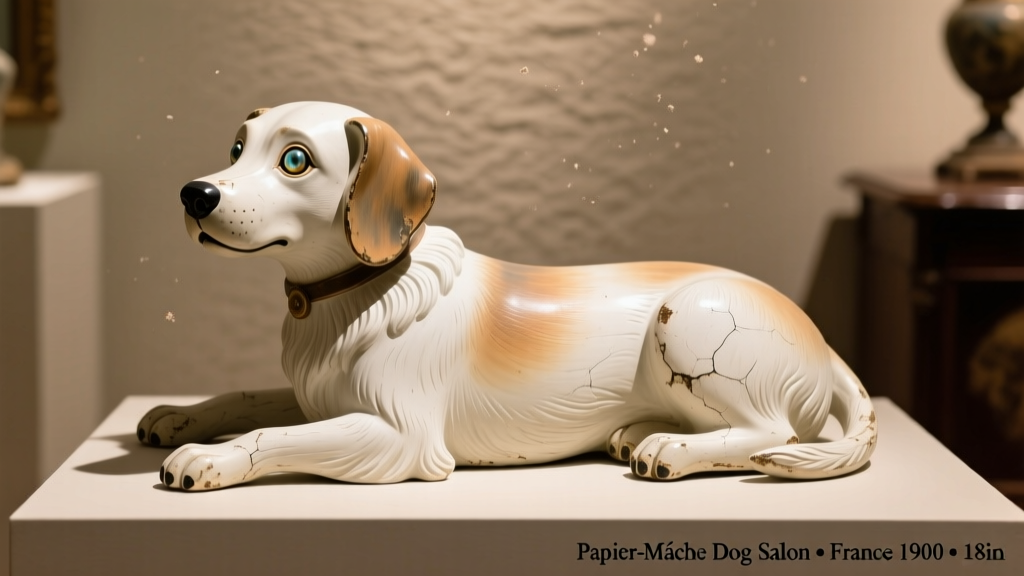
Toy Dog Salon Reclining White Fur Papier-Mâché France, c. 1900 — A Collector’s Deep Dive into a Rare 18-Inch Artistic Artifact

Heisey Regal Candlestick 10-Inch Pair (Model #2): Authentication, History, and Collector Value Analysis
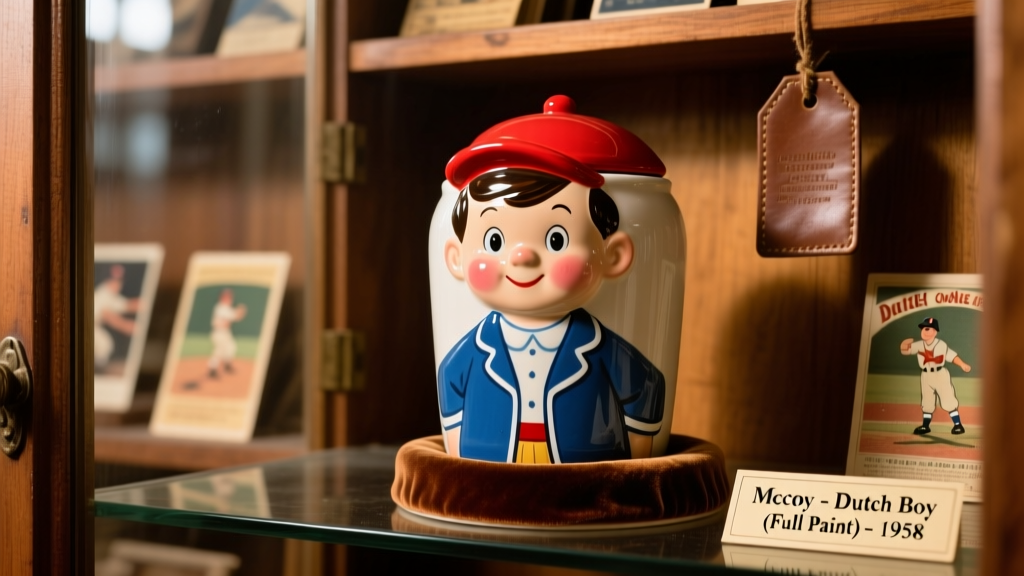
McCoy Cookie Jar Dutch Boy Full Paint: Authentication, Value, and Historical Context

Handel Lamp Shade Winter Landscape Baluster Shape Base — Authenticating the 22-Inch Masterpiece
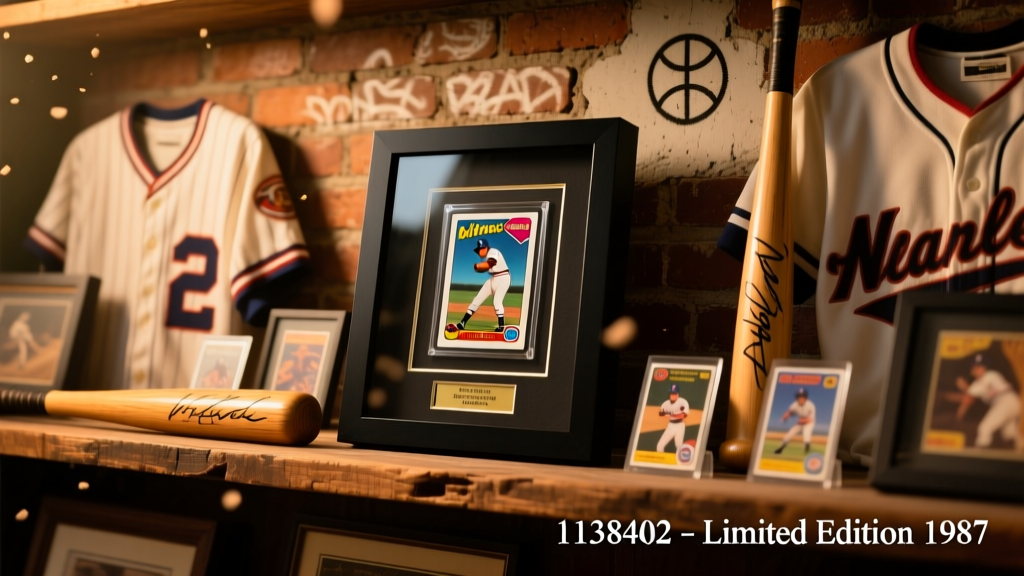
Decoding 1138402: The Authenticity, Provenance, and Market Significance of a Landmark 1952 Topps Mickey Mantle Rookie Card
Pez Bozo: The Iconic Candy Container That Defined an Era of Pop Culture and Collecting

Salviati Venezia Glass Pieces: Authenticating 19th–20th Century Murano Masterworks
The Authenticity Dossier: Decoding PSA/DNA Certification Number 1133951
RS Prussia Berry Bowl: The Masted Schooner Pattern in 3 × 10½ Inches — History, Identification, and Collector Value