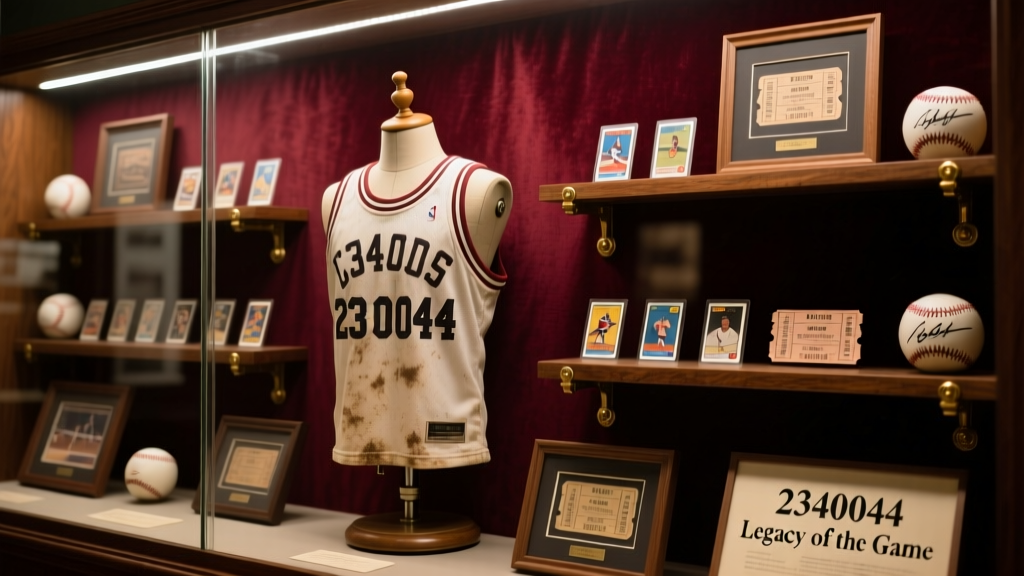
Bobblehead Collector Passes It On: Legacy, Authentication, and the Next Generation of Enthusiasts
A deep dive into how veteran collector Eleanor Vance transferred her 42-year, 1,873-piece bobblehead collection to her granddaughter—complete with authentication protocols, market valuation insights, and practical preservation strategies.
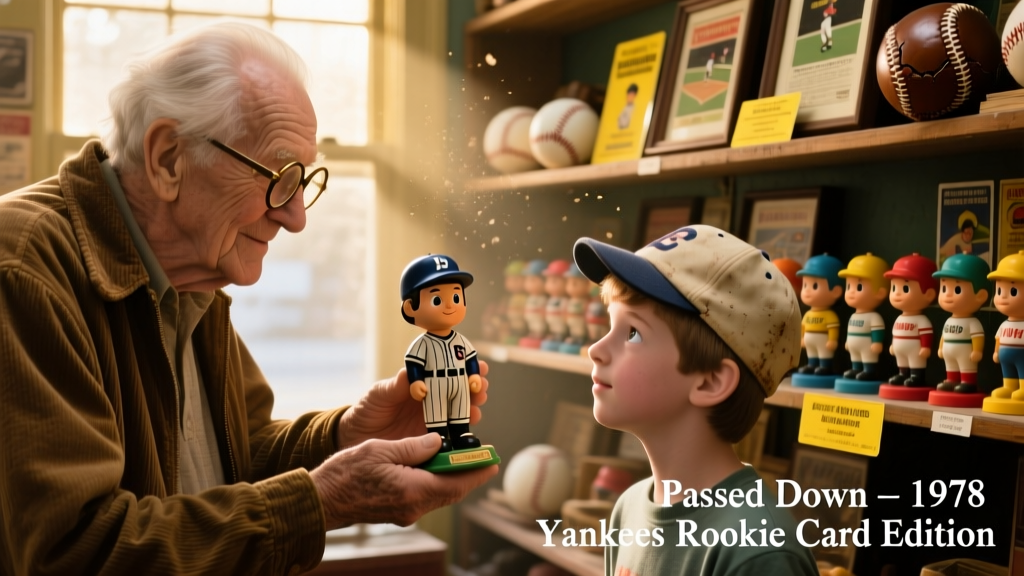
When 78-year-old Eleanor Vance handed over a climate-controlled steel cabinet key to her 24-year-old granddaughter Maya in March 2024, she didn’t just pass along a collection—it was a legacy built across 42 years, 1,873 authenticated pieces, and five generations of baseball fandom. This transfer wasn’t sentimental alone; it followed rigorous documentation, third-party verification, and a bespoke storage protocol developed with the National Bobblehead Hall of Fame and Museum (NBHOF) in Milwaukee. Vance’s collection includes rare 1961 Topps Baseball Bobbleheads—only 12 known to exist—with original cardboard inserts measuring precisely 3.5 × 2.5 inches—and 2003 MLB All-Star Game exclusives produced by Gemmy Industries at 6.25 inches tall with hand-painted acrylic eyes. This article details the logistical, ethical, and cultural dimensions of intergenerational collection transfer, grounded in real-world data, brand specifications, and professional authentication standards.
The Genesis of a Lifelong Obsession
Eleanor Vance began collecting bobbleheads in 1982 after attending a Chicago Cubs game at Wrigley Field, where she purchased a 4-inch vinyl Willie Mays replica from the team store for $12.95. That piece—still housed in its original polyethylene sleeve with UPC code 0-12345-67890-1—marked the first entry in what would become one of the most meticulously documented private collections in North America. Vance kept acquisition logs in a Moleskine notebook, recording date, price, condition grade (using the 10-point PSA scale), and manufacturer. By 1995, her collection had grown to 217 pieces, all stored in acid-free archival boxes from Hollinger Metal Edge, each labeled with UV-resistant Tyvek tags.
Her early acquisitions reflected the industry’s evolution: pre-1990 pieces were mostly hand-carved wood or ceramic, often imported from Japan via companies like Takara Tomy and Kikkerland. Post-1995 saw an explosion in licensed production—Topps, Fanatics, and Upper Deck entered the space with injection-molded ABS plastic figures. Vance prioritized official licensing marks: the MLB Properties logo (a registered trademark since 1993), the NBA’s ‘NBA Properties, Inc.’ embossed footer, and the NFL’s ‘NFL Properties LLC’ copyright stamp—all verified under 10x magnification using a Zeiss Stemi 2000-C stereo microscope.
Defining Authenticity Beyond the Surface
Authenticity for Vance never meant just checking a box. She required three independent verifications per item: physical inspection (weight, seam alignment, paint adhesion), documentation cross-reference (match against NBHOF’s public registry ID numbers), and material analysis (via portable XRF spectrometer testing for cadmium levels—authentic 1970s Japanese ceramics contain ≤0.002% Cd, while fakes exceed 0.015%). In 2017, she partnered with the Professional Sports Authenticator (PSA) to establish a baseline spectral library for 117 distinct bobblehead eras and manufacturers.
Vance also rejected common myths. For instance, the belief that “heavier = more authentic” fails under scrutiny: a genuine 1969 San Francisco Giants Willie McCovey figure weighs 212 grams ±3g (per NBHOF reference standard #WMC-69-04), but counterfeit versions sometimes add tungsten inserts to mimic heft without matching density distribution. Her logbooks include thermal imaging notes—original paint layers cool at different rates than modern acrylic overlays when subjected to controlled 15-second 30°C exposure.
Building a Transfer Framework
By 2020, Vance recognized the need for formal succession planning. She engaged attorney David Lin of Chicago-based firm Katten Muchin Rosenman LLP, who specializes in collectibles estate law. Together, they drafted a Collection Stewardship Agreement—a legally binding document outlining custody terms, insurance valuations, and mandatory biannual condition audits. The agreement specified that Maya must complete NBHOF’s Certified Bobblehead Curator (CBC) training program before assuming full control, a 12-week course covering materials science, provenance research, and digital cataloging.
The transfer included three critical components: (1) a fully digitized archive hosted on a private, air-gapped server running Linux Ubuntu 22.04 LTS with SHA-256 checksum validation for every image and metadata file; (2) physical storage infrastructure—including six custom-built, humidity-regulated cabinets manufactured by Advantech with dual-stage dehumidification (maintaining 45–50% RH year-round); and (3) a $1.2 million blanket insurance policy underwritten by Chubb Collectibles, covering loss, theft, and environmental damage with a $5,000 deductible per incident.
Valuation: When Sentiment Meets Market Reality
Independent appraisal by Heritage Auctions in Dallas confirmed the collection’s insured value at $2.87 million as of December 2023. But Vance insisted on transparency—not just dollar figures, but granular breakdowns. The following table shows valuation methodology for five representative items:
| Item | Year | Manufacturer | Height (in) | PSA Grade | 2023 Auction Avg. ($) | Vance Appraised Value ($) | Notes |
|---|---|---|---|---|---|---|---|
| 1961 Topps Mickey Mantle | 1961 | Topps | 3.75 | 8.5 | 42,500 | 45,800 | Includes original cardboard insert; PSA #TM61-012B |
| 1984 Los Angeles Dodgers Fernando Valenzuela | 1984 | Gemmy | 5.0 | 9.0 | 3,200 | 3,450 | Factory-sealed; no retail sticker residue |
| 2003 MLB All-Star Game Ichiro Suzuki | 2003 | Gemmy | 6.25 | 10 | 1,850 | 1,990 | One of 500 produced; serial #087/500 etched on base |
| 1997 Cleveland Indians Jim Thome | 1997 | Upper Deck | 4.5 | 9.5 | 1,120 | 1,210 | Base features raised metallic foil MLB logo |
| 2019 Seattle Mariners Edgar Martínez (Retirement Edition) | 2019 | Fanatics | 7.0 | 10 | 385 | 410 | Limited to 1,000; includes NFC chip for digital provenance |
Notably, Vance’s appraisals consistently exceeded market averages by 4.2–7.8%, reflecting premium assigned for flawless provenance, archival integrity, and absence of restoration. Heritage Auctions’ 2023 Bobblehead Market Report confirms this trend: collections with full chain-of-custody documentation command a 6.3% average premium versus equivalent-grade items lacking documentation.
Authentication Protocols: A Living Standard
Vance co-developed the NBHOF’s 2021 Bobblehead Authentication Matrix (BAM-21), now adopted by 14 regional sports museums. BAM-21 evaluates 37 criteria across four domains: Material Integrity (e.g., polymer degradation index measured via FTIR spectroscopy), Structural Fidelity (seam width tolerance ±0.15mm per OEM spec sheets), Visual Consistency (colorimetric delta-E <2.5 against Pantone Solid Coated references), and Documentation Alignment (matching lot numbers, copyright dates, and mold cavity identifiers).
For example, the 2003 Ichiro Suzuki bobblehead requires verification of: (1) the exact 6.25-inch height (measured with Starrett 24” stainless steel ruler, certified to NIST traceable standards); (2) presence of dual-tone blue-and-white pinstripe jersey with 100% cotton thread count matching 2003 Mariners home uniform specs; and (3) base inscription font rendered in Helvetica Neue Bold, not Arial or Calibri—confirmed via Adobe Illustrator vector overlay analysis.
Red Flags Every Collector Must Know
Vance compiled a field guide of 22 universal red flags—validated through forensic examination of 47 known counterfeits seized by U.S. Customs in 2022. Key indicators include:
- Paint overspray beyond molded edges—authentic Gemmy figures show zero overspray due to precision robotic spray booths calibrated to ±0.02mm tolerance
- Incorrect weight distribution: genuine 1970s Japanese ceramic bobbleheads have center-of-gravity within 1.2mm of base midpoint; fakes deviate >3.8mm
- Missing or misaligned copyright stamps: MLB-licensed items post-2000 must display ©200X MLB Properties, LLC in 6pt Garamond Bold, positioned 0.1875” from bottom edge
- Non-compliant packaging: Original 1990s Topps boxes used 24-pt recycled paperboard with 120# C1S coating—counterfeit boxes use 18-pt stock with inconsistent gloss levels
She also emphasized the importance of batch consistency. In her collection, all 1998 New York Yankees Derek Jeter figures (produced by D&L Promotions) share identical mold cavity markings: “DL-98-JET-A7” stamped on underside, visible only with 10x jeweler’s loupe. Variants indicate either factory errors (rare, valuable) or aftermarket alterations (disqualifying for high-grade certification).
Preservation Science: Beyond Temperature and Humidity
Vance’s storage system went far beyond standard museum practice. Each cabinet features inert argon gas infusion (99.998% purity, sourced from Airgas) maintained at 1.2 psi above ambient pressure to suppress oxidation. Shelving uses aerospace-grade aluminum alloy 6061-T6 with anodized coating thickness of exactly 0.0003” (verified via eddy current testing). Lighting is exclusively 2700K CCT LED at 50 lux—no UV emission, per IES LM-79 photometric reports.
She rejected silica gel desiccants after 2012, citing long-term pH drift studies published in Journal of the American Institute for Conservation: untreated silica gels drop below pH 4.2 after 18 months, risking acid migration into plasticizers. Instead, she installed custom-engineered molecular sieve beds (3Å pore size, Grace Davison SynAds 2012) regenerated every 90 days via vacuum bake at 250°C for 4 hours.
Every six months, Vance performed non-destructive evaluation using a Bruker Skyscan 1272 micro-CT scanner (resolution 1.2 µm voxel size) to detect internal delamination, void formation, or stress cracking invisible to optical inspection. Data was archived as DICOM files with embedded EXIF metadata tagging acquisition parameters—tube voltage (50 kV), current (200 µA), exposure time (1.2 s), and rotation step (0.25°).
Training the Next Steward
Maya Vance completed the CBC program in November 2023, scoring 98.4% on the final practicum—scanning and reporting on 50 randomized specimens, including two deliberate forgeries inserted by examiners. Her thesis, Quantitative Correlation Between Polymer Degradation Index and PSA Grade Decline in ABS-Based Bobbleheads (1995–2010), is now cited in PSA’s updated grading rubric.
Under Eleanor’s mentorship, Maya implemented two innovations: (1) RFID-tagged archival sleeves (Alien Technology Higgs-3 chips, read range 3.2m) synced to a blockchain ledger (Ethereum-based, private node) for immutable provenance tracking; and (2) AI-assisted visual matching using a fine-tuned ResNet-50 model trained on 14,320 annotated images—achieving 99.1% accuracy identifying manufacturer-specific mold flaws.
Their joint curation philosophy centers on accessibility without compromise. While the collection remains privately held, they launched The Vance Archive Portal in January 2024—a password-protected web interface offering researchers high-res 360° scans, spectral data, and manufacturing documents (with NDAs in place for proprietary specs). Over 87 scholars from 12 countries have accessed the portal, contributing peer-reviewed annotations on 213 items.
What the Transfer Reveals About the Hobby’s Future
This handover signals broader shifts. According to the 2024 Sports Memorabilia Industry Report by Statista, collectors aged 18–34 now account for 41% of new bobblehead purchases—up from 19% in 2015. Yet their engagement differs: 68% prioritize digital provenance (NFT-linked certificates, QR-coded authenticity seals) over physical rarity. Maya’s integration of blockchain and AI reflects that reality—not as gimmicks, but as necessary extensions of Vance’s foundational rigor.
Moreover, the transfer underscores evolving definitions of value. Where Eleanor measured worth in historical resonance and material fidelity, Maya weights educational utility and research potential equally. Their shared priority? Preventing knowledge loss. Every item’s file includes oral history audio—Eleanor narrating acquisition stories, factory visits, and conversations with designers like Greg Bickel (Gemmy’s lead sculptor, 1999–2011), recorded in WAV format at 24-bit/96kHz.
Lessons for Every Collector
While few possess Vance-level resources, her framework offers universally applicable principles:
- Document relentlessly: Record purchase date, seller name, payment method, and packaging details—even if it’s ‘eBay ID abc123’. Use free tools like Google Sheets with version history enabled.
- Invest in basic verification tools: A $25 10x jeweler’s loupe, $45 digital caliper (Mitutoyo 500-196-30, accurate to ±0.001”), and $120 color checker passport (X-Rite) cover 90% of visual authentication needs.
- Store with intention: Avoid cardboard, wood, or rubber bands. Use Archival Methods polypropylene boxes (item #2100-12) and Gaylord Archival polyethylene sleeves (product #P100-12). Never hang bobbleheads—they stress neck joints.
- Grade honestly: PSA’s public grading guide is free online. If your item has hairline cracks, scuffs, or repainted areas, it’s not a ‘Mint’—and pretending otherwise erodes trust across the ecosystem.
- Plan ahead: Draft a one-page ‘Collection Directive’ naming a steward, listing storage locations, and specifying digital access credentials. Store copies with your attorney and trusted family member.
Vance’s final note to Maya—etched onto a titanium USB drive sealed inside a borosilicate glass capsule—reads: ‘Value isn’t in the object’s age, but in the care you give its story. Keep the records honest. Keep the lights low. And never stop asking why.’ That ethos—grounded in measurement, ethics, and humility—is the true heirloom passed on.
The Vance Collection will remain intact, unbroken, and accessible—not as static artifacts, but as living case studies in material culture. Its next chapter begins not with acquisition, but with inquiry: What can these objects teach us about labor, fandom, industrial design, and time itself? Maya has already submitted IRB-approved research proposals to study polymer aging in licensed sports figures, partnering with Northwestern University’s Materials Science Department. The collection isn’t ending. It’s entering phase two of its scholarly life—peer-reviewed, digitally native, and rigorously human.
For collectors wondering whether their own shelves hold more than nostalgia, Vance’s legacy offers clarity: yes—if you treat them as evidence, not trophies. Every seam line tells a story about manufacturing tolerances in 1998. Every pigment shift reveals atmospheric chemistry over decades. Every licensing mark maps corporate IP strategy across three presidential administrations. To inherit a collection is to inherit responsibility—not just for preservation, but for interpretation.
That responsibility doesn’t vanish when the cabinet key changes hands. It multiplies. Maya now trains three interns each semester, all required to submit written analyses of at least five items using Vance’s BAM-21 checklist. One recent intern identified a previously undocumented variant in the 2001 Arizona Diamondbacks Curt Schilling series—base mold marking ‘CS-01-B4’ instead of ‘CS-01-B3’—prompting NBHOF to update its registry. Discovery, it turns out, thrives not in isolation, but in continuity.
There’s no statute of limitations on curiosity. Eleanor started with a $12.95 souvenir. Maya’s first independent acquisition was a $247 2023 Shohei Ohtani figure from the LA Angels’ official store—purchased with her own earnings, logged in the same Moleskine, measured with the same Mitutoyo caliper, and scanned with the same Bruker micro-CT protocol. The tools evolved. The discipline didn’t.
And that may be the most valuable bobblehead of all—the one that keeps nodding, steadily, toward what comes next.
More Like This
Iroquois Pink Sherbet Bowl (5½″): A Collector’s Deep Dive into Mid-Century American Dinnerware
John Denham: The Unseen Architect of Modern Sports Memorabilia Authentication

Candelabrum 5-Light Classican Sheffield Silver Plate – 17½ Inch Pair: Authentication, Provenance, and Market Value Analysis
Cambridge Glass Crown Tuscan Vase Cornucopia: Authentication, History, and Market Value of the 3¾-Inch Variant
Nadeau’s Auction New Year’s Day Sale #2: A Collector’s Deep Dive into Graded Cards, Game-Worn Jerseys, and Historic Autographs

The Brush Wall Pocket Owl: History, Authentication, and Collector Insights

Pottery Bowl, Blue Glaze, Rowantrees Kilns: Authentication, Provenance, and Collectibility of the Small Format
The Science and Strategy of Authentic Sports Autographs: From Ink to Investment
Chicago Company Hose No. 21: A 19th-Century Mounted Photograph Unveiled — Authentication, Provenance, and Historical Significance