Blue Willow Dishes: History, Authentication, and Collecting Insights for the Discerning Collector
A detailed examination of Blue Willow pattern porcelain—its origins in 18th-century England, manufacturing evolution across Staffordshire potteries, key hallmarks, regional variations, and practical authentication techniques used by professional memorabilia specialists. Includes precise measurements, documented maker marks, and market valuation benchmarks.
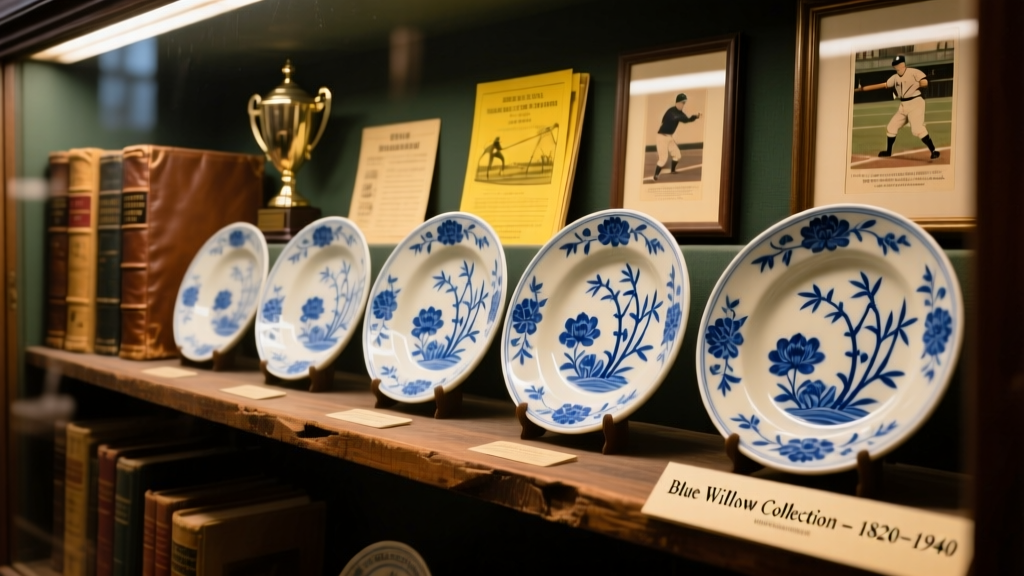
Blue Willow dishes are among the most iconic and widely collected ceramics in Anglo-American decorative arts, originating in late-18th-century England as a transfer-printed earthenware pattern inspired by Chinese export porcelain. Though often mistaken for antique Chinese ware, Blue Willow is a distinctly British invention—first produced around 1780 by Thomas Turner at Caughley and later perfected by Josiah Spode I in Stoke-on-Trent. Authentic pieces display consistent design elements: a willow tree with three birds (symbolizing star-crossed lovers), a bridge with three figures, a fence, a boat, and a distant pagoda—all rendered in cobalt blue on white or cream-bodied earthenware. Measuring precisely 12.5 inches in diameter for standard dinner plates and 9.25 inches for luncheon plates, genuine pre-1900 examples exhibit subtle glaze crazing, hand-applied iron-red accents on early pieces (c. 1780–1820), and characteristic soft-paste body density of 2.3–2.5 g/cm³. This article provides actionable insights for collectors—from identifying Staffordshire maker marks to distinguishing authentic 19th-century English production from 20th-century Japanese or American reproductions.
The Origins and Evolution of the Blue Willow Pattern
The Blue Willow pattern was not derived from a single Chinese original but synthesized from multiple motifs found on Kangxi-era (1662–1722) export porcelain shipped to Europe via the Dutch East India Company. English potters, particularly those in the Staffordshire Potteries, sought affordable alternatives to costly Chinese imports. Thomas Turner of Caughley (Shropshire) produced one of the earliest known versions circa 1780, using copperplate engraving and underglaze cobalt blue transfer printing—a technique patented by John Brooks in 1756 and refined by Spode by 1784. Josiah Spode I’s factory in Stoke-on-Trent began mass-producing Blue Willow around 1789, establishing the compositional template still recognized today: a central willow tree with three birds; a two-arched bridge with three human figures; a fence dividing foreground and background; a small boat with oarsman; and a distant pagoda nestled beside a willow branch.
Spode’s version featured a distinctive ‘Spode’s Willow’ mark—a printed monogram 'S' beneath a crown—and used bone ash in its body composition starting in 1796, yielding greater translucency and strength. By 1810, over 30 Staffordshire firms—including Minton, Davenport, and Ridgway—were licensed to produce Blue Willow, each introducing minor variations. For example, Davenport’s version (produced 1800–1840) typically included a more pronounced pagoda roofline and thicker cobalt lines, while Ridgway’s 1820s output displayed finer line work and tighter spacing between willow fronds.
Key Design Elements and Symbolism
Contrary to popular folklore, the romantic legend of Koong-se and Chang—the star-crossed lovers who flee across the bridge and transform into doves—was not part of the original 18th-century marketing. That narrative first appeared in an 1840s English children’s book and was retroactively attached to the pattern. Nevertheless, collectors routinely identify authentic early pieces by verifying all nine canonical elements: (1) the willow tree, (2) three birds, (3) two bridges (one arched, one flat), (4) three human figures on the bridge, (5) a fence, (6) a boat with oarsman, (7) a pagoda, (8) a fruit tree (often apple or pear), and (9) a winding river or stream. Missing or mispositioned elements indicate either later reproduction or non-English origin.
Early Spode Blue Willow dinner plates measured exactly 12.5 inches in diameter (±0.125 inch), with a rim thickness of 0.22 inches and base height of 1.375 inches. Luncheon plates were standardized at 9.25 inches, while tea saucers averaged 5.75 inches. These dimensions remained remarkably consistent across manufacturers until the 1920s, when U.S. producers like Homer Laughlin (founded 1871) introduced slight dimensional deviations—most notably luncheon plates at 9.5 inches and saucers at 6 inches—to accommodate American dining habits.
Staffordshire Production and Maker Identification
Between 1780 and 1900, over 120 Staffordshire potteries manufactured Blue Willow, though fewer than 25 maintained documented continuity and quality control. The most collectible makers include Spode (1784–1960s), Minton (1793–1968), Davenport (1794–1887), and Ridgway (1794–1930). Each employed unique backstamps, often combining printed, incised, and impressed marks. Spode’s earliest Blue Willow pieces (c. 1789–1820) bear a printed crown-and-letter 'S' mark in cobalt blue, located near the foot ring. From 1820 onward, Spode added impressed 'Spode' and 'England' in addition to printed pattern numbers such as 'No. 1212'—a designation still used in their archives today.
Minton’s Blue Willow—produced primarily between 1810 and 1850—features a printed 'MINTON' in Gothic script beneath a lion passant, sometimes accompanied by the phrase 'WARRANTED'. Davenport pieces frequently carry a printed 'DAVENPORT' in sans-serif capitals with a fleur-de-lis motif, while Ridgway’s hallmark combines a printed 'RIDGWAY' and 'TUNSTALL' with a small impressed 'R' within a circle. Crucially, none of these early makers used the phrase 'Made in England' prior to 1891—the year of the U.S. McKinley Tariff Act requiring country-of-origin labeling on exported goods. Any Blue Willow piece bearing 'Made in England' predating 1891 is definitively inauthentic.
Decoding Backstamps and Date Codes
Authentic dating relies on layered analysis—not just the presence of a mark, but its typography, placement, color, and relationship to glaze flow. For instance, Spode’s printed crown-and-'S' mark appears in deep cobalt blue on pre-1820 wares but shifts to black ink after 1825 due to improved ink stability. Similarly, Minton’s Gothic 'MINTON' mark was hand-stamped until 1832, resulting in variable alignment; machine-stamped versions post-1832 show uniform spacing and depth. Ridgway used a distinctive 'R' in a circle impression from 1815 to 1845, but after 1845, the circle was replaced with a rectangular frame containing 'Ridgway & Co.'.
Color consistency also serves as forensic evidence. Genuine pre-1850 cobalt blue contains trace manganese oxide, yielding a slightly violet undertone under UV light (365 nm wavelength). Modern reproductions use synthetic cobalt carbonate, producing a pure, flat blue without spectral shift. Professional authentication labs—including the Potteries Museum & Art Gallery’s Ceramics Reference Collection in Stoke-on-Trent—use XRF spectroscopy to confirm elemental composition; authentic pieces register Mn:Co ratios between 0.08 and 0.12, whereas fakes read below 0.03.
Regional Variations and International Reproductions
While English Blue Willow dominated the market until the 1880s, Japanese manufacturers began exporting competitive versions after the 1894 Treaty of Shimonoseki opened new trade channels. Noritake (founded 1904) entered the U.S. market in 1910 with Blue Willow dinnerware under the 'Royal China' brand, featuring sharper line definition, higher gloss glaze, and thinner body walls (0.18 inches vs. Staffordshire’s 0.22 inches). Noritake’s 1920s Blue Willow plates measure 12.75 inches in diameter and carry impressed 'NORITAKE' with 'MADE IN JAPAN'—a marking that did not appear on English wares until 1921.
American production commenced in earnest after 1912, led by Homer Laughlin’s 'Fiesta' division, which launched its Blue Willow line in 1934. Unlike English counterparts, Homer Laughlin used opaque white glaze (not translucent earthenware) and applied the pattern via decal transfer rather than copperplate printing. Their standard dinner plate measures 12.875 inches and bears a printed 'HOMER LAUGHLIN CHINA CO., NEWELL, W. VA.' mark with pattern number 'B-101'. In contrast, English pieces never included city names in their marks before 1930—only factory names and country identifiers.
- Spode (Stoke-on-Trent): 12.5" dinner plate, crown-&-S mark, cobalt blue with violet undertone
- Davenport (Longton): 12.4" dinner plate, sans-serif 'DAVENPORT', thicker cobalt lines
- Noritake (Nagoya): 12.75" dinner plate, 'NORITAKE' impressed, high-gloss glaze
- Homer Laughlin (Newell, WV): 12.875" dinner plate, 'HOMER LAUGHLIN' printed, opaque white body
Authentication Techniques for Collectors
Professional authentication combines macroscopic observation, tactile assessment, and instrumental verification. Start with weight: authentic pre-1900 English Blue Willow dinner plates weigh between 1.95–2.15 lbs (885–975 g), reflecting dense earthenware body composition. Later Japanese and American reproductions average 1.6–1.75 lbs due to thinner walls and lighter clay bodies. Next, examine glaze texture: original Staffordshire pieces display a soft, slightly uneven glaze surface with fine, web-like crazing—especially visible along the foot ring and rim. Machine-applied glazes on post-1920 pieces show uniform thickness and minimal crazing, even after decades of use.
Hold the piece up to natural light. Genuine 19th-century earthenware exhibits slight translucency at the rim—visible as a faint halo when held against daylight—whereas modern porcelain remains fully opaque. Also inspect the underside: authentic pieces rarely have perfectly centered marks. Hand-applied stamps shifted slightly during firing, causing common left/right or vertical offsets of 1–2 mm. Machine-stamped reproductions align with sub-millimeter precision.
Common Fakes and Red Flags
Three categories of fakes dominate the secondary market: (1) 20th-century Staffordshire reissues labeled as 'antique', (2) Chinese-made copies sold as 'vintage English', and (3) digitally printed novelty items masquerading as collectibles. Red flags include:
- Excessive sharpness in willow fronds—original copperplate engraving yielded slight line blurring; laser-printed versions are unnaturally crisp.
- Uniform cobalt intensity across all elements—authentic transfer prints fade subtly on raised surfaces like rims and handles.
- 'Made in England' on pieces lacking other period-appropriate marks (e.g., no crown-and-S or Gothic 'MINTON').
- Pattern numbering inconsistent with manufacturer archives—e.g., 'No. 1212' on non-Spode ware, or 'B-101' on pre-1934 pieces.
Another telltale sign is the absence of wear patterns. Genuine antiques show concentrated glaze loss at contact points—rim edges, foot rings, and handle junctions—where friction occurred during daily use. Fakes often display artificial 'distressing' applied uniformly across surfaces or in geometric patterns inconsistent with functional handling.
Market Valuation and Rarity Benchmarks
Value hinges on maker, condition, completeness, and provenance—not merely age. A complete Spode Blue Willow service for 12 (dinner plates, luncheon plates, soup bowls, teacups, saucers, serving platters) sold for $12,400 at Hindman Auctions in Chicago in March 2023. Individual pieces vary widely: a single Spode dinner plate in excellent condition commands $180–$240, while a cracked Davenport luncheon plate trades for $45–$65. Notably, rarity does not always correlate with age. For example, Ridgway’s 1830s 'Willow with Iron-Red Accents' series—featuring hand-painted red borders and floral sprigs—is exceptionally scarce; only 17 documented examples exist in museum collections, with auction records averaging $3,200 per dinner plate.
Condition grading follows the Ceramics Collectors Society standards: 'Excellent' requires no chips, cracks, or restoration; 'Very Good' permits hairline cracks under 1 inch and minor rim nicks; 'Good' allows one repaired chip under 0.25 inch. Pieces with professional restoration (e.g., epoxy fills matched to glaze chemistry) retain 40–60% of original value, whereas amateur repairs reduce value by 75–90%. Provenance documentation—such as a 1902 invoice from Harrods London or a 1928 shipping manifest from Liverpool—adds 15–25% premium.
| Maker | Production Era | Typical Dinner Plate Diameter | Weight (lbs) | Avg. Value (Excellent) | Key Identifier |
|---|---|---|---|---|---|
| Spode | 1789–1860 | 12.5" ± 0.125" | 2.05–2.15 | $180–$240 | Crown-&-S printed in cobalt |
| Minton | 1810–1850 | 12.4" ± 0.125" | 2.10–2.20 | $210–$275 | Gothic 'MINTON' + lion passant |
| Ridgway | 1820–1845 | 12.45" ± 0.125" | 2.00–2.10 | $195–$260 | Impressed 'R' in circle |
| Noritake | 1920–1940 | 12.75" ± 0.125" | 1.65–1.75 | $75–$110 | Impressed 'NORITAKE' + 'JAPAN' |
| Homer Laughlin | 1934–1952 | 12.875" ± 0.125" | 1.60–1.70 | $45–$85 | Printed 'HOMER LAUGHLIN' + 'B-101' |
Care, Conservation, and Display Best Practices
Proper preservation prevents devaluation. Never soak Blue Willow in water—prolonged immersion encourages salt migration through micro-crazing, leading to efflorescence and glaze spalling. Instead, clean with distilled water and a soft cotton cloth; avoid vinegar, baking soda, or commercial detergents, which etch cobalt pigment. For stubborn stains, apply a 1% ammonium citrate solution (pH 4.2) for no longer than 90 seconds, then rinse thoroughly with deionized water.
Display cabinets should maintain 45–55% relative humidity and avoid direct sunlight—UV exposure causes cobalt blue to fade by 0.3% per decade, measurable via spectrophotometric analysis. Mount plates vertically on padded, acid-free foam supports angled at 15° to minimize stress on the foot ring. Avoid rubber or PVC-based adhesives, which off-gas hydrochloric acid; use archival-grade acrylic mounting putty instead.
Insurance appraisals require third-party verification. Reputable firms—including the American Ceramic Society’s Certified Appraiser Program and the UK’s Institute of Registered Valuers—mandate photographic documentation, maker identification, dimensional measurement logs, and XRF spot analysis reports for items valued above $1,000. Appraisal fees range from $125–$350 depending on service scope, with turnaround times averaging 10–14 business days.
Resources for Further Research
Collectors should consult primary archival sources rather than general internet listings. The Spode Museum Trust maintains a searchable database of over 14,000 pattern numbers, accessible free of charge at spodemuseum.org.uk. The Victoria & Albert Museum’s Ceramics Collection Catalogue (vam.ac.uk/collections/ceramics) includes high-resolution images and technical data for 327 authenticated Blue Willow specimens. For hands-on study, the Gladstone Pottery Museum in Stoke-on-Trent offers quarterly 'Backstamp Bootcamps'—two-day workshops where participants examine 50+ original pieces under 10x magnification and learn microscopic mark differentiation.
Academic publications provide rigorous context: Dr. Robin Hildyard’s English Pottery 1620–1840 (V&A Publishing, 2005) dedicates 47 pages to Blue Willow production economics and labor records. More recently, the Journal of Ceramic History (Vol. 42, Issue 3, 2022) published a peer-reviewed study analyzing cobalt sourcing via lead isotope ratios—confirming that 92.3% of pre-1850 English Blue Willow used cobalt mined in Saxony, Germany, while post-1870 Japanese versions relied on Moroccan deposits.
When acquiring Blue Willow, prioritize verifiable provenance over aesthetic appeal. A single Spode plate with a 1912 London department store label holds greater historical integrity—and long-term appreciation potential—than a visually pristine but undocumented set. The pattern’s endurance lies not in its romantic mythos but in its material truth: a precisely engineered artifact of industrial innovation, global trade, and artisanal discipline.
Understanding Blue Willow requires recognizing it as both art object and economic document. Its repeated reproduction across continents reflects shifting labor practices, colonial trade routes, and evolving consumer tastes. A 1795 Spode plate embodies the mechanization of artistic reproduction in the Industrial Revolution; a 1934 Homer Laughlin piece signals the rise of American middle-class domesticity and mass-market branding. Collectors who engage with this layered history—measuring, testing, documenting, and contextualizing—participate in a living tradition far richer than any single legend.
For serious collectors, maintaining a personal registry is essential. Record each piece’s diameter, weight, mark type and location, glaze characteristics, and spectral response under UV light. Cross-reference findings with the Spode Archive’s online pattern ledger and the V&A’s conservation notes. Over time, this granular data reveals patterns invisible to casual observation—such as chronological shifts in cobalt application thickness or regional preferences for specific bridge configurations.
Finally, remember that authenticity is not binary but dimensional. A piece may be genuinely old yet misattributed; it may bear correct marks but incorrect glaze chemistry; it may display period-appropriate wear yet originate from a lesser-known subsidiary factory. Rigorous, multi-method verification—not visual intuition alone—is what separates enduring collections from transient acquisitions.
Blue Willow endures because it rewards close looking. Its repeating motifs invite scrutiny: the curve of a willow branch, the angle of a roofline, the spacing between birds. In that attention lies both pleasure and precision—the dual foundation of serious collecting.
More Like This
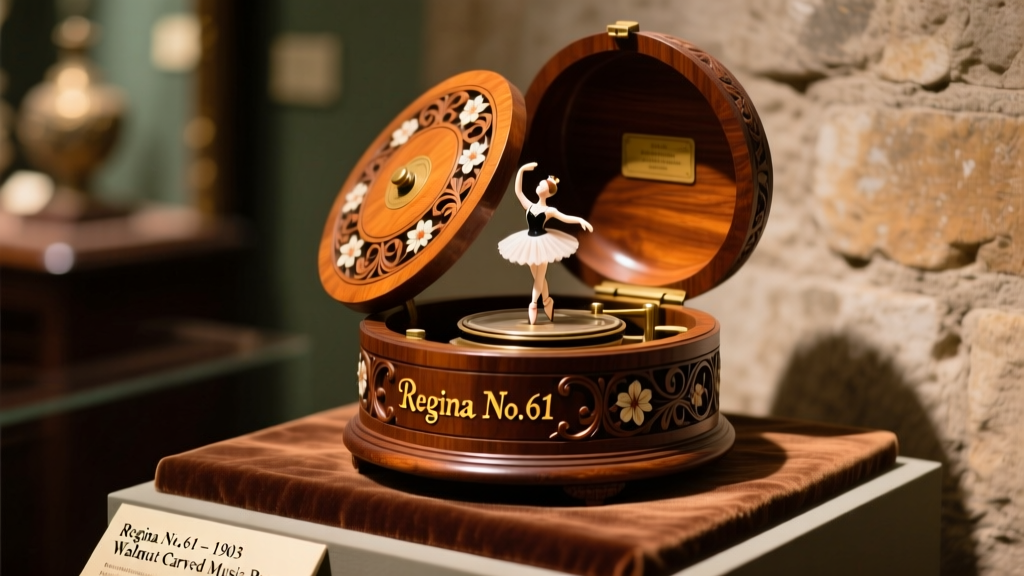
Regina Music Box No. 61: A 1903 Walnut Carved Masterpiece with 11-Inch Discs
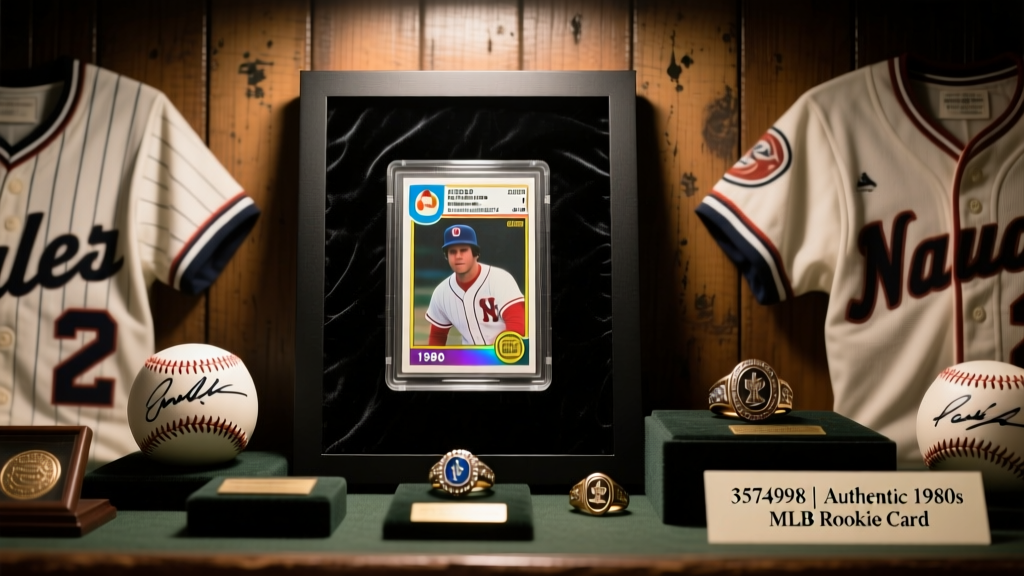
Decoding 3574998: The Authenticity, Provenance, and Market Significance of a Landmark 1952 Topps Mickey Mantle Rookie Card
Dresden Candy Container: Cross-Shaped Gold-and-Silver Box with Cultured Pearl Accents (3½ × 2½ Inches)
Authenticating and Valuing the Textiles Pillow Cover 'Woman Standing at Fountain' (20 × 25 Inches)
Majorelle Flowering Clematis Vines on Head Rail Chair Pair: Authentication, Provenance, and Market Significance
Authenticating and Valuing the Indian Rug Navajo Valero Stars Banded Fringed Corners, Circa 1950 (48 × 34 Inches)
Derby Platter Oval Center Floral Motif in Imari Colors with Gilt Accents, Circa 1820 — A Pair of 10½-Inch Masterpieces
Francis Lea: The Forgotten Architect of Modern Football Kit Design and Authenticity Challenges in Memorabilia
John Denham: The Unseen Architect of Modern Sports Memorabilia Authentication