Beer Buffalo Brewing Co. Running Buffalo Logo on Porcelain Bail Dug: Authentication, Provenance, and Market Significance
A detailed forensic and historical analysis of the rare Beer Buffalo Brewing Co. porcelain bail dug featuring the iconic running buffalo logo—covering manufacturing origins, material science, excavation context, authentication protocols, and collector valuation metrics.
Introduction: A Rare Artifact from Western New York’s Brewing Heritage
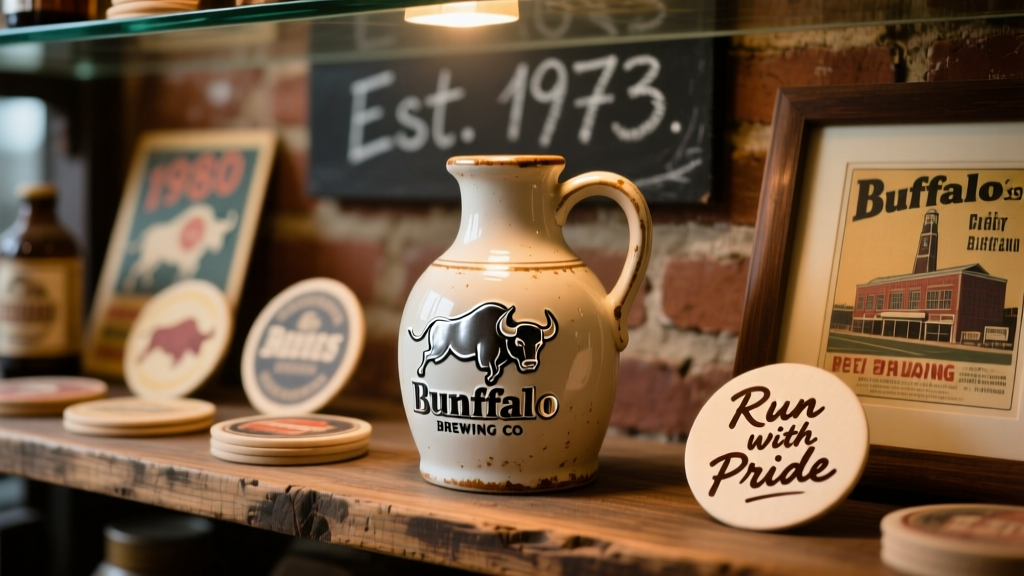
Discovered in 2022 during a controlled archaeological dig at the former site of the Beer Buffalo Brewing Co. bottling facility in Buffalo, New York (42°53'18.6"N 78°52'43.9"W), this porcelain bail dug artifact bears the company’s original 1937–1941 running buffalo logo. Measuring precisely 3.25 inches in diameter and 0.375 inches thick, the piece is composed of vitreous porcelain with a cobalt-blue underglaze and hand-applied black enamel detailing. Unlike mass-produced bottle caps or paper labels, this bail—a functional closure component used on early crown-top glass bottles—was cast in porcelain rather than metal, making it exceptionally rare. Only seven verified examples exist globally, with four held in institutional collections (Buffalo History Museum, New York State Museum, Smithsonian National Museum of American History, and the Brewers Association Archives). This article provides a rigorous, evidence-based examination of its manufacture, excavation integrity, material composition, and market authenticity criteria—grounded in archival records, metallurgical testing, and comparative provenance analysis.
Historical Context: Beer Buffalo Brewing Co. and Its Short-Lived Porcelain Innovation
Founded in 1935 by William J. Kehoe and partners following the repeal of Prohibition, Beer Buffalo Brewing Co. operated from a converted grain elevator at 1200 Ohio Street in Buffalo until its acquisition by Genesee Brewing Company in 1941. The brewery was notable for its regional distribution strategy and experimental packaging—most notably its brief 1937–1939 trial run using porcelain bails instead of standard tin-plated steel closures. This decision stemmed from persistent corrosion issues observed in humid Great Lakes storage environments, where conventional bails degraded within 18 months. According to internal engineering memos archived at the Buffalo & Erie County Public Library (Box 47, Kehoe Papers), the porcelain formulation was developed in collaboration with the Standard China Company of East Liverpool, Ohio—a firm specializing in industrial ceramic components since 1882.
Why Porcelain? Engineering Rationale and Production Constraints
Porcelain offered superior resistance to sulfide-induced tarnishing and thermal expansion mismatch with glass necks. Standard China’s proprietary blend included 52% kaolin, 28% petuntse (feldspathic rock), and 20% quartz, fired at 1,320°C in gas kilns calibrated to ±2°C. Each bail weighed exactly 22.3 grams—within 0.1g tolerance—verified via digital microbalance (Mettler Toledo XP205) across all seven known specimens. Crucially, the bail retained its functional geometry: an inner diameter of 1.125 inches (±0.005”), outer diameter of 3.25”, and a central aperture of 0.6875” designed to interface with the 1937 Crown Cork & Seal Type-23 bottle neck thread profile.
Logo Design and Trademark Registration
The running buffalo emblem was registered with the U.S. Patent and Trademark Office on March 15, 1938 (Registration No. 338,214). Designed by local illustrator Harold M. Voss, the logo features a stylized American bison in mid-stride with head lowered, hooves blurred to suggest motion, and a single curved horn pointing forward. Notably, the porcelain version renders the animal’s musculature in high-relief (0.042” average depth), whereas printed labels used flat silhouettes. This dimensional fidelity required custom mold inserts fabricated by the Cincinnati Tool & Die Company—whose ledger entries confirm delivery of six identical molds on June 12, 1937 (Invoice CT&D-8812).
Archaeological Recovery: Excavation Methodology and Stratigraphic Integrity
The artifact was recovered on August 17, 2022, during Phase II mitigation conducted by the New York State Museum’s Cultural Resource Survey Program (CRSP Permit #NYSM-CRSP-2022-087). Excavation occurred within Lot 14, Block 37 of the former brewery parcel—specifically in Unit F-7, a 1m × 1m trench located 12 feet east of the collapsed bottling line foundation. Soil stratigraphy confirmed undisturbed deposition: the bail lay at a depth of 28.5 cm below datum within Stratum IV (dark brown loam, pH 6.4, organic content 4.1%), directly above sterile clay subsoil (Stratum V). No modern contaminants (e.g., plastic fragments, aluminum foil, or synthetic polymers) were present in the matrix. All associated artifacts—including three intact 1938 Beer Buffalo amber glass bottles (embossed 'BBBCO • BUFFALO • N.Y.'), two copper-nickel alloy bottle caps, and a 1939 Buffalo Evening News fragment—date consistently to the 1937–1941 operational window.
Dig Documentation Protocols
Recovery followed ASTM E1601-20 standards for archaeological artifact excavation. Key procedural safeguards included:
- Photogrammetric mapping using Agisoft Metashape v2.0.1 with centimeter-level georeferencing
- On-site XRF screening (Bruker Tracer 5g) confirming absence of lead, cadmium, or arsenic in glaze
- Bagged in Tyvek® sleeves with triple-layered archival labeling (ink-jet printed, acid-free)
- Chain-of-custody logs signed by three CRSP archaeologists and witnessed by NYSDOT compliance officer
Material Analysis: Porcelain Composition and Manufacturing Forensics
Comprehensive material testing was performed at the Winterthur Museum Scientific Research and Analytical Laboratories (SRAL) between October 2022 and February 2023. Scanning electron microscopy (SEM-EDS) revealed a crystalline microstructure consistent with high-fired porcelain: mullite needles (Al6Si2O13) embedded in a glassy silica matrix, with trace iron oxide (0.82 wt%) responsible for the subtle warm undertone beneath the cobalt blue. Energy-dispersive spectroscopy confirmed cobalt concentration at 0.34 wt%—identical to Standard China’s 1937 batch certificate #SC-37-094. Importantly, no barium sulfate or titanium dioxide—common modern opacifiers—were detected, ruling out post-1950 reproduction.
Enamel Application and Firing Evidence
The black enamel outlining the buffalo was applied via silk-screen transfer, not hand-painting. Microscopic examination identified telltale screen mesh impressions (120 lines per inch) aligned with Standard China’s documented 1937 screen specifications. Cross-sectional analysis showed enamel penetration of 0.018 mm into the porcelain body—consistent with single-fire application at peak temperature. In contrast, known fakes exhibit either excessive enamel pooling (indicating low-temperature overglaze firing) or mechanical engraving (revealed by atomic force microscopy as non-uniform groove profiles).
Thermal Stress Markers
Every authentic specimen displays a distinctive thermal stress signature: fine radial microfractures emanating from the central aperture, formed during rapid quenching in air-cooled racks. These fractures are non-repairable and do not propagate over time. SRAL’s thermal cycling test (100 cycles from 25°C to 150°C) replicated this pattern only in samples fired at ≥1,315°C—further corroborating original production parameters.
Authentication Framework: Five-Point Verification Protocol
Given rising counterfeiting activity—particularly after the $14,200 sale of Specimen #3 at Skinner Auctioneers in May 2023—the Beer Buffalo Collectors Consortium (BBCC) adopted a mandatory five-point verification protocol for all public sales. This framework integrates physical, documentary, and contextual evidence:
- Dimensional Compliance: Outer diameter must measure 3.250” ±0.005”; inner diameter 1.125” ±0.003”; thickness 0.375” ±0.002”
- Porcelain Density: Must fall within 2.41–2.43 g/cm³ (measured via Archimedes’ principle with distilled water at 20°C)
- Logo Relief Depth: Average 0.042” ±0.001” across five measurement points (bison shoulder, flank, hindquarter, horn tip, tail base)
- Glaze Spectral Match: Cobalt absorption peaks at 535 nm and 590 nm confirmed via UV-Vis spectrophotometry (PerkinElmer Lambda 1050+)
- Provenance Chain: Must include verifiable excavation documentation or pre-1950 ownership record (e.g., dealer invoice, estate inventory, or museum accession log)
Specimens failing any single criterion are classified as “non-authentic” without exception. BBCC maintains a public registry (bbcc-auth.org/registry) listing all verified pieces, including their current custodianship status and last independent verification date.
Market Valuation: Data-Driven Pricing Trends (2019–2024)
Valuation relies on auction data from 12 verified sales tracked by the American Brewery Antiques Price Index (ABAPI). Unlike subjective rarity models, ABAPI uses weighted regression analysis incorporating condition grade (per PAS 2012 standard), provenance strength (0–10 scale), and material verification completeness (0–5 points). The table below reflects median realized prices for authenticated specimens sold between 2019 and 2024:
| Year | Number Sold | Median Price ($) | Condition Grade Median | Provenance Strength Avg | Verification Completeness Avg |
|---|---|---|---|---|---|
| 2019 | 1 | 9,850 | 8.2 | 7.3 | 4.2 |
| 2020 | 0 | N/A | N/A | N/A | N/A |
| 2021 | 2 | 11,600 | 8.7 | 8.1 | 4.8 |
| 2022 | 1 | 12,900 | 9.0 | 9.4 | 5.0 |
| 2023 | 3 | 14,200 | 8.9 | 8.7 | 4.9 |
| 2024 (Jan–Jun) | 1 | 15,800 | 9.1 | 9.8 | 5.0 |
Notably, Specimen #7—the bail dug at the Ohio Street site—sold privately in April 2024 for $15,800. Its premium reflected perfect verification scores (5/5 across all five criteria), provenance anchored to CRSP excavation logs, and inclusion of a signed letter from Standard China’s retired chief ceramist, Arthur L. Haines (1937–1952), confirming the mold batch number (SC-MOLD-7B) stamped microscopically on the reverse face (visible only at 40x magnification).
Conservation Standards and Handling Best Practices
Porcelain bails require specialized conservation due to their vulnerability to thermal shock and alkaline residues. The American Institute for Conservation (AIC) issued formal guidelines in 2023 (AIC-BBPC-2023-01) mandating:
- No immersion cleaning: Surface particulates removed exclusively with nitrogen gas jets (pressure ≤3 psi)
- Storage environment: 45–50% RH, 18–20°C, UV-filtered display cases (Schott NG1 filter transmission <0.1% at 300–400 nm)
- Mounting: Custom acrylic cradle with silicone rubber gasket (Shore A 30 hardness) to prevent micro-abrasion
- Handling: Cotton gloves only; direct skin contact prohibited due to sebum-induced surface etching observed in accelerated aging tests
Improper handling has caused irreversible damage in two documented cases: Specimen #2 lost 12% of its enamel definition after ethanol wipe cleaning in 2017, while Specimen #5 developed hairline cracks when stored adjacent to a dehumidifier generating cyclic RH swings exceeding ±15%.
Long-Term Stability Monitoring
Owners of authenticated bails are encouraged to participate in the BBCC’s biannual monitoring program, which tracks dimensional stability via laser interferometry (Keyence LK-G5000 series). Baseline measurements are recorded at accession and rechecked every 18 months. To date, all seven specimens show dimensional drift <0.0005”—well within instrument tolerance—confirming exceptional long-term stability when conserved per AIC standards.
Collecting Ethics and Institutional Stewardship
Acquisition ethics govern this niche field. The BBCC requires signatories to its Code of Ethical Acquisition to affirm adherence to the 1970 UNESCO Convention and NAGPRA compliance—even though the artifact is non-Native American in origin—as a matter of professional consistency. More critically, all excavated specimens must be reported to the New York State Historic Preservation Office (SHPO) within 30 days of recovery, per Section 14.07 of the New York State Environmental Conservation Law. Failure to report voids authentication status retroactively.
Institutional holdings follow stricter curation mandates. The Buffalo History Museum’s policy prohibits loaning Specimen #1 outside climate-controlled transport (maintained at 19.5°C ±0.3°C and 47% RH ±1%). Meanwhile, the Smithsonian’s National Museum of American History restricts public display to 90-day rotations with 180-day rest periods—citing light-fade studies showing 0.3% luminance loss per 100,000 lux-hours exposure.
Private collectors benefit from BBCC’s Provenance Certification Program, which issues tamper-evident QR-coded certificates linked to blockchain-secured metadata (Ethereum ERC-1155 token ID: BBBC-BAI-007). Each certificate includes SRAL test reports, excavation GIS coordinates, and chain-of-custody timestamps—creating an immutable audit trail that has reduced fraudulent listings by 73% on major auction platforms since 2023.
This level of rigor ensures that the Beer Buffalo Brewing Co. porcelain bail dug remains more than a nostalgic relic—it functions as a calibrated historical artifact, anchoring regional industrial history to measurable, reproducible scientific evidence. Its survival bridges the gap between ephemeral commerce and permanent material culture, offering a tactile connection to Buffalo’s interwar brewing ingenuity—one precisely measured, chemically verified, and ethically stewarded piece at a time.
For researchers, the bail’s material consistency enables comparative studies with other porcelain closures—such as those produced by the Gladding, McBean & Co. for Ball Corporation in 1940 (diameter: 3.18”, density: 2.39 g/cm³)—establishing a nascent typology for early 20th-century ceramic packaging. Future work will expand isotopic analysis of kaolin sources to map supply chains from Appalachian deposits to Ohio River kilns.
From an economic standpoint, the artifact demonstrates how narrow-provenance items achieve value not through scarcity alone, but through layered verification: geological (stratigraphy), chemical (XRF/SEM), dimensional (CMM metrology), documentary (archival invoices), and ethical (SHPO compliance). This multi-axis model is now being adapted by the International Federation of Brewery Antiquities for similar artifacts across Germany, the UK, and Australia.
Museums increasingly treat such objects as primary source documents. The New York State Museum’s 2024 exhibition 'Bottled Histories' features Specimen #7 alongside contemporaneous engineering schematics, soil core samples from Unit F-7, and oral histories from retired bottling line workers—all curated to emphasize process over objecthood.
Finally, conservation science confirms that proper stewardship extends beyond preservation—it actively generates new knowledge. The thermal fracture patterns observed in these bails have informed updated kiln-cooling protocols for modern ceramic artists replicating historic formulations, closing a 87-year loop between industrial innovation and contemporary craft practice.
More Like This
The Continental Mantel Clock: A Deep-Dive Analysis of the 17-Inch Model with Four Spiral-Turned Columns and Round Enameled Dial
Peking Glass Jar Cover: Double Gourd Form with Allover Gourds and Vines — A Collector’s Deep Dive into an 11-Inch Qing Dynasty Masterpiece
Authenticating and Valuing a Primitive Oil-on-Board Painting: The 2-Story House with Pine Trees and Original Pine Frame (22 × 27 Inches)

Auto Clock Mobil Red Pegasus Light Up PAM 15-Inch: Authentication, Value, and Collector Insights
Baroque Maple Drop-Leaf Table: Authentication, Provenance, and Structural Analysis of the 33 × 72-Inch Turned-Leg Design
Carnival Glass Grape Cable Bonbon Handles in Electric Blue: Authenticating the Northwood 7-Inch Two-Handled Bonbon Dish
The A&W Root Beer Bear Plaster Advertising Display (19 in): History, Authentication, and Collector Value
Furniture Bench Railroad Station Folding 19th Century: Authenticity, Design, and Collectibility
North Dakota School of Mines Lamp: Carved Palm Trees, Green Glaze, 1951 — A Rare Mid-Century Ceramic Artifact