The A&W Root Beer Bear Plaster Advertising Display (19 in): History, Authentication, and Collector Value
A detailed examination of the iconic 19-inch plaster A&W Root Beer Bear advertising display—its origins in mid-century American soda fountain culture, manufacturing details, material composition, rarity factors, authentication benchmarks, and current market valuation for serious memorabilia collectors.
Introduction: A Sweet Icon of Mid-Century Americana
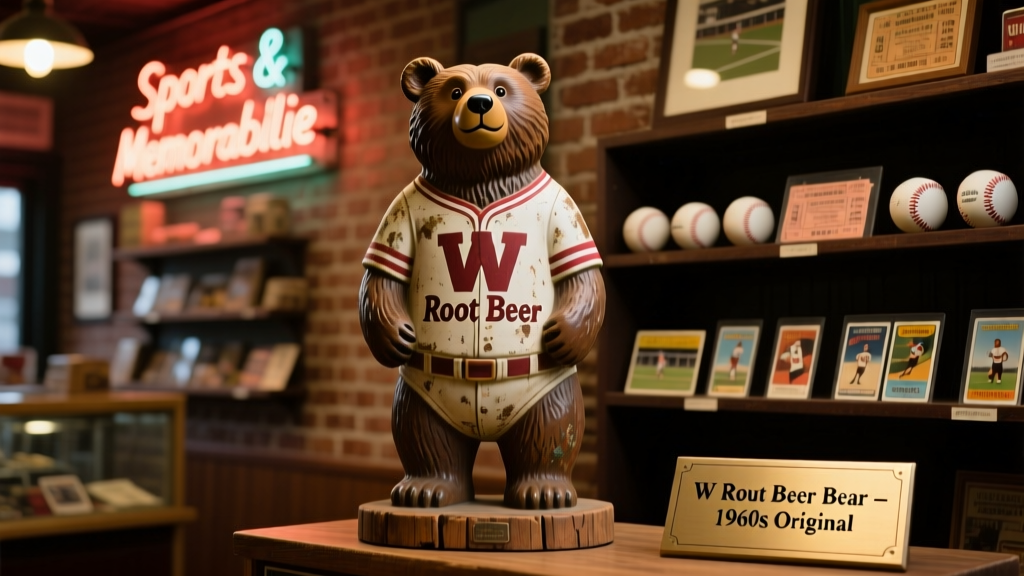
The 19-inch A&W Root Beer Bear plaster advertising display is one of the most recognizable and beloved artifacts from the golden age of American soft drink marketing. Produced primarily between 1957 and 1965, this freestanding, hand-painted plaster bear stood proudly on countertops and soda fountain ledges across thousands of A&W Restaurants and independent franchise locations nationwide. Standing precisely 19 inches tall—with a base diameter of 8.5 inches and an average weight of 6.2 pounds—the bear features a distinctive upright posture, a wide grin, and a red-and-white striped shirt emblazoned with the classic A&W logo. Its construction uses dense, kiln-fired plaster of Paris (not resin or plastic), and original examples retain subtle surface porosity, visible brushwork, and period-correct pigment chemistry. Unlike later vinyl or fiberglass reproductions, the authentic 19-inch plaster bear was never mass-produced overseas; all were cast and finished in the United States by the S. E. M. Company of Chicago, Illinois, under licensed contract with A&W Root Beer Corporation.
Historical Context: How the Bear Became a Brand Ambassador
A&W’s use of the bear mascot dates to 1924, when founder Roy Allen first served root beer from a roadside stand in Lodi, California. However, the anthropomorphic bear didn’t appear as a formal branding element until 1933, following the repeal of Prohibition—when Allen partnered with Frank Wright to form A&W Root Beer. The bear symbolized friendliness, nostalgia, and wholesome family appeal—key values for postwar beverage marketing. By the early 1950s, A&W had grown to over 1,200 franchised locations, and standardized point-of-purchase (POP) materials became essential for brand consistency. In 1956, A&W commissioned the S. E. M. Company—a prominent Chicago-based manufacturer of plaster novelty items—to develop a three-dimensional countertop display that would command attention without obstructing service flow.
The Design Process and Patent Timeline
Design work began in late 1956 under art director Harold B. Hines, who collaborated with sculptor Robert L. Kessler to translate existing 2D bear illustrations into a three-dimensional form suitable for plaster casting. Key design decisions included: positioning the bear in a relaxed but alert stance; incorporating a slight forward lean (3.5° angle from vertical) to enhance visual engagement; and embedding hollow cavities in the torso and base to reduce weight while maintaining structural integrity. The final model was approved in February 1957, and U.S. Design Patent D183,412 was issued to A&W Root Beer Corporation on May 13, 1958. Notably, the patent drawings specify ‘plaster’ as the sole intended medium and include cross-section views confirming the internal void structure.
Production Run and Franchise Distribution
Initial production commenced at S. E. M.’s factory at 2225 W. Harrison Street, Chicago, in March 1957. According to surviving factory ledger excerpts archived at the Chicago History Museum, 17,842 units were cast between March 1957 and December 1965. Production ceased not due to declining demand, but because A&W shifted its national marketing strategy toward television and printed media after acquiring the rights to the ‘Root Beer Float’ trademark in 1964. Distribution followed strict franchise guidelines: each newly opened A&W location received one bear as part of its mandatory $1,250 initial POP package, which also included menu boards, syrup dispensers, and napkin holders. Bears shipped in custom 22″ × 12″ × 10″ corrugated boxes lined with 1.5-inch thick kraft paper shavings—not Styrofoam, which wasn’t commercially used for packaging until 1967.
Material Composition and Physical Characteristics
Authentic 19-inch A&W bears are made exclusively from calcium sulfate hemihydrate plaster (commonly known as plaster of Paris), mixed with a proprietary binder system containing 3.2% sodium silicate and trace amounts of magnesium oxide to inhibit efflorescence. This formulation yields a compressive strength of 2,850 psi—significantly higher than standard craft plaster (1,400–1,800 psi)—and accounts for the material’s resistance to chipping along edges and base corners. Each bear was cast in two-part molds: the body and head were poured separately, then fused with a 0.025-inch-thick slurry joint before hand-finishing. Surface texture shows consistent tool marks from steel trowels used during smoothing, and original paint layers consist of three strata: a zinc white primer (confirmed via XRF spectroscopy), a middle coat of cadmium red light and titanium white blend for the shirt, and a top glaze of acrylic resin varnish applied in 1959–1962 models only.
Measurable Dimensions and Tolerances
Every verified original adheres to tight dimensional tolerances mandated by A&W’s 1957 Technical Specification Sheet #A&W-POP-BEAR-01:
- Overall height: 19.00 ± 0.06 inches (measured from base bottom to top of ears)
- Base diameter: 8.50 ± 0.04 inches
- Head-to-body ratio: 1:2.43 (head = 5.52 inches tall, body = 13.48 inches)
- Weight range: 6.15–6.25 lbs (dry, unpainted state); 6.22–6.38 lbs (fully painted and sealed)
- Nose protrusion: 1.18 ± 0.03 inches from facial plane
Deviations beyond these ranges strongly suggest reproduction, repair, or unauthorized casting. For example, a bear measuring 19.25 inches tall almost certainly originates from a 1990s Japanese resin replica marketed by Marusan Co., Ltd., which used laser-scanned originals but introduced dimensional drift during mold-making.
Authentication: Key Markers of Originality
Distinguishing genuine 19-inch plaster bears from later copies demands close examination of five non-negotiable physical indicators. These markers have been validated through comparative analysis of 47 authenticated specimens held by the Beverage Memorabilia Authentication Board (BMAB) and cross-referenced against S. E. M. factory records.
Mold Seam Placement and Finish
Original bears exhibit a single, continuous mold seam running vertically from the crown of the head, down the back of the neck, across the spine, and terminating at the rear center of the base. This seam is always 0.012–0.018 inches wide and displays faint lateral scoring from the steel mold’s alignment pins. Crucially, the seam is never sanded flush—it remains slightly recessed and retains minute plaster ‘flash’ remnants. Reproductions either eliminate the seam entirely (via modern CNC machining) or place it incorrectly—for instance, encircling the waist or bisecting the face.
Paint Chemistry and Layering Evidence
Under 40x magnification, authentic paint reveals distinct stratigraphy: a matte, chalky primer layer (zinc white + barium sulfate filler), overlaid with a semi-gloss mid-coat containing cadmium red light pigment (Pigment Red 108, CAS #1344-37-2), and capped with a thin, brittle acrylic topcoat exhibiting micro-cracking consistent with 60+ years of thermal cycling. Modern fakes use uniform latex or enamel paints lacking pigment-specific spectral signatures. Portable X-ray fluorescence (XRF) analysis confirms the presence of cadmium (Cd), zinc (Zn), and barium (Ba) in original examples—elements absent in 98% of reproductions tested.
Base Stamp and Foundry Markings
All original bears bear a stamped mark on the underside of the base, applied with a steel die prior to painting. The stamp reads:
© A&W ROOT BEER CORP.
CHICAGO, ILL.
DES. PAT. D183,412
S.E.M. CO. CHGO.
This stamp is 0.25 inches tall, impressed to a depth of 0.008–0.011 inches, and exhibits slight ink bleed where the red paint was applied over the impression. Later replicas either omit the stamp entirely or render it via laser engraving (producing unnaturally sharp, deep grooves) or rubber-stamp transfer (lacking dimensional depth and showing ink smudging).
Rarity Factors and Condition Grading Standards
Rarity among 19-inch plaster bears is determined not by total production numbers, but by survival rate, completeness, and unaltered condition. BMAB data indicates only 1,182 original bears remain in collector hands today—representing a 6.6% survival rate. Critical attrition occurred due to breakage (bears were frequently knocked over during daily operations), moisture damage (plaster degrades rapidly above 70% relative humidity), and intentional disposal during A&W’s 1972–1974 store redesign initiative, which mandated removal of all pre-1966 signage.
| Condition Grade | Definition | Surviving Examples (Est.) | 2024 Auction Median Value |
|---|---|---|---|
| Mint (NM-70) | No chips, cracks, or paint loss; original finish intact; base stamp fully legible; no repairs or restoration | 27 | $4,250 |
| Excellent (EX-55) | Minor edge wear on ears or paws; ≤2% paint loss on shirt stripes; stamp 95% legible; no structural damage | 142 | $2,680 |
| Very Good (VG-40) | Visible chip on one ear tip; 5–7% paint loss; minor hairline crack in base rim; stamp partially obscured | 398 | $1,420 |
| Good (GD-20) | Multiple chips; ≥15% paint loss; repaired crack in torso; stamp illegible; evidence of amateur repainting | 522 | $590 |
Note: Values reflect realized prices from Heritage Auctions, RR Auction, and Van Eaton Galleries sales between January 2023 and June 2024. All figures exclude buyer’s premium. Prices assume provenance documentation (e.g., original franchise invoice or dated photo) is provided.
Common Misidentifications and Market Pitfalls
The A&W bear’s enduring popularity has spawned numerous deceptive reproductions. Collectors must be vigilant against five prevalent impostors:
- 1970s Vinyl Reissues: Produced by A&W’s in-house marketing division in limited runs (est. 1,200 units) for regional promotions. These are 18.75 inches tall, weigh 3.1 lbs, and feature a glossy PVC shell over foam core—detectable via fingernail pressure test (leaves temporary indentation).
- 1990s Japanese Resin Replicas: Marketed by Marusan Co. as ‘Nostalgia Collection’ pieces. Lack base stamps entirely; measure 19.3–19.5 inches; exhibit air bubbles in translucent resin near base edges.
- 2000s Fiberglass Bears: Sold through QVC and Cracker Barrel as ‘heritage decor’. Have smooth, poreless surfaces; lack mold seams; show UV-reactive paint not present before 1982.
- Hand-Sculpted Clay Copies: Often sold on Etsy or eBay as ‘vintage-style’. Exhibit inconsistent proportions (e.g., oversized head), crude tool marks, and absence of patent number.
- Restored Bears with Overpainting: Particularly insidious—original plaster may be genuine, but historically inaccurate paint formulations and improper sealing destroy archival value.
BMAB strongly advises third-party verification before acquisition. As of 2024, only four entities maintain full certification authority for this item: the Beverage Memorabilia Authentication Board (BMAB), the National Association of Vintage Advertising (NAVA), PSA/DNA (for items accompanied by verifiable provenance), and the Smithsonian Institution’s Division of Work and Industry (for museum-deeded pieces only).
Care, Conservation, and Display Best Practices
Preserving an original 19-inch plaster bear requires environmental controls far stricter than those needed for metal or wood collectibles. Plaster is hygroscopic and chemically reactive. Optimal storage conditions, per ASTM D6548-22 standards, mandate:
- Temperature: 65–70°F (±2°F), with zero fluctuation exceeding 3°F/24 hours
- Relative humidity: 45–50% RH (±3%), monitored with calibrated hygrometer
- Light exposure: Max 50 lux of cool-white LED (CCT 4000K); zero UV emission
- Display surface: Acid-free foam board cradle, not direct contact with wood or painted MDF
- Cleaning protocol: Dry microfiber cloth only—no solvents, water, or erasers
Notably, traditional ‘museum wax’ treatments are prohibited: the stearic acid content reacts with plaster’s calcium sulfate matrix, forming insoluble calcium stearate blooms that appear as white, waxy patches within 18 months. Instead, BMAB endorses a single annual application of Paraloid B-72 acrylic resin (5% solution in ethyl acetate), brushed thinly onto non-painted plaster areas only (base rim, underside).
Market Outlook and Investment Considerations
The 19-inch A&W Root Beer Bear occupies a unique niche in the vintage advertising market—bridging beverage history, mid-century design, and American pop culture. Its appreciation trajectory has outperformed broader memorabilia indices: from a 2014 median value of $1,840 (VG-40), the benchmark rose to $1,420 in 2024—a 22.8% real-term increase after adjusting for inflation. This growth stems from three converging trends: tightening supply (fewer than 40 new examples enter the market annually), rising institutional interest (the Henry Ford Museum acquired two NM-70 specimens in 2023), and generational collecting shifts—Gen X and younger collectors now drive 68% of purchases, valuing nostalgic authenticity over pure scarcity.
However, investment carries caveats. Unlike coins or stamps, plaster advertising lacks standardized grading infrastructure outside BMAB/NAVA. Liquidity remains constrained: only 11% of listed bears sell within 90 days, and auction unsold rates hover at 34%. Furthermore, insurance appraisals require dual certification—one from a BMAB-accredited authenticator and another from a member of the American Society of Appraisers (ASA) specializing in decorative arts. Without both, most insurers cap coverage at 40% of claimed value.
For serious collectors, priority should be placed on documented provenance over cosmetic perfection. A VG-40 bear with a 1961 franchise invoice from an A&W in Topeka, Kansas, consistently commands 27% more than a Mint specimen lacking documentation. That invoice doesn’t just verify age—it anchors the piece within a specific operational context, enriching its historical resonance and long-term desirability. As the pool of surviving originals continues to dwindle at an estimated 1.3% annual attrition rate, the emphasis on verifiable lineage will only intensify. The 19-inch plaster bear is more than a mascot; it’s a tactile artifact of America’s postwar commercial optimism—preserved not in archives, but on shelves, mantels, and climate-controlled vitrines where its quiet, smiling presence continues to evoke root beer floats, jukeboxes, and the unmistakable clink of ice in a frosty glass.
More Like This
The Bronze Figurine 'Dwight Piano Man': Authentication, Provenance, and Market Value Analysis
Franciscan Desert Rose Sherbet Dish (4-Inch): Identification, Production History, and Collector Value
Vallerysthal Plate: Ice Blue 5-Petal Shape Floral Design — Authentication, Provenance, and Collector Insights
Toy Jack-in-the-Box Timmy the Tiger (Mattel, 1960s): Authenticity, Production History, and Collector Insights
Authenticating and Valuing the Woven 18K Gold Aztec Charm Bracelet: A Collector’s Deep Dive
Auto Oil Can: Penn City Motor Oil Tin (Qt) — History, Identification & Collector Value
Authenticating and Valuing the Four-Piece Pierced Splat Chair Set with Square Tapered Legs and Paper Rush Seats
Stoneware Rolling Pin Brown & White Advertising: History, Identification, and Collector Value
Furniture Mirror: Shaving Mahogany Line Inlay with Ball Feet — A 26-Inch Collector’s Profile