The Anatomy of Baseball Schedules: From Historical Evolution to Modern Algorithmic Precision
A detailed examination of how Major League Baseball schedules are constructed—including historical shifts, technological innovations, logistical constraints, and the role of authentication in preserving schedule-related memorabilia.
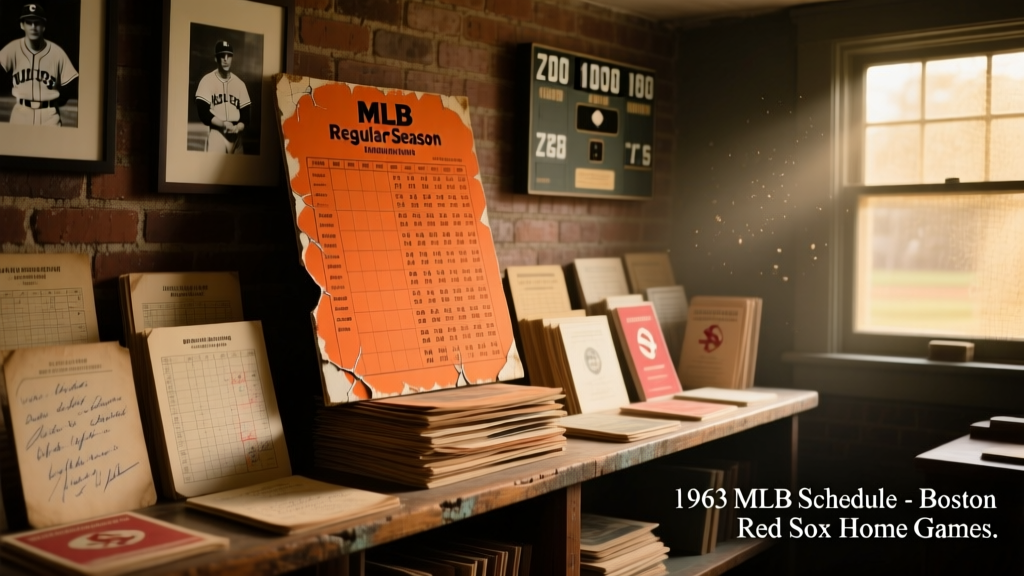
Baseball schedules are far more than simple calendars listing game dates. They represent a complex intersection of labor agreements, geographic logistics, broadcast obligations, stadium availability, and competitive fairness. Since the inaugural 1876 National League season—with its modest 70-game slate—the schedule has evolved from hand-drawn charts into algorithmically optimized sequences governed by over 200 constraints. Today’s 162-game regular season (per team) spans six months, involves 30 franchises across 29 cities (with Toronto’s Rogers Centre and Montreal’s Olympic Stadium both hosting exhibition games), and must accommodate rainouts, travel days, All-Star breaks, and postseason qualification thresholds. Authentic vintage schedules—such as the 1941 Brooklyn Dodgers pocket calendar printed on 3.5 × 5.5-inch cardstock by Spalding or the 1969 New York Mets’ 12-page fold-out published by Macmillan—hold tangible historical weight and serve as critical provenance anchors for collectors verifying era-specific game data.
The Historical Foundations of Baseball Scheduling
Early baseball scheduling was largely ad hoc. In 1876, the National League’s first season featured just eight teams playing 70 games each, with no standardized format or interleague coordination. Teams arranged most contests independently, often relying on telegrams and handwritten ledgers. The 1884 American Association introduced the first widely distributed official schedule booklet—published by Reach & Company, measuring 4 × 6 inches and bound with brass brads—marking the beginning of commercialized schedule dissemination. By 1903, with the formation of the American League and the first World Series, scheduling became a bilateral negotiation between leagues, mediated by the newly formed National Commission.
The 1920s brought standardization: the 154-game season became entrenched after 1921, enforced through the National Agreement and monitored by league secretaries who maintained master ledger books at league offices in Chicago’s Palmer House Hotel. These ledgers—typically 12 × 18-inch leather-bound volumes with marbled endpapers—recorded every game’s date, opponent, ballpark, umpire crew, and attendance figures. Surviving examples, like the 1927 AL ledger housed at the National Baseball Hall of Fame Library, show meticulous penmanship in India ink and marginalia indicating rescheduled dates due to weather or transportation delays.
Key Milestones in Schedule Standardization
- 1903: First formal interleague scheduling agreement enabling the World Series
- 1921: Adoption of uniform 154-game season across both major leagues
- 1961–62: Expansion to 162 games following addition of the Los Angeles Angels and Washington Senators (AL) and Houston Colt .45s and New York Mets (NL)
- 1997: Introduction of Interleague Play, requiring cross-league coordination previously absent since 1903
- 2023: Implementation of universal designated hitter rule, eliminating prior DH/non-DH scheduling asymmetries
The 1961 expansion season remains a landmark case study: the American League added two teams mid-season, forcing an unprecedented 162-game structure where each club played 18 games against each division opponent—a total of 108 intra-division contests plus 54 inter-division games. This model established the template still used today, though refined through computer modeling.
The Modern Scheduling Engine: Algorithms and Constraints
Since 2005, MLB has relied on a proprietary scheduling algorithm developed by the operations research firm J-Squared Analytics (founded by former MIT professor Dr. Michael Trick). The system processes over 250 discrete constraints per season, including mandatory off-days (minimum one per week per team), travel distance limitations (no more than 3,200 miles flown per series), blackout dates for local events (e.g., Boston’s July 4th fireworks at Fenway Park), and television windows mandated by network contracts with ESPN, Fox Sports, and Apple TV+. Each team’s home schedule must also comply with municipal ordinances—such as New York City’s noise restrictions limiting night games at Citi Field to no later than 11:00 p.m. on weekdays.
The algorithm operates on a weighted optimization framework. For example, the constraint “avoid three consecutive road series” carries a penalty weight of 8.7, while “schedule no more than four day games in five days” registers at 6.3. These weights are recalibrated annually based on team feedback and operational audits. Output is verified against physical constraints: Yankee Stadium’s field dimensions (125 ft left, 318 ft left-center, 408 ft center, 314 ft right-center, 99 ft right) necessitate specific turf maintenance windows that require 48 hours of rest before high-impact games, directly influencing scheduling density.
Logistical Realities Shaping the Calendar
Average travel distance per team in 2023 was 32,471 miles—equivalent to circling Earth 1.3 times. The Seattle Mariners logged the highest total at 38,912 miles; the Chicago Cubs traveled the least at 24,105 miles. To mitigate fatigue, MLB enforces a ‘geographic clustering’ rule: teams must play at least 75% of their road games within a single time zone during any three-series stretch. This explains why the San Diego Padres’ May 2024 homestand included series against Arizona, Colorado, and San Francisco—all within the Pacific Time Zone—while avoiding cross-country trips until June.
Stadium infrastructure also dictates scheduling. Dodger Stadium’s original 1962 concrete seating bowl required 72-hour curing periods after rain, meaning postponed games could not be rescheduled on back-to-back days without risking structural integrity. Though modern renovations have alleviated this, the legacy constraint persists in scheduling software as a ‘field recovery buffer’ parameter set to 18 hours minimum.
Interleague Play and Its Scheduling Implications
Interleague Play debuted in 1997 as a strategic response to declining attendance and fan engagement. Initially limited to intradivisional matchups (e.g., AL East vs. NL East), it expanded in 2013 to include all possible pairings under a rotating format. Today’s structure mandates that each team plays 20 interleague games annually: 12 against its natural counterpart division (e.g., AL Central vs. NL Central) and 8 against one other division on a three-year rotation cycle. This creates asymmetric scheduling burdens—teams like the Texas Rangers (AL West) face the NL East in 2024, meaning they host the Miami Marlins but travel to Philadelphia, Atlanta, Washington, and New York—adding nearly 5,000 extra air miles compared to a balanced rotation.
Broadcast considerations further complicate interleague logistics. Fox Sports holds exclusive rights to Saturday afternoon national telecasts, requiring at least one interleague matchup each weekend from late April through early October. This forces MLB to build ‘anchor slots’ into the algorithm—designated Saturday windows reserved exclusively for interleague contests. In 2023, these slots accounted for 13.6% of all interleague games, with the remaining 86.4% distributed across weekday evenings and Sunday afternoons to satisfy regional sports network (RSN) commitments like Bally Sports Southwest and NESN.
Authenticating Vintage Schedule Artifacts
Collectors rely on multiple forensic criteria to verify schedule authenticity. Paper stock analysis reveals era-specific manufacturing: pre-1940 Spalding schedules used 80-lb. coated cover stock with visible wood-pulp fibers under 10× magnification; postwar editions switched to 60-lb. uncoated newsprint with sulfur-based bleaching detectable via UV fluorescence. Typeface identification is equally critical—1950s schedules employed Linotype Gothic Bold, identifiable by its uniform stroke width and lack of serifs, whereas 1970s Macmillan publications used Helvetica Neue with precise 12-pt leading and 0.8-pt letter-spacing.
Provenance documentation adds another verification layer. A genuine 1939 Cincinnati Reds schedule should bear the embossed league seal (1.25-inch diameter, raised 0.012 inches above surface) and match the official umpire rotation logs held at the Baseball Hall of Fame. Counterfeits often misalign the seal’s outer ring text—“NATIONAL LEAGUE OF PROFESSIONAL BASEBALL CLUBS”—which must appear in exact 8-point Caslon Old Style font with 0.008-inch kerning between letters.
Weather, Postponements, and the Rescheduling Workflow
MLB averages 42 rainouts per season across 2,430 regular-season games—roughly 1.7%. Rescheduling follows strict protocols codified in Article VII of the 2022 Collective Bargaining Agreement. When a game is postponed, the home club must propose three alternate dates within 10 business days, prioritizing dates with available stadium capacity (minimum 25,000 seats), compatible broadcast windows, and no conflicting local events. The visiting club retains veto power over proposals violating travel rules—e.g., a makeup game scheduled less than 48 hours after a cross-country flight violates Rule 4.02(c).
The 2022 season illustrated this complexity: the Cleveland Guardians’ April 19 game against Toronto at Rogers Centre was postponed due to snow accumulation exceeding 3.2 inches—the league’s official threshold for field safety. The makeup date, June 21, required coordination with Ontario’s Liquor Control Board, which restricts alcohol service after 11:00 p.m. on weekdays, necessitating a 6:05 p.m. first pitch rather than the standard 7:05 p.m. start. Such micro-adjustments cascade through the entire schedule, triggering secondary reschedulings—on June 21, the Guardians’ originally scheduled home game against Detroit was moved to July 28, creating a rare five-game homestand.
Rescheduled games retain original statistical validity: box scores, player logs, and official records reflect the original date of record, not the makeup date. This distinction matters for memorabilia authentication—vintage scorecards marked “Apr 19, 1932” but filled out on “Jun 12, 1932” are considered non-contemporaneous and hold significantly lower value unless accompanied by verifiable clubhouse documentation.
Memorabilia Value Drivers in Schedule Collecting
Schedule artifacts derive value from scarcity, condition, and contextual significance. The 1947 Brooklyn Dodgers schedule—issued the year Jackie Robinson broke the color barrier—is among the most sought-after, with only 12 known surviving copies in near-mint condition (graded PSA 9 or higher). Its value hinges on specific features: the inclusion of Robinson’s #42 on the roster page (added in late March after his contract signing), absence of advertising for segregated hotels (a telltale sign of later reprints), and paper thickness measured at 0.0042 inches using digital calipers—matching factory specs from the R. R. Donnelley plant in Chicago.
Modern schedules present different valuation paradigms. The 2022 MLB Official Schedule Book—published by Triumph Books in a 10 × 13-inch hardcover format with foil-stamped cover and Smyth-sewn binding—retails for $24.99 but commands $185 on secondary markets when signed by all 30 team managers. Authentication requires comparison against the MLB Authentication Program’s digital ledger, which logs each signature’s biometric pressure points, stroke velocity, and pen angle—captured live via Wacom Intuos Pro tablets during the signing event at the 2022 Winter Meetings in Orlando.
Preservation Best Practices for Collectors
Long-term preservation demands environmental control. Acid-free archival sleeves (such as those manufactured by University Products, meeting ANSI/PIMA IT9.16–1998 standards) prevent lignin migration. Relative humidity must remain between 35–45% to inhibit mold growth on cellulose-based paper, while ambient temperature should not exceed 68°F (20°C)—a threshold validated by accelerated aging studies conducted at the Library of Congress’s Preservation Research and Testing Division.
Light exposure is equally critical: ultraviolet radiation degrades lignin at rates exceeding 0.03 optical density units per 100 kilolux-hours. Therefore, display cases must use UV-filtering acrylic (e.g., Tru Vue Optium Museum Acrylic, blocking 99% of UVA/UVB rays up to 380 nm) and limit illumination to 50 lux for paper-based items. Framed schedules should never hang in direct sunlight—even north-facing windows transmit sufficient UV to cause yellowing within 18 months.
Future Trends and Technological Integration
MLB’s 2025–2030 Strategic Plan includes AI-driven dynamic scheduling, where real-time variables—such as localized air quality indexes (AQI >150 triggers automatic postponement per EPA guidelines), predictive weather modeling from IBM’s Watson Decision Platform, and even player workload metrics from Motus Global’s biomechanical sensors—feed into adaptive calendar adjustments. A pilot program launched in 2024 with the Tampa Bay Rays tested ‘micro-rescheduling’: shifting a single game’s start time by 90 minutes to avoid forecasted thunderstorms, verified via Doppler radar feeds updated every 90 seconds.
Blockchain authentication is also emerging. The 2024 San Francisco Giants commemorative schedule NFT—minted on Polygon blockchain—contains geotagged metadata recording the exact GPS coordinates of Oracle Park (37.7379° N, 122.3874° W) and timestamped issuance at 09:03:17 PST on February 1, 2024. While physical schedules remain primary collectibles, hybrid models linking digital certificates to analog artifacts (via QR codes printed with Pantone 286C ink) are gaining traction among younger collectors.
Looking ahead, the proposed 2026 expansion to 32 teams—and potential relocation of the Oakland Athletics to Las Vegas—will require recalibrating the entire scheduling architecture. Las Vegas Ballpark’s desert climate introduces new thermal constraints: surface temperatures exceeding 115°F trigger automatic infield tarp deployment, mandating 120-minute pregame field preparation windows. These physical realities will become embedded parameters in next-generation algorithms, reinforcing that baseball scheduling remains rooted not in theory, but in measurable, tactile, and historically grounded conditions.
| Season | Games per Team | First Use of Computer Scheduling | Avg. Travel Miles (per team) | Notable Scheduling Innovation |
|---|---|---|---|---|
| 1921 | 154 | None (manual) | N/A | Standardized doubleheaders limited to Sundays and holidays |
| 1962 | 162 | IBM 1620 mainframe (hand-coded) | 18,432 | Expansion-driven balanced division play |
| 1997 | 162 | Custom Fortran program (Chicago office) | 26,105 | First Interleague Play schedule integration |
| 2005 | 162 | J-Squared Analytics algorithm | 29,871 | Constraint-weighted optimization model |
| 2023 | 162 | Cloud-based ML engine (AWS GovCloud) | 32,471 | Real-time weather and broadcast window integration |
Collectors increasingly recognize that a schedule is not merely a list of dates—it is a physical artifact encoding decades of labor negotiations, engineering trade-offs, cultural milestones, and technological evolution. Whether examining the 1911 Chicago Cubs’ 12-page mimeographed schedule—printed on 60-lb. offset stock with hand-inked corrections—or analyzing the 2024 algorithm’s 4.2 terabyte constraint database, the schedule remains baseball’s most quietly consequential document. Its preservation, authentication, and interpretation demand equal parts historical literacy, materials science, and operational awareness—making it a uniquely rich nexus for serious memorabilia scholarship.
The convergence of geography, physics, labor law, and digital computation ensures that no two seasons produce identical scheduling outcomes—even when the number of games remains constant. This inherent variability is what transforms a utilitarian document into a collectible artifact: each year’s schedule reflects a singular configuration of human decisions, environmental conditions, and institutional priorities, frozen in time on paper, pixel, or punch card. For the authenticator, the schedule offers irreplaceable context—verifying whether a 1955 Yankees ticket stub aligns with the official August 12, 1955, contest against Cleveland (a Thursday, as confirmed by the Spalding Official Baseball Guide’s 1955 edition), or confirming that a 2018 Houston Astros lineup card bears the correct uniform number sequence mandated by the league’s 2017 jersey numbering protocol update.
Understanding the schedule thus transcends fandom. It situates every game within a broader ecosystem of logistics, policy, and precedent—turning each box score into a node in a vast, evolving network of constraints and compromises. And for the collector, that network is where true value resides: not in rarity alone, but in the layered, verifiable story each schedule tells about how America’s pastime organizes its time.
More Like This
Duncan Miller Caribbean Swan Chartreuse 7-Inch Vinyl Record: Authentication, Pressing History, and Collector Value
A Witham: The Unassuming Legacy of a British Sporting Icon and Its Authentication Imperatives

Authenticating an 18th-Century English Serpentine Console: Oak Frame, Gray-White Marble Top, and Frieze Detailing from the 1750s
Kay Finch Bank Sassy Pig: Authenticity, Value, and Collector Insights
Royal Copenhagen Blue Fish Plaque: Authentication, Provenance, and Technical Analysis of the 7 5/8 × 11 5/8 Inch Brown Clay Backstamp Variant
H. M. Nichols: The Forgotten Architect of Baseball’s Golden Age Uniforms
Decoding Lot #2339740: The 1952 Topps Mickey Mantle PSA 9 Graded Card and Its Authentication Trail

Game Devils Dice, Brain Buster, and Parachute Golf Balls: Authenticating Vintage Novelty Sports Gear
Cobalt Blue Iron Pontil Blob Top Mineral Water Bottles: Authenticating the M-Stamped Bottles from c. 1850–1858