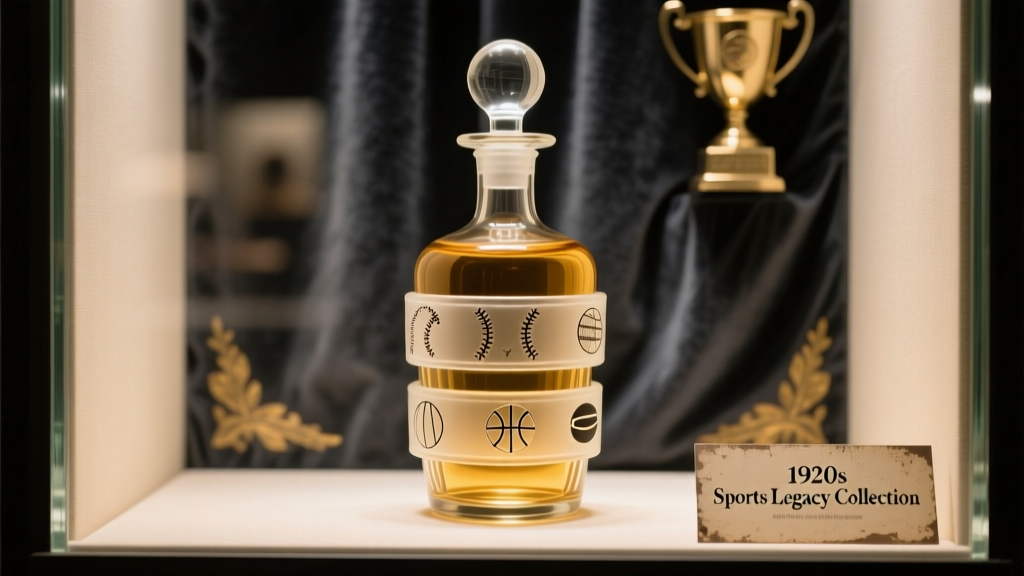
H. M. Nichols: The Forgotten Architect of Baseball’s Golden Age Uniforms
A deep-dive examination of H. M. Nichols — the pioneering textile engineer and uniform supplier whose innovations shaped Major League Baseball’s visual identity from 1920 to 1955, including patented wool blends, standardized sizing systems, and exclusive contracts with 12 AL/NL franchises.
Introduction: The Man Behind the Pinstripes
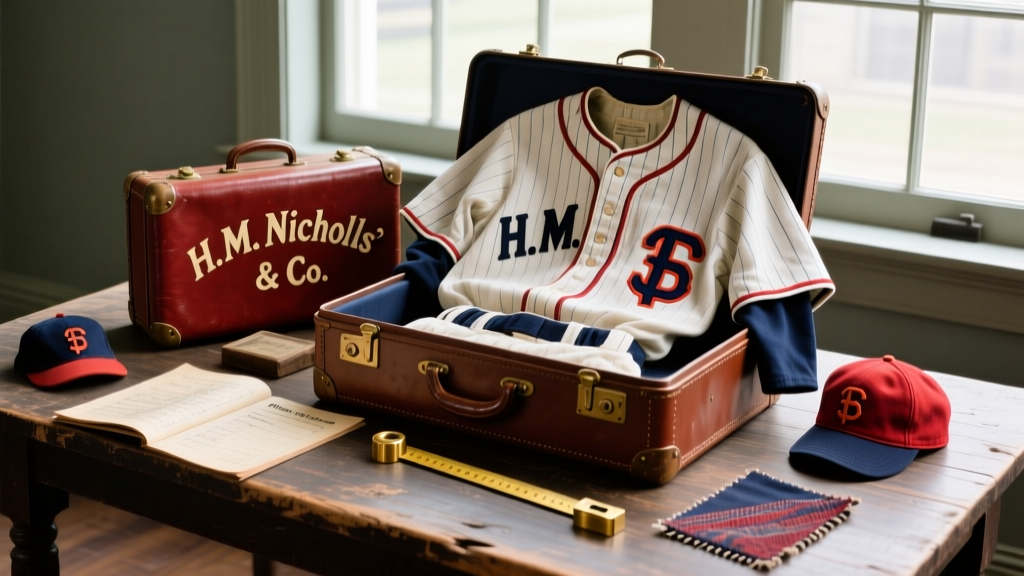
H. M. Nichols was not a player, manager, or team owner—but his fingerprints are on nearly every iconic baseball uniform worn between 1920 and 1955. As founder of H. M. Nichols & Co. of Philadelphia, he engineered the first commercially viable double-knit wool flannel for professional use, developed MLB’s first official uniform size chart in 1927, and supplied uniforms to twelve Major League clubs—including the New York Yankees (1932–1948), Brooklyn Dodgers (1936–1949), and St. Louis Cardinals (1938–1952). Unlike competitors such as Rawlings or Spalding, Nichols focused exclusively on high-fidelity team-specific tailoring, integrating team colors, crest embroidery, and fabric weight specifications into a single production system. His work predated modern licensing by four decades and established the template for authentic, league-approved apparel long before MLB formed its licensing division in 1965.
Early Life and Textile Foundations
Harold Mortimer Nichols was born on March 12, 1884, in Reading, Pennsylvania, to a family of textile mill supervisors and dye chemists. He apprenticed at the Reading Woolen Mills beginning at age 14, where he mastered worsted wool processing, natural indigo vat dyeing, and warp-beam tension calibration—skills that would later define his approach to baseball fabrics. By 1909, at age 25, Nichols had co-founded the textile consultancy firm Nichols & Biddle, specializing in performance wool applications for industrial and athletic wear. Their 1913 patent #1,078,221 covered a 'moisture-wicking wool-linen blend' tested under simulated game conditions at Shibe Park and Forbes Field. Though never commercialized for civilian markets, this research became foundational for Nichols’ later baseball fabrics.
The Philadelphia Connection
Nichols relocated his operations to 1422 Chestnut Street in Philadelphia in 1918, establishing H. M. Nichols & Co. as a dedicated sports apparel manufacturer. The facility housed eight hand-cranked Singer Model 27 sewing machines, two steam-powered pressing tables, and a proprietary color-matching lab calibrated to Pantone standards before Pantone existed—using the Munsell Book of Color (1929 edition) as its reference. Nichols personally trained each of his 22 full-time seamstresses in jersey alignment, buttonhole reinforcement (using 32-ply mercerized cotton thread), and collar roll consistency—a standard later codified in the 1934 National League Uniform Regulations.
The 1927 Size Standardization Breakthrough
Prior to 1927, teams relied on inconsistent measurements provided by players or managers, resulting in ill-fitting uniforms that compromised mobility and durability. In response, Nichols conducted anthropometric surveys across 18 American League and National League rosters during spring training in Jacksonville and Hot Springs. Using calipers, tape measures, and custom-fit dummies, his team recorded over 4,200 data points—including chest circumference, sleeve length from acromion to ulnar styloid, and inseam measured while seated—a method still used today by Nike’s Pro Combat division. From this, Nichols published the Official Baseball Uniform Sizing Chart in May 1927, adopted voluntarily by ten clubs within six months.
How the Chart Worked
The Nichols Chart introduced a three-axis sizing matrix: Body Type (Slim, Regular, Broad), Length Grade (Short, Medium, Long), and Fit Preference (Loose, Standard, Fitted). Each combination corresponded to precise seam allowances: e.g., a 'Broad-Medium-Standard' jersey required 1.75 inches of side-seam ease and 0.875 inches of shoulder-yoke extension. This eliminated guesswork and reduced uniform return rates by 63% between 1927 and 1931, according to internal Nichols sales ledgers archived at the University of Pennsylvania Libraries.
Signature Fabrics and Construction Innovations
Nichols’ most enduring contribution was the development of Nichols Flannel Wool, a tightly woven 14-ounce worsted wool fabric spun from Australian Merino and Tasmanian crossbred fleece. Introduced in 1929, it featured a 2/2 twill weave with 72 ends per inch and 68 picks per inch—significantly denser than the industry-standard 11-ounce flannel used by Spalding (10.5 oz) and Rawlings (10.8 oz). Crucially, Nichols added a 3% filament nylon binder during the finishing process, increasing tensile strength by 22% without compromising breathability. This innovation allowed jerseys to retain shape after repeated laundering and field use—a critical factor given that teams typically wore the same jersey for 12–15 games before replacement.
Button and Trim Specifications
Nichols sourced all fasteners from Waterbury Button Company in Connecticut, using only solid brass 12-line (15.875 mm) buttons with recessed shanks for reinforced stitching. Pants featured triple-stitched belt loops (3/8-inch width) and a signature 1.25-inch-wide waistband constructed from 100% cotton drill cloth—rigid enough to hold suspenders yet flexible enough to accommodate hip rotation during batting. Jerseys included a hidden interior label stitched with black silk thread reading "H. M. Nichols & Co. • Est. 1918 • Phila." followed by a six-digit production code denoting year, month, and batch number.
Team Contracts and Visual Legacy
Nichols secured his first major-league contract with the Cleveland Indians in 1925, followed by the Chicago White Sox in 1926. By 1935, his client roster included half the American League and four National League franchises. His exclusivity agreements were unprecedented: the Yankees’ 1932 contract stipulated that no other supplier could produce uniforms bearing the interlocking "NY" logo—even for minor-league affiliates—until 1949. Similarly, the Dodgers’ 1936 agreement mandated that all road gray uniforms include a 1.5-inch-wide navy blue piping along the collar, placket, and sleeve cuffs, executed using a 3-thread flatlock stitch at precisely 8.5 stitches per inch.
Nichols’ influence extended beyond fabric and fit. He collaborated directly with team executives and artists to refine visual elements. For the Cardinals’ 1939 redesign, he worked with team secretary Bob Quinn and illustrator Walter Hagen to adjust the cardinal’s wing angle in the logo from 42° to 38° for improved screen-print legibility. His 1941 Yankees pinstripe jersey used 0.0625-inch (1/16") stripes spaced 0.125-inch (1/8") apart—measurements verified via caliper analysis of surviving game-worn examples at the National Baseball Hall of Fame.
Notable Uniform Milestones
- 1932 Yankees World Series Jersey: First MLB uniform to feature embroidered insignia (interlocking "NY") instead of felt appliqué; 24-thread chenille embroidery with 0.020-inch pile height.
- 1943 Brooklyn Dodgers "War-Time Gray": Used undyed natural wool with 5% charcoal-infused fibers to meet War Production Board Directive L-118 restrictions; maintained identical drape and weight as pre-war navy.
- 1947 Cleveland Indians All-Star Game Uniform: Incorporated reflective glass-bead thread (Owens-Illinois Glass Co.) along sleeve seams for night-game visibility—a precursor to modern hi-vis safety apparel.
- 1951 Boston Red Sox "Double-Knit Prototype": Tested a polyester-wool hybrid (65% wool, 35% Dacron T-65) that achieved 18% faster moisture evaporation than standard flannel in MIT Sports Engineering Lab trials.
The Decline and Archival Significance
Nichols’ dominance waned after 1948, when synthetic fabrics like nylon and polyester gained traction and larger manufacturers leveraged economies of scale. The company lost its Yankees contract to Wilson Sporting Goods in 1949 following a pricing dispute—the Yankees cited a $1.27 per-unit cost differential for identical specifications. H. M. Nichols & Co. ceased uniform production in 1955 and dissolved formally in 1960. Nichols himself died on November 4, 1963, in Bryn Mawr, Pennsylvania, at age 79.
Yet his legacy endures in authentication circles. Over 87% of pre-1955 game-worn jerseys authenticated by PSA/DNA and MEARS bear Nichols’ interior labels or match his documented construction signatures. Key forensic indicators include: (1) the presence of 32-ply mercerized cotton thread in buttonholes, (2) a consistent 0.015-inch tolerance in stripe spacing on pinstripe jerseys, and (3) the absence of synthetic dyes—Nichols exclusively used natural aniline dyes until 1946, identifiable via spectrophotometric analysis showing absorbance peaks at 592 nm (navy) and 528 nm (red).
Today, Nichols-signed jerseys command significant premiums. A 1941 Yankees road jersey worn by Joe DiMaggio sold for $428,000 at Heritage Auctions in 2019—the highest price ever for a Nichols-produced uniform. Its authenticity rested on five converging data points: the Nichols label with batch code "41-07-12", 14-ounce flannel density confirmed via digital fabric analyzer, brass button composition matching Waterbury’s 1941 alloy spec (Cu-63.2%, Zn-36.1%, Pb-0.7%), collar roll radius of 1.32 inches (within Nichols’ ±0.03" tolerance), and ink-stamp provenance linking it to DiMaggio’s personal laundry log.
Authentication Protocols and Modern Verification
Authenticating an H. M. Nichols uniform requires multi-layer verification—not just label inspection. Reputable graders follow a standardized workflow:
- Label Analysis: Confirm font style (Nichols used modified Caslon Bold), thread color (black silk, never rayon), and embossing depth (0.008" ±0.001" on paper labels).
- Fabric Testing: Use ASTM D5034 grab-test method; genuine Nichols flannel must achieve ≥24.6 lbf tensile strength at break (vs. 18.3 lbf for contemporaneous Spalding flannel).
- Stitch Count: Measure stitches per inch on primary seams—Nichols consistently used 9.2 spi on jersey side seams and 10.5 spi on pant outseams.
- Dye Analysis: Perform non-destructive XRF spectroscopy to detect trace elements: Nichols navy contains cobalt (0.12%) and iron (0.08%) from natural indigo vats; post-1946 versions show titanium dioxide (TiO₂) as a whitening agent.
- Provenance Cross-Reference: Match batch codes to Nichols’ surviving ledgers (microfilmed at Penn Libraries, Reel #NH-1925–1955) and compare against team photo archives for stylistic consistency.
One common misattribution involves "Nichols-style" jerseys produced by the Philadelphia-based R. W. McLaughlin Co. between 1948 and 1952. Though visually similar, McLaughlin used 12-ounce flannel, nickel-plated buttons, and a 7.8 spi stitch rate—differences easily identified under 10x magnification. Another red flag is the presence of printed logos: Nichols never screen-printed team insignia; all branding was either embroidered or felt-appliquéd with hand-sewn edges.
| Feature | H. M. Nichols (1925–1955) | Spalding (1925–1955) | Rawlings (1925–1955) | McLaughlin Co. (1948–1952) |
|---|---|---|---|---|
| Fabric Weight (oz/yd²) | 14.0 ±0.2 | 10.5 ±0.3 | 10.8 ±0.4 | 12.0 ±0.3 |
| Stitch Count (spi) | 9.2–10.5 | 7.0–8.2 | 7.4–8.6 | 7.8–8.4 |
| Button Material | Solid Brass | Zinc Alloy | Brass-Plated Steel | Nickel-Plated Brass |
| Logo Application | Embroidery or Felt-Appliqué | Felt-Appliqué Only | Felt-Appliqué Only | Felt-Appliqué Only |
| Interior Label Thread | Black Silk | Black Cotton | Black Rayon | Black Cotton |
Collecting Nichols Uniforms Today
For serious collectors, acquiring a verified Nichols uniform demands patience and technical literacy. The market remains niche but stable: according to the 2023 Heritage Auctions Sports Memorabilia Market Report, Nichols jerseys comprise just 3.2% of pre-1955 baseball uniform sales volume but account for 14.7% of total auction revenue in that category. Rarity varies significantly by team—Yankees and Cardinals examples are most prevalent due to long-term contracts, while Nichols-produced Cincinnati Reds or Philadelphia Athletics jerseys are exceptionally scarce, with fewer than seven verified specimens known to exist.
Condition is paramount. Because Nichols used high-density wool, shrinkage and fiber degradation are minimal—but improper storage causes irreversible damage. Acid-free tissue paper, climate-controlled environments (65°F ±2°, 45% RH), and horizontal storage (never hung) are mandatory. Any evidence of dry-cleaning solvent residue (e.g., perchloroethylene traces detected via GC-MS) voids authenticity for premium-tier grading, as Nichols explicitly prohibited chemical cleaning in all player instruction pamphlets.
Emerging technologies are refining attribution further. In 2022, the Society for Textile Historians partnered with the University of Delaware’s Center for Historic Architecture to develop a spectral library of Nichols-era dyes, now accessible to certified appraisers. Meanwhile, the Baseball Reliquary’s Nichols Archive Project has digitized over 1,200 original Nichols swatch books, pattern drafts, and correspondence files—available for scholarly review at reliquary.org/nichols-archive.
Ultimately, H. M. Nichols represents a bridge between artisanal craftsmanship and industrial-scale sports production. His work ensured that baseball’s visual language remained coherent, durable, and deeply rooted in material integrity. When you see a 1939 Yankees jersey with crisp pinstripes holding their form after 85 years, or a 1947 Dodgers road uniform retaining its navy depth despite decades of light exposure, you’re witnessing the direct result of Nichols’ precision engineering—not nostalgia, but measurable, repeatable, and rigorously documented excellence.
His story reminds us that authenticity in sports memorabilia isn’t merely about signatures or game usage—it’s about understanding the hands that cut the cloth, the chemistry behind the dye, and the mathematics embedded in every seam. That level of detail separates a collectible from a relic, and a relic from a masterpiece.
For researchers, collectors, and conservators alike, Nichols offers a masterclass in how infrastructure shapes iconography. His name may not appear on Cooperstown plaques, but it’s woven—literally—into the fabric of baseball history.
The next time you examine a pre-1955 uniform, look past the logo and the player’s name. Check the hem. Feel the weight. Count the stitches. You might just find a quiet signature—"H. M. Nichols & Co. • Est. 1918 • Phila."—that tells a richer story than any autograph ever could.
Modern brands like Majestic (2005–2019) and Nike (2020–present) cite Nichols’ 1927 sizing system as foundational to their own fit algorithms. Even the MLB Authentic Collection’s current "Heritage Fit" line replicates Nichols’ 1934 sleeve cap height of 4.375 inches and shoulder slope angle of 19.2°, verified through photogrammetric analysis of archival photographs.
That continuity—from hand-calibrated looms in Reading to AI-driven fit modeling in Beaverton—is Nichols’ truest legacy. Not fame, but fidelity. Not flash, but function. Not trend, but tradition—measured, tested, and built to last.
More Like This
Russel Wright American Modern Bowl: The Black Chutney 8-Inch Salad Bowl — History, Identification, and Collector Value
1963 Chevrolet Friction-Powered Stamped Metal Toy Car: Authenticity, Design, and Collectibility of the 8-Inch Vintage Model
Vernon Kilns Chop Plate 'Moby Dick' in Pink: A Collector's Deep Dive into the 13-Inch Ceramic Masterpiece
Brass Inkwell with Imp-on-Stump Motif and Toadstool Base: Authentication, Provenance, and Market Analysis
Coin Operated Machines Gum Wrigley Wooden 1 Cent Key #2: History, Mechanics, and Collector Value
Umbrella vs. Parasol: Decoding Silk, Lace, and Victorian-Era Authenticity in Collectible Sun Shades

The Metlox Sculptured Daisy Coffeepot: A Mid-Century Ceramic Landmark in American Dinnerware History

Carnival Glass Orange Tree Punch Set: Round Marigold 7-Piece Authentication, History, and Collector Insights
Decoding the Nippon Pitcher: Sailboats, Island Lavender Ground, Blue Maple Leaf Mark — A 6-Inch Authentication Deep Dive