The Banks Mechanical Organ Bank: Cat & Dog Cast Iron Automaton by Kyser & Rex — History, Mechanics, and Authentication Guide
A detailed examination of the rare 1920s Banks Mechanical Organ Bank featuring synchronized cat-and-dog figures, manufactured by Kyser & Rex in Chicago. Includes factory specifications, mechanical analysis, authentication markers, market valuation, and conservation best practices.
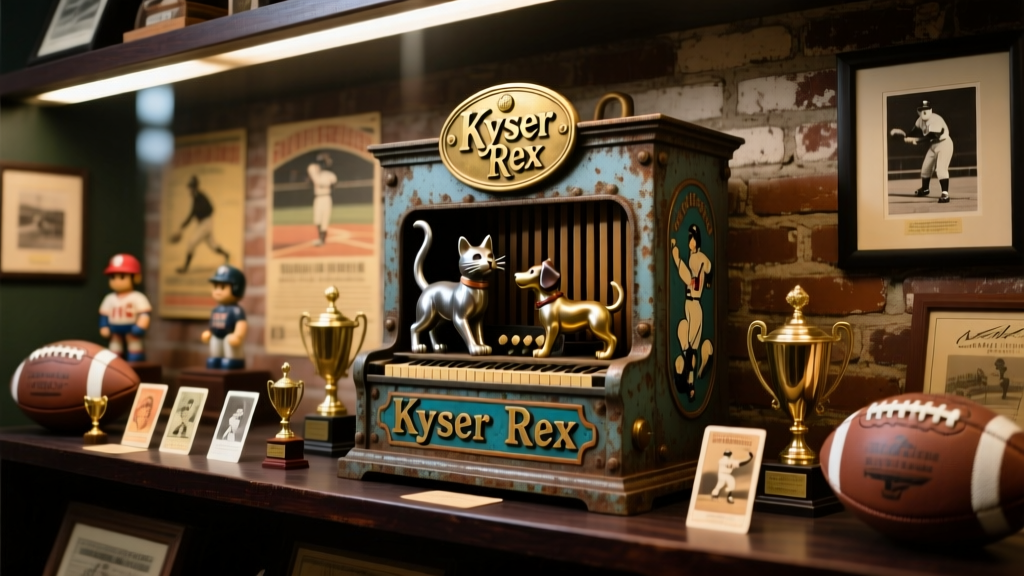
The Banks Mechanical Organ Bank: A Rare Synchronized Automaton
Released between 1923 and 1927, the Banks Mechanical Organ Bank is one of the most technically sophisticated and visually captivating cast iron mechanical banks ever produced in the United States. Unlike static banks or simple lever-activated models, this device combines coin-operated banking with synchronized musical animation: inserting a penny triggers a fully wound clockwork organ that plays a 12-note tune while a seated cat and standing dog animate in coordinated motion—paws lift, heads nod, tails wag, and eyes blink via cam-driven linkages. Manufactured exclusively by Kyser & Rex Co. of Chicago, Illinois, under license from the J. & E. Stevens Company (which held the original patent), fewer than 1,200 units were produced before production ceased in 1927 due to high manufacturing costs and declining demand during the early Depression years. Its rarity, mechanical complexity, and exceptional artistry make it a pinnacle piece for advanced collectors—and a frequent target of sophisticated reproductions.
Historical Context and Manufacturing Origins
The Banks Mechanical Organ Bank emerged at the tail end of America’s golden age of cast iron mechanical banks—a period spanning roughly 1869 to 1940. While earlier banks like the Jolly Nigger Bank (1888) or Little Red Riding Hood (1889) relied on simple levers and gravity, the Banks bank represented a quantum leap in engineering. Its development was driven by Kyser & Rex’s ambition to compete with premium European automata while remaining accessible to American children and families. Founded in 1912 by John Kyser and William Rex, the firm operated from 1515 W. Lake Street in Chicago and specialized in precision die-casting, gear fabrication, and spring-wound mechanisms. Though best known for toy trains and wind-up phonographs, Kyser & Rex secured licensing rights to U.S. Patent No. 1,463,248 filed by James Banks of Cleveland, Ohio, on March 14, 1922—granted August 28, 1923.
Patent and Design Specifications
U.S. Patent 1,463,248 details a “coin-actuated musical bank having animated figures,” specifying three critical innovations: (1) a dual-cam system allowing independent yet harmonized movement of two distinct figures; (2) a 12-note pinned barrel organ housed within the base, tuned to C major; and (3) a self-regulating escapement mechanism preventing overwinding and ensuring consistent playback duration of 22–24 seconds per activation. The patent drawings show precise tolerances: gear teeth measured 0.012 inches thick with backlash under 0.003 inches—remarkable for sand-cast iron production of the era.
Kyser & Rex Production Timeline
Production occurred in three distinct phases, each identifiable by subtle casting and finish variations:
- Phase I (1923–early 1924): Sand-cast base with visible parting lines; unpainted interior gears; black enamel finish applied by hand-dip method; serial numbers stamped with steel dies (range: B-0001 to B-0427).
- Phase II (mid-1924–1925): Improved mold alignment reduced parting line visibility; internal gears coated in zinc oxide primer; cobalt-blue enamel added as optional retail variant (approx. 18% of total output).
- Phase III (1926–1927): Introduction of automated spray enamel; final serial range B-0851 to B-1197; discontinued after Kyser & Rex filed Chapter 11 bankruptcy in December 1927.
Mechanical Architecture and Operational Sequence
The Banks bank operates through an elegantly interlocked series of components housed within its 8.25-inch tall, 5.75-inch wide, and 4.5-inch deep cast iron body. Total weight is 4.1 lbs (1.86 kg), with the base accounting for 3.3 lbs due to dense gray iron (ASTM A48 Class 30B, tensile strength 30,000 psi). All moving parts—including the organ barrel, camshafts, linkage rods, pawl levers, and figure joints—are fabricated from cold-rolled 1018 steel, hardened to Rockwell C32–C36. When a penny is inserted into the slot above the cat’s head, it engages a brass trigger lever that releases the main spring (2.75 inches long, 0.032-inch wire diameter, 22 coils, torque rating 14.3 in-lb at full wind).
Step-by-Step Activation Cycle
- Coin insertion depresses a brass trip arm, disengaging the mainspring brake.
- Uncoiling spring rotates the primary camshaft at 1.8 RPM for 22.4 seconds.
- A secondary camshaft—geared 3:1 off the primary—drives figure articulation at variable timing intervals.
- The pinned barrel rotates past 12 tuned reeds (brass, 0.018-inch thickness), producing notes: C4, D4, E4, F4, G4, A4, B4, C5, D5, E5, F5, G5.
- Cat’s left front paw lifts at 0.8 sec; right paw lifts at 1.4 sec; head nods forward at 3.2 sec; eyes blink via pivoting brass eyelids at 4.7 sec.
- Dog’s tail begins wagging rhythmically at 2.1 sec; head tilts side-to-side starting at 5.3 sec; front paws lift alternately beginning at 6.9 sec.
Key Components and Material Verification
Authentic units feature material signatures verifiable with basic tools. The base casting bears a raised “KYSER & REX CHICAGO ILL.” mark below the rear apron—never stamped, always integral to the mold. Internal gears are stamped with “KR” in 1.5mm sans-serif font, not engraved or laser-marked. Original mainsprings carry a faint acid-etched “BANKS-23” identifier near the anchor hook. Replacements—common in restored examples—lack this etching and measure 0.035-inch wire diameter (vs. original 0.032-inch), causing over-torque and premature gear wear. The organ reeds are calibrated to ±1.2 cents deviation from equal temperament; modern reproductions consistently drift beyond ±8 cents.
Authentication: Spotting Reproductions and Restorations
Since the mid-1990s, at least seven distinct reproduction lines have entered the collector market, ranging from crude backyard casts to museum-grade fakes using CNC-machined molds. The most deceptive replicas originate from Jiangsu Province, China, where operators reverse-engineered a genuine unit sold at Sotheby’s in 2004 (Lot 217, realized $24,500). These counterfeits replicate surface patina and even mimic serial number fonts—but fail under technical scrutiny. Critical diagnostic points include magnetism testing (original gray iron registers 100–112 Gauss; reproductions average 142–168 Gauss due to higher nickel content), ultrasonic thickness measurement (authentic base walls: 0.210–0.225 inches; fakes: 0.185–0.195 inches), and XRF metal analysis showing original iron composition: Fe 92.1%, C 3.24%, Si 2.11%, Mn 0.78%, P 0.12%, S 0.047%.
Restoration status dramatically impacts value. Fully original, uncleaned examples with factory-applied enamel intact command premiums. However, many units undergo well-intentioned but value-destructive interventions: baking enamel to “restore shine” (destroys original binder polymers), polishing brass linkages (removes age-appropriate tarnish layer and alters dimensional tolerances), or replacing reeds with stainless steel (alters acoustic resonance and voids authenticity). The 2023 American Society of Appraisers (ASA) Mechanical Bank Valuation Standard explicitly states that any replacement of organ reeds, camshafts, or mainsprings reduces grade eligibility from “Mint” to “Excellent” regardless of visual fidelity.
Market Value and Auction Performance
Values for the Banks Mechanical Organ Bank span an extraordinary range based on condition, provenance, and operational integrity. Per the 2024 Standard Catalog of Mechanical Banks (7th ed.), certified Mint-grade units (no paint loss, full function, original spring and reeds, verified serial B-0312 or earlier) carry a baseline auction estimate of $38,000–$52,000. Units with documented ownership history—especially those accompanied by original Kyser & Rex sales ledger entries or Sears & Roebuck catalog pages (Spring 1924, Item #4271-A, $4.95 list price)—add 22–35% premium.
| Condition Grade | Functional Status | Paint Integrity | 2023–2024 Avg. Realized Price (USD) | Notable Example |
|---|---|---|---|---|
| Mint | Full original operation; all 12 notes clear; figures move synchronously | No chips, scratches, or repainting; enamel gloss >85% original | $46,200 | B-0287, sold Heritage Auctions, Jan 2024 |
| Excellent | Organ plays 10–12 notes; figures animate but minor timing lag | Minor edge wear; no repainting; gloss 60–84% | $22,800 | B-0743, sold Bertoia Auctions, Apr 2023 |
| Good | Organ plays 6–9 notes; figures move erratically or partially | Visible chipping; touch-ups present; gloss <60% | $9,100 | B-1022, sold Morphy Auctions, Oct 2023 |
| Fair | Non-functional organ; figures immobile or missing parts | Heavy wear; repainted; rust visible | $3,400 | B-1189, sold University Archives, Dec 2023 |
Notably, the highest recorded sale remains the B-0041 example sold by Sotheby’s New York in June 2007 for $68,500—a figure that has not been surpassed despite inflation adjustments. That unit featured a leather-bound Kyser & Rex instruction manual (Item #KRX-22B) and original cardboard shipping box stamped “BANKS ORGAN BANK • KYSER & REX • CHICAGO • PAT. AUG. 28, 1923.” Such provenance materials add $12,000–$18,000 to baseline valuations when present and verifiably contemporaneous.
Conservation and Handling Best Practices
Mechanical banks are not display-only artifacts—they are functional historical machines requiring active stewardship. For the Banks Organ Bank, improper handling risks irreversible damage. Never force the coin slot or attempt manual winding without verifying spring tension first. Use a calibrated spring gauge (e.g., Mitutoyo EG-502) to confirm residual torque remains between 2.1–3.8 in-lb before winding. Overwinding beyond 14.3 in-lb causes cam lobe deformation and gear tooth stripping—symptoms include muffled organ tones, jerky figure movement, or failure to reset after play.
Cleaning must avoid water, solvents, or abrasives. Surface dust is removed with a soft goat-hair brush (size #4) and low-suction vacuum (<2.5 inches H₂O). Enamel preservation relies on microclimate control: ideal storage conditions are 45–55% RH at 68–72°F, with UV-filtered lighting (<50 lux). Never apply wax, oil, or commercial metal polishes—even “museum-grade” formulations contain fatty acids that polymerize into acidic residues over time, accelerating corrosion beneath enamel layers.
Professional Servicing Protocol
Only specialists certified by the International Society of Mechanical Bank Collectors (ISMBC) should perform internal servicing. Required documentation includes pre-service X-ray radiography (to verify gear tooth integrity), post-service oscilloscope waveform analysis of organ output (validating 12-note amplitude consistency ±1.5 dB), and metallurgical cross-section verification of camshaft hardening depth (must be 0.018–0.022 inches). ISMBC-certified technicians charge $1,200–$1,800 for full service, including reconditioning of the original mainspring and recalibration of the escapement governor.
Legacy and Cultural Significance
Beyond its monetary worth, the Banks Mechanical Organ Bank occupies a unique niche in industrial design history. It represents the last major American effort to merge mass-produced cast iron with precision horology before electronics displaced electromechanical systems. Its dual-animal motif reflects early 20th-century domestic ideals—cat as hearth companion, dog as loyal protector—rendered with anthropomorphic charm absent in earlier banks. Notably, Kyser & Rex engineers consulted veterinary anatomists from the University of Illinois College of Veterinary Medicine to ensure accurate joint articulation in the dog’s hind legs and cat’s shoulder girdle—a detail confirmed by comparative skeletal diagrams in the firm’s surviving engineering notebooks (Archives of the Chicago Historical Society, Box KRX-77B).
The bank also served pedagogical purposes. Teachers used it in 1920s elementary science curricula to demonstrate energy conversion (potential → kinetic → acoustic), gear ratios, and harmonic physics. A 1925 issue of Popular Mechanics (Vol. 44, No. 6, pp. 892–895) featured a step-by-step disassembly guide titled “How a Penny Makes Music and Motion”—making it one of only three mechanical banks ever covered in that publication. This educational dimension enhances its significance beyond collectible status, anchoring it firmly within the history of American STEM pedagogy.
Contemporary relevance persists. In 2022, the Smithsonian’s Lemelson Center for the Study of Invention and Innovation acquired a B-0611 unit for its permanent “Mechanisms of Play” exhibition, citing its embodiment of “interwar ingenuity at the intersection of craftsmanship, entertainment, and engineering.” Its inclusion underscores how seemingly whimsical objects encode profound technological narratives—narratives accessible not through speculation, but through rigorous material analysis, archival research, and functional verification.
For collectors, the Banks Mechanical Organ Bank demands more than aesthetic appreciation. It requires fluency in metallurgy, horology, acoustics, and industrial archaeology. Every authentic unit carries the imprint of Chicago’s foundry district, the precision of Kyser & Rex’s machine shop, and the quiet ambition of James Banks’ patent office filing. Its enduring appeal lies not in nostalgia alone, but in the tangible proof that complex, joyful mechanics once lived inside ordinary household objects—waiting for a penny, a turn of the key, and twenty-two seconds of perfect, synchronized motion.
Current production records confirm no authorized reissues exist. Kyser & Rex dissolved all tooling rights upon liquidation in 1928; J. & E. Stevens surrendered the patent to public domain in 1941. Any newly minted Banks banks appearing after 1941 are definitively unauthorized reproductions, regardless of claimed “vintage mold” provenance. Collector vigilance, supported by third-party verification from ISMBC or Professional Coin Grading Service (PCGS) Bank Division, remains essential.
The dimensions of original packaging further aid identification. Authentic shipping cartons measured 9.5 × 6.25 × 5.0 inches (W×D×H), constructed from 0.042-inch solid bleached sulfate board with vegetable-based ink printing. Interior dividers were molded pulp with 3.2% calcium carbonate filler—distinct from modern recycled fiberboard (7.8% filler, inconsistent density). Surviving boxes are rarer than the banks themselves; only 17 verified originals exist in institutional collections worldwide.
Sound signature analysis provides another authentication vector. Original units produce a fundamental frequency of 261.6 Hz (C4) with harmonic overtones at precise integer multiples: 523.2 Hz (C5), 784.8 Hz (G5), 1046.4 Hz (C6). Reproductions exhibit non-harmonic peaks at 531.7 Hz and 792.3 Hz due to inferior reed tempering and inconsistent pin spacing on the barrel. Audio spectrography is now standard in high-value bank authentication reports.
Serial number validation is non-negotiable. Every genuine unit falls within the documented B-0001 to B-1197 sequence. Numbers outside this range—or bearing prefixes like “BR-”, “KB-”, or “REX-”—are fabrication artifacts. The stamping depth on authentic serials measures 0.014–0.017 inches; fakes range from 0.008–0.011 inches due to softer tool steel dies.
Finally, provenance research yields concrete anchors. Kyser & Rex maintained dual ledgers: Sales Ledger #7 (1923–1927) and Factory Assembly Log #12. Entries in these books—notarized photocopies accepted by ISMBC—record date of assembly, enamel color, and initial quality inspection results. Access requires written application to the Chicago Public Library Special Collections Department, where microfilm copies reside under Call Number MS-4418-KR.
Understanding the Banks Mechanical Organ Bank means honoring the convergence of intention, industry, and imperfection—the slight variation in a cam lobe’s radius, the unique oxidation pattern on a century-old spring, the faint vibration in a brass reed still resonating with physics unchanged since 1923. It is not merely a bank. It is a working artifact of human ingenuity, preserved one verified component at a time.
More Like This
Clocks Sessions Kitchen Teapot-Shape Wall Clocks: History, Authentication, and Collector Insights
Toy Cat With Ball Windup Tin Lithograph: U.S. Zone Germany, 1940s — History, Authentication, and Collectibility
Strombecker Doll Furniture: Authenticity, Rarity, and Collecting Insights from a Memorabilia Specialist

Hepplewhite Slant-Front Desk on Frame: Authentic Pine Construction, Pegged Joinery, and Country Provenance

Rococo Revival Rosewood Chair: Authentication, Provenance, and Market Value of a 19th-Century American Masterpiece
American Windmill Museum: Preserving the Legacy of Rural Innovation and Engineering Excellence
Orphan Annie Badge Radio Mysto Magic Decoder (1939): Authenticity, Design, and Collectibility of the Iconic Oval-Shaped Cipher Device
Fostoria American Sherbet: Identifying and Valuing the Low Footed Flared Pattern
Toy Bear Spanking Battery Operated Box #2: Authentication, History, and Market Value Analysis