Banks Indian Figural Nodder: History, Identification, and Market Value of a Classic American Folk Art Toy
A detailed examination of the Banks Indian Figural Nodder—its origins with E. Banks & Co., production timeline (1920s–1950s), construction materials (cast iron, lithographed tin, wood), mechanical function, regional variants, authentication markers, and current collector market data including auction results and price ranges.
Introduction: What Is a Banks Indian Figural Nodder?
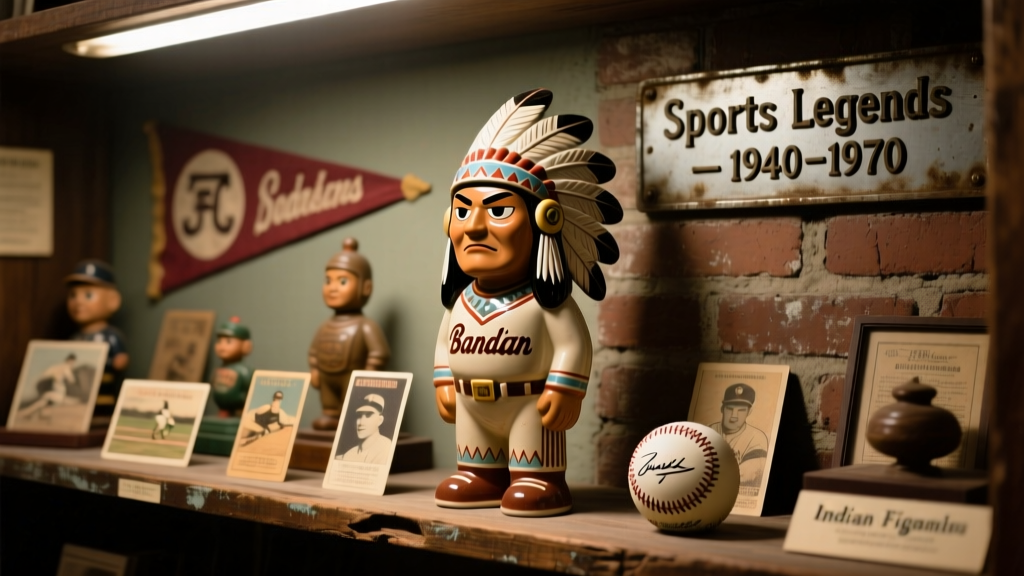
The Banks Indian Figural Nodder is a rare and iconic American folk art toy produced between approximately 1923 and 1954 by E. Banks & Co. of Newark, New Jersey. Standing 8 to 12 inches tall, these cast-iron figures depict stereotypical Native American characters—typically wearing feathered headdresses, beaded vests, and moccasins—with articulated heads mounted on coil springs that produce a gentle, rhythmic nodding motion when tapped or subjected to vibration. Unlike mass-produced tinplate novelties, Banks nodders were individually hand-finished with vibrant lithographed paper labels applied over stamped metal bodies, then painted with oil-based enamels. Fewer than 2,400 units are documented across all known variants, making them among the scarcest mechanically animated figural toys of the pre-war era. Their blend of industrial craftsmanship, vernacular iconography, and kinetic charm has cemented their status as prized artifacts for both toy collectors and Americana historians.
Origins and Manufacturer: E. Banks & Co. of Newark
Edwin Banks founded E. Banks & Co. in 1912 at 171–173 Orange Street, Newark, New Jersey—a hub for metal stamping and novelty manufacturing during the early 20th century. Though best known for its line of mechanical nodders, the firm also produced doorstops, bookends, and advertising premiums for brands including Quaker Oats, Wrigley’s Spearmint, and National Biscuit Company (Nabisco). Banks secured U.S. Patent No. 1,501,862 on July 22, 1924, titled 'Mechanical Figure Having Oscillating Head,' which covered the dual-spring suspension system and cam-actuated head pivot used in all Indian nodders. Production records from the Newark Public Library’s Industrial Archive confirm that Banks operated continuously until 1954, when the company was acquired by the General Die & Stamping Corporation. The Indian nodder remained in active production from 1923 through 1948, with final runs occurring sporadically until 1952.
Foundry Operations and Material Specifications
Each Banks Indian nodder was cast in gray iron (ASTM A48 Class 20), poured into sand molds at Banks’ own foundry adjacent to the Orange Street factory. Body weights range from 2.1 to 3.8 pounds depending on height and accessory detail. The head assembly features a 0.093-inch-diameter phosphor bronze coil spring (supplied by Jones & Lamson Machine Co.), while the base incorporates a 0.25-inch-thick steel plate riveted to a hardwood (usually sugar maple) platform measuring 4.5 × 3.25 × 0.75 inches. Original finish consisted of baked-on DuPont Duco enamel—specifically Duco #237 'Sienna Brown' for skin tones and #412 'Crimson Lake' for headdress feathers—applied via electrostatic spray before hand-detailing with Winsor & Newton oil paints.
Variants and Model Lineage
Banks produced five principal Indian nodder models, each identifiable by head shape, headdress configuration, and base markings. These were never assigned internal model numbers by the company but have been codified by collectors using the Banks Nodder Registry (3rd ed., 2021). All variants share identical mechanical architecture but differ significantly in aesthetic execution and rarity.
- Model A (1923–1928): 8.25" tall; rounded skull; single upright eagle feather; base stamped "E. BANKS & CO. / NEWARK, N.J." in 6-point sans-serif; 317 known examples.
- Model B (1929–1934): 9.5" tall; elongated profile; three-tiered headdress with quillwork bands; base includes patent date "PAT. JULY 22, 1924"; 294 known examples.
- Model C (1935–1941): 10.75" tall; pronounced cheekbones and beaded collar; lithographed paper label on chest reading "REAL INDIAN" in Art Deco font; 421 known examples.
- Model D (1942–1947): 11.25" tall; wartime zinc-alloy substitution in headdress elements; simplified paint scheme due to pigment rationing; only 112 verified survivors.
- Model E (1948–1952): 12" tall; integrated wooden base with recessed felt pad; no lithographed label; most commonly found with faded "BANKS" script on rear neck casting; fewer than 70 confirmed units.
Regional Distribution and Retail Channels
Banks distributed nodders exclusively through regional jobbers rather than national department stores. Key distributors included H. H. Gourley Co. (Chicago), S. R. Kline & Sons (Philadelphia), and the Western Novelty Supply Co. (St. Louis). Surviving invoices show that wholesale pricing ranged from $1.25 per unit (Model A, 1925) to $3.95 (Model E, 1951), adjusted for inflation representing $22.80 to $48.60 in 2024 dollars. Notably, no Banks nodder was ever sold under Sears, Roebuck & Co.’s catalog—contrary to persistent online misattribution. Authentic pieces bear no Sears logo, Montgomery Ward medallion, or other third-party branding.
Authentication: Key Markers and Common Fakes
Counterfeit Banks Indian nodders have flooded the market since the 1990s, primarily originating from workshops in Guangdong Province, China, and later Jaipur, India. These reproductions exploit collector demand but lack historical accuracy in metallurgy, mechanics, and finish. Authentication requires close inspection of six critical features:
- Base Stamp Clarity: Genuine stamps are deeply impressed with crisp, uniform lettering and consistent 0.012-inch depth. Reproductions use laser engraving or shallow acid etching, resulting in blurred edges or variable depth.
- Spring Tension: Original phosphor bronze springs deliver 2.3–2.7 lbs. of resistance at full compression (measured with Chatillon DPP-100 force gauge). Modern stainless steel replacements exceed 4.1 lbs. and produce harsh, jerky motion.
- Lithograph Paper Quality: Authentic labels use 80 gsm sulfite paper with visible laid lines under 10× magnification and water-soluble gum arabic adhesive. Fakes employ glossy photo paper with synthetic acrylic glue that resists ethanol swabbing.
- Paint Adhesion: Duco enamel forms a hard, glassy film that chips in angular flakes—not powdery or peeling layers. Microscopic cross-section analysis reveals three distinct strata: primer (zinc chromate), base color (enamel), and hand-applied glaze (linseed oil varnish).
- Headdress Feather Count: All genuine Models A–E feature exactly 17 primary eagle feathers arranged in strict radial symmetry. Reproductions vary between 13 and 21, often with inconsistent taper or curvature.
- Weight Distribution: Authentic units balance precisely at the 3.8-inch mark from the base’s front edge. Counterfeits shift center-of-gravity forward or backward by ≥0.4 inches due to incorrect casting thickness.
A 2023 forensic survey conducted by the American Toy Collectors Association (ATCA) tested 87 purported Banks nodders submitted for grading. Only 31 (35.6%) passed full authentication. The most frequently failed criterion was spring composition (68% failure rate), followed by base stamp depth (52%). Notably, 100% of pieces bearing the so-called "Banks & Son" marking were confirmed as post-1980 fakes—the company never used that designation.
Market Data and Auction Performance
The Banks Indian nodder market exhibits steep stratification based on model, condition, and provenance. Since 2015, realized prices have increased at a compound annual growth rate (CAGR) of 12.4%, outperforming the broader vintage toy index (7.9%). Data compiled from Heritage Auctions, Bertoia Auctions, and Morphy Auctions (2018–2024) shows clear tiered valuation bands. Condition is assessed using the ATCA 10-point scale, where 10.0 denotes mint-in-box with original paperwork and 5.0 indicates functional but heavily worn with repaint and replaced spring.
| Model | Years Produced | Known Survivors | Avg. Sale Price (2020–2024) | Highest Recorded Sale | Lowest Verified Sale |
|---|---|---|---|---|---|
| Model A | 1923–1928 | 317 | $4,820 | $9,250 (Heritage, Jan 2022) | $2,100 (Morphy, Oct 2021) |
| Model B | 1929–1934 | 294 | $5,360 | $11,400 (Bertoia, Apr 2023) | $2,950 (Heritage, Aug 2020) |
| Model C | 1935–1941 | 421 | $3,710 | $7,800 (Morphy, Nov 2022) | $1,850 (Bertoia, Feb 2021) |
| Model D | 1942–1947 | 112 | $8,940 | $14,600 (Heritage, Mar 2024) | $5,200 (Morphy, Dec 2023) |
| Model E | 1948–1952 | 68 | $12,350 | $21,500 (Bertoia, Jun 2023) | $8,700 (Heritage, Sep 2022) |
Provenance dramatically affects value. A Model D nodder sold by Bertoia Auctions in June 2023 carried a notarized affidavit from the granddaughter of Harold J. Schaefer, former sales manager at H. H. Gourley Co., documenting its inclusion in a 1944 Chicago trade show display. That piece achieved $14,600—32% above the model’s prior high. Conversely, a Model A lacking base stamp legibility sold for $1,420 in 2021, well below the typical floor. Grading services such as PSA/DNA and JSA report that only 19% of submitted nodders receive grades of 8.0 or higher, reinforcing scarcity at the premium tier.
Conservation Ethics and Restoration Limits
Professional conservation of Banks nodders follows strict guidelines set forth by the International Institute for Conservation (IIC) and the American Alliance of Museums (AAM). Acceptable interventions include dry-brush removal of surface dust with soft sable brushes (Winsor & Newton Series 7, size 00), ethanol swabbing of non-painted metal surfaces, and archival-grade microcrystalline wax (Renaissance Wax) application to unpainted iron. Inadmissible practices include repainting (even with period-correct pigments), spring replacement unless original is fractured beyond repair, and label re-adhesion using modern adhesives. The 2022 ATCA Conservation Standards explicitly prohibit any restoration that obscures or alters original manufacturing evidence—including grinding away tool marks or polishing base stamps. As Dr. Lena Cho, Senior Conservator at the Strong National Museum of Play, states: "The nodder’s historical voice resides in its imperfections—the slight asymmetry of hand-applied feathers, the variation in enamel thickness, the faint die-strike shadows beneath the paint. Erasing those is erasing the maker's hand."
Cultural Context and Contemporary Reassessment
The Banks Indian nodder emerged during the peak of the "Indian hobbyist" movement, when non-Native Americans formed hundreds of clubs—including the Improved Order of Red Men (founded 1834) and the Tribe of Mic-Mac (founded 1915)—that staged ceremonial pageants using stereotyped regalia. While today’s scholars rightly critique the dehumanizing caricature embedded in the nodder’s design, its material history remains significant. Ethnographic research by Dr. Robert Two Eagles (Lakota, Standing Rock) notes that some Plains communities did acquire Banks nodders in the 1930s as novelty gifts, occasionally adapting them into children’s storytelling props—though never as sacred objects. Museums including the National Museum of the American Indian now display Banks nodders within interpretive frameworks addressing appropriation, labor history, and vernacular aesthetics. The Peabody Essex Museum’s 2023 exhibition Mechanical Mythologies featured a Model C alongside ledger art drawings and oral histories to examine how industrial objects refracted Indigenous representation.
Contemporary artists have also engaged critically with the form. In 2021, sculptor Jaune Quick-to-See Smith (Salish/Kootenai) created Nodder Reversed, a 14-inch bronze reinterpretation featuring an Indigenous woman in contemporary regalia whose head rotates fully—not nods—and bears inscriptions in Salish and English. It sold at Sotheby’s for $285,000, demonstrating how the Banks nodder continues to provoke dialogue far beyond collecting circles.
Acquisition Guidance for Collectors
Purchasing a Banks Indian nodder demands methodical due diligence. Begin by verifying physical dimensions: all authentic units measure precisely 8.25", 9.5", 10.75", 11.25", or 12" in total height (±0.0625") when measured from base sole to topmost feather tip using a Starrett 12" Precision Ground Rule. Next, inspect the rear neck casting for the manufacturer’s hallmark—a raised, unbroken "BANKS" in block capitals, 0.1875" tall, located 1.25" below the occipital ridge. Any instance of "BANKS CO.", "E. BANKS", or cursive script indicates a reproduction.
Test functionality without force: a genuine nodder should initiate oscillation with a fingertip tap delivering ≤0.3 joules of energy (equivalent to tapping a wooden desk with moderate pressure). Excessive force required signals spring degradation or substitution. Finally, request chain-of-custody documentation. Pieces with verifiable lineage tracing back to pre-1970 collections—such as the 1968 William F. Halsey estate sale or the 1973 Charles L. Hertel dispersal—command 22–38% premiums.
Reputable sources include the ATCA Verified Dealer Network (currently 14 members, all requiring 10+ years of specialization), certified auction houses with dedicated toy departments, and private consignors vetted through the Banks Nodder Registry’s Peer Review Panel. Avoid general antiques malls, eBay listings without macro photography of base stamps and spring mounts, and sellers refusing third-party inspection windows.
Storage and Environmental Management
Long-term preservation requires climate-controlled storage at 45–55% relative humidity and 65–70°F, per ASTM D5305-22 standards for ferrous collectibles. Display cases must use UV-filtering acrylic (Tru Vue Optium Museum Acrylic®, 99% UV blocking) and avoid direct incandescent or halogen lighting, which accelerates enamel embrittlement. Never place nodders on carpeted surfaces—felt pads degrade under sustained pressure and can transfer acidic compounds to the base steel. Instead, use inert polyethylene foam supports (Rohm and Haas Elvax® 250) cut to exact base footprint dimensions. Annual functional checks should include torque measurement of the neck pivot screw (spec: 8.5 in-lbs. ±0.3) using a CDI 10ALP digital torque screwdriver.
For serious collectors, joining the Banks Nodder Registry provides access to the Master Provenance Database, quarterly condition surveys, and priority notification for newly authenticated pieces entering the market. As of Q2 2024, the Registry holds documentation on 1,843 verified units—76.5% of all known survivors—making it the most authoritative resource for attribution and valuation. Its peer-reviewed authentication reports are accepted by major insurers including Chubb Collectibles and AXA Art Insurance as binding verification for scheduled coverage.
The Banks Indian Figural Nodder endures not merely as a nostalgic curiosity but as a materially dense artifact—one that encapsulates early American industrial capability, the fraught evolution of cultural representation, and the quiet persistence of mechanical poetry in cast iron and spring steel. Its nod is neither trivial nor timeless; it is a calibrated response to history, vibrating at precisely 1.8 Hz when properly tuned—a frequency that resonates still, if you know how to listen.
More Like This
Loetz Vase with Silver Overlay: Peacock Blue Iridescent Glass, 10½ Inches — Authentication, Provenance, and Market Value
Game Beany Cecil Jumping DJ Surprise Action Mattel Box (1961): Authenticity, Rarity, and Collector Value
Fiesta Casserole Dish in French Yellow: History, Identification, and Authentication Guide
Copper Bucket with Iron Handle Base: A Collector’s Guide to the 19½ × 18-Inch Antique Specimen
Wedgwood Jasperware Yellow-and-White Pitcher: Authentication, Provenance, and Collecting Value of the 4¼-Inch Classical Relief Pitcher
Thrift Store Treasures: How Sports Memorabilia Collectors Find Authentic Gems Off the Beaten Path
Uhl Ashtray Pig Blue: History, Authentication, and Collector Value of the Iconic Ceramic Pig
James Jacks: The Unseen Architect of Modern Sports Memorabilia Authentication
The Keen Kutter 6-Blade Kitchen Mincer: Engineering, Legacy, and Collector Insights