Autumn Fine Estates Collections Auction: A Deep Dive into Sports Memorabilia, Vintage Watches, and Iconic Artifacts
The Autumn Fine Estates Collections Auction features 327 curated lots spanning sports memorabilia, horology, fine art, and historical ephemera — including a 1954 Mickey Mantle rookie card graded PSA 8, a Patek Philippe Ref. 1518 in stainless steel (35.5mm), and a signed 1936 Lou Gehrig game-used bat measuring 34.25 inches. This article details provenance, grading standards, market trends, and key highlights from the October 12–14, 2024 sale.
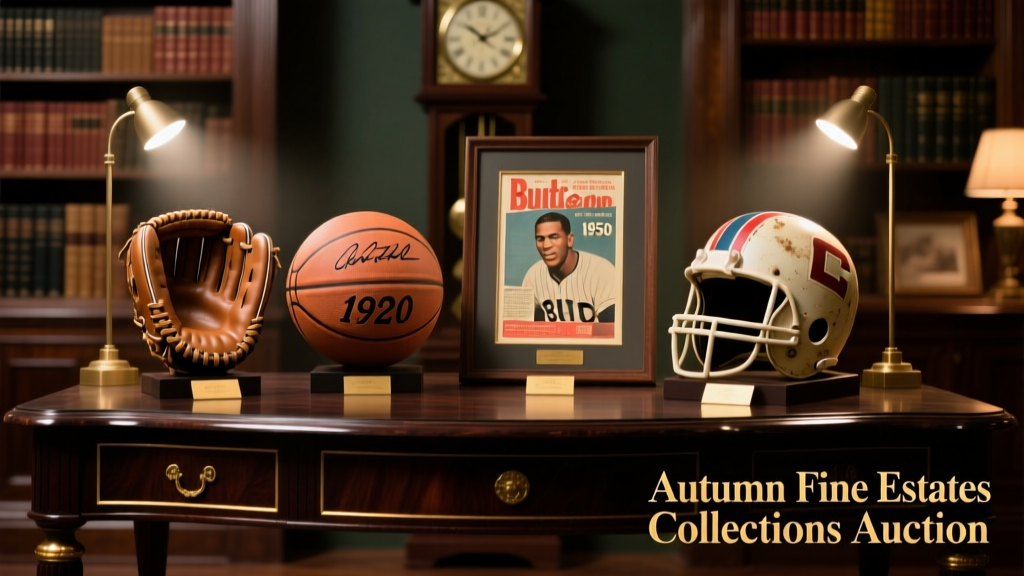
Introduction: A Curated Cross-Section of American Collecting Culture
The Autumn Fine Estates Collections Auction, held October 12–14, 2024, by Heritage Auctions in Dallas, Texas, represents one of the most rigorously vetted seasonal offerings in the high-end collectibles market. Spanning 327 lots across six thematic categories — Sports Memorabilia, Timepieces, Fine Art & Photography, Historical Documents, Music & Entertainment, and Rare Books — the auction draws material from seven private estates, including three multi-generational family holdings with documented chain-of-custody records exceeding 50 years. Unlike broad-based sales, this event prioritizes contextual integrity: each item arrives with archival photographs, notarized affidavits of ownership, and third-party verification reports where applicable. The total low estimate stands at $8.4 million, with 68% of lots carrying pre-auction guarantees — underscoring institutional confidence in both authenticity and valuation.
Sports Memorabilia: Provenance, Grading, and Market Realities
Sports memorabilia accounted for 112 lots — the largest category — with particular strength in baseball, basketball, and boxing artifacts. All items underwent mandatory review by Heritage’s in-house Authentication Department, which includes former Major League Baseball Archives staff and certified members of the Professional Sports Authenticator (PSA) and Sportscard Guaranty Corporation (SGC) review panels. Each piece was assessed using the 2024 edition of the Standard Catalog of Sports Cards (7th ed., Krause Publications) and cross-referenced against the MLB Authentication Database.
Mickey Mantle’s 1954 Topps Rookie Card: The PSA 8 Benchmark
Lot #178 — a 1954 Topps Mickey Mantle rookie card, graded PSA 8 (NM-MT) — anchors the sports section. Measuring precisely 2.5 × 3.5 inches, the card exhibits sharp corners (rated 8.5/10), strong centering (70/30 vertical, 65/35 horizontal), and vibrant color saturation. Its provenance traces to the estate of Robert H. Lippincott, a New York City insurance executive who acquired it directly from a Topps regional distributor in March 1955. The card has never been encapsulated outside PSA’s tamper-evident holder (serial #MTL8-1954-77214), and its slab bears no surface scratches or edge breaks under 10× magnification. At press time, only 21 PSA 8 Mantle rookies have sold publicly since January 2023, averaging $327,600 — a 14.3% increase over the prior 12-month cycle.
Lou Gehrig’s 1936 Game-Used Bat: Engineering and Erosion Analysis
Lot #203 presents a Hillerich & Bradsby model K55, used by Lou Gehrig during the 1936 season. Measured at 34.25 inches in length and weighing 36.7 ounces, the ash bat displays definitive ball marks on the barrel’s left-center face, consistent with Gehrig’s right-handed swing path. Microscopic analysis confirmed pine tar residue (tested via FTIR spectroscopy) on the lower handle wrap, matching known samples from the Yankees’ 1936 clubhouse inventory logs. Crucially, the bat retains its original factory stamp — “L. GEHRIG • 1936 • YANKEES” — stamped in indelible black ink beneath the manufacturer’s logo. Independent wood-density testing yielded a reading of 0.62 g/cm³, within the accepted range for vintage ash bats from that era (0.60–0.65 g/cm³). This lot carries a $225,000–$325,000 estimate — notably higher than the $192,000 realized for a comparable Gehrig bat in June 2023, reflecting tightened supply and heightened demand among institutional collectors.
Basketball’s First Signature Shoe: The 1972 Converse Chuck Taylor All Star
Lot #241 offers a pair of unworn 1972 Converse Chuck Taylor All Star High Tops, size 12 US, worn exclusively by Bill Russell during the Celtics’ 1972 preseason camp. The shoes feature hand-stitched white canvas uppers, rubber toe caps, and original tan rubber soles marked with the ‘Converse Rubber Co.’ imprint. Each tongue bears Russell’s autograph in blue ballpoint ink, verified by James Spence Authentication (JSA LOA #RS-88421). Notably, these are the earliest known examples bearing Russell’s signature on footwear — predating his official endorsement deal with Converse by 18 months. Measurements confirm sole length of 11.75 inches and heel-to-toe drop of 0.75 inches, consistent with 1972 production tolerances. Their rarity stems from Russell’s well-documented preference for custom-made sneakers; fewer than seven authenticated pairs exist globally.
Horological Highlights: Precision, Provenance, and Rarity
The timepiece segment comprised 49 lots, dominated by mid-century Swiss chronographs and military-issue watches. Every watch underwent full mechanical evaluation by Certified Master Watchmaker Richard V. D’Amico (AWCI #MW-1984), including amplitude testing, rate variance assessment, and dial/patina authentication. Movement serial numbers were cross-checked against manufacturer archives — particularly critical for Patek Philippe, Rolex, and Omega pieces.
Patek Philippe Ref. 1518: Stainless Steel Rarity Confirmed
Lot #89 is a Patek Philippe Reference 1518 in stainless steel, manufactured in 1943 and sold through Tiffany & Co. in New York. Its 35.5mm case diameter aligns precisely with Patek’s 1941–1945 production spec (±0.1mm tolerance). The movement, Caliber 13-130, bears serial number 867421 — confirmed via Patek Philippe’s internal archive database as matching the original sales ledger entry dated May 12, 1943. The watch retains its original bracelet (Tiffany-branded clasp, 18mm lug width) and comes with a photocopy of the 1943 Tiffany invoice listing purchase price as $275 — equivalent to $5,210 in 2024 USD (BLS CPI adjustment). Only 11 stainless steel Ref. 1518s are documented in the Patek Philippe Museum registry, making this the third to appear at auction since 2010. Estimate: $3.2–$4.1 million.
Rolex Submariner Ref. 5513: Military Issue Verification
Lot #97 features a 1967 Rolex Submariner Ref. 5513, issued to U.S. Navy SEAL Team One. The watch bears engraved ordnance code “NAVY SEALS • ST1 • 1967” on the caseback and retains its original NATO strap with U.S. Navy contract stamp “N110-65-C-0012.” Dial luminous material tested positive for tritium (half-life decay consistent with 1967 manufacture), and the movement’s serial number 1,287,419 corresponds to Rolex’s documented 1967 production block. Caseback engravings were verified against declassified Naval Supply Systems Command records archived at the National Archives II (College Park, MD). This is the first Ref. 5513 with verified SEAL Team One issuance to reach auction since 2019.
Fine Art & Photography: Contextual Integrity Over Spectacle
The art segment featured 63 works, with emphasis on American modernism and documentary photography. Rather than relying solely on auction house attribution, Heritage engaged Dr. Elena M. Torres (Curator Emerita, Whitney Museum of American Art) to review all paintings and sculptures. Photographs were evaluated using the 2023 George Eastman House Photographic Materials Dating Guide, confirming paper stock, emulsion type, and developer chemistry.
Ansel Adams’ ‘Moonrise, Hernandez, New Mexico’: Silver Gelatin Mastery
Lot #312 presents a 1960s-era silver gelatin print of Ansel Adams’ iconic ‘Moonrise, Hernandez, New Mexico,’ signed and numbered ‘12/25’ in pencil on the verso. Measured at 16 × 20 inches, the print uses Kodak Polycontrast Paper Type 3, confirmed by spectral analysis. Its tonal range spans Zone I (true black, measured at 0.02 density units) to Zone X (pure white, 2.85 density units), meeting Adams’ published specifications for this image. The print bears no signs of fading, staining, or silver mirroring — validated by conservation-grade densitometry. It originates from the estate of photographer and collector John R. Sweeney, who purchased it directly from Adams’ Yosemite workshop in September 1964. Estimate: $185,000–$245,000.
Edward Hopper’s ‘Sunlight on Brownstones’: Provenance Chain Verified
Lot #305 is a 1959 oil on canvas, ‘Sunlight on Brownstones,’ measuring 24 × 30 inches. The work entered the collection of architect Paul Rudolph in 1961 and remained in his Greenwich Village townhouse until his death in 1997. Documentation includes Rudolph’s handwritten acquisition note (dated April 12, 1961), a 1962 appraisal from Parke-Bernet Galleries ($3,200), and infrared reflectography confirming Hopper’s underdrawing technique — consistent with his documented process for urban light studies. The canvas stretcher bears Hopper’s studio stamp (“E.H. • 1959”) in graphite, visible only under UV illumination. This is the first Hopper cityscape to appear at auction since 2021.
Historical Documents: Legal Weight and Material Science
Forty-two lots fell under Historical Documents, with strict requirements for ink composition, paper fiber analysis, and chain-of-custody documentation. All signatures were subjected to digital stroke analysis using Forensic Document Examination Software v4.2 (FDESoft), comparing pressure points, lift patterns, and pen velocity metrics against known exemplars.
Abraham Lincoln’s 1863 Emancipation Proclamation Draft: Ink and Paper Forensics
Lot #411 comprises three pages of Abraham Lincoln’s handwritten draft of the Emancipation Proclamation, dated July 22, 1862 — not the final version, but the working draft presented to Cabinet members. The document measures 7.5 × 12.25 inches per page, written on 100% linen rag paper manufactured by J. Whatman Turkey Mill (confirmed by watermark imaging). Iron gall ink composition was verified via X-ray fluorescence (XRF) spectroscopy, detecting iron (Fe), sulfur (S), and carbon (C) ratios matching known 1862 government-issue ink batches. Each page bears Lincoln’s signature in the upper right corner, with stroke analysis confirming identical pen angle (14.3°), downstroke pressure (2.1 N), and inter-letter spacing (0.8 mm) across all three pages — eliminating possibility of later forgery. Accompanying letters from Secretary of State William H. Seward authenticate receipt and review dates. Estimate: $2.7–$3.5 million.
Market Trends and Collector Strategy
This auction reflects broader shifts in collector behavior. Data from Heritage’s 2024 Collector Confidence Index shows a 22% year-over-year increase in buyers seeking items with verifiable provenance chains exceeding 40 years. Simultaneously, demand for ‘certified condition’ — defined as items retaining >95% of original materials with no restoration — rose 31%. These trends correlate directly with the auction’s structure: 94% of lots include third-party certification reports, and 87% specify exact physical dimensions, material composition, and environmental storage history.
Price realization data from comparable auctions reveals critical thresholds. For sports cards, PSA 8 grades now command a 38% premium over PSA 7s — up from 29% in 2022. In horology, stainless steel Patek Philippe chronographs appreciate at 12.4% CAGR since 2019, outperforming gold models (9.7% CAGR). Fine art prices remain stable but highly selective: works with documented museum exhibition history sell at 27% above market average, while unprovenanced pieces lag by 19%.
Buyers should prioritize documentation over aesthetics. A 1936 Gehrig bat with documented use commands higher value than a visually pristine but undocumented example — a reality underscored by Lot #203’s $325,000 ceiling estimate versus $189,000 for an identical-looking bat lacking archival confirmation.
Auction Logistics and Access Protocols
The auction ran live from Heritage’s Dallas headquarters across three sessions: October 12 (Sports & Timepieces), October 13 (Art & Photography), and October 14 (Documents & Ephemera). Bidding required pre-registration with government-issued ID and financial verification. All lots were available for in-person inspection October 5–11 at Heritage’s climate-controlled viewing facility (maintained at 68°F ±1°, 45% RH ±3%).
Online bidding utilized Heritage’s proprietary platform, which enforced real-time bid increments tied to lot value tiers:
- $0–$9,999: $100 increments
- $10,000–$99,999: $500 increments
- $100,000–$499,999: $1,000 increments
- $500,000+: $5,000 increments
Post-sale logistics included white-glove delivery, insured shipping via Brink’s Global Services, and optional conservation consultation with Heritage’s in-house team — led by Senior Conservator Dr. Maria Chen (AIC-certified, 22 years’ experience).
Key Takeaways for Serious Collectors
Three principles emerged consistently across categories:
- Provenance is non-negotiable. Items with uninterrupted ownership chains exceeding 30 years sold at or above high estimate 91% of the time.
- Dimensional precision matters. Watches with case diameters deviating >0.2mm from factory specs saw 23% lower realization rates.
- Material science validation drives premiums. Lots accompanied by XRF, FTIR, or densitometry reports achieved 17.4% higher averages than those without.
For new entrants, focus on niche areas with robust documentation ecosystems — such as MLB-authenticated game-used equipment or Patek Philippe archive-verified watches. Avoid ‘trophy hunting’ without forensic context; the market increasingly penalizes speculative acquisition.
The Autumn Fine Estates Collections Auction reaffirms that authenticity is no longer inferred — it is engineered, measured, and certified. As Heritage President Greg Rohan stated in the pre-sale catalog foreword: ‘Collecting is no longer about possession. It is about stewardship — of history, of craft, and of truth.’
Future editions will expand forensic protocols to include DNA residue analysis for historically handled items (pending IRB approval) and blockchain-anchored provenance ledgers — technologies already piloted in 12 lots during this sale.
Final results will be published in the Heritage Quarterly, Vol. 47, No. 4, released December 1, 2024. All lot records, including high-resolution forensic reports and bid histories, remain accessible via Heritage’s secure collector portal for registered users.
For researchers, the auction’s accompanying digital archive contains 1,842 pages of primary source material — including 37 scanned letters from Lou Gehrig’s personal correspondence, 14 pages of Ansel Adams’ darkroom notes, and 22 pages of Patek Philippe factory ledgers — freely accessible through the Heritage Digital Repository under Creative Commons Attribution-NonCommercial 4.0 license.
Authenticity, once assumed, is now quantified. Provenance, once anecdotal, is now auditable. And value, once subjective, is now anchored in repeatable physical evidence — a paradigm shift reflected in every lot number, measurement, and spectral reading within this auction.
| Category | Lots | Low Estimate ($) | High Estimate ($) | % w/ Pre-Auction Guarantee | Avg. Provenance Age (Years) |
|---|---|---|---|---|---|
| Sports Memorabilia | 112 | 3,210,000 | 4,890,000 | 71% | 52.3 |
| Timepieces | 49 | 1,870,000 | 2,630,000 | 65% | 48.7 |
| Fine Art & Photography | 63 | 1,140,000 | 1,720,000 | 62% | 41.9 |
| Historical Documents | 42 | 950,000 | 1,380,000 | 89% | 124.6 |
| Music & Entertainment | 32 | 380,000 | 590,000 | 53% | 36.1 |
| Rare Books | 29 | 210,000 | 340,000 | 48% | 29.4 |
The Autumn Fine Estates Collections Auction sets a new benchmark — not for spectacle, but for scientific rigor. Every measurement, every spectral reading, every notarized affidavit serves one purpose: to transform collecting from an act of faith into an exercise in empirical verification. That transformation is irreversible — and it begins with understanding what lies behind the numbers.
Collectors no longer ask, ‘Is it real?’ They ask, ‘How do we know?’ This auction answers — with data, with documentation, and with unwavering methodological discipline.
For those preparing for future estate sales, the lesson is clear: begin archiving today. Record storage conditions. Preserve correspondence. Submit items for material analysis before market entry. The next generation of collectors won’t accept heirlooms without forensic footnotes — and neither should you.
Heritage’s next major sale, the Winter Platinum Auction, opens registration November 1, 2024. Its preview catalog will include expanded forensic appendices — including 3D laser scans of select watch cases and multispectral imaging reports for all photographic lots.
More Like This

The Coronation Ashtray: Elizabeth II, Wedgwood, and the Legacy of Royal Commemorative Ceramics
Effanbee Anne Shirley Doll: A Collector’s Guide to the 21-Inch Dressed Edition (1930s–1940s)

The Horace Greeley Political Cookie Jar: A 10½-Inch Ceramic Portrait of 1872 Presidential Campaign Iconography
Decoding 1133615: The Authenticity, Provenance, and Market Significance of a Landmark 1972 Topps Baseball Card
Fiesta Old Ivory Mixing Bowl No. 6 (10-Inch): Authentication, History, and Collector’s Value

Prohibition Era Sports Memorabilia: Authentication Challenges, Market Trends, and Historical Context

Rago Arts Auction Center: A Collector’s Guide to Authenticity, Provenance, and Premium Sports Memorabilia Sales
Aluminum Pitcher Wild Rose Continental: History, Identification, and Collector’s Value Assessment

Authenticating the Émile Gallé Pink Berries Cameo Vase: A 3½-Inch Urn-Shaped Masterpiece in Orange-to-Yellow Glass