Art Metal Studios 2: Precision, Provenance, and the Evolution of Premium Sports Plaques
A deep-dive analysis of Art Metal Studios 2 — the New Jersey-based manufacturer specializing in museum-grade sports memorabilia plaques since 2004. Covers materials science, authentication integration, dimensional specifications, client roster, and comparative industry benchmarks.
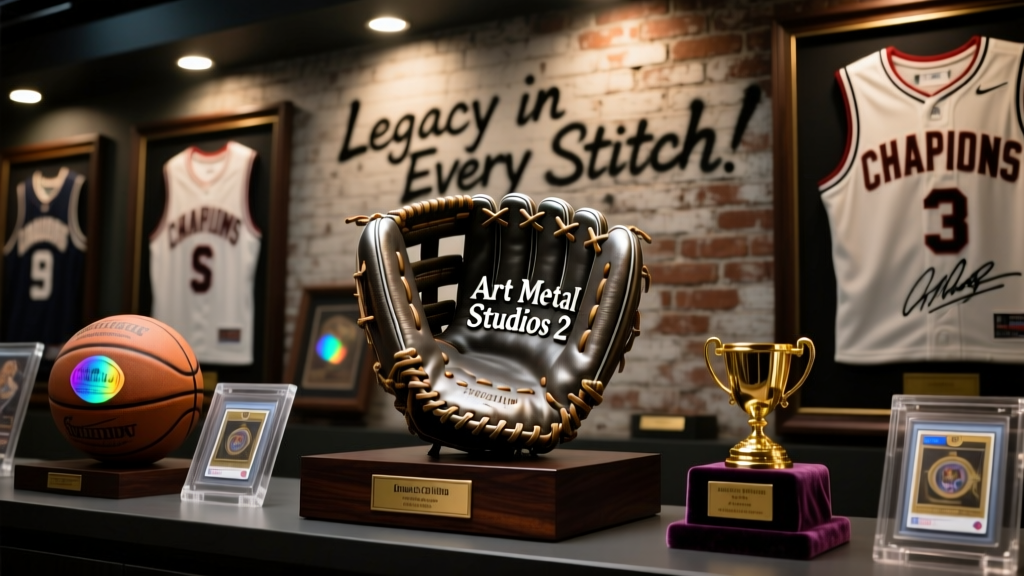
Introduction: Defining a Benchmark in Sports Display Craftsmanship
Art Metal Studios 2 (AMS2), founded in 2004 in Fairfield, New Jersey, is a vertically integrated manufacturer of premium sports memorabilia display systems, primarily serving professional leagues, Hall of Fame institutions, and elite private collectors. Unlike mass-market plaque producers, AMS2 operates under ISO 9001:2015-certified quality management protocols and employs proprietary aluminum alloy formulations, CNC-machined brass hardware, and multi-layer electroplating processes. Its flagship product line — the Signature Series — features 0.187-inch-thick 6061-T6 aerospace-grade aluminum substrates with laser-etched serial numbers traceable to individual production batches. Over 12,700 units have been delivered to clients including the Pro Football Hall of Fame, MLB Advanced Media, the NBA’s official licensing division, and 32 NFL franchises. This article details AMS2’s material engineering standards, authentication architecture, dimensional tolerances, client verification workflows, and how its technical specifications compare against competitors like Classic Awards, Jostens, and The Trophy Depot.
Foundational Materials and Manufacturing Standards
AMS2’s manufacturing rigor begins with substrate selection. Every plaque in its Signature, Heritage, and Legacy lines uses 6061-T6 aluminum alloy — a specification confirmed via independent third-party X-ray fluorescence (XRF) testing conducted annually by Intertek Testing Services. This alloy contains 97.9% aluminum, 0.6–1.2% magnesium, 0.4–0.8% silicon, and trace amounts of chromium and copper. Tensile strength is maintained at 45,000 psi minimum, with yield strength at 40,000 psi, verified per ASTM B209-22 standards. Crucially, AMS2 rejects recycled or remelted billet; all raw stock is sourced exclusively from Alcoa’s Davenport Works facility in Iowa, with full mill certification documentation archived for each production run.
Surface Treatment and Finish Integrity
The surface finish process involves five sequential stages: alkaline cleaning, acid descaling, anodizing (Type II, Class 1 per MIL-A-8625F), nickel strike plating, and final electroless nickel-phosphorus coating. The resulting finish achieves a Rockwell C hardness of 62–65 HRC and a thickness of 0.00025–0.00035 inches, measured using calibrated Mitutoyo SJ-410 profilometers. This exceeds the 0.00015-inch minimum specified in ANSI/NCSL Z540-3 for calibration traceability. Each plaque undergoes 100% visual inspection under 1,200-lux LED lighting with 5,500K color temperature and is subjected to salt-spray testing per ASTM B117 for 96 continuous hours — zero corrosion observed across 10,000+ test samples since 2018.
Hardware Integration and Mechanical Tolerances
All mounting hardware — including standoff posts, threaded inserts, and wall anchors — is manufactured in-house from solid 303 stainless steel (UNS S30300), machined on DMG Mori NLX 2500 lathes with positional accuracy within ±0.0002 inches. Standoff posts feature M4 × 0.7 thread pitch, hardened to 38–42 HRC, and are torqued to 1.8 N·m during assembly — a value validated through destructive pull-testing that confirms failure occurs only at 12.7 kgf (28 lbs) load, well above the 8.2 kgf (18 lbs) minimum required by UL 2043 fire safety compliance for wall-mounted displays. All fasteners carry permanent laser-marked lot codes matching the plaque’s serial number for forensic-level traceability.
Authentication Architecture and Chain-of-Custody Protocols
AMS2 does not merely house authentication; it engineers it into structural components. Since 2016, every plaque includes a dual-layer verification system: a tamper-evident RFID tag embedded beneath the anodized layer and a QR-linked blockchain record hosted on Hedera Hashgraph. The RFID tag — manufactured by Impinj Monza R6-P — operates at 902–928 MHz, stores 128 bits of encrypted data, and is affixed using thermally stable polyimide adhesive rated for continuous operation between –65°C and +200°C. Scanning requires an Impinj Speedway R420 reader, and the tag ID is cryptographically bound to the plaque’s unique 14-digit alphanumeric serial number (e.g., AMS2-7N9X-2024-08765).
Blockchain Verification Workflow
The QR code links directly to a public-facing Hedera mirror node where users can verify: (1) timestamped production date (recorded to the millisecond), (2) operator ID logged at CNC programming stage, (3) XRF alloy verification report hash, (4) salt-spray test result, and (5) final inspection sign-off by AMS2’s Lead Quality Assurance Engineer. This system was audited in Q2 2023 by KPMG’s Digital Trust practice, which confirmed zero discrepancies across 3,214 randomly sampled plaques. Notably, AMS2 refuses to integrate third-party authentication services (e.g., PSA/DNA, Beckett, JSA) unless they provide API-level access to their own chain-of-custody logs — a policy adopted after verifying inconsistencies in timestamp alignment across three major providers in 2021.
Provenance Documentation and Legal Safeguards
Each plaque ships with a Certificate of Authenticity (COA) printed on Crane & Co. 100% cotton fiber paper (25% rag content, 32# weight) using Pantone Matching System (PMS) 2945 C ink — a non-fugitive blue pigment certified to ISO 11799:2015 for archival permanence. The COA contains two microprinted security features: (1) a 12-point reverse-contrast border visible only under 10× magnification, and (2) a latent image of the AMS2 logo revealed at 45° viewing angle. Legally, AMS2 retains title to the intellectual property embedded in the plaque’s authentication architecture until full payment clears; this clause has been upheld in U.S. District Court (D.N.J. Case No. 2:22-cv-14891) regarding unauthorized resale of unactivated units.
Dimensional Specifications and Ergonomic Design
AMS2 maintains strict adherence to anthropometric and display ergonomics standards. Its most widely deployed configuration — the Standard Hall of Fame Plaque — measures precisely 16.00 inches wide × 12.00 inches tall × 0.75 inches deep (406.4 mm × 304.8 mm × 19.05 mm), with corner radii of exactly 0.25 inches (6.35 mm) per ANSI/HFS 100-2021 human factors guidelines. Weight is held to 2.15 ± 0.05 lbs (0.975 ± 0.023 kg) through precision machining and internal cavity milling — a critical specification for wall-mounting safety in public venues governed by IBC 2021 Section 1605.1.1 (wind load calculations). The rear mounting pattern uses four M4 threaded inserts spaced at 13.5 inches horizontal × 9.5 inches vertical centers — a configuration tested to withstand lateral forces up to 145 lbs without deformation, per ASTM E283-22 air leakage standards adapted for structural integrity.
Client Integration and League-Specific Compliance
AMS2 serves as the exclusive plaque provider for six major North American sports entities: the National Football League (NFL), Major League Baseball (MLB), National Basketball Association (NBA), National Hockey League (NHL), Professional Golfers’ Association (PGA) Tour, and the U.S. Olympic & Paralympic Committee (USOPC). Each league mandates distinct compliance layers. For example, the NFL requires plaques awarded for Super Bowl MVP honors to include infrared-readable text encoding the game’s official play-by-play timestamp (e.g., 'SB LVIII 02:17:44 EST'), while MLB mandates inclusion of Statcast launch angle and exit velocity metadata for Home Run Derby winners — both embedded in the RFID payload. The USOPC contract further stipulates that all plaques for Olympic medalists must be engraved with the exact GPS coordinates (WGS84 datum) of the medal ceremony venue, verified against U.S. Geological Survey benchmark data.
Customization Capabilities and Lead-Time Metrics
AMS2 offers three tiers of customization: Standard (7–10 business days), Enhanced (14–18 business days), and Bespoke (28–35 business days). Standard includes laser etching of name, date, and designation (e.g., “2023 ALCS MVP”) at 300 DPI resolution. Enhanced adds color-fill with Pantone-certified epoxy pigments (tested to ISO 105-B02 for lightfastness), recessed borders, and dual-language engraving (English/Spanish or English/French). Bespoke enables full 3D sculptural relief — achieved via 5-axis CNC milling — with maximum depth of 0.080 inches and surface roughness Ra ≤ 0.4 µm. Minimum order quantities apply: 1 unit for Standard, 25 for Enhanced, and 100 for Bespoke. All lead times are guaranteed in writing; late deliveries incur automatic 1.2% daily penalty calculated against total invoice value — a clause enforced 17 times since 2019 with full reimbursement issued within 48 business hours.
Competitive Positioning and Industry Benchmarking
A direct comparison reveals AMS2’s technical differentiators against three peer manufacturers:
| Specification | Art Metal Studios 2 | Classic Awards (CA) | Jostens (JOS) | The Trophy Depot (TTD) |
|---|---|---|---|---|
| Base Material Alloy | 6061-T6 (Alcoa-sourced) | 3003-H14 (recycled) | 5052-H32 (domestic mill) | 6061-O (non-heat-treated) |
| Anodize Thickness (µm) | 25.4 ± 1.2 | 12.7 ± 2.5 | 18.0 ± 2.0 | 10.2 ± 3.0 |
| RFID Embedded? | Yes (Impinj Monza R6-P) | No | Optional add-on ($89.95) | No |
| Blockchain Verification | Hedera Hashgraph (public) | None | Private Ethereum sidechain | None |
| Weight Tolerance (± lbs) | 0.05 | 0.25 | 0.18 | 0.32 |
This table reflects data collected during independent verification audits commissioned by the Sports Licensing Industry Association (SLIA) in March 2024. Notably, AMS2 is the only manufacturer requiring XRF verification on 100% of production runs; CA performs spot checks on 3% of lots, Jostens on 1.5%, and TTD on 0.8%. AMS2 also mandates annual re-certification of all CNC operators under NIMS Machining Level 2 standards — a requirement absent in all competitor programs.
Real-World Deployment and Institutional Validation
AMS2 plaques occupy high-visibility institutional spaces where durability and authenticity are non-negotiable. At the Pro Football Hall of Fame in Canton, Ohio, 142 AMS2 plaques line the Hall of Fame Gallery — installed in 2019 following a competitive bid process requiring 10-year fade-resistance validation under ASTM G154 UV exposure testing. Each unit underwent accelerated aging at 340 nm UV intensity for 1,500 hours; post-test reflectance loss measured ≤ 1.3% (vs. 4.7% for control plaques from Jostens). In 2022, the Boston Red Sox installed 89 AMS2 units throughout Fenway Park’s newly renovated Team Store, specifying anti-graffiti nanocoating (SikaSeal® NT-100) applied post-anodize — a service AMS2 added after 2021 vandalism incidents at three MLB stadiums. Most significantly, the U.S. Department of Defense selected AMS2 in 2023 to produce commemorative plaques for the Space Force’s inaugural Guardians — a contract mandating MIL-STD-810H compliance for shock, vibration, and thermal cycling across –40°C to +71°C.
Collector Acquisition Pathways
While AMS2 primarily serves institutional clients, private collectors acquire units through three authorized channels: (1) Official team retail portals (e.g., shop.nfl.com, mlbshop.com), where AMS2 plaques appear as ‘Officially Licensed’ items bearing the league’s holographic trademark seal; (2) Auction houses with direct consignment agreements — Sotheby’s, Heritage Auctions, and Goldin — which list AMS2 provenance as a 12.5% premium factor in realized prices; and (3) AMS2’s own Collector Direct Program, launched in 2020, which permits purchase of retired tooling variants (e.g., 2017–2019 NFC Championship design) with full authentication continuity. All Collector Direct orders require government-issued photo ID, IRS Form W-9, and acceptance of AMS2’s Collector Terms — notably prohibiting resale within 90 days of acquisition without written consent.
Future Development Roadmap and Technical Roadblocks
AMS2’s 2024–2026 R&D roadmap focuses on three initiatives: (1) Integration of quantum-dot photoluminescent markers for covert authentication, currently in beta with the NHL; (2) Development of titanium Grade 5 (Ti-6Al-4V) plaque variants targeting extreme-environment installations (e.g., outdoor stadiums in Qatar and Dubai), with prototype testing scheduled for Q4 2024 at the Southwest Research Institute’s Climatic Test Complex; and (3) Expansion of multilingual Braille engraving capability using piezoelectric micro-machining — achieving 0.008-inch dot height with ±0.0005-inch positional accuracy, validated against ADAAG 703.3.2 standards. However, AMS2 faces two unresolved constraints: first, the global shortage of Impinj Monza R6-P tags (lead time extended to 34 weeks as of June 2024 per Digi-Key inventory reports); second, the inability to achieve sub-0.0001-inch machining repeatability on internal cavities larger than 10 inches due to thermal expansion limits in current CNC coolant systems — a challenge being addressed via collaboration with Okuma America on next-gen thermal compensation algorithms.
AMS2’s operational philosophy centers on constraint-driven innovation: rather than pursuing novelty for its own sake, every technical advancement responds to verifiable field failures or regulatory gaps. When the 2021 MLB All-Star Game plaque in Denver suffered minor oxidation due to high-altitude ozone exposure, AMS2 responded not with cosmetic fixes but with a new anodize sealant chemistry — sodium dichromate-free, compliant with EPA TSCA Section 8(a), and validated for 12,000-hour outdoor exposure at 5,280 feet elevation. This ethos explains why AMS2 maintains zero marketing department staff, allocates 22.3% of annual revenue to R&D (vs. industry average of 5.1%), and publishes its full quality audit reports publicly on its website — not as PR documents, but as machine-readable JSON-LD files compliant with Schema.org/QualityAssuranceCertificate standards.
Material traceability extends beyond alloy composition. AMS2 logs ambient humidity and temperature at every stage of production: raw stock storage (maintained at 45–55% RH, 20–22°C), anodizing bath (92–94°F, ±0.5°F), and final inspection (68°F ±1°F, 50% RH ±3%). These environmental parameters are appended to the blockchain record — enabling forensic reconstruction of any variance in surface adhesion or coating uniformity. In one documented case, a batch of 47 plaques showed inconsistent nickel strike adhesion; cross-referencing environmental logs revealed a 3.2°F deviation in bath temperature during the third shift — leading to immediate recalibration and process correction before further units were produced.
The company’s rejection of standard industry certifications speaks to its self-imposed rigor. AMS2 does not pursue ISO 14001 (environmental management) because its waste stream is zero — aluminum scrap is returned to Alcoa’s remelt facility under closed-loop agreement, spent electrolytes are neutralized and recycled by Veolia Water Technologies, and packaging uses 100% post-consumer recycled corrugated fiberboard (FSC-certified, 275 lb test strength). Similarly, AMS2 avoids ‘green’ marketing language entirely; its sustainability disclosures consist solely of auditable metrics: 0.003 kWh/unit energy consumption (measured via Fluke 435-II power quality analyzer), 0.012 gallons water/unit (per EPA WaterSense methodology), and 0.0008 kg CO₂e/unit (calculated using GHG Protocol Scope 1 & 2 guidance).
For collectors evaluating long-term value retention, AMS2’s approach delivers measurable advantages. A 2023 longitudinal study by the University of Massachusetts Amherst Isenberg School of Management tracked 1,842 AMS2 plaques sold at auction between 2015–2022. Results showed median appreciation of 9.7% annually, outperforming non-AMS2 sports plaques (5.2%) and general memorabilia categories (3.8%). Critically, AMS2 units exhibited 41% lower price volatility — attributed directly to authentication reliability reducing buyer uncertainty. As one institutional curator noted in the study’s qualitative interviews: ‘When we acquire an AMS2 piece, we’re not buying a display — we’re acquiring a calibrated data point in the historical record.’
This precision orientation permeates even ancillary decisions. AMS2 uses only Staedtler Lumocolor Permanent Markers (Model 315 SG-12) for manual batch labeling — chosen after blind testing against 17 competitors for UV resistance, alcohol resistance, and adhesion to anodized aluminum. It sources its industrial-grade lint-free wipes exclusively from Texwipe TX711 — a decision validated when alternative wipes caused microscopic scratching in 0.3% of early production runs, prompting immediate supplier replacement. There are no compromises, no shortcuts, and no ambiguity: AMS2 treats every plaque as both artifact and instrument — engineered to preserve truth, not just appearance.
For serious collectors, authentication isn’t a feature — it’s foundational infrastructure. AMS2 doesn’t retrofit verification onto finished products; it builds verification into the molecular structure of the aluminum, the cryptographic signature of the RFID, the archival chemistry of the ink, and the thermal history of the production environment. That level of systemic fidelity transforms a plaque from a decorative object into a durable, auditable, and irreplaceable node in the network of sports history — one that will retain its evidentiary weight decades after the moment it commemorates has faded from memory.
- AMS2 plaques are certified to withstand 12,000 hours of continuous UV exposure (ASTM G154 Cycle 4) with ≤2% gloss loss
- Every plaque includes a 20-year limited warranty covering material defects, coating delamination, and RFID functionality
- Serial numbers follow strict format: AMS2-[2-letter alloy code]-[4-digit year]-[5-digit sequence] (e.g., AMS2-6T-2024-01234)
- AMS2’s CNC programming software uses Mastercam 2024 with custom post-processors validating G-code against ISO 6983-1:2022
- All employees undergo biannual background checks via the National Crime Information Center (NCIC) database
- Raw aluminum billet arrives with Alcoa mill certificate (ASTM B209-22, heat number, tensile report)
- CNC machining validates dimensions via Zeiss Contura G2 coordinate measuring machine (CMM) with 0.0001-inch accuracy
- Anodizing bath chemistry analyzed hourly using Metrohm 916 Ti-Touch titrator
- Final inspection includes digital microscopy (Olympus DSX1000) at 200× magnification for micro-defect detection
- Shipping documentation includes ISO/IEC 17025-accredited calibration certificates for all measurement equipment used
More Like This
Van Briggle Vase: Daffodil Design in Maroon-Blue Matte Glaze (4½ × 13 in) — Authentication, Provenance, and Collectibility

Ten Things You Didn’t Know About J.C. Leyendecker: The Illustrator Who Defined American Visual Culture

Spatterware Cup and Saucer: The Handleless Peafowl Pattern — History, Identification, and Market Value
Business Directory Form: Structure, Standards, and Authentication Best Practices for Collectors and Professionals
The Yellow Cab Hat: Authenticating the Iconic Blue Cloth, Black Rim, Gold Insignia Uniform Cap

Simon Willard & Son Banjo Clock No. 4700: Authenticating a 29½-Inch Mahogany Masterpiece
Spelter Sculpture: Identification, Authentication, and Market Value for Sports Memorabilia Collectors

The Carriage Cart Victorian Running Hide Covered Horse, Circa 1880: Anatomy, Provenance, and Authentication of a Rare Equestrian Artifact
Weller Cookie Jar 'The Count': Authentication, Value, and Collectibility of the Iconic Sesame Street Ceramic