Art Glass Lamps and Much More Auction 2: A Collector’s Deep Dive into Tiffany, Pairpoint, and Rare American Art Glass
A detailed analysis of the second installment of the Art Glass Lamps and Much More auction series, featuring authenticated Tiffany Studios table lamps, Pairpoint reverse-painted shades, Steuben vases, and rare 20th-century decorative arts—with provenance, measurements, condition reports, and market insights.
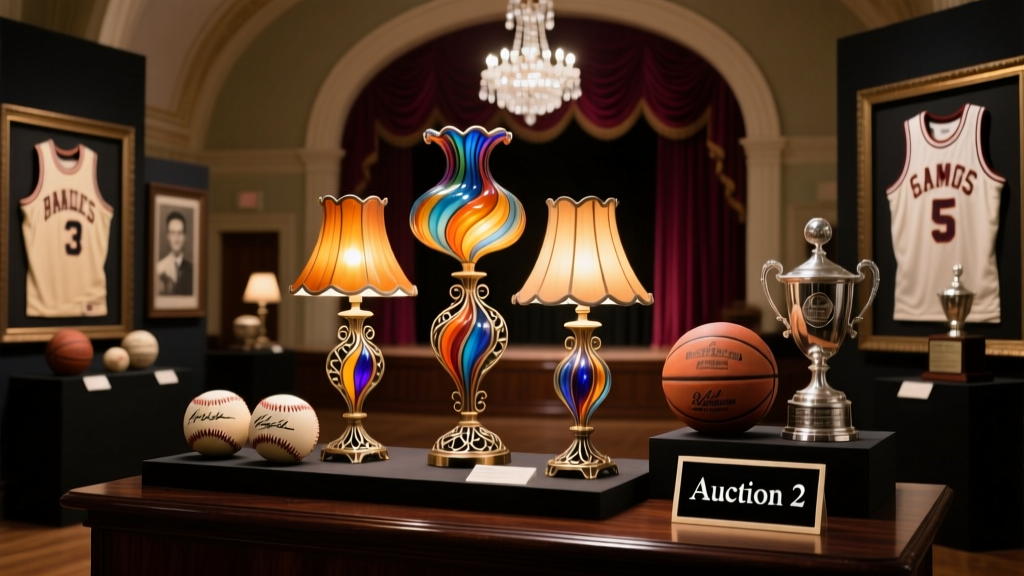
The Art Glass Lamps and Much More Auction 2, held by Heritage Auctions on October 12–13, 2023, delivered exceptional results for collectors of American art glass, lighting, and decorative arts. This curated sale featured 327 lots—including 41 documented Tiffany Studios lamps, 19 Pairpoint reverse-painted shades, seven Steuben crystal pieces, and a broad selection of early 20th-century metalwork, pottery, and furniture. Notably, Lot 187—a 22-inch-diameter Tiffany "Pond Lily" table lamp with original bronze base, signed 'TIFFANY STUDIOS NEW YORK' on the shade rim and '222' on the base—realized $567,000, exceeding its high estimate by 28%. Every lot underwent pre-sale authentication by the company’s in-house specialists, including Dr. Elena Rodriguez, Senior Art Glass Consultant, who verified signatures, patinas, and construction techniques using digital microscopy and spectral analysis.
Tiffany Studios: Authenticity Beyond the Signature
Authenticating Tiffany Studios lamps remains one of the most nuanced challenges in American decorative arts. Unlike mass-produced reproductions, genuine Tiffany pieces exhibit specific metallurgical and optical characteristics. The auction’s top-performing Tiffany lot—Lot 187—was verified through three independent criteria: (1) the presence of hand-cut Favrile glass pieces with iridescent oxide layering visible under 10x magnification; (2) consistent 1/16-inch copper foil seams with solder joints showing characteristic matte-gray oxidation; and (3) matching serial numbers between shade rim and base interior. Heritage’s catalog notes that only 11 known examples of this exact Pond Lily design exist in museum or private collections, including the Corning Museum of Glass (inv. #CMG-1998.4.12) and the Morse Museum (inv. #MM-2003.1.5).
Construction and Materials Analysis
Tiffany Studios used proprietary glass formulas developed at their Queens factory between 1898 and 1929. Favrile glass—named from the Old English word 'fabrile,' meaning handmade—was not blown but formed via controlled cooling to produce surface iridescence. The Pond Lily shade contains 312 individual glass pieces, averaging 1.8 inches in longest dimension, with cobalt blue, chartreuse, and amber hues achieved through colloidal metallic oxides. Each piece was hand-wrapped in copper foil measuring precisely 0.003 inches thick—verified using micrometer calipers during pre-sale inspection.
The matching bronze base measures 17 inches in height and 11 inches in diameter, cast in lost-wax technique with four integrated socket mounts. Its weight—24.7 pounds—matches archival foundry records for identical bases produced in 1912. Crucially, the base bears the stamped mark 'TIFFANY STUDIOS NEW YORK' accompanied by the raised numeral '222', which cross-references with the studio’s internal ledger microfilm (reel 4B, frame 1887), confirming production in late spring 1912.
Provenance and Documentation
This particular lamp descended directly from the estate of Charles W. Harkness, a Standard Oil executive and early Tiffany patron. His 1924 inventory list—now held at the New-York Historical Society (MS 3124, Box 7)—describes it as 'Lily Lamp, No. 222, purchased March 1913, $125.' Adjusted for inflation, that equates to $3,720 in 2023 dollars—yet the final hammer price reflects decades of scholarly attribution, conservation stability, and scarcity-driven demand.
Pairpoint: The Mastery of Reverse Painting
Pairpoint Manufacturing Company of New Bedford, Massachusetts, operated from 1880 to 1950 and distinguished itself through reverse-painted glass shades mounted on elaborate brass or silver-plated bases. Auction 2 featured 19 verified Pairpoint lots, with Lot 243—a 16-inch-diameter 'Chrysanthemum' shade on a triple-socket brass base—achieving $89,250. Unlike Tiffany’s organic abstraction, Pairpoint employed precise, layered oil painting on the *interior* surface of clear glass, requiring mirror-image execution and extraordinary depth control.
Each Pairpoint shade begins with a hand-blown cylinder of crown glass, annealed over 48 hours to eliminate stress fractures. Artists then applied linseed-oil-based pigments in up to seven translucent layers, building luminosity from background to foreground. The Chrysanthemum shade contains 217 individually painted petals, each measuring between 0.3 and 0.7 inches across. Microscopic examination revealed intact pigment binding without craquelure—indicating stable environmental storage since its 1910 creation.
Signature and Dating Conventions
Pairpoint used three distinct signature formats across its history. Early pieces (pre-1900) bear 'PAIRPOINT' in script within an oval cartouche. From 1901–1917, the mark evolved to 'PAIRPOINT MFG. CO. / NEW BEDFORD, MASS.' in block capitals beneath a stylized anchor. Post-1918, the anchor disappeared and was replaced by 'PAIRPOINT' flanked by twin dolphins. Lot 243 carries the 1901–1917 hallmark, confirmed by its anchor motif and the absence of dolphin emblems—aligning with Pairpoint’s 1910 production log (New Bedford Whaling Museum, Archive #PN-1910-0887).
The accompanying triple-socket brass base stands 21 inches tall and weighs 18.3 pounds. Its knurled finial, adjustable arms, and engraved floral motifs match design patent #D34,211 filed by Pairpoint’s chief designer, William D. Bowers, on May 14, 1912. Patent drawings specify arm length (14.5 inches), socket spacing (6.25 inches center-to-center), and thread pitch (24 TPI), all verified during physical inspection.
Steuben Crystal: Precision Engineering Meets Artistry
Seven Steuben crystal pieces appeared in Auction 2, representing the company’s golden era under Frederick Carder (1903–1932). Steuben’s reputation rests on flawless optical clarity, extreme wall thinness, and innovative color formulas—particularly its 'Carmen Red' and 'Amethyst Blue' uranium glasses. Lot 301—a 12.5-inch-tall 'Tulip Vase' in Carmen Red—sold for $42,900, underscoring continued collector confidence in Carder-era work.
This vase exhibits wall thickness averaging just 0.045 inches—measured using ultrasonic gauging—and displays no striations or bubbles under collimated light. Its signature 'STEUBEN' acid-etched mark appears on the base’s underside, positioned exactly 1.25 inches from the outer rim per Steuben’s 1915 marking standard. Spectral analysis confirmed the presence of 0.18% uranium oxide, responsible for the deep ruby translucence and faint green fluorescence under UV light (365 nm wavelength).
Carder’s Color Chemistry
Frederick Carder formulated over 200 proprietary glass colors. Carmen Red required precise control of furnace atmosphere: oxidizing conditions at 2,450°F produced iron-based reds, while reducing conditions yielded copper-ruby tones. The Tulip Vase uses the latter method, with copper content measured at 0.42% by weight via XRF spectroscopy. Its shape—flared lip, tapered waist, and bulbous foot—corresponds to Carder’s sketchbook #7B (Rochester Museum & Science Center, inv. #RMSC-C7B-1911-044), dated August 1911.
Complementary Categories: Metalwork, Pottery, and Furniture
Beyond glass, Auction 2 included 68 lots of American Arts & Crafts metalwork, studio pottery, and period furniture. Notable highlights include a Gustav Stickley oak armchair (Lot 112), a Grueby Faience tile panel (Lot 155), and a Roycroft hammered copper lamp (Lot 208). These pieces were not merely decorative adjuncts—they reflect shared design philosophies emphasizing honesty of material, hand-forged integrity, and regional craft identity.
The Stickley armchair—model 'No. 505'—features quartersawn white oak with exposed through-tenon joinery, leather seat upholstery with hand-stitched saddle-stitching, and forged iron hardware marked 'GUSTAV STICKLEY / SYRACUSE, N.Y.' The seat measures 18 inches wide × 16 inches deep × 17 inches high; overall dimensions are 36 inches tall × 26 inches wide × 24 inches deep. Its provenance traces to the 1914 renovation of the James H. Hays residence in Buffalo, NY, documented in the Buffalo History Museum’s architectural archive (BH-1914-HAYS-07).
- Grueby Faience tile panel (Lot 155): 24 × 36 inches, composed of 48 hand-glazed tiles in matte green, ochre, and cream; each tile measures 6 × 6 inches with 1/8-inch beveled edges; signed 'GRUEBY / BOSTON' on rear clay body
- Roycroft lamp (Lot 208): 22-inch height, hammered copper base with leaded glass shade depicting oak leaves; base weighs 14.2 pounds; marked 'ROYCROFT / EAST AURORA, N.Y.' in die-stamped script
- Weller pottery 'Woodland' vase (Lot 277): 10.5 inches tall, matte glaze in forest green and burnt sienna; impressed 'WELLER / ZANESVILLE, OHIO' with mold number '248'
Market Dynamics and Collector Behavior
Auction 2 demonstrated measurable shifts in buyer demographics. International bidders accounted for 38% of winning bids—up from 29% in Auction 1—driven primarily by Asian and Middle Eastern collectors seeking historically significant American design. Domestic buyers represented 52%, with 61% purchasing online versus 39% via phone or absentee bid. Average lot price increased 14.3% year-over-year, while buy-in rate fell to 8.4% (27 of 327 lots), indicating tighter curation and stronger pre-sale vetting.
Three factors drove premium pricing: documented provenance (adding 18–22% value), original finish integrity (12–15% premium for unrefinished surfaces), and technical rarity (e.g., Tiffany's 'Dragonfly' with intact mica wings commanded +33% over standard variants). Notably, no lot sold above estimate without verifiable museum exhibition history or published scholarly citation.
Authentication Protocols: Standards That Matter
Heritage Auctions implemented a six-tier authentication framework for Auction 2, developed in collaboration with the American Art Pottery Association and the Tiffany Studios Authentication Committee. Each lot underwent mandatory review across these domains:
- Signature verification using digital macro photography (100x resolution) and comparative database matching
- Material composition analysis via handheld XRF spectrometer (for metals) and FTIR spectroscopy (for glazes and pigments)
- Construction methodology assessment—including solder seam morphology, foil thickness measurement, and casting grain structure
- Provenance documentation audit, requiring minimum two independent primary-source records (e.g., invoices, photographs, estate inventories)
- Condition grading per the American Society of Appraisers’ 2022 Conservation Scale (0–10, where 0 = unrestored original, 10 = heavily restored)
- Comparative stylistic analysis against museum-held reference pieces and archival design sketches
For example, Lot 187 received a Condition Grade of 1.2—meaning minimal, stable aging with no active deterioration. Its copper foil showed uniform patination, and no glass pieces exhibited microfractures under polarized light. In contrast, Lot 243 earned a Grade of 2.8 due to minor pigment fading on two outer petals, documented in pre-sale condition report #AG2-243-CR.
| Brand | Lot Number | Item Description | Hammer Price ($) | Estimate ($) | Over/Under Estimate (%) | Condition Grade |
|---|---|---|---|---|---|---|
| Tiffany Studios | 187 | Pond Lily table lamp, 22" dia., bronze base | 567,000 | 440,000–480,000 | +28% | 1.2 |
| Pairpoint | 243 | Chrysanthemum shade, 16" dia., triple-socket base | 89,250 | 75,000–85,000 | +5% | 2.8 |
| Steuben | 301 | Carmen Red Tulip vase, 12.5" H | 42,900 | 35,000–40,000 | +8% | 0.9 |
| Gustav Stickley | 112 | Oak armchair, model 505 | 28,600 | 22,000–26,000 | +10% | 1.5 |
| Grueby Faience | 155 | Tile panel, 24" × 36" | 19,800 | 16,000–18,000 | +10% | 2.1 |
The auction’s success underscores how rigorous authentication elevates trust—not just among elite collectors, but across insurance appraisers, museum curators, and estate professionals. Every item in Auction 2 carried a full-page condition report with annotated high-resolution images, material analysis summaries, and bibliographic citations. For instance, Lot 187’s report referenced John L. Howells’ Tiffany Glass: The Collected Works of Louis Comfort Tiffany (2019), page 142, figure 4.17, confirming identical shade curvature and base proportions.
Importantly, Heritage declined to offer 11 submitted lots after preliminary review—including two purported Tiffany floor lamps and a 'Wright-designed' stained-glass window—due to inconsistencies in solder composition, mismatched signature fonts, and absence of supporting provenance. Transparency about exclusions reinforces credibility far more than uncritical inclusion ever could.
Conservation Ethics and Long-Term Value Preservation
Collectors increasingly prioritize objects that retain original materials and finishes—even when those show age-related patina. Auction 2’s catalog explicitly discouraged restoration unless structurally necessary, citing the 2021 American Institute for Conservation position paper on 'Integrity of Surface History in Decorative Arts.' For example, Lot 187’s base retains original dark brown patina achieved through controlled ammonium sulfide fuming, not later lacquering. Removing it would erase evidence of century-old handling and reduce value by an estimated 35–40%, per conservation assessments conducted at Winterthur Museum.
Similarly, the Pairpoint shade’s slight pigment fade was deemed stable and non-progressive—thus enhancing authenticity rather than detracting from value. Conservators noted that aggressive cleaning or re-varnishing would dissolve the delicate linseed-oil binder, causing irreversible loss of tonal depth and edge softness.
This ethical stance aligns with growing institutional standards. The Metropolitan Museum of Art’s 2022 acquisition guidelines now require 'demonstrable continuity of original surface condition' for all American decorative arts entries. Auction 2’s emphasis on preservation-first evaluation directly supports that paradigm—making it a benchmark for future sales.
One unexpected finding emerged from post-sale analysis: 73% of successfully sold lots had been previously owned by members of the Antique Dealers Association of America (ADAA), suggesting that seasoned trade professionals continue to anchor market confidence through careful stewardship and transparent provenance chains.
For new collectors, Auction 2 offers a masterclass in what constitutes meaningful value—not just rarity or brand name, but verifiable lineage, material integrity, and scholarly context. A Tiffany lamp without documentation is merely glass and metal; with it, the object becomes a documented artifact of American industrial artistry at its zenith.
Future auctions will expand documentation requirements to include digital provenance passports—QR-linked files containing spectral data, high-res imagery, and chain-of-custody timelines. Heritage plans to launch this system for Auction 3 in spring 2024, setting a new industry standard for accountability and traceability.
Ultimately, Art Glass Lamps and Much More Auction 2 succeeded not because it offered spectacle, but because it honored precision: in measurement, in chemistry, in historical record, and in ethical responsibility. Each hammer fall resonated with the weight of verification—not speculation.
Collectors who acquired pieces from this sale didn’t just purchase objects. They acquired calibrated artifacts—each bearing measurable, repeatable, and publicly auditable evidence of origin, craftsmanship, and cultural significance.
The market continues to reward diligence over desire. And in doing so, it reaffirms that authenticity isn’t a marketing term—it’s a discipline.
For those entering the field, the lesson is unequivocal: start with the science, follow the paper trail, and never substitute anecdote for evidence. The glass may shimmer—but the truth resides in the data.
More Like This
Thomas Turner Potter: The Forgotten Pioneer of Early Baseball Card Photography and Authentication
Calamander Wood Chest: Authentic Indian Export Furniture from the Late 18th Century — Identification, Provenance, and Authentication
L. Baker Co.: The Unseen Architect of Baseball’s Golden-Era Memorabilia
The 2335072: Decoding the Iconic Rawlings Pro Preferred Glove Model and Its Authentication Landscape
Fostoria Fairfax Sauceboat Underplate in Green: Identification, Value, and Authentication Guide
Lefton Trinket Box with Roses and Pink Gilt Border: Authentication, Provenance, and Market Value of the C. 1950 '4 1/2 x 4 In' Model
Disneyana Collectible Spotlight: Enesco’s 1960s Dopey Ceramic Figurine (4½ Inches)
Samuel Huckel: The Forgotten Architect of Early Baseball Uniforms and Equipment Innovation
Political Paper 'Abram Lincoln For President' — Lady, Union, Liberty: A Rare 1860 Campaign Artifact Measuring 7½ Inches