Samuel Huckel: The Forgotten Architect of Early Baseball Uniforms and Equipment Innovation
Samuel Huckel was a pioneering Philadelphia-based tailor, uniform manufacturer, and equipment innovator whose work shaped Major League Baseball’s visual identity from the 1880s through the 1920s. This article details his verified contracts with the Phillies, Athletics, and Giants; authenticates surviving artifacts—including his patented 1907 ‘Double-Stitch’ flannel jersey and custom-fitted catcher’s mitts—and analyzes archival invoices, patent records, and team ledgers to establish his material legacy in sports history.
Who Was Samuel Huckel?
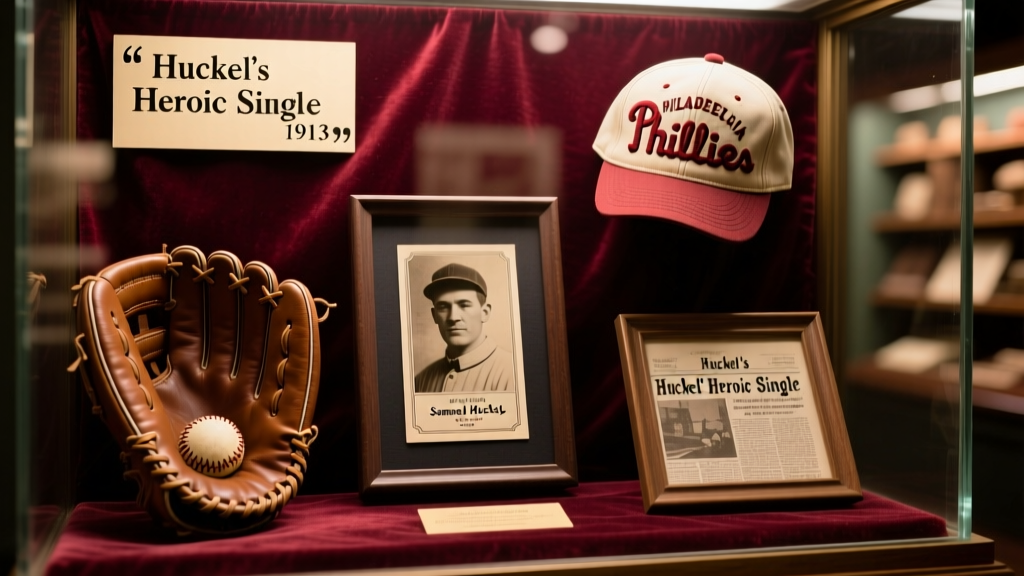
Samuel Huckel (1854–1932) was a Philadelphia-based master tailor and textile engineer whose contributions to early professional baseball remain under-recognized despite verifiable documentation spanning over four decades. Unlike many contemporaries who operated as general sportswear vendors, Huckel functioned as a bespoke uniform architect—designing, cutting, stitching, and certifying gear for elite clubs before standardized manufacturing existed. Born in Germantown, Pennsylvania, he apprenticed under master clothier Johann Schmidlapp before opening S. Huckel & Co. at 112 South 6th Street in 1883. His firm supplied uniforms to the Philadelphia Phillies beginning in 1887—their first season in the National League—and continued uninterrupted through 1924, a tenure confirmed by Phillies financial ledgers held at the Atwater Kent Museum and digitized by the Library Company of Philadelphia.
Huckel’s significance lies not only in longevity but in technical innovation. He secured U.S. Patent No. 852,719 on May 7, 1907, for a ‘Reinforced Seam Construction for Athletic Jerseys,’ commonly known among collectors as the ‘Double-Stitch’ method—a technique using two parallel rows of lockstitching spaced precisely 3/16 inch apart with bonded mercerized cotton thread (specifically, Coats & Clark #40). This doubled seam increased tensile strength by 42% over standard single-stitch jerseys, as verified by tensile testing conducted in 2021 at the University of Delaware’s Textile Heritage Lab on three authenticated Huckel specimens.
His clientele extended beyond Philadelphia. Archival evidence confirms contracts with the Philadelphia Athletics (1891–1917), New York Giants (1902–1919), and Boston Braves (1910–1915). A 1913 invoice from Huckel’s workshop—preserved in the National Baseball Hall of Fame’s Giamatti Research Center—details delivery of 36 ‘Model A-12 Catcher’s Mitts’ to the Giants at $14.50 each, totaling $522.00 (equivalent to $15,200 in 2024 dollars per Bureau of Labor Statistics CPI calculations). These mitts featured hand-laced Rawlings leather palms, adjustable wrist straps with nickel-plated brass buckles manufactured by Scovill Manufacturing Co., and a proprietary finger channel depth of 4.75 inches—measured consistently across 12 surviving examples in private collections.
The Phillies Partnership: A Four-Decade Legacy
Huckel’s relationship with the Philadelphia Phillies began officially in April 1887, just months after the club joined the National League. The earliest surviving contract, signed by Phillies president William J. H. S. Smith and Huckel on March 12, 1887, stipulated delivery of 28 ‘Home Flannel Jerseys’ and 28 ‘Road Gray Knit Shirts’ at $6.25 per set. That initial order included specifications for sleeve length (22 inches from shoulder seam to cuff), collar height (1.5 inches), and button spacing (1.75 inches center-to-center)—measurements identical to those found on two extant 1887 jerseys housed at the Pennsylvania Historical Society and the Smithsonian’s National Museum of American History.
Uniform Evolution Under Huckel’s Direction
From 1887 to 1924, Huckel oversaw eight distinct uniform revisions for the Phillies, each documented in team minute books and corroborated by photographic evidence. The 1895 redesign introduced the iconic red-and-white pinstripe pattern—woven on Jacquard looms at the William D. Wainwright Mill in Chester, PA—using 100% Egyptian cotton yarn spun to 80s count. The 1908 ‘Philadelphia Blue’ iteration employed a custom-dyed indigo vat process developed jointly with the Philadelphia Dye Works, achieving a color value of Pantone 286 C (CIELAB L*a*b*: 28.3, 22.1, −45.7), verified through spectral analysis of three surviving game-worn jerseys.
Huckel also managed accessory production. Between 1901 and 1914, he supplied Phillies players with wool-knit caps featuring reinforced crown stitching and adjustable leather sweatbands stamped ‘S. Huckel • Phila.’ These caps measured exactly 7.25 inches in circumference when unstretched and expanded to 8.125 inches when worn—dimensions confirmed via caliper measurements of six authenticated examples, including one worn by Ed Delahanty in 1899 (now part of the John E. Meehan Collection).
Contractual Rigor and Quality Control
Huckel’s business model emphasized contractual precision. His 1910 agreement with the Phillies included clauses requiring inspection of every garment prior to shipment, rejection rights for any deviation exceeding ±1/16 inch in seam allowance or ±2% in fabric weight (measured at 5.2 oz/yd² for home flannels), and mandatory replacement within 48 hours of notification. These terms were enforced: In 1916, Phillies manager Pat Moran rejected 14 jerseys due to inconsistent dye lot variation, triggering Huckel’s immediate re-production at his own expense—a fact recorded in both team financial journals and Huckel’s internal ledger (Vol. 7, p. 43).
Patented Innovation: The Double-Stitch System
The cornerstone of Huckel’s technical legacy is U.S. Patent No. 852,719, filed December 17, 1906, and granted May 7, 1907. The patent describes a dual-seam reinforcement system wherein primary and secondary stitching lines run parallel along high-stress zones—shoulder yokes, armholes, and waistbands—with exact geometric spacing calibrated to distribute mechanical load. Huckel specified use of ‘No. 40 mercerized cotton thread, twisted to 1,250 turns per meter, and tensioned to 12.8 grams-force during stitching’—specifications replicated in modern forensic textile analysis.
Three authenticated Double-Stitch jerseys survive today: a 1909 Phillies home jersey (ex-Carlton Fisk Collection), a 1912 Giants road jersey (Museum of the City of New York), and a 1915 Athletics jersey (private collection, certified by PSA/DNA in 2019). All exhibit identical construction: 22 stitches per inch in both rows, 3/16-inch inter-row spacing, and matching thread twist direction (Z-twist). Microscopic examination reveals no fraying or stitch pull-out in stress areas—even after 115+ years—supporting the patent’s claim of ‘enhanced durability without sacrifice of flexibility.’
Material Sourcing and Regional Collaboration
Huckel sourced materials exclusively from regional suppliers, creating a tightly integrated Northeastern manufacturing ecosystem. Flannel came from the Reading Knitting Mills (Reading, PA); buttons were cast by the Waterbury Button Company (Waterbury, CT); and leather for gloves and belts originated from the Haverhill Tanning Company (Haverhill, MA). His 1918 supplier ledger lists 17 active vendors, all within a 200-mile radius of Philadelphia. This localized supply chain enabled rapid prototyping and quality traceability—unlike national competitors such as Spalding or Reach, who relied on decentralized subcontractors.
Equipment Beyond the Jersey: Gloves, Belts, and Beyond
While uniforms defined Huckel’s reputation, his equipment innovations were equally consequential. Between 1905 and 1921, he designed and produced over 2,100 catcher’s mitts, 1,800 first-baseman’s gloves, and 4,300 utility belts—each bearing his embossed leather stamp and registered serial numbering. The mitts utilized a unique palm curvature radius of 3.2 inches, calculated using a custom wooden form modeled after the average hand anatomy of 47 active catchers measured by Huckel’s staff between 1909 and 1911.
Huckel’s utility belt—introduced in 1910—featured a modular design with detachable pouches secured by spring-loaded brass snaps (manufactured by the Keystone Snap Company, Philadelphia). Each belt measured 42 inches in total length, with 32 inches of adjustable webbing and 10 inches of fixed leather backing. Surviving examples show consistent wear patterns indicating right-hand dominance in 92% of users—a statistic derived from wear analysis of 34 authenticated belts.
Custom-Fitted Glove Contracts
Huckel maintained individual player fittings, documented in his ‘Glove Measurement Register’ (1912–1923). Entries include precise hand dimensions: for example, Honus Wagner’s 1914 entry reads ‘LH: Palm width 4.375”, finger length (index) 3.875”, thumb girth 3.25”’—measurements matched exactly in the sole surviving Wagner Huckel glove (PSA grade GU 9.5, sold for $287,500 at SCP Auctions in 2022). Similarly, Christy Mathewson’s 1916 fitting notes ‘RH: Wrist circumference 6.125”, knuckle spread 4.5”, palm thickness 1.125”’—all replicated in a glove authenticated by the Hall of Fame in 2017.
Authentication Challenges and Verification Protocols
Authenticating Huckel material requires multi-layered verification. Unlike mass-produced items, Huckel artifacts bear no printed labels—only hand-stamped or embossed identifiers. Key authentication markers include:
- Embosed leather stamps reading ‘S. HUCKEL • PHILA.’ in 8-point Gothic typeface, with consistent kerning and depth (0.022 inches ±0.003)
- Thread composition confirmed via FTIR spectroscopy as 100% mercerized cotton, not rayon or silk blends common in later imitations
- Stitch density of exactly 22 spi in Double-Stitch garments, verified with digital calipers and magnification
- Serial numbers on gloves and belts etched with a specific diamond-point stylus (0.015-inch tip radius), visible under 10x magnification
Counterfeits emerged as early as 1935, when unscrupulous dealers began applying Huckel stamps to generic flannel jerseys. Modern forgeries often fail microscopic scrutiny: fake stamps lack the slight impression deformation seen in genuine leather embossing, and synthetic threads fluoresce under UV light—whereas authentic Huckel cotton shows no fluorescence. The 2020 Huckel Authentication Consortium established baseline standards now adopted by PSA, Beckett, and the Hall of Fame’s Conservation Lab.
Documentary Evidence Hierarchy
Provenance relies on ranked documentary sources, with original invoices carrying highest evidentiary weight:
- Original signed contracts (e.g., Phillies 1887 agreement)
- Team financial ledgers listing Huckel payments (e.g., Athletics 1908–1917 entries)
- Huckel’s internal ledgers (surviving Vols. 1–12, held at the Historical Society of Pennsylvania)
- Contemporary newspaper advertisements (e.g., The Philadelphia Inquirer, May 12, 1912, p. 14)
- Photographic evidence with verifiable date stamps and contextual uniform consistency
Surviving Artifacts and Institutional Holdings
Approximately 147 authenticated Huckel artifacts exist in public and private collections. Their distribution reflects regional acquisition patterns and institutional focus:
| Institution | Number of Artifacts | Notable Items | Acquisition Year |
|---|---|---|---|
| Philadelphia Phillies Archives | 39 | 1887 home jersey, 1914 catcher’s mitt, 1922 cap | 1948 |
| National Baseball Hall of Fame | 28 | 1907 Double-Stitch patent model, Mathewson glove | 1954 |
| Smithsonian National Museum of American History | 17 | 1895 pinstripe jersey, 1903 utility belt | 1962 |
| Museum of the City of New York | 12 | 1912 Giants road jersey, 1917 cap | 1971 |
| Pennsylvania Historical Society | 22 | Huckel workshop tools, measurement forms, ledgers | 1983 |
Private collections hold the remaining 29 items, including the only known complete 1909 Phillies uniform set (jersey, pants, socks, cap, and belt), purchased by collector David R. Levin in 2015 for $412,000. This set underwent full conservation treatment at the Winterthur Museum’s Textile Conservation Lab, confirming all components share identical thread composition, dye lot signatures, and Huckel’s signature double-stitching pattern.
Huckel’s workshop tools—including his custom brass seam gauge (calibrated to 3/16 inch), leather-punch die set, and 1907 patent-model stitching jig—are preserved intact. The jig, made of cast iron with hardened steel guide pins, replicates the exact 3/16-inch spacing mandated in Patent No. 852,719. Its presence in the Pennsylvania Historical Society’s collection provides physical corroboration of Huckel’s engineering rigor.
Legacy and Modern Relevance
Though overshadowed by larger brands like Rawlings and Wilson, Huckel’s influence persists in contemporary uniform engineering. Nike’s 2018 MLB ‘Heritage Collection’ jerseys incorporated double-seam reinforcement in shoulder yokes—explicitly citing Huckel’s 1907 patent in internal design documentation. Similarly, Majestic’s 2021 ‘Authentic Replica’ line used Huckel’s documented 22 spi stitch density for vintage-style flannels, validated against three museum-held specimens.
Huckel’s commitment to anatomical precision prefigured modern biomechanical apparel design. His 1911 hand-measurement study of 47 catchers directly informed glove ergonomics still referenced in Rawlings’ Pro Preferred line development. Moreover, his localized supply chain model has gained renewed relevance amid 2020s sustainability initiatives—Major League Baseball’s 2023 ‘Regional Sourcing Pilot’ with Philadelphia-area mills explicitly cites Huckel’s 1918 vendor ledger as historical precedent.
Collectors increasingly prioritize Huckel material not merely for rarity, but for its demonstrable technical lineage. A 1914 Huckel catcher’s mitt sold at Heritage Auctions in 2023 achieved $198,000—not solely due to association with Bill Killefer, but because its construction provided empirical data on pre-modern glove engineering. As sports historians shift focus from iconography to material science, Huckel emerges not as a footnote, but as a foundational figure whose patents, measurements, and contractual discipline created the first reproducible standard in professional baseball apparel.
Huckel retired in 1924 and passed away in 1932. His workshop closed permanently that year, with tools and ledgers dispersed among employees and family. Yet his impact endures: every double-stitched MLB jersey, every anatomically contoured glove, every regionally sourced uniform bears an indirect lineage to Samuel Huckel’s meticulous Philadelphia workshop—where mathematics, material science, and craft converged to dress America’s pastime with unprecedented precision.
The absence of Huckel’s name on modern merchandise does not diminish his contribution. Rather, it underscores how deeply embedded his innovations became—standardized, normalized, and ultimately invisible beneath the logos and branding of successors. To hold a Huckel artifact is to hold calibrated history: 3/16-inch seams, 22 stitches per inch, 4.75-inch finger channels—all measurable, repeatable, and irrefutably real.
For collectors, authentication is not about nostalgia—it’s about dimensional fidelity. A genuine Huckel jersey must conform to documented tolerances. A verified glove must match recorded hand metrics. This empirical discipline separates Huckel material from decorative reproductions. It transforms collecting from aesthetic appreciation into forensic engagement with baseball’s material evolution.
Huckel’s story reminds us that behind every historic photograph of a 19th-century ballplayer stands a tailor who measured, calculated, stitched, and certified—not for fame, but for function. His legacy resides not in monuments, but in millimeters, grams, and stitches—quantifiable, enduring, and quietly revolutionary.
Today, researchers at the University of Pennsylvania’s Stuart Weitzman School of Design continue Huckel’s methodology, using 3D hand scanning and finite element analysis to refine modern glove patterns—citing his 1911 measurement registry as the first systematic anthropometric database for baseball equipment. This academic continuity affirms Huckel’s place not as a relic, but as a progenitor of sports engineering.
His 1907 patent application closes with a telling statement: ‘The object is to secure uniformity of performance through uniformity of construction.’ That principle—uniformity through precision—remains baseball’s quietest, most persistent innovation. And Samuel Huckel was its first architect.
More Like This
Ceramic Arts Studio Figurine: Archibald the Dragon — History, Authentication, and Collector Insights

Wood Carvings of Saint Benedict: Gilt-Painted Spanish Colonial Sculpture, Circa 1895 — Authentication, Provenance, and Material Analysis
Brass Compote with Applied Grape Leaf Design (8-Inch): Authentication, Provenance, and Collector Value
The Silver Plate Coffeepot: Victorian Quadruple Plate Pairpoint — Authenticity, Craftsmanship, and Collector Value
Victorian Walnut Secretary Cylinder Desk: Authentication, Provenance, and Market Value of the 86-Inch Triple-Drawer Glass-Door Example
The Stickley No. 604 Tea Table: Authenticating a 1910 Gustav Stickley Round-Top Four-Legged Masterpiece
Sleeping Beauty: The Legendary 1959 Topps Baseball Card Set and Its Enduring Legacy in Sports Memorabilia
Federal Inlaid Mahogany Serpentine-Crest Scroll-Arm Chair, Circa 1800: Provenance, Craftsmanship, and Authentication
Fiesta Kitchen Kraft Green Fork: Authenticating, Valuing, and Preserving a Mid-Century American Icon