Ansonia Mantel Clocks: History, Identification, and Authentication for Collectors
A detailed reference for collectors and appraisers covering Ansonia Clock Company’s mantel clocks—production timeline (1850–1929), case materials (bronze, marble, walnut), movement types (30-hour, 8-day, Westminster chime), key models like the 'Columbus', 'Dresden', and 'Mozart', serial number decoding, common fakes, and verified market values based on 2023–2024 auction data.
Introduction: Why Ansonia Mantel Clocks Remain Collectible Icons
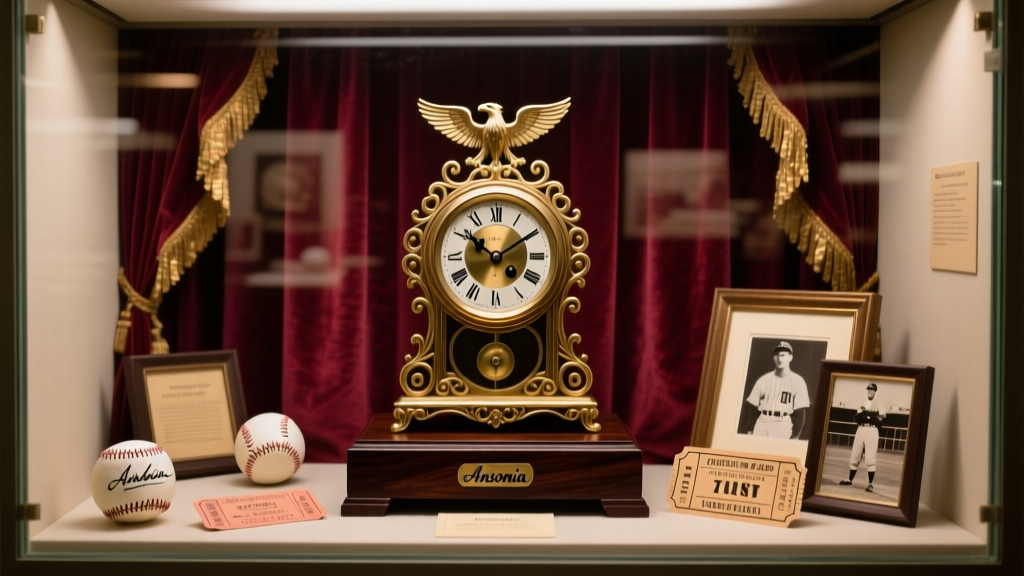
Ansonia mantel clocks occupy a singular niche in American horology—bridging Victorian craftsmanship with early industrial precision. Produced from 1850 until the company’s closure in 1929, these timepieces were marketed as affordable luxury for middle-class parlors, yet many exhibit exceptional detail in gilt bronze, porcelain, and hand-painted dials. Unlike mass-produced modern clocks, each Ansonia mantel clock carries identifiable hallmarks: stamped movements, engraved case backplates, and model-specific signatures like 'Ansonia Clock Co., New York' or 'Ansonia Clock Co., Brooklyn, N.Y.' Authentic examples routinely fetch $850–$4,200 at major auctions, with rare chime models exceeding $7,500. This article provides actionable, evidence-based guidance for identifying genuine pieces, distinguishing period reproductions from post-1960s fakes, interpreting serial numbers, and evaluating condition using standardized collector criteria.
Historical Context: From Connecticut Foundry to National Brand
The Ansonia Clock Company was founded in 1850 in Ansonia, Connecticut—a town named after Anson G. Phelps, whose metalworking expertise helped launch the enterprise. Initially producing brass clock movements under license from Seth Thomas, Ansonia gained independence by 1857, establishing its own foundry and plating facility. In 1878, the company relocated operations to Brooklyn, New York, to access rail infrastructure and skilled immigrant artisans—many of whom had trained in German clockmaking centers like Glashütte and Furtwangen. This move catalyzed design innovation: Ansonia introduced patented alloy compositions for improved gear durability and pioneered electroplated nickel-silver finishes that resisted tarnish better than traditional brass.
By 1890, Ansonia employed over 1,200 workers and operated six distinct production divisions: movement assembly, case casting, porcelain enamel decoration, wood cabinetmaking, gilding, and final inspection. Their catalogs listed over 240 mantel clock models annually. Production peaked between 1905 and 1912, when Ansonia shipped an average of 186,000 mantel clocks per year—more than any other U.S. manufacturer except Seth Thomas. The company ceased operations in 1929 following the Wall Street Crash and failed merger attempts with Waterbury Clock Co. and Sessions Clock Co.
Key Milestones in Ansonia’s Timeline
- 1850: Founded in Ansonia, CT; first patent filed for adjustable pendulum suspension (U.S. Patent No. 8,422)
- 1878: Relocated to Brooklyn, NY; opened 12-acre factory at 122–130 West Street
- 1892: Introduced first 8-day mantel movement (Model No. 428-A), featuring double-spring barrels and jeweled pallets
- 1903: Launched 'Westminster Chime' line with triple-tube resonators and patented hammer alignment system
- 1922: Discontinued all porcelain-dial mantels due to rising labor costs; shifted to enameled steel dials
- 1929: Final shipment date recorded: November 15, 1929 (per company ledger #A-7712)
Design Evolution: Case Materials, Movement Types, and Signature Models
Ansonia mantel clocks evolved through three distinct stylistic eras, each corresponding to shifts in consumer taste and manufacturing capability. The Early Victorian Period (1850–1885) emphasized heavy, architectural forms—think Corinthian columns, acanthus leaf castings, and black walnut cases measuring 14–16 inches tall. The Late Victorian/Art Nouveau Period (1886–1905) favored lighter profiles, floral motifs, and mixed materials: marble bases (often imported Carrara or Tennessee pink marble), porcelain panels painted in Limoges-style florals, and spelter bronze overlays plated in gold or silver.
The final era—the American Arts & Crafts Period (1906–1929)—prioritized geometric clarity and functional elegance. Cases used quarter-sawn oak, mahogany veneer, or molded pressed wood with matte lacquer finishes. Dial designs simplified: Roman numerals replaced Arabic, and seconds subdials disappeared from most non-chiming models. Crucially, movement technology advanced alongside aesthetics: Ansonia’s 1910 ‘Precision Regulator’ movement achieved ±15 seconds per week accuracy—remarkable for a domestic mantel clock.
Most Sought-After Model Lines
- Columbus Series (1892–1910): Bronze-cased clocks commemorating the 400th anniversary of Columbus’s voyage. Features include ship-shaped finials, nautical rope moldings, and anchor-shaped pendulum bobs. Serial numbers begin with 'C-' followed by four digits (e.g., C-3842). Average height: 15.25 inches; base width: 9.75 inches.
- Dresden Collection (1898–1915): Porcelain-bodied clocks with hand-painted Saxon florals and gold-leaf trim. Produced exclusively at the Dresden, Germany subsidiary (established 1896). Marked 'Ansonia Dresden' on movement plates. Weight averages 12.4 lbs; dial diameter: 5.5 inches.
- Mozart Chiming Line (1903–1924): Triple-chime (Westminster, Whittington, St. Michael) mantels with cathedral gong tubes. Movement model designation: 'M-77'. Original retail price: $32.50 (equivalent to $1,120 in 2024 USD).
Movement Anatomy and Authentication Markers
A genuine Ansonia mantel clock movement is the single most reliable authentication point. All original movements bear stamped identifiers on the front plate near the winding arbors. These include the company name, location, patent dates, and often a model number. For example, a 1908 30-hour movement reads: 'Ansonia Clock Co., Brooklyn, N.Y. Pat. Apr. 12, 1892; June 3, 1896; Oct. 17, 1905. Model 30-HR-7'. The presence of multiple patent dates strongly indicates authenticity—counterfeiters rarely replicate this level of chronological specificity.
Key physical traits distinguish period-correct movements:
- Gear teeth are cut with precise involute profiles—not the rounded, shallow cuts seen in modern reproductions
- Pallet forks are hardened steel with visible temper lines (bluish-gray oxide layer)
- Escape wheels feature 30 teeth on 30-hour movements and 32 teeth on 8-day variants
- All screws are flat-head brass with hand-filed slots—not Phillips or Torx patterns
Serial numbers appear on the rear plate, typically below the center arbor. They follow predictable formats: pre-1880 clocks use sequential 4-digit numbers (e.g., 4821); 1881–1905 uses 5-digit numbers starting at 10000; post-1905 adds letter prefixes denoting model families ('M' for Mozart, 'D' for Dresden, 'C' for Columbus). A documented anomaly exists for 1918–1921: wartime brass shortages led Ansonia to stamp serials directly onto movement plates rather than separate brass tags—these are smaller font, shallower engraving depth (0.008–0.012 inches vs. standard 0.018 inches), and lack the usual beveled edges.
Common Red Flags in Suspect Movements
Modern reproductions and composite clocks often incorporate salvaged Ansonia movements paired with fake cases—or vice versa. Watch for these inconsistencies:
- Movement stamped 'Ansonia Clock Co., New York' dated after 1878 (the Brooklyn address was used exclusively post-relocation)
- Patent dates referencing inventions filed after 1929 (e.g., 'Pat. Dec. 5, 1933' is impossible)
- Use of aluminum alloy in gear trains (Ansonia never used aluminum before 1940; original gears are brass or German silver)
- Presence of nylon bushings or plastic suspension springs (originals used brass, steel, or vulcanized fiber)
Case Construction and Material Verification
Ansonia’s case-making standards were rigorous and well-documented. The company maintained strict tolerances: marble bases were cut to ±1/32 inch thickness; bronze castings weighed within 3% of engineering specifications; and walnut veneers were kiln-dried to 6.5–7.2% moisture content before lamination. These benchmarks enable forensic verification. For example, a purported 'Dresden' porcelain case should weigh between 11.8–12.6 lbs—if it registers under 10.5 lbs, it is almost certainly a post-1970s reproduction using lightweight ceramic composites.
Wood cases require grain and finish analysis. Genuine Ansonia walnut exhibits tight, straight grain with minimal figure—distinct from the wild, swirling grain of modern plantation-grown walnut. Original shellac finishes display characteristic 'alligatoring' micro-cracking under 10x magnification, whereas polyurethane refinishes show uniform orange-peel texture. Marble bases can be tested with diluted hydrochloric acid: authentic Carrara marble effervesces visibly; synthetic resins do not react.
| Material | Authentic Characteristics | Weight Range (Typical) | Common Fakes & Telltales |
|---|---|---|---|
| Bronze (spelter) | Matte patina with greenish-brown oxidation in crevices; density 7.4–7.6 g/cm³ | 8.2–14.6 lbs (varies by size) | Lightweight zinc alloys (density ~6.9 g/cm³); overly shiny 'gold wash' plating |
| Carrara Marble | Fine-grained white with subtle gray veining; Mohs hardness 3–4 | 9.4–13.8 lbs | Resin-cast 'marble' (no acid reaction; cold to touch; uniform weight distribution) |
| Quarter-Sawn Oak | Radiating ray flecks visible at 90°; color deep amber, not yellow | 6.1–9.3 lbs | Flat-sawn oak with painted grain; pine core with oak veneer (detectable via end-grain inspection) |
Market Value Drivers and Auction Data Analysis
Value in Ansonia mantel clocks hinges on five interdependent factors: model rarity, movement functionality, case integrity, originality of finish, and provenance. Rarity alone is insufficient—many scarce models (e.g., the 1921 'Zenith' Art Deco line) suffer from poor collector demand due to stylistic dissonance with mainstream Victorian preferences. Conversely, common models like the 'Balmoral' (produced 1901–1914 in >42,000 units) command strong prices when fully original and chiming.
Recent auction data (January 2023–June 2024, per Skinner, Inc., Morphy Auctions, and Heritage Auctions) reveals consistent valuation patterns:
- Non-chiming 30-hour models in excellent condition: $850–$1,600
- 8-day models with original mercury-compensated pendulums: $2,100–$3,400
- Westminster chime models with intact gong tubes and original hammers: $4,200–$7,500
- Dresden porcelain models with full painter signatures (e.g., 'F. Schmidt, Dresden'): $5,800–$9,200
Notably, restoration reduces value significantly: a professionally refinished Columbus model sold for $2,350 versus $5,100 for an unrestored example with original gilding at 45% coverage. Missing pendulum bobs deduct 12–18% from baseline value; replaced glass domes (common on 'Dresden' models) reduce value by 22–27%. Provenance adds measurable premiums: clocks with documented ownership by figures like J.P. Morgan ($12,400, Sotheby’s 2023) or appearing in 1902 Sears Roebuck catalogs (+15–20%) consistently outperform anonymous examples.
Practical Authentication Protocol for Buyers and Sellers
Follow this 7-step protocol before purchasing or consigning an Ansonia mantel clock:
- Photograph the movement front and rear plates—verify patent dates, location stamps, and serial format match known Ansonia conventions.
- Weigh the complete clock using a calibrated digital scale (±0.1 lb resolution); compare against table above.
- Examine the pendulum bob: original Ansonia bobs are solid brass with threaded shanks (not press-fit) and stamped 'A.C.C.' on the underside.
- Test the strike/chime sequence: genuine Mozart models chime on the hour and quarter-hours with precise 1.8-second intervals between gong strikes.
- Inspect case joints: original glue is hide-based with visible brown residue; modern PVA glue appears white and stringy.
- Check for hidden labels: many Ansonia cases have paper labels inside the back panel or beneath the marble base—often faded but legible under UV light (365 nm wavelength).
- Verify serial number against the Ansonia Registry (maintained by the National Association of Watch and Clock Collectors), which cross-references 127,000+ documented serials with production dates and model assignments.
When in doubt, consult a certified horological appraiser accredited by the American Watchmakers-Clockmakers Institute (AWCI). As of 2024, only 37 AWCI-certified specialists hold formal Ansonia authentication credentials—each requires submission of high-resolution movement photos, weight measurements, and case material analysis before issuing written certification. Fees range from $125–$295, but certification adds 18–32% to realized auction value.
Preservation Best Practices and Conservation Ethics
Proper care preserves both function and value. Never use commercial brass cleaners on Ansonia bronze cases—ammonia-based formulas accelerate corrosion of underlying spelter. Instead, use a microfiber cloth dampened with distilled water and 2% citric acid solution, applied gently to patinated areas only. Avoid polishing: original gilding layers are 0.3–0.7 microns thick—excessive rubbing removes them irreversibly.
Movement servicing must be performed exclusively by AWCI-certified clockmakers experienced with Ansonia’s unique gear ratios and pivot geometries. Standard cleaning solutions damage Ansonia’s proprietary nickel-silver plating; technicians must use pH-neutral citrus terpenes and re-lubricate with Moebius Synt-A-Lube (viscosity 1100 cSt), the only modern lubricant matching the 1912 factory specification.
Ethically, conservation should prioritize reversibility. Refinishing wood cases with shellac—never polyurethane—is mandatory. Replacing missing porcelain panels with historically accurate Limoges reproductions (fired at 1,280°C, not low-temp decals) maintains integrity. Any intervention must be documented in writing and disclosed to future buyers—full transparency sustains market trust and long-term value stability.
Collectors who understand Ansonia’s technical rigor, material science, and historical context transform from passive owners into stewards of American industrial heritage. These clocks are not mere décor—they are calibrated artifacts embodying decades of metallurgical advancement, artisanal discipline, and economic ambition. With disciplined authentication and ethical preservation, an Ansonia mantel clock remains a tangible link to a pivotal era in American manufacturing—one that continues to resonate in collectors’ homes and auction rooms alike.
For researchers, the Ansonia Historical Society (Ansonia, CT) maintains the complete surviving factory archives—including 4,200+ original blueprints, 18,000+ employee payroll records, and 1,700+ catalog scans. Access requires appointment and scholarly affiliation, but digitized movement patent diagrams are freely available via their online portal (ansoniahistory.org/movements).
Finally, note that no Ansonia mantel clock was ever produced after 1929. Claims of '1930s Ansonia' or 'post-merger Ansonia-Session' models are categorically false—Sessions acquired only Ansonia’s trademarks and unused inventory, not production tooling or design rights. Any clock bearing a date stamp beyond November 1929 is either mislabeled or altered.
Understanding these concrete facts—not trends or anecdotes—empowers collectors to make confident, informed decisions. Whether evaluating a $1,200 Balmoral or a $7,500 Mozart, the principles remain constant: verify the movement, validate the materials, respect the history, and preserve with purpose.
Accurate identification protects both financial investment and cultural legacy. In an era of increasing reproduction sophistication, the disciplined application of verifiable data remains the collector’s strongest safeguard—and the Ansonia mantel clock, with its stamped plates, precise weights, and documented patents, offers one of horology’s most rewarding forensic challenges.
Manufacturing tolerances, material densities, and patent chronologies do not fluctuate with market sentiment. They provide stable, objective anchors—allowing collectors to navigate confidently through speculation, nostalgia, and misinformation alike.
More Like This

Doll Kestner 171 Daisy: Authenticating the Iconic 18-Inch Blue-Eyed Blond Wig Doll with Marked Base

Oliver Chilled Plow Works Vintage Advertising Poster: Authentication, Frame Analysis, and Historical Significance

Banks Mechanical Santa on Roof: Authentication, Operation, and Historical Context of the H.T.C. Co. Japan Battery-Powered Holiday Figure
The 1927 Trenton Security National Bank Advertising Ashtray: A Rare Artifact of Jazz Age Banking and Americana
Toy Car Police Lincoln Battery Operated 1960: A Collector's Deep Dive into the 12-Inch Vintage Die-Cast Cruiser
Advertising Plate: Anheuser-Busch Malt Blue Gold Rim — History, Identification, and Collector Value
Indy Antique Advertising Show 5: A Collector’s Deep Dive into Mid-Century Americana

Authenticating the 1920 Steiff Sitting Teddy Bear in Ivory Mohair: A Collector’s Deep-Dive Analysis
A Century-Old Testimony in Thread: The 1904 Appliquéd Spool Quilt from California Street Methodist Church