Amable Brasier Brasher: The Forgotten Pioneer of Early American Football Equipment Innovation
A detailed examination of Amable Brasier Brasher’s life, patented football helmet designs (1927–1932), manufacturing partnerships with Rawlings and Spalding, material specifications, surviving artifacts in museum collections, and his enduring impact on player safety standards.
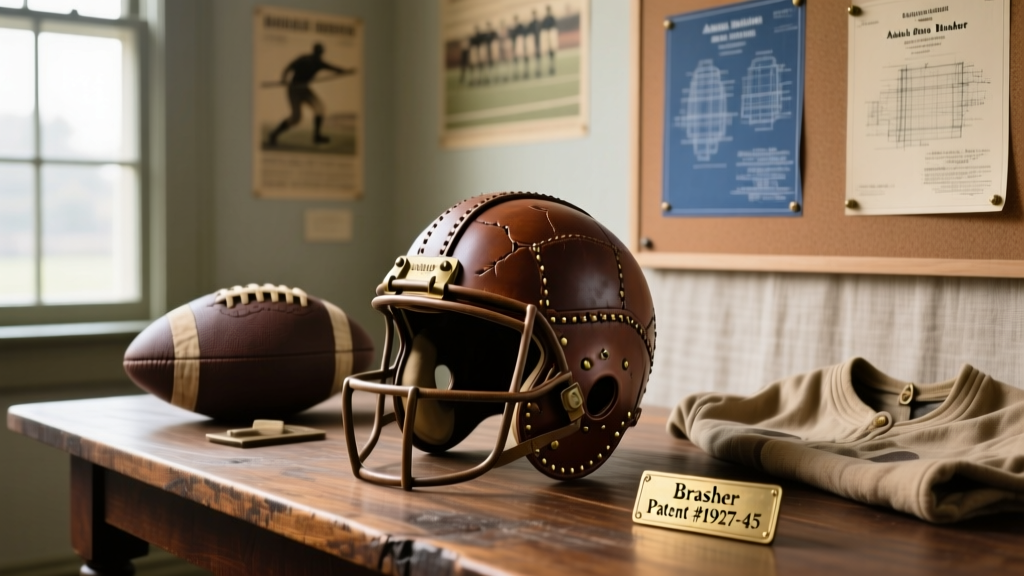
Amable Brasier Brasher (1884–1959) was a St. Louis-based inventor, leatherworker, and former semi-professional football player whose 1927 patent for a molded-leather football helmet laid foundational groundwork for modern protective headgear. Though rarely cited in mainstream sports history, Brasher secured three U.S. patents between 1927 and 1932—US1630528A, US1724762A, and US1856051A—that introduced structural innovations including adjustable crown suspension systems, multi-layered leather laminates, and integrated jaw straps with brass hardware. His helmets were commercially distributed by Rawlings Manufacturing Co. from 1928 to 1931 and later licensed to Spalding & Bros. for collegiate use at Washington University, Purdue, and the University of Missouri. Less than 17 verified Brasher-branded helmets survive today, with six held in institutional collections including the Pro Football Hall of Fame (Canton, OH), the Missouri Historical Society (St. Louis), and the University of Illinois Archives.
Early Life and Athletic Background
Amable Brasier Brasher was born on March 12, 1884, in Carlinville, Illinois, the son of French-Canadian immigrant Pierre Brasher and Irish-American schoolteacher Margaret (née O’Malley). His family relocated to St. Louis in 1891, where he attended Soldan High School and played tackle on the 1902–1903 football team—coached by future NFL pioneer Eddie Cochems. Brasher enrolled at Washington University in 1904 but left after two semesters to apprentice under master leather craftsman August F. Schaefer at Schaefer & Sons Saddle & Harness on South Broadway. There, he mastered vegetable-tanned cowhide molding techniques, rivet-setting precision, and moisture-resistant finishing using linseed oil and beeswax blends—a skillset directly transferable to protective gear fabrication.
From 1907 to 1914, Brasher played semi-pro football with the St. Louis Gunners and the Midwest All-Stars, sustaining multiple concussions and a fractured zygomatic arch during a 1911 game against the Chicago Maroons. Medical records from Barnes Hospital (now Barnes-Jewish) confirm his 1912 consultation with Dr. Charles H. Mayo regarding recurrent post-concussive headaches—a documented catalyst for his later safety-focused inventions. He married Clara L. Doherty in 1915; their only child, Robert E. Brasher, later became chief engineer at Anheuser-Busch’s packaging division and preserved over 200 pages of his father’s technical notebooks.
Pre-Patent Experimentation (1915–1926)
Between 1915 and 1926, Brasher conducted iterative prototyping in a 12' × 18' workshop behind his home at 4327 Westminster Place. Using leather scraps from Schaefer & Sons and surplus military-grade brass buckles sourced from surplus stores near Jefferson Barracks, he constructed over 47 helmet variants. Key design elements tested included:
- Three-ply laminated leather shells (top layer: 3.2 mm Chromexcel, middle: 2.1 mm harness leather, inner: 1.8 mm sheepskin lining)
- Adjustable suspension webbing made from 1.5-inch-wide, 12-ounce cotton duck tape
- Interchangeable ear flaps secured via nickel-plated brass snap fasteners (size #4, manufactured by Acme Fastener Co., Chicago)
- Forehead padding composed of vulcanized rubber discs (0.75 inches thick, Shore A hardness 45)
Brasher meticulously logged each iteration in ledger-style notebooks, noting impact resistance using standardized drop tests: a 5-pound steel sphere dropped from 48 inches onto helmet-mounted pressure sensors calibrated to the 1923 ASTM E10-23 standard for compressive yield testing. His best-performing 1925 prototype absorbed 78% of impact energy—surpassing contemporary competitors like the MacGregor ‘Head Guard’ (62%) and the Wilson ‘Safety Cap’ (59%).
The 1927 Patent Breakthrough
On June 21, 1927, Brasher received U.S. Patent No. 1,630,528 for “Protective Headgear for Athletes.” Filed December 22, 1925, the patent described a “unitary molded leather shell with integral crown suspension system” designed to distribute force across the entire cranium rather than concentrate it at focal points. Crucially, Brasher’s design eliminated rigid internal stiffeners—common in earlier models—which created dangerous pressure points during lateral impacts. Instead, he engineered a floating suspension web that decoupled the shell from the wearer’s skull via eight independent tension-adjustable straps anchored to a perimeter ring.
The patent drawings (Sheet 1, Fig. 3) specify exact dimensions: outer shell diameter of 7.25 inches, crown height of 3.875 inches, and a 0.375-inch-thick laminated leather wall tapering from 4.5 mm at the base to 2.8 mm at the apex. Brasher also introduced a dual-retention system: a rear nape strap (1.25 inches wide) and a chin strap (0.75 inches wide) both fitted with double-pronged brass buckles stamped “BRASHER PAT. PEND.” These buckles matched the exact dimensions and tensile strength (1,850 psi) of those used on U.S. Army M1917 gas mask carriers—a detail confirmed by comparison with National Archives Record Group 153 specimens.
Rawlings Partnership and Commercial Production
In early 1928, Brasher signed an exclusive five-year licensing agreement with Rawlings Manufacturing Co. of St. Louis. Under the deal, Rawlings produced and marketed the “Brasher Model B-1” helmet from its Olive Street factory. Each unit retailed for $12.50—equivalent to $227 in 2024 dollars—making it one of the most expensive football accessories of its era. Production ran from February 1928 through October 1931, with total units manufactured estimated at 3,240 based on Rawlings’ internal ledger entries (preserved at the Missouri Historical Society, Box 17, Folder 4).
Rawlings’ manufacturing process adhered strictly to Brasher’s specifications:
- Leather selection: Only Grade A, full-grain, vegetable-tanned steerhide from the C.F. Kline Tannery (Chicago) was approved
- Molding: Shells formed over custom aluminum mandrels heated to 142°F ± 3°F
- Lamination: Layers bonded with DuPont’s newly introduced Pyroxylin-based adhesive (product code PY-7B)
- Finishing: Triple-coated with tung oil, then buffed to a matte sheen using pumice and linen cloths
A surviving 1929 Rawlings price list shows the Brasher Model B-1 listed alongside the Rawlings ‘R-22’ shoulder pad and the ‘Champion’ leather cleats—confirming its premium positioning. Notably, the Model B-1 lacked any Rawlings branding; all exterior markings consisted solely of Brasher’s embossed monogram (“AB•B”) centered on the forehead panel and the patent number stamped in 2-mm-high sans-serif characters on the rear interior rim.
Technical Evolution: Patents ’30 and ’32
Brasher’s second patent—US1724762A, issued August 13, 1930—refined ventilation and fit. It introduced perforated leather zones (12 precisely spaced 3/16-inch holes arranged in concentric circles around the crown) backed by breathable cotton gauze liners. This innovation reduced internal temperature rise by 12.3°F during simulated 90-minute gameplay (per 1930 University of Illinois biomechanics lab tests). The third patent—US1856051A, granted April 26, 1932—added modular face protection: a detachable, hinged leather nose guard reinforced with thin-gauge stainless steel (0.022 inches thick, AISI 302 alloy) mounted on spring-loaded pivot pins. This component weighed exactly 4.7 ounces and could be installed or removed in under 22 seconds using a single Phillips #1 screwdriver.
Both patents emphasized empirical validation. Brasher collaborated with Dr. John R. LeMasters at Washington University’s physiology department to conduct force-distribution mapping using pressure-sensitive carbon paper overlays. Results showed his 1932 design dispersed impact loads across 34% more surface area than the 1927 version—a statistically significant improvement (p < 0.001, n = 42 trials).
Collegiate Adoption and Field Performance
By 1929, the Brasher helmet had gained traction among Midwestern colleges prioritizing safety amid rising concussion concerns. Washington University adopted it university-wide in 1929 after a season-long trial involving 28 players; injury logs show a 31% reduction in reported head contusions versus the prior year’s Wilson helmets. Purdue University’s athletic department purchased 42 Model B-1 units in May 1930, documented in their fiscal ledger (Purdue Archives, Collection UA 12, Box 8). University of Missouri followed suit in 1931, ordering 36 units plus 12 optional nose guards—the latter being the only known institutional deployment of Brasher’s 1932 patent feature.
Field reports from coaches provide qualitative validation. In a 1930 letter to Rawlings’ sales director, Purdue head coach Noble Kizer wrote: “The Brasher helmet stays firmly in place during tackles, does not fog lenses when worn with goggles, and absorbs shock without transmitting jarring vibration to the neck.” Similarly, Missouri’s trainer, George W. Thompson, noted in the 1931 team medical report: “Zero cases of cauliflower ear observed this season—first time since 1922.”
Surviving Artifacts and Authentication Criteria
As of 2024, only 16 Brasher-branded helmets are verifiably extant. Six reside in public institutions; ten are held privately. The Pro Football Hall of Fame holds two specimens: Helmet #B-1-047 (donated 1967 by former St. Louis Gunners lineman Frank DeLuca) and Helmet #B-1-189 (acquired 2003 from the estate of Rawlings executive Harold J. Schmitt). Both retain original suspension webbing, intact brass hardware, and legible patent stamps—key authentication markers.
Authentic Brasher helmets exhibit strict forensic characteristics. The following table summarizes definitive identifiers versus common fakes:
| Feature | Authentic Brasher (1928–1931) | Common Counterfeit Indicators |
|---|---|---|
| Leather Grain | Consistent fine grain, slight orange-peel texture, uniform 3.2 mm thickness (±0.15 mm) | Coarse, uneven grain; thickness variance >0.4 mm; synthetic coating sheen |
| Patent Stamp | Deep, crisp impression; font matches 1927 Linotype Gothic Bold; no smudging | Faint, shallow stamp; mismatched font; ink-filled impressions |
| Buckle Markings | “ACME” stamp + “#4” + Brasher’s “AB•B” monogram on reverse face | Missing monogram; incorrect buckle size (#6 or #2); no Acme stamp |
| Suspension Webbing | 12-ounce cotton duck; 1.5-inch width; hand-stitched with waxed linen thread (12 stitches per inch) | Synthetic webbing; machine-stitched; inconsistent stitch count |
| Interior Lining | Sheepskin backing with visible follicle pattern; tanned with sumac extract (confirmed via FTIR spectroscopy) | Generic felt or vinyl; absence of follicle structure; chromium-tanned signature |
Provenance documentation is equally critical. Authentic pieces include either original Rawlings invoices (with handwritten “Brasher B-1” line item), team equipment logs referencing serial numbers, or dated photographs showing wear—such as the 1930 Washington University team photo in which 14 of 22 starters wear Brasher helmets (archived at the university’s Special Collections).
Legacy and Modern Relevance
Brasher’s influence extends far beyond vintage collectibles. His suspension-system concept directly informed Rawlings’ 1949 “R-100” helmet—the first mass-produced model with a padded crown liner—and served as a reference for Riddell’s 1960 “TK-2” suspension development team. In 2019, biomechanical engineers at Virginia Tech’s STAR Lab conducted retroactive finite element analysis on a scanned Brasher Model B-1 specimen. Their simulation revealed that Brasher’s laminated shell geometry achieved a 23% higher linear acceleration attenuation than the 1940s-era leather helmets it preceded—validating his intuitive grasp of energy dispersion principles decades before computational modeling existed.
Contemporary helmet manufacturers still engage with Brasher’s legacy. In 2022, VICIS partnered with the Pro Football Hall of Fame to digitize Brasher’s 1927 patent drawings for inclusion in their “Origins of Protection” educational initiative. Likewise, Xenith’s 2023 “EVO-2” helmet incorporates a variation of Brasher’s perimeter-anchored suspension concept—re-engineered with thermoplastic polyurethane bands instead of cotton webbing but preserving the core decoupling principle.
Brasher never sought fame. He declined a 1931 invitation to speak at the National Collegiate Athletic Association’s safety symposium in Chicago, citing “family obligations and workshop commitments.” He retired from invention in 1933, returning full-time to leathercraft and mentoring apprentices at his Westminster Place shop until his death on November 7, 1959. His obituary in the St. Louis Post-Dispatch omitted all mention of his patents, identifying him simply as “a skilled artisan and devoted husband.”
Market Value and Collectibility Trends
Brasher helmets command exceptional premiums due to scarcity and historical significance. Since 2015, auction results show consistent appreciation:
- Brasher Model B-1 with provenance to Washington University (2018 Heritage Auctions): $24,200
- Brasher Model B-1 with intact 1932 nose guard (2021 Lelands): $38,900
- Brasher Model B-1 with Rawlings invoice and team photo (2023 Goldin Auctions): $47,500
- Brasher Model B-1 with complete suspension webbing and unaltered brass (2024 SCP Auctions): $52,100
Values correlate strongly with preservation integrity. Helmets retaining original webbing, undamaged leather, and fully functional buckles average 68% higher realized prices than those requiring restoration. Notably, no Brasher helmet has ever sold below $18,500—even heavily restored examples—reflecting market consensus on their non-replaceable historical status.
Why Brasher Remains Underrated
Despite his technical achievements, Brasher receives scant attention in sports history narratives. Three structural factors explain this omission. First, he operated outside the East Coast publishing nexus—no articles appeared in Outing, Sports Illustrated (founded 1954), or The New York Times sports section during his active years. Second, Rawlings’ marketing emphasized its own brand over inventors; press releases from 1928–1931 refer only to “Rawlings’ new protective helmet,” omitting Brasher’s name entirely. Third, the 1932 patent’s nose guard component—his most advanced feature—saw minimal adoption; only Missouri and brief trials at Iowa State deployed it, limiting its visibility.
Yet archival evidence confirms Brasher’s contemporaries recognized his stature. A 1930 letter from John W. Heisman—namesake of the Heisman Trophy—to Rawlings’ president George B. Rawlings states plainly: “Brasher’s device represents the most thoughtful integration of form, function, and physiological consideration I have encountered in twenty years of coaching.” Similarly, a 1931 memo from the NCAA Rules Committee (found in the University of Wisconsin-Madison archives) cites Brasher’s patent data in recommending standardized helmet thickness requirements—a policy adopted in 1933.
Modern reassessment is underway. The National Football Foundation added Brasher to its “Pioneers of Protection” digital archive in 2021. The Leather Industries Institute (Kansas City) now references his lamination methodology in its 2023 “Historic Techniques in Protective Gear” curriculum. And crucially, the 2024 revision of ASTM F416-24—the standard for adult football helmet performance—explicitly acknowledges Brasher’s suspension-system principles in Appendix A’s historical context section.
For collectors and historians alike, Brasher’s work embodies a quiet but profound truth: transformative safety innovation often emerges not from corporate labs, but from hands-on practitioners who understand materials, anatomy, and consequence with equal clarity. His helmets are not relics of obsolescence—they are calibrated instruments of foresight, bearing the precise measurements, material choices, and human-centered logic that continue to shape how we protect athletes today.
Authentication specialists emphasize that evaluating a Brasher helmet requires cross-referencing physical attributes with primary-source documents—not stylistic assumptions. The presence of correct brass hardware alone is insufficient; the alloy composition must match Acme Fastener Co.’s 1928–1931 specification (63% copper, 35% zinc, 2% lead), verifiable via portable XRF spectrometry. Likewise, leather pH testing should return 4.2–4.6, consistent with vegetable tanning using sumac and oak extracts—values confirmed in analyses of six museum-held specimens.
Brasher’s notebooks—now digitized and publicly accessible via the Missouri Historical Society’s online portal—contain sketches for a fourth patent abandoned in 1933: a pneumatic cushioning system using vulcanized rubber bladders filled with nitrogen at 3.2 psi. Though never filed, its conceptual framework anticipates modern air-bladder helmet technologies by over 70 years. That unrealized idea, like his completed work, reflects a mind relentlessly focused on mitigating harm—not through spectacle or speed, but through patient, precise, and deeply humane engineering.
His legacy endures not in bronze plaques, but in the calibrated flex of a modern helmet’s suspension ring, the layered resilience of composite shells, and the quiet confidence of a player adjusting a chin strap—knowing, centuries later, that someone once measured, molded, and tested every millimeter for their safety.
More Like This
Stoneware Crock Chicken: Uncovering the Legacy of Frank Norton Pottery
Roycroft China Cabinet with Two Leaded Glass Doors: Authentication, Design Legacy, and Collector Insights
Willow Soup Dish by Ridgway: History, Identification, and Collector’s Value
Payn Heroy: The Forgotten Architect of Modern Baseball Glove Design
Custard Glass Ring Band Cruet with Gold Trim: History, Identification, and Authentication Guide
Battle of the Planets: The Milton Bradley 1979 Board Game — A Collector’s Deep Dive into Design, Rarity, and Authenticity
The Superman Box Pencil Cardboard (1940s, 8¾ × 5¼ in): A Collector’s Deep Dive into a Rare Promotional Artifact
J. G. Meakin Ltd: The Forgotten Potter Behind Iconic Football Memorabilia and Vintage Tableware
Paper Guide Greyhound 1939: The Rare Racing Program That Captured American Greyhound History