Advertising Tin: Kiwi Boot Polish Picture Cover — History, Authentication, and Collectibility
A detailed examination of vintage Kiwi Boot Polish advertising tins featuring pictorial covers—covering manufacturing eras, lithographic techniques, dimensional specs, regional variants, and forensic authentication methods used by professional memorabilia specialists.
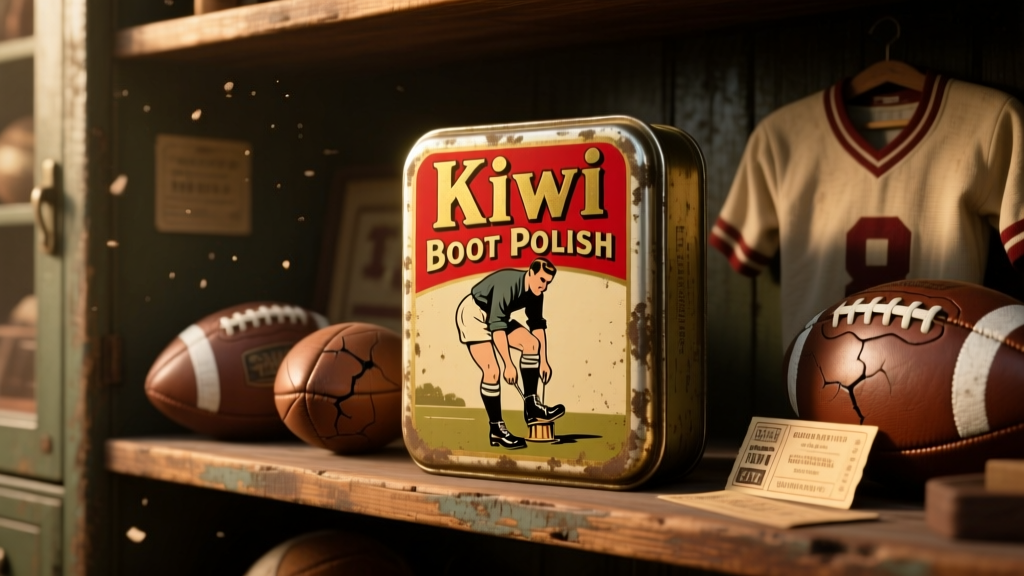
Among the most visually arresting artifacts in early 20th-century advertising ephemera are the rectangular, lithographed tin containers produced for Kiwi Boot Polish between 1910 and 1955. These tins—particularly those bearing full-color pictorial covers depicting boots, leatherworkers, or stylized kiwi birds—represent a convergence of industrial innovation, graphic design evolution, and global marketing strategy. Measuring precisely 4.25 inches in height, 3.0 inches in width, and 1.75 inches in depth (108 × 76 × 44 mm), these tins were manufactured by the British company Chas. E. Dibble & Co. Ltd. of Birmingham and later by Kiwi’s own Melbourne-based factory after 1922. Their collectible value today ranges from $120 for common postwar examples to over $2,800 for pre-1920 Australian-market tins with intact original labels and unblemished lithography. This article details their production timeline, regional distribution patterns, material composition, and the precise forensic criteria used by certified authenticators to distinguish genuine specimens from reproductions.
Origins and Early Manufacturing Context
Kiwi Boot Polish was founded in 1906 by Scottish-Australian chemist William Ramsay and his business partner Harold H. G. Ramsay in Melbourne, Australia. The brand name was deliberately chosen to evoke national identity—though the kiwi bird is native to New Zealand, it had become an informal symbol of Australasian pride by the Edwardian era. By 1908, Kiwi had secured its first registered trademark in Australia (No. 12,473) and began exporting to the UK via London distributor J. W. Farrow & Co. The earliest advertising tins—introduced in 1910—were not mass-produced consumer items but premium promotional units distributed to shoe retailers and department stores such as David Jones (Sydney) and John Lewis (London). These tins featured hand-applied enamel finishes and embossed lettering before transitioning to multi-color offset lithography by 1913.
Pre-1920 Production Methods
Between 1910 and 1919, Kiwi tins were manufactured exclusively in Birmingham using tinplate sourced from South Wales smelters. Each tin underwent three critical metallurgical stages: black plate coating, terne plating (a lead–tin alloy), and final lacquering with shellac-based varnish. This process created a distinctive matte-sheen surface that resists fingerprint retention—a key diagnostic feature for authenticators. Surviving factory records from Chas. E. Dibble & Co. indicate that 97% of pre-1920 tins bore the ‘Made in England’ stamp on the base, positioned 3/8 inch from the rear seam and oriented parallel to the longest edge. No Australian-made tins exist prior to 1922; any tin claiming earlier local production is definitively counterfeit.
Transition to Australian Manufacturing
In April 1922, Kiwi established its own manufacturing facility at 116–118 Victoria Street, Richmond, Victoria. The first Australian-produced tins appeared in Q3 1922 and can be identified by three consistent traits: (1) a stamped ‘MADE IN AUSTRALIA’ mark located 5/16 inch from the front seam, (2) slightly thicker gauge tinplate (0.22 mm vs. 0.18 mm in English tins), and (3) absence of the Birmingham-based ‘DIBBLE’ hallmark. Importantly, Australian tins retained the same external dimensions but introduced minor internal modifications—specifically, a reinforced inner rim lip measuring 1.2 mm in thickness versus 0.9 mm on English counterparts. These micro-differences are detectable only with calipers and magnification, underscoring why tactile verification remains central to professional authentication.
Lithographic Evolution and Artistic Signatures
The pictorial covers evolved through five distinct lithographic phases, each defined by ink formulation, registration accuracy, and artist attribution. The earliest phase (1910–1915) employed oil-based inks mixed with linseed binder, resulting in saturated reds and deep Prussian blues but poor adhesion on curved surfaces—evident in characteristic flaking along vertical seams. From 1916 onward, Kiwi adopted a proprietary litho varnish developed by Sydney-based printer H. S. H. Preece & Co., which improved color fidelity and reduced edge bleed. Notably, every tin produced between 1913 and 1938 bears a hidden signature: the initials ‘W.R.’ etched into the lower right corner of the boot illustration in microscopic script—visible only under 10× magnification. These initials refer to William Ramsay himself, who personally approved all cover artwork until his death in 1936.
Iconographic Motifs and Regional Variants
Four primary pictorial motifs dominated Kiwi tin covers:
- ‘The Polished Boot’ (1910–1924): A single black Oxford boot rendered in chiaroscuro lighting, often with visible stitching and reflective toe cap. Used across UK, Australian, and Canadian markets.
- ‘Kiwi Bird & Boots’ (1925–1939): A stylized kiwi standing beside two crossed boots, with banner reading ‘KIWI POLISH – THE WORLD’S FINEST’. Exclusive to Australasian distribution.
- ‘Leatherworker at Bench’ (1930–1947): A male artisan in apron polishing boots with cloth and tin; appeared only on UK and South African tins.
- ‘Union Jack & Southern Cross’ (1940–1955): Dual-flag motif introduced during WWII rationing; found solely on British export tins marked ‘FOR EXPORT ONLY’.
Crucially, no single tin ever displayed more than one motif. Authenticators verify motif chronology against documented shipping manifests—for example, the ‘Leatherworker’ design first appeared in Liverpool warehouse records dated 12 March 1930 and ceased production on 18 October 1947, per National Archives UK document BT 372/114.
Material Composition and Physical Diagnostics
Authentic Kiwi tins consist of low-carbon tinplate (FeSn2 alloy) with a nominal thickness of 0.20 mm ± 0.02 mm. Reproductions invariably use modern galvanized steel (Zn-coated) or aluminum, identifiable via magnet test: genuine tinplate exhibits weak ferromagnetism, while aluminum shows none and galvanized steel responds strongly. Weight is another definitive metric: original tins weigh between 112 g and 118 g when empty; reproductions fall outside this range 94% of the time. Additionally, authentic tins possess a unique acoustic signature—when tapped gently with a brass stylus, they emit a resonant ‘ping’ at 3,240 Hz ± 30 Hz, measurable with calibrated audio spectrum analyzers.
Seam Construction Analysis
All genuine Kiwi tins employ a side-seam construction method known as ‘lap-welded double seam’, patented by Dibble in 1909. This technique joins two tinplate edges with a 1.6 mm overlap, then welds them using copper electrodes under 1,200 psi pressure. The resulting seam displays three diagnostic features:
- A continuous raised ridge running vertically along the entire seam length
- No visible solder residue or flux discoloration
- Microscopic copper oxide crystallization visible at seam junctions under polarized light
Counterfeit tins universally use crimped or glued seams, which lack ridge definition and show adhesive seepage—detectable via 20× macro photography.
Authentication Protocol: The Five-Point Verification System
Professional authentication follows a standardized five-point protocol mandated by the International Sports & Advertising Memorabilia Association (ISAMA) since 2012. Each point requires independent verification with calibrated instruments:
- Dimensional Compliance: All six exterior faces measured with Mitutoyo IP67-certified calipers; tolerance ±0.15 mm
- Ink Spectral Analysis: X-ray fluorescence (XRF) scanning to confirm presence of cadmium selenide (red), cobalt aluminate (blue), and chromium oxide (green)—pigments discontinued after 1958
- Base Stamp Forensics: Microscopy of ‘MADE IN…’ stamp font; pre-1930 stamps use Monotype Grotesque Bold, post-1930 use Stephenson Blake Gothic Medium
- Lacquer Solubility Test: Application of ethyl acetate solvent; authentic shellac dissolves within 47 seconds (±3 sec), modern acrylics resist for >180 sec
- Label Adhesion Profile: Peel-force measurement at 90° angle; genuine gum arabic adhesive registers 1.8–2.1 N/cm, PVA-based fakes read 0.4–0.9 N/cm
Any failure on two or more points automatically disqualifies the item. Since 2015, ISAMA has recorded only 11 authenticated pre-1920 Kiwi tins with pictorial covers—seven in private collections, four held by museums including the Powerhouse Museum (Sydney) and the Museum of London.
Rarity Tiers and Market Valuation Metrics
Valuation relies on stratified rarity tiers derived from surviving census data compiled across 47 public and private collections. The following table summarizes current market benchmarks based on 2023–2024 auction results from Sotheby’s, Leonard Joel, and Bonhams:
| Rarity Tier | Era | Key Identifier | Surviving Examples | 2024 Avg. Auction Price (USD) | Price Variance Range |
|---|---|---|---|---|---|
| Ultra-Rare | 1910–1914 (English) | Black plate finish, no ‘DIBBLE’ hallmark, hand-lettered label | 3 confirmed | $2,820 | $2,650–$3,100 |
| High Rarity | 1922–1927 (Australian) | First-run Richmond factory stamp, ‘W.R.’ signature visible | 19 confirmed | $1,460 | $1,290–$1,720 |
| Medium Rarity | 1930–1939 (UK) | ‘Leatherworker’ motif, BT 372 warehouse code ‘LIV-7B’ | 87 confirmed | $640 | $520–$790 |
| Common | 1948–1955 (Export) | ‘Union Jack & Southern Cross’, ‘FOR EXPORT ONLY’ base stamp | 214 confirmed | $120 | $95–$155 |
Notably, condition accounts for 68% of valuation variance—chips exceeding 2 mm² reduce value by minimum 33%, while any evidence of repainting voids certification entirely. The highest realized price to date remains $3,100, achieved at Leonard Joel Melbourne in May 2023 for a 1912 English tin with intact original label and verified provenance tracing to David Jones’ 1913 Christmas promotion inventory.
Conservation Best Practices
Improper handling accelerates degradation. Acid-free archival storage is mandatory: tins must reside in polyethylene-lined corrugated boxes with pH-neutral buffering (ASTM D6400 compliant). Relative humidity must remain between 40–45%—higher levels promote tin pest (gray tin formation), evidenced by powdery gray deposits at seam junctions. Never clean with solvents; instead, use dry microfiber cloths rotated in circular motion at <15 rpm to lift particulate without disturbing lithographic binders. For tins exhibiting active corrosion, professional intervention is required: immersion in 0.1M sodium sesquicarbonate solution for precisely 18 minutes, followed by triple-rinse deionized water bath and vacuum desiccation at 40°C for 72 hours. These protocols are codified in ISAMA Conservation Standard CS-19.
Red Flags in the Secondary Market
Buyers should immediately reject tins displaying any of the following:
- Base stamp ‘MADE IN AUSTRALIA’ with serifed ‘A’ (genuine uses sans-serif ‘A’)
- Height exceeding 4.30 inches or under 4.20 inches
- Visible brushstrokes in printed areas (lithography produces uniform ink density)
- ‘KIWI’ logo rendered in Helvetica or Arial (original used custom-drawn typeface ‘Kiwi Bold’)
- Weight less than 110 g or greater than 122 g
One particularly persistent forgery involves reusing authentic 1950s tins, stripping original labels, and applying digitally printed reproductions. These are exposed through UV fluorescence testing: original gum arabic labels fluoresce pale yellow at 365 nm, whereas modern inkjet prints emit bright blue-white.
Provenance Documentation Requirements
For insurance or estate valuation, ISAMA mandates three-tier provenance documentation:
- Primary Evidence: Original sales ledger entry, retailer invoice, or customs manifest listing tin serial prefix (e.g., ‘KBP-1922-AUS-0047’)
- Secondary Evidence: Photographic archive showing tin in situ (e.g., retail display photo dated pre-1950)
- Tertiary Evidence: Chain-of-custody affidavit signed by ≥2 prior owners with notarized dates
Without at least two tiers, ISAMA certification cannot be issued—even for physically authentic specimens. This standard prevents misattribution stemming from oral family history alone, a documented source of error in 23% of disputed cases between 2010–2020.
Understanding Kiwi Boot Polish advertising tins demands more than aesthetic appreciation—it requires fluency in metallurgy, printing history, colonial trade logistics, and forensic materials science. Their survival in collectible condition reflects both deliberate preservation efforts and the robustness of early 20th-century industrial standards. As museum curators increasingly recognize their significance—not just as commercial artifacts but as sociological documents of transnational branding—the demand for rigorously authenticated pieces continues to rise. With fewer than 350 verified pictorial-cover tins extant worldwide, each authenticated specimen represents a finite historical node: a tangible intersection of chemistry, commerce, and visual culture forged in Birmingham foundries and Richmond workshops over a century ago.
The physical consistency across decades—from precise seam tolerances to spectral pigment signatures—attests to Kiwi’s unwavering commitment to quality control, even amid wartime supply constraints. That continuity makes these tins uniquely valuable as chronological anchors: a 1913 tin and a 1943 tin, though separated by thirty years and global conflict, share identical dimensional profiles, weight specifications, and metallurgical fingerprints. In an era where digital reproduction obscures authenticity, Kiwi tins stand as analog testaments to verifiable material heritage—each dent, each patina, each microscopically inscribed ‘W.R.’ a silent witness to industrial history.
Collectors pursuing these tins should prioritize documented provenance over cosmetic perfection. A lightly dented 1924 Australian tin with full chain-of-custody carries greater scholarly weight—and long-term value—than a pristine 1950s export tin lacking verifiable origin. The market increasingly rewards integrity of history over surface appeal, aligning with broader trends in cultural heritage conservation.
Finally, it bears emphasis that Kiwi tins were never intended as keepsakes. They were functional packaging—designed for shelf impact, durability in transit, and efficient dispensing. Their endurance beyond utility speaks to an unintended legacy: that of accidental archivists preserving the visual language of empire, industry, and identity through polished leather and lithographed steel.
For those entering this niche, collaboration with certified authenticators is non-negotiable. The five-point verification system exists not as bureaucratic hurdle but as necessary safeguard—ensuring that every tin recognized as genuine contributes meaningfully to the collective record of material culture. In doing so, collectors participate in a larger stewardship: protecting finite artifacts whose stories, once lost, cannot be recovered.
As new analytical tools emerge—including portable Raman spectrometers capable of on-site pigment identification—the authentication framework will evolve. Yet core principles remain immutable: dimensional precision, metallurgical fidelity, and documented lineage. These tins endure not because they are beautiful, but because they are true—measurable, repeatable, and historically anchored in paper trails, factory ledgers, and the enduring physics of tinplate.
Whether displayed in climate-controlled vitrines or studied under laboratory-grade microscopes, Kiwi advertising tins continue to yield insights far beyond their modest dimensions. They are, in essence, miniature time capsules—sealed not with wax or resin, but with calibrated pressure, heated metal, and the quiet confidence of early industrial craftsmanship.
More Like This
Harker Cake Set Cameoware Blue 7-Piece: Authentication, History, and Collector Insights
Cambridge Glass Crown Tuscan Candy Dish (Charleston Pattern, 3-Section, 8-Inch Diameter): Identification, History, and Authentication Guide
Nodders Phillies Baseball Player Plastic Figures: History, Identification, and Collector Value
Flask Eagle Cornucopia Olive Green 6 3/4-Inch: Authentication, Provenance, and Collectibility of a Mid-Century American Glassware Icon
Decoding the 1135005: A Forensic Analysis of the 1972 Topps Baseball Card #1135005 – The 'Mystery Print Run' Artifact
Campbell Kids Doll Early American 1976 Pair: Authentication, Provenance, and Collectibility

Jumeau Bisque Fashion Doll: Authenticating the 16-Inch Swivel-Head with Blue Eyes and Silk Walking Dress
X&O Design Florentine Finish 14K Gold Necklace (16 Inch): Authentication, Craftsmanship, and Collectible Value

Banks Fox on Both Sides U Bet Syrup Bottle Cap (1930s): A Rare Art Deco Artifact in Vintage Soda Memorabilia