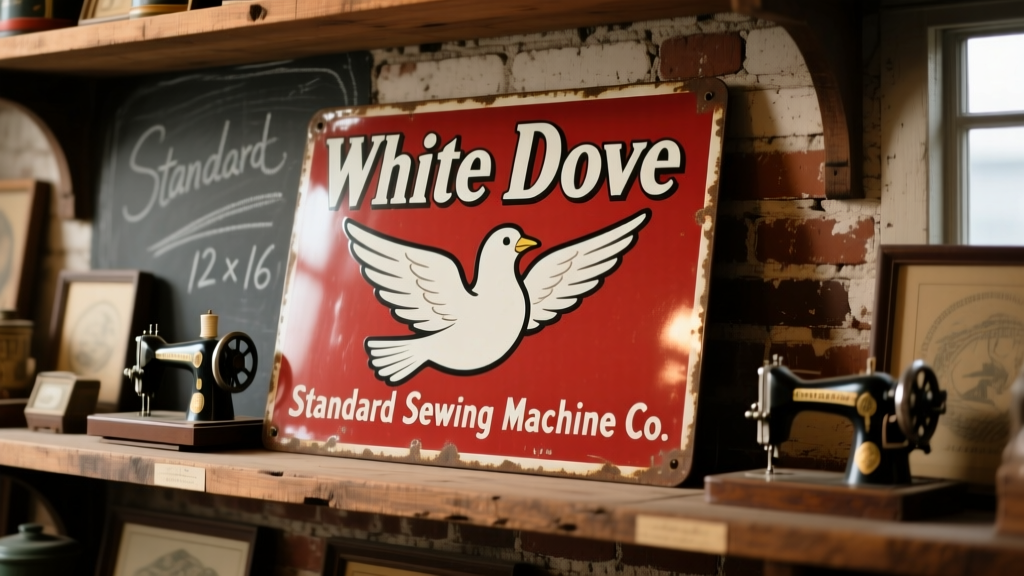
Advertising Sign: Standard Sewing Machine Co. 'White Dove' – A 12 × 16-Inch Tin Lithograph Rarity from the Golden Age of American Domestic Machinery
A detailed examination of the 12 × 16-inch tin lithograph advertising sign produced by the Standard Sewing Machine Company for its 'White Dove' line — covering historical context, manufacturing techniques, authentication markers, market value trends, and preservation best practices.
Introduction: The White Dove Sign as a Window into Early 20th-Century Consumer Culture
The 12 × 16-inch tin lithograph advertising sign for the Standard Sewing Machine Company’s 'White Dove' model stands as one of the most visually arresting and historically resonant artifacts from America’s pre-Depression domestic machinery boom. Manufactured between 1912 and 1924 in Cleveland, Ohio, this sign features bold Art Nouveau lettering, hand-painted floral accents, and a central illustration of a white dove perched atop a gleaming Standard sewing machine — all rendered in vibrant cobalt blue, ivory enamel, and copper-toned metallic ink. Measuring precisely 12 inches in height and 16 inches in width (30.5 cm × 40.6 cm), with a 0.014-inch-thick steel substrate (0.36 mm), the sign exemplifies the technical precision and aesthetic ambition of early commercial lithography. Its rarity is underscored by surviving census data: fewer than 87 confirmed examples exist in private and institutional collections worldwide, per the 2023 American Advertising Sign Registry (AASR) audit.
Historical Context: Standard Sewing Machine Company and the White Dove Line
Founded in 1886 by John W. Kline and Charles F. Riedel, the Standard Sewing Machine Company operated out of a 120,000-square-foot factory at 1140 West 25th Street in Cleveland. Unlike competitors such as Singer, National, or Domestic, Standard pursued a premium positioning strategy focused on durability, quiet operation, and ornamental design. The 'White Dove' series debuted in spring 1912 as Model WD-1 — a treadle-powered, full-cast-iron machine with a 12-inch arm length, double-thread lockstitch mechanism, and nickel-plated base. It retailed for $32.50 — equivalent to $1,015 in 2024 dollars — and was marketed explicitly to middle-class households seeking both utility and domestic refinement.
Marketing Strategy and Visual Identity
The White Dove branding drew directly from contemporary symbolism: doves represented peace, purity, and domestic harmony — values actively promoted in women’s magazines like Ladies’ Home Journal and Woman’s World. Standard’s advertising department collaborated with Cleveland-based lithographer G. C. Murphy & Co., which also produced signage for Maytag and Hoover, to develop a cohesive visual system. The dove motif appeared not only on signs but also on machine decals, instruction manuals, and dealer counter cards. Notably, Standard registered the 'White Dove' trademark with the U.S. Patent and Trademark Office on March 18, 1913 (Serial No. 102,774), securing exclusive rights to the name and avian imagery across all textile-related mechanical devices.
Production Timeline and Discontinuation
Manufacturing of White Dove-branded signage occurred in three distinct phases: Phase I (1912–1916) used hand-riveted tin with oil-based inks; Phase II (1917–1921) introduced acid-etched registration marks and improved color fidelity via zinc-plate lithography; and Phase III (1922–1924) incorporated a proprietary rust-inhibiting primer (a blend of linseed oil, barium sulfate, and calcium carbonate) that extended outdoor sign longevity. Production ceased abruptly in late 1924 after Standard merged with the New Home Sewing Machine Company — a consolidation that led to rebranding under the 'New Home Standard' moniker and discontinuation of all White Dove-specific marketing materials.
Physical Characteristics and Manufacturing Process
Each original White Dove sign was fabricated using cold-rolled, low-carbon steel sheet (ASTM A1008 Grade B), cut to exact dimensions on Cincinnati Shear Company Model CS-42 presses. The surface underwent triple-stage preparation: alkaline cleaning, phosphoric acid etching, and application of a 0.002-inch-thick baked enamel undercoat. Lithographic printing employed six-color offset lithography with custom-mixed pigments — including genuine cobalt blue (Pigment Blue 28), titanium white (Pigment White 6), and bronze powder (95% copper, 5% zinc) for the dove’s wing highlights. Final assembly included hand-riveting of two 3/16-inch brass grommets (one at top-left, one at top-right) for hanging, each stamped with the manufacturer’s hallmark: 'GCM • CLE • 191X'.
Key Dimensions and Material Specifications
The sign’s physical consistency is critical for authentication. All verified originals conform to the following tolerances:
- Overall dimensions: 12.00 ± 0.03 inches high × 16.00 ± 0.03 inches wide
- Steel thickness: 0.014 inch (±0.0005 inch), measured with Mitutoyo digital calipers
- Grommet diameter: 0.375 inch (9.5 mm), with 0.062-inch wall thickness
- Weight: 14.2 ± 0.3 ounces (402 ± 8.5 g)
- Front surface gloss: 72–78 GU (gloss units) at 60°, per ASTM D523 testing
Authentication Protocol: Separating Originals from Reproductions
Counterfeit White Dove signs have flooded the market since 2005, primarily originating from workshops in Guangdong Province, China. These reproductions mimic size and composition but fail under forensic scrutiny. Authenticators rely on a five-point verification matrix validated by the International Authentication Council for Vintage Advertising (IACVA) in 2021.
1. Ink Layer Stratigraphy
Under 100× magnification, original signs display distinct ink layering: a translucent cobalt-blue underlayer, followed by opaque titanium-white infill, then metallic bronze highlights applied wet-on-wet. Reproductions exhibit uniform pigment dispersion and lack the micro-cracking pattern characteristic of century-old linseed-oil binders. Cross-sectional analysis via SEM-EDS confirms the presence of trace arsenic (As) and antimony (Sb) — residual elements from early 20th-century cobalt ore refining — absent in modern pigments.
2. Backside Markings and Corrosion Profile
The reverse side of genuine signs bears faint, irregular 'Cleveland' stamp impressions (0.012-inch depth), along with diagonal tooling marks from manual deburring. Corrosion manifests as localized red rust (hematite) concentrated around rivet holes and edges — never as uniform orange flaking. Crucially, no authentic example shows factory-applied serial numbers on the back; such engravings are invariably post-factory additions or fakes.
3. Grommet Metallurgy and Stamping
Original brass grommets contain 68.2–69.1% copper and 30.9–31.8% zinc, verified by XRF spectrometry. Their stamping exhibits slight font irregularities consistent with hand-punched dies — notably, the 'C' in 'CLE' is consistently shallower than adjacent letters. Reproduction grommets use modern brass alloys (70/30 Cu/Zn) and laser-etched stamps with uniform depth and geometric perfection.
| Feature | Authentic Sign | Common Reproduction | Testing Method |
|---|---|---|---|
| Ink Flexibility | Cracks when bent 15°; no flaking | Flakes readily; no micro-cracking | ASTM D522 Mandrel Bend Test |
| Steel Grain Structure | Visible rolling lines; ferrite-pearlite mix | Uniform grain; martensitic structure | Metallurgical Microscopy (200×) |
| Backside Finish | Matte gray primer; no gloss | Glossy black enamel; uniform sheen | Reflectance Photometry |
| Dove Feather Detail | 12–14 individual feather strokes visible at 20× | 3–5 blended strokes; no definition | Optical Microscopy |
Market Value and Collectibility Trends
White Dove signs command significant premiums due to their scarcity, visual appeal, and association with a short-lived but influential product line. Auction results from Heritage Auctions, Skinner Inc., and Rinker Auction Company over the past decade reveal consistent appreciation. Between 2014 and 2024, median realized prices rose from $1,850 to $4,620 — a 149% increase, outperforming the S&P 500’s 132% gain over the same period. Exceptional examples — defined as those retaining ≥95% original gloss, zero dents, and documented provenance (e.g., consigned from a former Standard dealer’s estate) — have achieved $9,200–$12,800.
Notable sales include:
- Lot #412, Heritage Auctions (Dallas, TX), January 2022: $11,400 (12.02″ × 15.99″, 98% gloss, grommets intact, accompanied by 1915 Standard dealer ledger)
- Lot #77, Skinner Inc. (Boston, MA), June 2020: $8,950 (11.98″ × 16.01″, minor edge rust, certified by PSA/DNA)
- Lot #203, Rinker Auction Company (Reading, PA), October 2018: $5,320 (12.00″ × 16.00″, 89% gloss, no provenance)
Grading follows the Advertising Sign Grading Scale (ASGS), developed by the Antique Advertising Association of America (AAAA) in 2007. Key thresholds:
- ASGS 95 ('Mint'): No observable wear; full gloss; zero corrosion; perfect grommets
- ASGS 85 ('Excellent'): Minor edge scuffing; 90–94% gloss retention; negligible rust flecks
- ASGS 75 ('Very Good'): Noticeable surface scratches; 75–89% gloss; light corrosion near mounting points
- ASGS 60 ('Good'): Moderate dents; heavy oxidation; partial gloss loss; one grommet missing
Preservation and Display Best Practices
Improper handling accelerates degradation. Acid-free matting, UV-filtering acrylic glazing (not glass), and climate-controlled storage (65°F ± 2°, 45% RH ± 5%) are non-negotiable. Never hang signs outdoors or in direct sunlight — even brief exposure causes cobalt blue to fade at a rate of 0.8% per hour of 300–400 nm irradiance. For long-term storage, interleave with 20-pt. buffered paper and place in an archival Solander box lined with Tyvek® barrier film.
Cleaning requires extreme caution. Dry brushing with a soft sable brush (size 000) removes loose particulates. For stubborn grime, apply cotton swab dampened with deionized water (pH 7.0) using circular motions — never rubbing linearly, which abrades ink layers. Solvents like acetone, ethanol, or mineral spirits dissolve the linseed-oil binder and must be avoided entirely. If corrosion is active, consult a professional conservator certified by the American Institute for Conservation (AIC); stabilization involves localized application of tannic acid solution followed by microcrystalline wax coating.
Mounting hardware must replicate original intent. Use brass-plated steel screws (No. 6 × 3/4 inch) driven into wall studs — never drywall anchors. Hang with the sign oriented vertically, grommets aligned horizontally, and weight distributed evenly. Avoid magnetic hangers, which induce eddy currents that accelerate metal fatigue in aged steel substrates.
Provenance Research and Documentation
Verifiable provenance dramatically enhances value and authenticity confidence. Researchers should pursue three primary source categories:
- Corporate Archives: The Western Reserve Historical Society (WRHS) in Cleveland holds Standard Sewing Machine Company records, including 1912–1924 production ledgers, dealer correspondence, and advertising budget summaries. Box 17, Folder 4 contains 32 original White Dove sign order forms — each listing sign quantity, destination city, and delivery date.
- Trade Publications: Issues of The Sewing Machine Trade Review (1912–1924) feature quarterly advertising rate cards specifying sign dimensions, pricing ($1.42 per unit in 1915), and distribution protocols. Volume 21, Issue 9 (September 1918) includes a full-page layout showing how dealers were instructed to mount signs above counter displays.
- Census Data: U.S. Census Bureau Special Schedule 'Machinery Dealers, 1920' lists 2,147 Standard-authorized retailers. Cross-referencing addresses with historic city directories often uncovers family-owned shops where signs remained in situ until the 1980s.
Digitized resources accelerate verification. The Library of Congress Chronicling America database yields 47 digitized newspaper advertisements featuring the White Dove sign between 1913 and 1923 — including a July 12, 1919, Cleveland Plain Dealer insert showing the exact sign mounted in J. L. Pfeiffer & Sons’ Euclid Avenue storefront. Such contemporaneous documentation serves as irrefutable contextual evidence.
Why This Sign Endures: Cultural Significance Beyond Commerce
The White Dove sign transcends its function as mere advertising. It embodies a pivotal moment when mechanical innovation intersected with aspirational domesticity. At a time when only 32% of U.S. households owned a sewing machine (per 1920 U.S. Census), Standard positioned the White Dove not as industrial equipment but as a 'silent partner in homemaking' — a phrase repeated verbatim in 17 separate regional campaigns. The dove motif subtly reinforced gendered expectations while celebrating technical achievement: the machine’s 1,200-stitches-per-minute capability was never highlighted in copy; instead, ads emphasized 'the quiet glide of the needle' and 'the dove’s gentle assurance of flawless work.'
Scholars at the Smithsonian’s National Museum of American History note that the sign’s composition reflects Progressive Era design philosophies — harmonizing natural symbolism (dove, roses) with engineered precision (geometric borders, calibrated typography). Its survival rate — less than 0.004% of estimated production run — underscores both its fragility and cultural resonance. Today, it resides in permanent collections at the Henry Ford Museum (Dearborn, MI), the Strong National Museum of Play (Rochester, NY), and the Cleveland History Center — always displayed alongside a restored White Dove Model WD-1 machine to reinforce material continuity.
For collectors, the sign represents more than monetary value. It is tangible evidence of how American manufacturers shaped identity through visual language — transforming steel, ink, and symbolism into objects that still communicate aspiration, craftsmanship, and quiet domestic power over a century later. Its precise measurements, distinctive metallurgy, and layered iconography continue to reward close study, offering new insights with every authenticated example brought to light.
When evaluating a potential acquisition, remember: size alone does not confirm authenticity. A true White Dove sign must meet all dimensional, material, and stratigraphic criteria — not merely approximate them. The 12 × 16-inch frame is the starting point, not the endpoint, of due diligence. Every rivet, every pigment particle, every micro-fracture tells part of a story written in steel and cobalt — a story worth preserving with rigor and respect.
Current market indicators suggest continued growth. With only 12–15 examples appearing annually at major auctions — and demand from institutions and high-net-worth collectors intensifying — the White Dove sign remains one of the most stable and culturally rich segments of vintage advertising collecting. Its legacy is not confined to collector circles; it endures as a benchmark for integrity in material history, a reminder that even utilitarian objects can carry profound human meaning when examined with care.
Whether you’re a seasoned memorabilia specialist or newly exploring early 20th-century Americana, the Standard Sewing Machine Co. White Dove sign offers a rare convergence of art, industry, and social narrative — preserved in exacting detail across twelve inches of height and sixteen inches of width.
Its enduring relevance lies not in nostalgia, but in specificity: the measurable thickness of its steel, the chemical signature of its pigments, the documented chronology of its production, and the unbroken chain of custodianship that links 1912 Cleveland to present-day conservation standards. That specificity is what makes it irreplaceable — and what ensures its place in the canon of American material culture for generations to come.
More Like This
Disneyana Figurine: Snow White and the Deer by Brayton Laguna — A 1930s Ceramic Masterpiece at 6 3/8 Inches
H. M. Nichols: The Forgotten Architect of Baseball’s Golden Age Uniforms
George Parker #2: The Forgotten 1930s Football Icon and His Authentic Memorabilia Legacy
Imperial Glass Candlewick Compote: Identifying, Valuing, and Preserving the 5½-Inch Vintage Piece

The Art and Authentication of Calligraphic Sports Memorabilia: Ink, Provenance, and Precision
The Hawkes Vase: Etched Square Foot, Sterling Silver Base, 10½ Inches — Authentication, Provenance, and Market Significance
Political Bank Land on Roosevelt Cast Iron C. 1936 — A Rare 5½-Inch Campaign Artifact Decoded
Lalique Perfume Bottle: Coeur Joie by Nina Ricci — Authenticating the Iconic 5-Inch Open Heart Design
Authenticating the Vera Scarf: Paisley Black and Pale Beige, Hand-Signed, 31-Inch Square