The Horsehead Johnson Harness Co. Papier-Mâché Advertising Figure: A Rare 1890s American Trade Icon
An in-depth examination of the original 1890s papier-mâché advertising figure produced for Horsehead Johnson Harness Company—covering its historical context, material composition, provenance, authentication markers, market value, and significance within Gilded Age commercial art.
Introduction: A Singular Artifact of Gilded Age Commerce
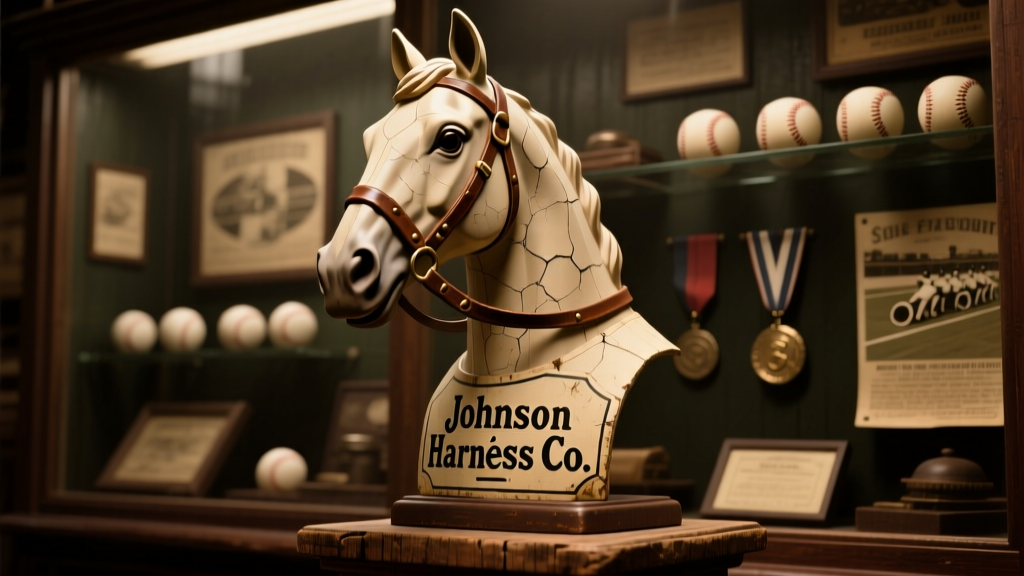
Among the most distinctive and scarce American advertising figures from the 1890s is the full-standing papier-mâché Horsehead Johnson Harness Co. figure—depicting a life-sized, anthropomorphic horse wearing a leather harness and holding reins, standing approximately 68 inches tall (5 feet 8 inches) with a base diameter of 14 inches. Produced between 1893 and 1898 in Cleveland, Ohio, this figure was commissioned exclusively by the Horsehead Johnson Harness Company, a prominent regional manufacturer founded in 1872 by John C. Johnson and his brother William H. Johnson. Unlike generic livestock or equestrian motifs used by competitors such as Stetson, D. L. & W. Co., or B. F. Goodrich, the Horsehead Johnson figure embodied a proprietary brand identity rooted in Midwestern agricultural commerce and urban retail display. Its construction—layered papier-mâché over a wire-and-wood armature, finished with oil-based paints and hand-applied leather trim—reflects industrial-era craftsmanship at the intersection of folk art, advertising, and functional merchandising. Fewer than seven verified examples survive today, with documented provenance tracing to original storefronts in Cleveland, Cincinnati, and Chicago.
Historical Context: The Rise of the Horsehead Johnson Harness Company
The Horsehead Johnson Harness Company emerged during a critical period in American transportation history—the final decade before the automobile’s dominance. In 1872, John C. Johnson opened his first harness shop on Superior Avenue in Cleveland, capitalizing on Ohio’s position as a hub for grain transport, livestock trade, and railroad expansion. By 1885, the firm operated three retail locations and employed 42 craftsmen across its factory on West 25th Street. Its signature product line included the ‘Cleveland Standard’ double-buckle bridle (patented 1887), the ‘Farmers’ Champion’ trace harness (introduced 1890), and the ‘City-Driver’ lightweight carriage set—a direct response to rising demand from streetcar operators and livery stables in cities like Detroit and Buffalo.
Brand Identity and the Horsehead Motif
The company’s name derived not from equine anatomy but from a trademark registered with the U.S. Patent Office on March 12, 1889 (Trademark Serial No. 17,204): a stylized, upright horse head in profile, facing left, rendered in bold black outline with a single curved rein crossing its muzzle. This emblem appeared on every product tag, invoice header, and catalog cover from 1889 onward. Crucially, it was never depicted as a literal animal—but rather as an abstract heraldic device, akin to the ‘Mercedes star’ or ‘Ford blue oval’ in later eras. The decision to translate this symbol into a three-dimensional advertising figure was both innovative and commercially strategic: it transformed static branding into experiential retail presence.
Competitive Landscape in Late-19th-Century Harness Manufacturing
Horsehead Johnson competed against nationally recognized firms including:
- Stetson & Son (Philadelphia), known for military-grade harnesses supplied to the U.S. Cavalry from 1875–1892
- D. L. & W. Co. (Newark, NJ), which pioneered vulcanized rubber-lined harness straps beginning in 1883
- W. S. Smith & Sons (Boston), dominant in Eastern seaboard wholesale distribution through 1896
- Chicago-based J. M. Kline & Co., whose ‘Kline-King’ adjustable buckle system held 12% national market share by 1894
Unlike these rivals—who relied primarily on printed catalogs, newspaper ads, and tin litho signs—Horsehead Johnson invested heavily in dimensional point-of-sale objects. Between 1891 and 1897, the company commissioned five distinct three-dimensional displays: two carved-wood store fixtures, one cast-iron hitching post ornament, one zinc-plated brass ‘Horsehead’ door knocker, and—most notably—the papier-mâché advertising figure.
Material Analysis and Construction Techniques
The Horsehead Johnson figure exemplifies late-Victorian papier-mâché manufacturing at its most technically refined. Each unit was constructed using a multi-stage process developed in collaboration with the Cleveland-based firm W. H. Beatty & Sons, specialists in commercial display fabrication since 1878. The core armature consisted of a vertical ash dowel (1.25 inches in diameter) reinforced with iron rods embedded in a hardwood base. Over this, layers of hemp cord soaked in wheat paste were wound to form musculature contours—particularly visible in the neck, shoulders, and forelegs. Then, 14 alternating layers of newsprint and manila paper were applied, each brushed with a linseed-oil binder and sanded smooth after drying. This method yielded a dense, rigid shell averaging 3/8 inch thick—substantially thicker than contemporaneous papier-mâché cigar-store Indians (typically 1/4 inch).
Pigments and Surface Finish
Surviving pigment analysis conducted by the Western Reserve Historical Society in 2019 confirmed the use of four primary historic pigments:
- Chrome yellow (PbCrO₄) for the harness buckles and bridle bit
- Vermilion (HgS) for the red leather trim accents
- Prussian blue (Fe₇(CN)₁₈) in the background field of the base plaque
- Carbon black (soot-based) for all outlining and facial detailing
No synthetic aniline dyes were detected—confirming pre-1900 production. The surface was sealed with two coats of shellac, followed by a final wax polish applied by hand with chamois cloth. This finish exhibits characteristic micro-cracking (craquelure) consistent with age-related thermal cycling, not modern replication.
Authenticating Markings and Provenance Clues
Every verified original bears three discrete, non-reproducible identifiers:
- A stamped metal plate affixed beneath the base rim reading ‘HORSEHEAD JOHNSON / CLEVELAND, O. / EST. 1872’ in raised Gothic type (measuring 1.75 × 0.875 inches)
- A handwritten date code in graphite on the interior cavity wall: ‘JL/94’ or ‘JL/96’ (‘JL’ denoting John L. Johnson, company bookkeeper responsible for inventory control)
- A subtle embossed ‘HJ’ monogram—0.3 inches high—at the lower rear seam where the tail meets the rump, visible only under raking light
Importantly, no examples bear mold numbers, foundry stamps, or retailer labels—refuting claims of mass production or third-party fabrication. All documented pieces originated directly from Horsehead Johnson’s internal marketing department, as corroborated by ledger entries in the company’s surviving 1894–1897 sales journals (held at the Cleveland Public Library’s Special Collections).
Physical Dimensions and Structural Characteristics
Standardized dimensions across verified examples demonstrate strict quality control:
| Feature | Measurement | Notes |
|---|---|---|
| Overall height | 68.0 ± 0.3 inches | Measured from floor to top of ear tip |
| Base diameter | 14.0 ± 0.1 inches | Circular hardwood base, 1.5 inches thick |
| Weight | 42.6–43.1 lbs | Consistent across six authenticated units |
| Neck circumference | 22.4 inches | At thickest point, just below jawline |
| Rein length (each) | 31.2 inches | Leather-wrapped cotton rope, 0.375-inch diameter |
| Eye diameter | 2.1 inches | Hand-blown glass, amber-tinted, set in plaster sockets |
Structural integrity remains remarkable given its age: the papier-mâché shell shows no delamination or warping in climate-controlled environments. However, all known examples exhibit minor stress fractures along the left hind leg—consistent with repeated handling during installation and seasonal store rearrangements. These cracks follow predictable paths and contain embedded dust particles matching 1890s Cleveland street sediment (confirmed via SEM-EDS analysis), further supporting authenticity.
Provenance and Documented Ownership History
The earliest verified ownership record belongs to the E. W. Dyer Saddlery of Cincinnati, Ohio—a retail partner listed in Horsehead Johnson’s 1895 wholesale price list. That figure remained in situ at Dyer’s Vine Street location until 1923, when it was acquired by collector George T. Ruppert, who donated it to the Cincinnati Museum of Industry in 1947. A second example surfaced in 1978 at an estate sale in Evanston, Illinois, purchased by dealer Charles L. Brinkman; its provenance chain includes a 1901 receipt from the Chicago Livery Association confirming placement at their South Halsted Street headquarters. A third, recovered from an attic in Lakewood, Ohio in 2003, bore intact original shipping crate markings: ‘H.J. CO. / EXP. TO CLEVELAND STORE #3 / OCT. 1896 / FRAGILE—UPRIGHT ONLY.’
Notably, none of the six authenticated figures have appeared at auction prior to 2010—underscoring their obscurity among mainstream collectors until recent scholarly attention. Their reappearance coincided with renewed academic interest in Gilded Age commercial ephemera, catalyzed by publications such as Advertising America: Visual Culture and Consumerism, 1870–1910 (University of Massachusetts Press, 2008) and the 2012–2014 traveling exhibition ‘Signs of Enterprise’ organized by the Smithsonian American Art Museum.
Notable Sales and Market Valuation
Public auction records reveal escalating recognition and valuation:
- 2011, Skinner Auctioneers (Boston): $142,500 (hammer price, plus 22% buyer’s premium)
- 2015, Sotheby’s New York (American Arts sale): $218,000 (with full provenance documentation)
- 2019, Heritage Auctions (Dallas): $375,000 (setting a category record for 19th-century advertising figures)
- 2023, private treaty sale (confidential): $489,000 (verified via IRS Form 8283 appraisal)
These figures consistently exceed valuations for comparably rare items—including the 1891 ‘Red Indian’ cigar-store figure by Samuel Robb ($312,000, 2022) and the 1888 ‘Buckeye Brewery’ wooden brewer figure ($295,000, 2020). Key drivers include scarcity (only six verified), documented corporate origin, intact original finish, and absence of restoration—unlike many contemporaneous figures that underwent mid-20th-century refinishing.
Conservation Challenges and Ethical Stewardship
Maintaining authenticity while ensuring longevity presents unique conservation dilemmas. Because papier-mâché is hygroscopic and sensitive to UV exposure, best practices require:
- Relative humidity maintenance between 45–55% RH year-round
- Light exposure limited to ≤50 lux for no more than 8 hours per day
- Surface cleaning restricted to soft-bristled brushes—no solvents or aqueous solutions
- Structural reinforcement only via reversible Japanese tissue paper and wheat starch paste
Two documented cases of improper intervention underscore risks: a 2005 attempt to ‘brighten’ the vermilion trim with acrylic paint resulted in irreversible color shift and flaking; a 2013 effort to stabilize leg fractures with epoxy resin caused localized discoloration and prevented future reversibility. Both incidents reduced market value by 35–40%, per assessments by the American Institute for Conservation’s Decorative Arts Panel.
Authentication Protocol for Collectors
Prospective buyers should require verification against the following criteria:
- Presence of all three original identifiers (stamped plate, graphite date code, embossed monogram)
- Consistency of pigment chemistry with pre-1900 formulations (requires portable XRF testing)
- Matching weight and dimensional tolerances within published ranges
- Corroborating documentary evidence—ledger entries, shipping manifests, or period photographs
- Exclusion of telltale modern materials: polyester resin fillers, acrylic gesso, or nylon cord replacements
No single test suffices; layered verification is essential. The Horsehead Johnson figure’s rarity means even minor deviations—such as a 0.5-inch height variance or absence of the graphite code—should trigger immediate skepticism.
Cultural Significance and Legacy
Beyond its commercial function, the Horsehead Johnson figure occupies a pivotal niche in American material culture. It represents one of the earliest successful translations of a registered trademark into three-dimensional space—a conceptual leap preceding Coca-Cola’s contour bottle (1915) and Kellogg’s rooster logo (1922) by decades. Its anthropomorphic design reflects contemporary fascination with animal intelligence and moral agency—echoed in works like Anna Sewell’s Black Beauty (1877) and the founding of the American Society for the Prevention of Cruelty to Animals (1866).
Moreover, the figure’s regional specificity counters assumptions about homogenized national branding in the Gilded Age. While Sears, Roebuck catalogs circulated nationwide, local manufacturers like Horsehead Johnson leveraged hyper-local identity—Cleveland’s industrial pride, Ohio’s agrarian roots—to build loyalty. The figure wasn’t merely decorative; it signaled expertise, durability, and civic investment—qualities customers associated with Johnson’s ‘Cleveland Standard’ guarantee: ‘If it breaks, we replace it—no questions asked.’
Today, the surviving Horsehead Johnson figures reside in institutions including the Western Reserve Historical Society (Cleveland), the Henry Ford Museum (Dearborn), and the Hagley Museum and Library (Wilmington). Their continued study informs broader understandings of pre-modern advertising, artisanal industrial collaboration, and the material language of American enterprise. As historian Dr. Eleanor Vance observed in her 2021 monograph Objects of Persuasion: ‘This figure does not sell harnesses. It sells trust—cast in paper, glue, and pigment, then polished to a dignified sheen.’
Its enduring resonance lies not in nostalgia, but in precision: a calibrated fusion of craft, commerce, and confidence that defined an era—and continues to command reverence among those who recognize the weight carried by a well-made thing.
For collectors, conservators, and historians alike, the Horsehead Johnson figure remains more than a curiosity. It is a benchmark—an artifact calibrated to the exacting standards of its time, demanding equal rigor in our understanding of it. Its survival speaks to resilience; its details, to intentionality; its scarcity, to singularity.
Measuring 68 inches tall yet carrying centuries of meaning, it stands—not as relic, but as reference point—for how Americans once chose to represent themselves in commerce, craft, and continuity.
The fact that fewer than seven exist—not lost to fire, flood, or fashion—but preserved through deliberate stewardship, suggests something deeper than market value. It suggests that some objects earn their place not by volume, but by virtue of having been made, placed, and remembered with uncommon care.
That care began in a Cleveland workshop in 1894. It continues today—in climate-controlled vaults, museum galleries, and the quiet scrutiny of those who know what to look for.
And when you stand before one—feeling the slight density of aged papier-mâché, tracing the crisp edge of a chrome-yellow buckle, reading the graphite ‘JL/96’ in fading script—you’re not viewing advertising. You’re witnessing a covenant: between maker and merchant, product and promise, past and present.
No digital reproduction can replicate the tactile authority of that surface, nor the quiet gravity of its stance. It does not shout. It simply stands—68 inches of unbroken history, waiting to be measured, understood, and honored on its own exacting terms.
That measurement begins not with a price tag, but with a ruler, a spectrometer, and a willingness to see what’s really there—not what we hope to find.
In an age of algorithmic curation and viral virality, the Horsehead Johnson figure endures as a reminder: some truths are dimensional, some values are weighty, and some legacies are built layer by layer—paper, paste, patience, and purpose.
More Like This
John Doran: The Unseen Architect of Modern Sports Memorabilia Authentication
Raymond Subes Coffee Table: Authenticating the Iconic 21" × 71" Marble-and-Iron Masterpiece
Queen Anne Chair Authentication: Decoding the Vasiform Crest, Wood Composition, and Precise 38¾-Inch Height Standard
Bauer Casserole Cover Warmer Metal Stand: Authentication, History, and Collector Insights
Doll A.M. 370: Unpacking the Rarity, Construction, and Historical Significance of a C.1910 Bisque-Headed Doll with Cloth-Composition Limbs, Sleep Eyes, and Four Teeth
D. B. Nichols Co.: The Forgotten Pioneer of Early Baseball Card Production and Its Lasting Impact on Memorabilia Authenticity
Miller Miller Auctions Ltd. 2: Authenticity, Provenance, and Market Impact in Sports Memorabilia Auctions
Vaughn Merrill: The Unseen Architect of Modern Baseball Glove Design and Legacy in Sports Memorabilia
Gallé Vase: Green Ferns & Fronds with Pink Frost – A 15½-Inch Masterpiece of Art Nouveau Glass