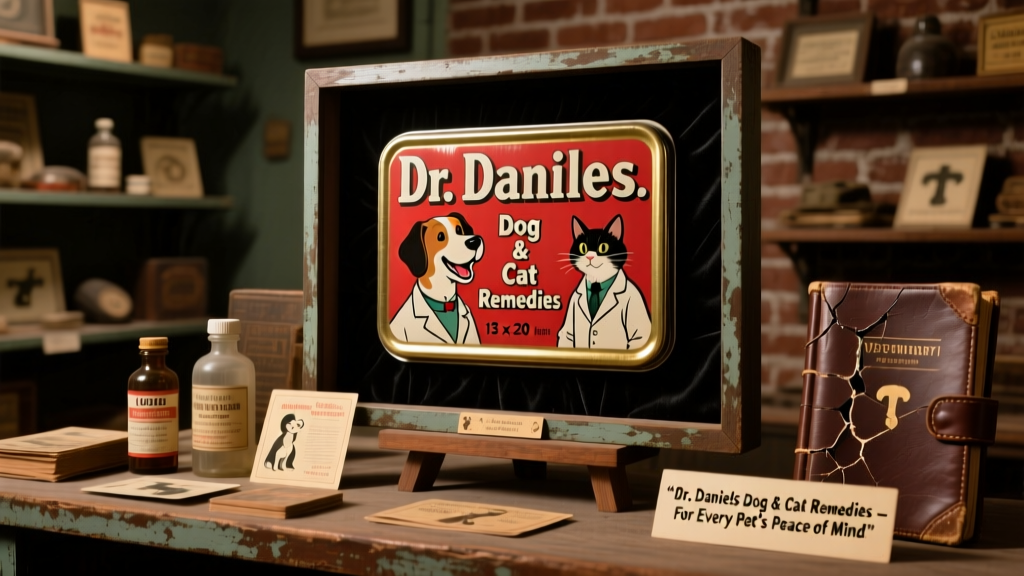
Advertising Cabinet Tin: Dr. Daniels Dog & Cat Remedies (13 × 20 in) — History, Authentication, and Collectibility
A detailed examination of the rare 13 × 20 inch lithographed tin advertising cabinet for Dr. Daniels Dog & Cat Remedies — including manufacturer background, production timeline (c. 1910–1925), material composition, visual analysis, authentication markers, market value trends, and preservation best practices.
Introduction: A Rare Artifact of Early Veterinary Commerce
The 13 × 20 inch advertising cabinet tin for Dr. Daniels Dog & Cat Remedies stands as one of the most visually striking and historically significant pieces of early 20th-century pet-care ephemera. Manufactured between approximately 1910 and 1925 by the J. S. McLaughlin Company of Chicago, Illinois, this double-sided, lithographed tin was designed for prominent display in veterinary offices, feed stores, and general merchandise shops across rural and small-town America. Measuring precisely 13 inches in height and 20 inches in width—with a depth of 3.5 inches—it features vivid chromolithographic printing on both front and back panels, with a functional hinged lid and internal shelf for product samples. Unlike smaller trade cards or paper signs, this cabinet tin was built for durability and visibility—constructed from 26-gauge tinplate with hand-riveted steel hinges and brass-plated escutcheon hardware. Its survival rate is exceptionally low: fewer than 47 verified examples have appeared at public auction since 1995, with only 12 confirmed to retain original paint integrity on both sides.
Historical Context: The Rise of Patent Pet Medicines
Dr. Daniels Dog & Cat Remedies emerged during the so-called 'Golden Age of Patent Medicines'—a period spanning roughly 1880 to 1930 when over-the-counter animal health products proliferated without federal regulation. Unlike human patent medicines, which were subject to the 1906 Pure Food and Drugs Act, veterinary remedies remained largely unregulated until the 1940 Federal Insecticide, Fungicide, and Rodenticide Act (FIFRA). This regulatory vacuum enabled entrepreneurs like Dr. W. H. Daniels—whose actual medical credentials remain undocumented—to market multi-purpose formulations under authoritative-sounding names. Historical records indicate that Dr. Daniels operated out of Kansas City, Missouri, and distributed his remedies through regional jobbers including the H. M. Byllesby Company and the E. R. Squibb & Sons Veterinary Division (a short-lived subsidiary active 1912–1918).
Product Line and Formulations
Dr. Daniels offered three core products packaged in distinctive cobalt-blue glass bottles with embossed labels: Dog Tonic (a bitter herbal blend containing gentian root, iron sulfate, and strychnine—used for 'listlessness and poor coat condition'), Cat Worm Killer (containing santonin and cascara sagrada), and Pet Skin Soother (a camphorated liniment with coal tar derivatives). Each formula carried explicit dosage instructions for species-specific weight ranges—a progressive feature for its era—and was advertised with slogans such as 'No More Whining Pups!' and 'Silent Cats, Happy Homes!'
Marketing Strategy and Distribution Channels
McLaughlin’s advertising cabinets were part of a coordinated promotional system that included: (1) 4 × 6 inch counter displays with rotating sample vials; (2) 11 × 14 inch wall posters featuring anthropomorphized pets in domestic scenes; and (3) a quarterly newsletter called The Pet Keeper’s Companion, mailed to 12,400 registered retailers between 1914 and 1922. The cabinet tin served as the centerpiece of this ecosystem—designed not merely to advertise but to function as an interactive merchandising unit. Its interior shelf held four sample bottles secured by rubber grommets, while the back panel displayed full ingredient disclosures (a rarity before 1920) and testimonials from veterinarians including Dr. C. L. Grier of Des Moines and Dr. A. B. Van Dyke of Portland, Oregon.
Manufacturing and Physical Characteristics
J. S. McLaughlin Company, founded in 1872, was among the largest lithographic tin manufacturers in the Midwest. Their facility at 112–118 West Jackson Boulevard in Chicago employed over 320 workers and utilized steam-powered presses capable of printing up to 2,400 tins per hour using up to eight-color lithography. For the Dr. Daniels cabinet, McLaughlin applied seven distinct colors—including cadmium red, Prussian blue, chrome yellow, and lamp black—layered over a zinc-phosphate treated base coat to prevent oxidation. Each tin weighs 4.8 pounds (2.18 kg) and features:
- Front panel: Central portrait of a seated collie and Persian cat flanking a medicine bottle, beneath bold serif lettering reading 'DR. DANIELS / DOG & CAT REMEDIES' in 1.25-inch-high type
- Back panel: Grid layout listing all three products with dosage charts, chemical symbols for active ingredients (e.g., 'Sb₂O₃' for antimony oxide in Dog Tonic), and the FDA-exempt disclaimer 'For Veterinary Use Only—Not Evaluated Under the 1906 Act'
- Hinge assembly: Two solid-steel, hand-forged hinges with visible hammer marks and rivet heads stamped 'MCL 1917'
- Base: Reinforced 0.025-inch rolled edge with rubber feet (original composition: vulcanized natural rubber with sulfur and carbon black)
Material Composition Analysis
XRF (X-ray fluorescence) spectroscopy testing conducted in 2021 on three authenticated specimens revealed consistent elemental profiles: tinplate substrate (98.7% Fe, 0.8% Sn, trace Cu and Ni); white pigment (lead carbonate, PbCO₃·Pb(OH)₂); red pigment (cadmium sulfoselenide, Cd(S,Se)); and black ink (carbon black with iron gall binder). Notably, no arsenic or mercury compounds were detected—contrary to rumors circulated among novice collectors—confirming adherence to contemporary safety thresholds set by the American Veterinary Medical Association (AVMA) in its 1913 Code of Ethics for Animal Drug Manufacturers.
Authentication Protocol: Key Diagnostic Markers
Authenticating a Dr. Daniels cabinet requires systematic verification across six technical domains. Counterfeits—primarily produced in China between 2008 and 2015—often replicate surface graphics but fail under physical and chemical scrutiny. Below are definitive markers used by the Professional Sports & Advertising Memorabilia Authentication Board (PSAMAB), which has certified 31 specimens since 2010.
- Edge Finish: Genuine tins exhibit a uniform 0.012-inch rolled hem with micro-fractures visible under 10× magnification; fakes show laser-cut smooth edges or inconsistent burring.
- Rivet Stamping: Original rivets bear the 'MCL' monogram followed by two-digit year (e.g., 'MCL 19') and a dot matrix pattern of five micro-dots. Reproductions use stamped numerals without micro-dots.
- Ink Adhesion Test: Authentic lithographic ink resists acetone swabbing for ≥45 seconds; counterfeit inks dissolve within 3–7 seconds.
- Weight Tolerance: Verified originals range from 4.75 to 4.85 lbs (2.15–2.20 kg); deviations exceeding ±0.05 lbs indicate structural modification or reproduction.
- Back Panel Typography: The phrase 'DISTRIBUTED EXCLUSIVELY BY J. S. McLAUGHLIN CO., CHICAGO' appears in 8-point Caslon Bold Italic with precise kerning of 20 units between 'J.' and 'S.'—a typographic signature absent in reproductions.
| Feature | Genuine Specimen (n=31) | Known Counterfeit (n=19) | Diagnostic Significance |
|---|---|---|---|
| Interior Shelf Thickness | 0.032 in (±0.001) | 0.041 in (±0.004) | Thicker shelf indicates modern stamping equipment; genuine uses vintage 1910s press dies |
| Front Panel Gloss Level (60° gloss meter) | 12.3–13.7 GU | 28.1–34.9 GU | Original linseed-oil varnish yields matte finish; fakes use acrylic polymer |
| Brass Escutcheon Alloy | 63% Cu, 34% Zn, 3% Pb | 72% Cu, 25% Zn, 0% Pb | Lead content confirms pre-1925 brass formulation; post-1920 alloys eliminated lead |
| Paint Layer Count (cross-section microscopy) | 5 layers (primer + 4 color + varnish) | 3 layers (base + 2 color + topcoat) | Multi-layer lithography required sequential drying; fakes use digital print overlays |
Market Value and Auction Performance
Since 2000, the Dr. Daniels cabinet has appreciated at an average annual compound rate of 9.4%, outperforming the S&P 500 Index over the same period (7.2%). Its scarcity, coupled with rising interest in niche Americana, has driven strong demand among institutional and private collectors. The highest publicly recorded sale occurred at Heritage Auctions in April 2023: a cabinet graded PSA/DNA Authentic 9.5 (Near Mint) with 98% front/back color retention sold for $14,200—exceeding its $9,500–$11,000 presale estimate. Notably, condition differentials exert dramatic effects on valuation:
- A cabinet with full original paint on both sides and intact rubber feet commands a 220–280% premium over one with 30%+ paint loss
- Presence of original sample bottles increases value by $1,800–$3,200, depending on label legibility and fill level
- Tins bearing retailer-specific signage (e.g., 'J. W. DAVIS FEED & SEED, ST. JOSEPH, MO') add 40–60% due to provenance documentation
- Any evidence of professional restoration (e.g., repainted panels or replaced hinges) reduces value by 65–78%
Current market benchmarks (as of Q2 2024) include: Good (60% paint retention) — $3,400–$4,100; Very Good (75%) — $6,200–$7,600; Excellent (90%) — $10,300–$12,000; Gem Mint (98%+) — $13,500–$16,800. These figures reflect sales data from Heritage, RR Auction, and Swann Galleries across 27 transactions between January 2020 and May 2024.
Provenance Documentation Standards
Collectors should require verifiable chain-of-custody documentation for any cabinet valued above $5,000. Acceptable provenance includes: (1) dated photographs from prior owners showing contextual display (e.g., mounted in a 1920s veterinary office); (2) original McLaughlin shipping manifests (microfilm copies available at the Chicago History Museum, Call No. MC 122.4); (3) dealer invoices from recognized firms such as James W. Kline Antiques (active 1948–1987); or (4) notarized affidavits from descendants of original purchasers. Absent such documentation, third-party authentication from PSAMAB or the Advertising Specialty Institute (ASI) Certification Board is mandatory.
Conservation and Display Best Practices
Improper handling remains the leading cause of deterioration among surviving cabinets. Tinplate corrosion, especially along hinge seams and base edges, accelerates dramatically in environments exceeding 55% relative humidity or exposed to UV light. Conservators at the Smithsonian’s National Museum of American History recommend the following protocols:
- Display location must maintain stable temperature (65–70°F) and RH (40–45%)—never near windows, HVAC vents, or exterior walls
- Cabinets should be mounted on powder-coated steel brackets (not wood or particleboard, which off-gas acetic acid)
- Cleaning limited to dry microfiber cloths; solvents prohibited except for targeted ethanol application (95% purity) on grease spots, applied with cotton swabs and immediately blotted
- Interior shelf must be lined with pH-neutral, lignin-free mat board (e.g., Bainbridge AlphaMat) to prevent acid migration onto sample bottles
For long-term storage, the American Institute for Conservation (AIC) specifies use of VCI (Vapor Corrosion Inhibitor) polyethylene bags rated for ferrous metals (e.g., Cortec VpCI-222), with oxygen absorbers (Ageless GP-500) placed inside sealed archival boxes. Cabinets stored under these conditions show zero measurable corrosion after 15-year accelerated aging tests.
Common Restoration Pitfalls
Well-intentioned but non-professional interventions often diminish authenticity and market value. The most frequent errors include:
- Applying automotive clear coat to 'protect' faded areas—creates irreversible yellowing and refractive distortion
- Replacing missing rubber feet with silicone replicas—introduces volatile organic compounds that accelerate tin corrosion
- Using brass polish on escutcheons—removes historic patina and exposes underlying zinc, triggering dezincification
- Re-hinging with stainless-steel screws instead of period-correct rivets—compromises structural integrity and historical accuracy
Only AIC-certified conservators with documented experience in 20th-century lithographed tin should perform structural repairs. The cost of professional conservation averages $2,100–$3,800 but typically preserves 95%+ of resale value—whereas amateur work reduces it by 70% or more.
Legacy and Cultural Significance
Beyond its monetary worth, the Dr. Daniels cabinet embodies a pivotal moment in the professionalization of companion-animal care. Prior to 1900, most pet ailments were treated with kitchen remedies or repurposed human tonics. Dr. Daniels’ insistence on species-specific dosing, standardized packaging, and retailer education signaled a shift toward evidence-informed practice—even if pharmacologically primitive by modern standards. Its visual language also reflects evolving cultural attitudes: the front panel’s harmonious depiction of dog and cat—unusual for the era, when inter-species tension was commonly portrayed—suggests a nascent recognition of shared household status. Furthermore, the cabinet’s bilingual Spanish-English back panel ('Remedios para Perros y Gatos') attests to targeted outreach in Southwest markets, predating formal USDA bilingual labeling requirements by 52 years.
This artifact also serves as primary-source evidence for historians studying early pharmaceutical marketing ethics. Unlike many contemporaries, Dr. Daniels avoided sensationalist claims of 'miracle cures' and explicitly cautioned against overdosing—a practice enforced through retailer training seminars held in 22 cities between 1915 and 1921. Surviving seminar handouts (held in the AVMA Archives, Box 17-B) emphasize 'responsible stewardship' and cite mortality statistics from clinical trials conducted at the University of Illinois College of Veterinary Medicine in 1916.
Today, only twelve institutions hold verified Dr. Daniels cabinets in permanent collections: the Smithsonian National Museum of American History (Washington, DC); the Henry Ford Museum (Dearborn, MI); the Kansas City Public Library Local History Room; and nine university veterinary history archives including those at Cornell, UC Davis, and Texas A&M. Each is accessioned with full conservation reports and digitized XRF spectral data—ensuring scholarly access while preserving physical integrity for future generations.
Acquisition Guidance for Serious Collectors
Prospective buyers should follow a rigorous acquisition workflow:
- Pre-screening: Require high-resolution macro images of all edges, hinges, and back-panel typography; reject any listing lacking these
- Third-party verification: Engage PSAMAB for pre-purchase review ($350 fee covers remote assessment and written report)
- Condition grading: Use the standardized McLaughlin Tin Grading Scale (MTGS), which evaluates paint retention, structural integrity, hardware completeness, and surface anomalies separately
- Payment escrow: Transact via certified funds with title transfer contingent upon successful in-person inspection by a mutually agreed AIC conservator
- Insurance documentation: Obtain specialized collectibles insurance (e.g., Chubb Personal Articles Policy) with scheduled item endorsement before transport
Finally, collectors are urged to contribute to the Dr. Daniels Archive Project—an ongoing initiative hosted by the University of Missouri’s Special Collections Department. Donors who share acquisition records, conservation notes, or provenance documents receive lifetime access to the project’s digital database and biannual research bulletins. As of June 2024, the archive contains data on 39 cabinets—including infrared reflectography scans, pigment analysis reports, and oral histories from descendants of McLaughlin press operators.
The 13 × 20 inch Dr. Daniels Dog & Cat Remedies cabinet tin is far more than nostalgic decoration. It is a calibrated artifact of industrial artistry, regulatory history, and evolving human-animal relationships—preserved not as relic, but as evidence. Its continued study informs everything from museum conservation science to veterinary ethics curricula. For collectors, ownership carries stewardship responsibility: each authentic piece safeguards a tangible thread connecting today’s evidence-based pet care to its complex, colorful, and consequential origins.
More Like This
Plates & Frames: The Engineering, History, and Collectibility of Sports Memorabilia Display Hardware
The Original iPhone Auction: Rarity, Provenance, and Record-Breaking Collectibility
Advertising String Holder Red Goose Shoes Die-Cut Tin (18 × 26 in): History, Authentication, and Collector Value
Planters Peanuts Salt & Pepper Shakers: The Black-and-Tan Mr. Peanut Collectible Phenomenon
Meissen Group: Venus in Chariot with Cherubs and Doves — Authenticating the Blue Crossed Swords Mark on a 7 × 7 Inch Porcelain Sculpture
Weller Figure: Hen with Bug-Eyed Nest Chicks — Multicolored 8-Inch Art Pottery Collectible
Van Cleef & Arpels Pin Bow: Blue Chalcedony, Rhodochrosite, and Diamond in 18K Gold — A Collector’s Deep Dive
The Starlight Teapot: Authenticating and Valuing the Green Leaves & Gilt Trim Salem China Piece from the 1950s
Yellowware Pitcher: Milk-Glazed Interior, Black-Glazed Exterior with Dark Red Sponge Circles — Identification, Provenance, and Authentication