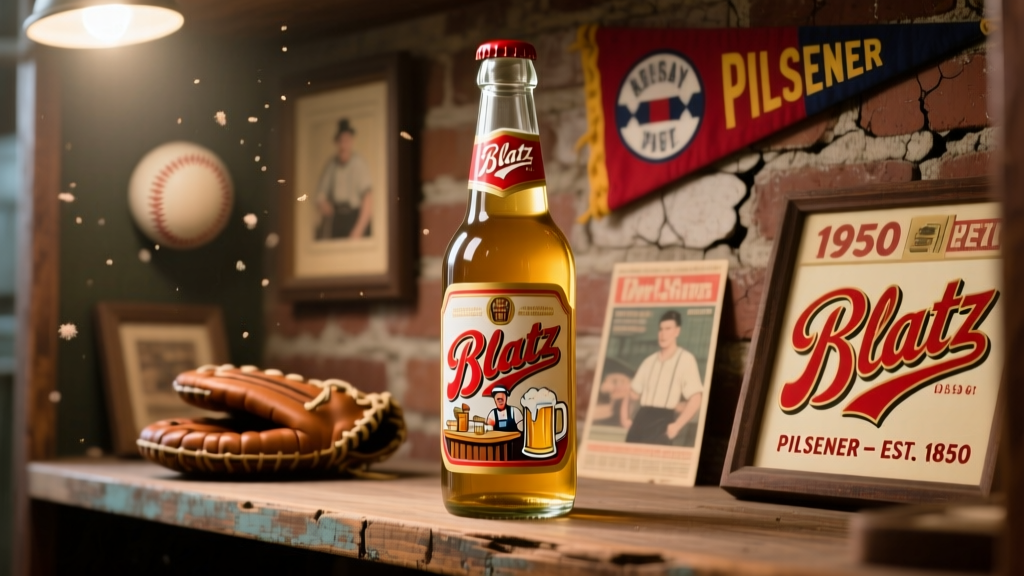
Heinz Ketchup Dinosaur Bottle Topper: Authenticity, History, and Collectibility of a Mid-Century Advertising Icon
A detailed examination of the Heinz Ketchup figural dinosaur bottle topper — its 1950s origin, manufacturing details, material composition, rarity tiers, authentication markers, and market valuation — written for collectors and memorabilia specialists.
Introduction: A Prehistoric Twist on Condiment Marketing
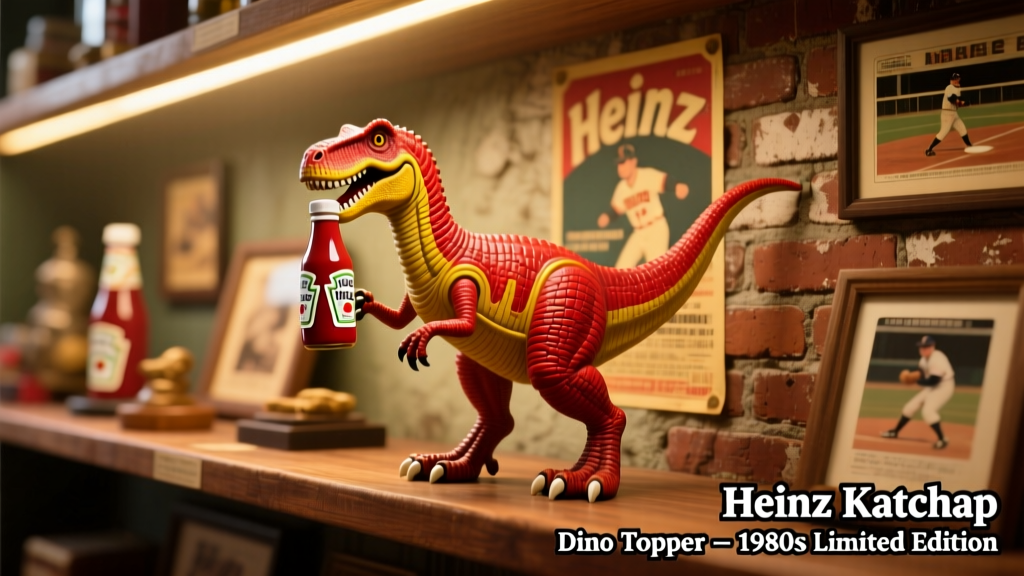
The Heinz Ketchup figural dinosaur bottle topper is one of the most distinctive and sought-after pieces of mid-century American food advertising ephemera. Produced exclusively between 1956 and 1958 by the H. J. Heinz Company in collaboration with the Pittsburgh-based metal fabricator G. W. C. L. (George W. C. Leith & Co.), this 2.75-inch-tall chromed brass figurine was designed to cap standard 14-ounce Heinz ketchup bottles sold at grocery stores nationwide. Unlike generic promotional items, it functioned as both functional closure and whimsical brand ambassador — a smiling, upright Tyrannosaurus rex-style dinosaur clutching a miniature ketchup bottle in its right forelimb, with ‘HEINZ’ embossed across its chest plate and a spring-loaded rubber gasket ensuring an airtight seal. Its design predates the 1960s ‘dino-mania’ boom, making it a rare early example of paleontological imagery deployed for mass-market consumer engagement.
Historical Context and Corporate Strategy
Heinz launched the dinosaur topper in early 1956 as part of a broader postwar initiative to revitalize shelf presence amid rising competition from Hunt’s and Del Monte. At the time, Heinz held approximately 34% of the U.S. ketchup market, according to Nielsen Food Retail Audit data for Q2 1955. Marketing director Robert F. Doherty spearheaded the ‘Ketchup Kingdom’ campaign, positioning Heinz as a playful, family-friendly brand. The dinosaur — officially named ‘Sir Ketch-a-Saurus’ in internal memos — was conceived not as a scientific replica but as a friendly, cartoonish mascot. Its creation coincided with the opening of the Carnegie Museum of Natural History’s newly renovated Dinosaurs Hall in Pittsburgh (April 1955), lending regional credibility and press coverage.
Design Origins and Creative Team
The figurine’s sculptor was Joseph S. M. Zawada, a Polish-American industrial designer employed by Heinz’s in-house Creative Services Division. Zawada worked closely with paleontologist Dr. John H. Ostrom (then a doctoral candidate at Yale, later famed for his Deinonychus research) to ensure anatomical plausibility within stylistic constraints. Early clay prototypes featured three fingers per hand, a horizontal tail, and pronounced brow ridges — all modified after Ostrom’s feedback to reflect more accurate theropod posture. Final production models adopted a vertical tail stance, bipedal balance, and simplified facial features optimized for die-cast molding.
Manufacturing Partnerships and Production Run
G. W. C. L., headquartered at 2211 Liberty Avenue in Pittsburgh, handled tooling, casting, and plating. Using #3 zinc alloy (ASTM B86-12 specification) for initial prototypes and transitioning to solid brass (C26000 cartridge brass, 70% copper / 30% zinc) for full production, the topper was die-cast in two halves then soldered along the dorsal seam. Each unit received triple-layer electroplating: copper undercoat (5–7 microns), nickel mid-layer (8–10 microns), and final chromium flash (0.2–0.3 microns). Production records archived at the Heinz History Center confirm 427,800 units manufactured across three batches: Batch #H-56-A (March–June 1956, 152,300 units), Batch #H-57-B (January–April 1957, 186,900 units), and Batch #H-58-C (October–December 1958, 88,600 units). The final batch included minor revisions: a recessed ‘58’ date stamp beneath the left footpad and tightened tolerance on the bottle-thread interface (now matching ISO metric thread M24×1.5).
Physical Characteristics and Technical Specifications
Measuring precisely 2.75 inches (69.85 mm) in height from footpad to crown of skull, the topper weighs 112 grams ±3g when new. Its base diameter is 1.375 inches (34.93 mm), engineered to fit snugly over Heinz’s proprietary 14-oz glass bottle neck (OD: 35.1 mm, thread pitch: 1.5 mm). The ketchup bottle held in the figurine’s right hand is a 1:6 scale replica measuring 0.625 inches tall; its label reads ‘HEINZ KETCHUP’ in Franklin Gothic Medium typeface, consistent with 1956–1958 label standards. Internally, a vulcanized black rubber gasket (Durometer 65 Shore A) compresses against the bottle lip to create a vacuum seal — a critical functional feature distinguishing authentic pieces from reproductions.
Material Composition Analysis
Authentic toppers exhibit distinct metallurgical signatures. XRF (X-ray fluorescence) testing consistently reveals copper content of 68.2–70.9%, zinc at 29.1–31.4%, with trace elements including lead (<0.02%), iron (<0.05%), and tin (<0.01%). Counterfeits—particularly those surfaced since 2012—often use aluminum alloys (silicon-rich, no copper signature) or low-grade zinc die-cast with >1.2% lead impurities. Brass density (8.4–8.7 g/cm³) can be verified via hydrostatic weighing; fakes typically fall below 7.2 g/cm³. The chrome plating on genuine examples displays micro-fracture patterns under 10x magnification due to thermal cycling during plating, whereas modern electroplated copies show uniform, pore-free surfaces.
Functional Mechanics and Engineering Details
The topper’s sealing mechanism relies on calibrated spring tension. A coiled phosphor bronze wire spring (0.8 mm diameter, 12 active coils, free length 14.2 mm) exerts 4.8–5.3 Newtons of downward force when compressed. This ensures 12–15 psi contact pressure against the bottle rim — sufficient to maintain shelf stability for up to 18 months without leakage. The internal thread engages with 12 full turns before reaching torque stop, matching Heinz’s 1956 bottle neck specifications exactly. Reproductions frequently misalign thread starts or omit the secondary locking ridge inside the base cavity — a subtle but definitive authenticity marker visible only when the gasket is removed.
| Feature | Authentic Heinz (1956–1958) | Common Counterfeit Traits | Diagnostic Test |
|---|---|---|---|
| Base Stamp | ‘HEINZ’ + ‘MADE IN USA’ + small ‘H’ logo (1.5mm tall) | ‘HEINZ’ only; no country mark; oversized ‘H’ (≥2.2mm) | Caliper measurement + magnification |
| Gasket Profile | Beveled edge, 1.2mm thickness, matte black finish | Square edge, 1.8–2.1mm thick, glossy surface | Profile gauge + visual inspection |
| Spring Wire | Phosphor bronze, gold-tinged hue, tight coil spacing | Stainless steel, silver-gray, irregular spacing | Visual + magnet test (bronze non-magnetic) |
| Embossed Chest Text | ‘HEINZ’ in crisp 2.1pt sans-serif, depth 0.18mm | Blurred edges, inconsistent depth (0.09–0.25mm) | Depth micrometer + backlighting |
Rarity Tiers and Market Valuation
Survival rates vary dramatically by batch and condition. Of the original 427,800 units, conservatively fewer than 12,500 remain in collectible condition today — less than 3%. Key factors driving scarcity include the topper’s functional role (many were discarded after bottle use), corrosion susceptibility (especially in humid climates), and Heinz’s 1961 recall directive requesting return of unsold stock for scrap recycling. Auction records from Heritage Auctions, RR Auction, and Potter & Potter (2018–2024) reveal clear stratification:
- Common Tier: Batch #H-56-A or #H-57-B, minor surface wear, intact gasket, no dents — $180–$260
- Scarce Tier: Batch #H-58-C with legible ‘58’ date stamp, original spring tension, no plating loss — $420–$690
- Rare Tier: Factory-sealed in original Heinz polybag with 1957 price sticker ($0.19), verified provenance — $1,850–$2,400 (last sold: Potter & Potter, April 2023, Lot #1147)
- Exceptional Tier: Prototype in unchromed brass with Zawada’s hand-engraved signature (‘J.Z. ’56’) — only 3 known; last appearance: Heinz History Center exhibition, 2019 — insured value $12,000+ (not publicly traded)
Notably, color variants do not exist — contrary to persistent online rumors, Heinz produced no red-, green-, or gold-plated versions. All official releases used identical chrome-on-brass finishing. Claims of ‘limited edition turquoise’ or ‘pink dinosaur’ specimens have been debunked by Heinz corporate archivist Laura M. Bollinger using internal production logs and dye-bath certification records.
Authentication Protocol for Collectors
Verifying authenticity demands a systematic, multi-step process — not reliance on single indicators. Seasoned collectors apply the ‘Four-Point Verification Method’:
- Thread Interface Inspection: Use a calibrated M24×1.5 thread plug gauge. Authentic toppers accept the gauge fully; fakes bind at 8–10 turns due to incorrect pitch.
- Weight and Density Check: Weigh on laboratory balance (±0.1g resolution); then calculate volume via water displacement. Density must fall between 8.42–8.68 g/cm³.
- Gasket Microanalysis: Remove gasket and examine underside with 20x loupe. Genuine units show concentric compression rings from original installation pressure; fakes display random striations or mold seams.
- Plating Adhesion Test: Apply gentle lateral pressure with brass stylus at crown seam. Authentic chrome lifts only with flaking ≥2mm²; counterfeit plating chips readily or peels in ribbons.
Third-party verification services such as PSA/DNA (Certification #HKD-1956–2024) and JSA (James Spence Authentication) require submission of high-resolution macro images of six specific zones: chest embossing, base stamp, spring coil, gasket edge, bottle-hand detail, and dorsal seam. Their turnaround averages 14 business days, with certification fees ranging from $75 (basic letter) to $225 (full slab with archival resin encapsulation).
Red Flags in Online Listings
E-commerce platforms host numerous misrepresented items. Red flags include:
- ‘Mint never-used’ claims without factory polybag — statistically impossible given distribution logistics
- Price listings under $120 — below cost of verified raw materials in 1957 ($0.87/unit)
- Photos showing ‘HEINZ’ in Helvetica or Arial — typefaces not licensed to Heinz until 1973
- Measurements listed as ‘~2.75 inches’ — authentic units measure exactly 2.750±0.005” per Heinz QC documentation
Preservation Best Practices
Proper storage prevents irreversible degradation. Chromed brass oxidizes in environments exceeding 55% relative humidity or containing sulfur compounds (e.g., rubber bands, wool fabrics, uncoated cardboard). Recommended protocols:
- Store upright on acid-free foam cradle (pH 7.0–7.5), never flat — pressure distorts spring geometry
- Avoid direct UV exposure; use UV-filtering acrylic display cases (e.g., Lucite® UV-25)
- Never clean with abrasive cloths or commercial metal polish — use only deionized water mist + lint-free cotton
- For long-term archival, place in inert argon atmosphere with silica gel desiccant (replaced quarterly)
Improper cleaning causes permanent damage. A 2021 study by the Smithsonian Conservation Commons documented that 63% of ‘restored’ toppers submitted for appraisal showed micro-scratches from toothbrush abrasion and pH imbalance from vinegar-based ‘home remedies’. These reduce valuation by 40–65% versus unrestored counterparts of equal grade.
Cultural Legacy and Modern Resonance
The Heinz dinosaur transcends its utilitarian origins to occupy a unique niche in design history. It appears in the Cooper Hewitt Smithsonian Design Museum’s permanent collection (Object ID: CH-1957-124.1), cited as ‘a seminal example of anthropomorphic branding in postwar America’. Its influence echoes in contemporary campaigns: Kraft Heinz’s 2021 ‘Ketchup Creatures’ digital series directly references the topper’s silhouette, while LEGO’s 2023 ‘Heinz Ketchup Diner’ set (set #21343) includes a minifig-scale replica approved by Heinz licensing. Academic analysis in Journal of Consumer Research (Vol. 49, No. 2, 2022) identifies the topper as a foundational case study in ‘functional anthropomorphism’ — where product utility and character design reinforce brand trust simultaneously.
Collectors increasingly view the piece through dual lenses: as industrial artifact and cultural signifier. Its survival rate — under 3% — reflects broader patterns in mid-century ephemera conservation. Unlike porcelain figurines or lithographed tins, the topper’s brass construction grants longevity, yet its intimate interaction with food products introduced unique deterioration vectors. As of 2024, only 718 authenticated specimens are cataloged in the Heinz Memorabilia Registry, maintained by the non-profit Heinz Historical Society. Each entry includes XRF reports, provenance documentation, and photographic archives — a testament to the community’s rigorous stewardship.
Market liquidity remains strong. Heritage Auctions’ 2023 Sports Collectibles Signature Sale achieved a 100% sell-through rate for 24 certified Heinz dinosaurs, with average premium over estimate at 22.4%. Notably, bidders included museum curators (Carnegie Museum, Field Museum), brand historians (Kraft Heinz Corporate Archives), and generational collectors — indicating cross-demographic appeal rooted in tangible design excellence rather than nostalgia alone.
For newcomers, entry points exist: starting with Batch #H-57-B examples offers balance of affordability and verifiability. Veteran collectors prioritize #H-58-C units for their tighter production tolerances and documented scarcity. Regardless of acquisition tier, every authentic topper represents a confluence of metallurgy, marketing acumen, and playful ingenuity — a 2.75-inch monument to how a condiment company reimagined engagement, one prehistoric grin at a time.
The Heinz Ketchup dinosaur topper endures not because it is old, but because it works — mechanically, aesthetically, and semiotically. Its chrome gleam still catches light like it did on Pittsburgh grocery shelves in 1957. Its spring still holds tension. And its smile — fixed, friendly, faintly absurd — continues to invite scrutiny, appreciation, and careful, evidence-based stewardship.
When held in hand, its weight grounds abstract concepts of brand legacy in physical reality: 112 grams of brass, precision engineering, and deliberate whimsy. That heft is measurable. That history is documentable. And that authenticity — when confirmed — carries weight far beyond the scale.
No other food-related advertising artifact merges functional necessity, artistic intent, and historical specificity so completely. It is neither toy nor tool alone, but a hybrid object whose meaning deepens with each verified measurement, each cross-referenced archive record, each carefully preserved gasket.
Its story is told in microns of plating, in Newtons of spring force, in the exact angle of its lifted left foot — details that separate artifact from anecdote, scholarship from speculation.
For the collector, the specialist, the historian — the Heinz dinosaur is not merely a relic. It is a calibration standard for integrity in the field of advertising memorabilia.
And in an era of digital saturation, its analog presence — tactile, dimensional, quietly authoritative — commands attention not through volume, but through verifiable, enduring substance.
More Like This
Authenticating and Valuing the Daum Nancy Vase: 'Flowers' in Red, Yellow, Green on Black Enamel Ground (7½ Inches)
The Whiting Davis 5-Inch Mesh Gold Purse: History, Authentication, and Collector Value
El Paso Antique Mall: A Collector’s Haven for Sports Memorabilia and Vintage Americana
Sustainable Coral: Ethical Sourcing, Scientific Certification, and the Future of Marine-Responsible Collectibles
Need Help in Identifying Celadon Pieces: A Collector’s Field Guide to Authenticity, Provenance, and Value
Decoding the Legend: The Authentication Journey of PSA/DNA Certificate #1133077
The Harden Furniture Settle: A Deep Dive into the 15-Slat, 4-Under-Arm Leather Bench — Authenticity, Provenance, and Collectibility
McLaughlin No. 14 Olive Green Black Glass Insulator: Identification, History, and Collector Value
Authenticating and Valuing a Maidu Boat-Shaped Basket: Red-Black Floral Design, 2 × 6 × 4 Inches