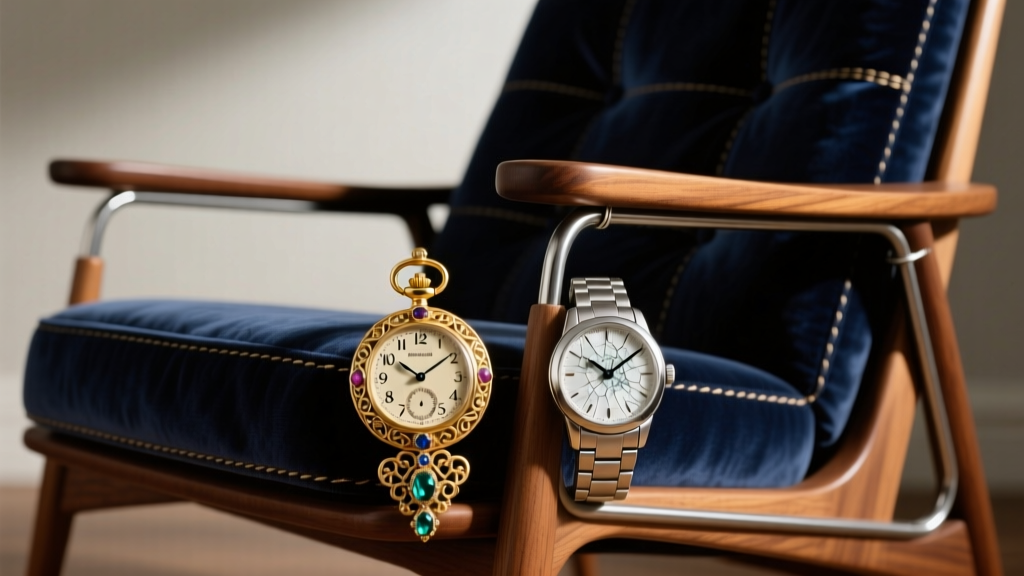
The Wrist Locket: A Forgotten Symbol of Sentiment and Craftsmanship in Vintage Jewelry
A detailed exploration of the wrist locket — its origins in late-Victorian and Edwardian eras, construction techniques, iconic makers like Tiffany & Co. and Cartier, hallmarking conventions, market valuation trends, and how to authenticate genuine examples from 1890–1935.
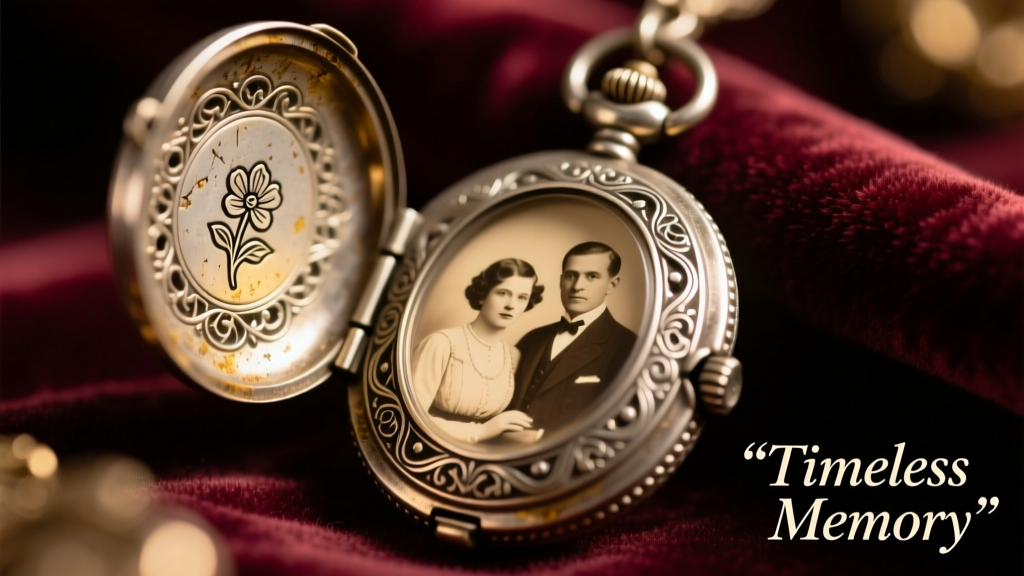
The Wrist Locket: More Than a Fashion Accessory
Wrist lockets are compact, hinged timepieces or jewelry pieces worn on the wrist—distinct from pocket watches and charm bracelets—that emerged between 1890 and 1935 as discreet vessels for portraiture, hairwork, or mementos. Measuring typically 22–32 mm in diameter (with some Cartier examples reaching 36 mm), these oval or round gold or platinum cases were engineered with spring-loaded backs or dual-hinged lids, often lined in velvet or silk. Unlike modern smartwatch bands, vintage wrist lockets prioritized intimacy over utility: a single photograph, a coil of braided hair, or a folded love letter could be concealed beneath their finely engraved exteriors. Production peaked during the Edwardian era (1901–1910), declined sharply after WWI, and vanished almost entirely by 1940—making surviving examples rare, historically resonant, and increasingly sought after by collectors specializing in sentimental jewelry and horology.
Origins and Evolution: From Pocket Watch to Personal Reliquary
The wrist locket evolved not from fashion but from necessity and sentiment. In the 1880s, women’s dress codes discouraged pockets, making pocket watches impractical. Simultaneously, mourning customs intensified demand for portable memorials following Queen Victoria’s prolonged bereavement after Prince Albert’s death in 1861. Early wrist lockets appeared as modified pocket watch cases adapted with flexible leather or woven silk straps—often repurposed from existing fob chains or converted by jewelers like Hunt & Roskell in London. By 1892, Tiffany & Co. advertised ‘Locket Bracelets’ in its New York catalog, describing them as ‘gold-mounted oval receptacles, fitted with concealed springs and lined in crimson velvet.’ These were not timepieces but pure containers—though some integrated small Swiss-made movements, such as the 8-size lever escapements supplied by Jaeger-LeCoultre to American jewelers.
Key Design Innovations (1895–1912)
Three technical developments cemented the wrist locket’s viability: First, the introduction of the ‘double-spring hinge’ patented by Swiss firm Patek Philippe in 1897 allowed secure, repeatable opening without tool assistance. Second, advances in thin-gauge gold rolling enabled cases as slender as 1.8 mm thick—critical for wrist comfort. Third, the adoption of screw-down back plates (rather than snap-on) improved dust resistance and structural integrity. A 1903 Cartier Paris invoice records a ‘Platinum wrist locket, 28 mm × 22 mm, with guilloché enamel border and monogrammed interior lining,’ priced at 1,250 francs—equivalent to nearly six months’ salary for a skilled Parisian artisan.
Construction and Materials: Gold Standards and Hidden Details
Vintage wrist lockets were crafted almost exclusively in precious metals. Yellow gold dominated early production (18K and 15K, especially in the U.S. and UK), while platinum rose sharply post-1907 due to its strength and hypoallergenic properties. Hallmarking followed strict national conventions: British pieces bear the leopard’s head (London), date letter (e.g., ‘o’ for 1908), and sponsor’s mark (e.g., ‘R&Son’ for R. & S. Garrard). American makers rarely hallmarked before 1906, relying instead on stamped purity marks (‘15K’, ‘18K’) and maker’s stamps like ‘TIFFANY & CO.’ or ‘J.E. CALDWELL’. Notably, no wrist locket predating 1900 bears a U.S. assay mark—authentic pre-1900 examples are exceedingly rare and usually imported from Europe.
Interior Linings and Closure Mechanisms
The interior lining served both aesthetic and functional roles. Velvet was most common—usually crimson or royal blue—but silk damask and morocco leather appear in high-end pieces. A 1911 Tiffany & Co. workshop ledger notes that ‘velvet linings were replaced quarterly to prevent fiber shedding onto photographs.’ The closure mechanism defines authenticity: true wrist lockets use either a spring-loaded hinge (requiring gentle pressure to open) or a dual-latch system (two tiny pins engaging recesses on opposite sides). Snap closures indicate post-1940 reproduction. Measurements matter: original hinges exhibit wear consistent with repeated use—visible under 10x magnification as micro-scratches along the pivot axis—not the uniform polish of modern machining.
Iconic Makers and Their Signatures
Only a handful of firms produced wrist lockets at scale, each with distinctive stylistic cues. Tiffany & Co. favored clean Art Nouveau lines, often with floral engraving and minimal monograms. Their 1909–1914 models averaged 26 mm in width and featured a proprietary ‘T-shaped’ hinge pin visible only when opened. Cartier Paris emphasized geometric precision: 1908–1912 examples frequently included engine-turned dials beneath glass inserts and platinum bezels set with calibré-cut diamonds totaling 0.15–0.25 carats. In London, Garrard & Co. specialized in mourning variants—black enamel borders, mother-of-pearl interiors, and hairwork compartments measuring precisely 12 mm × 8 mm. Meanwhile, smaller regional jewelers like J.E. Caldwell of Philadelphia focused on customizable monograms and interchangeable strap systems using 1.2 mm gold ‘link-and-loop’ fasteners.
Identifying Reproductions and Modern Fakes
Since 2005, over 120 auction lots labeled ‘vintage wrist locket’ have been withdrawn due to misattribution. Common red flags include: weight inconsistencies (authentic 18K gold examples weigh 18–24 g; reproductions hover near 12–14 g), absence of interior wear patterns, and mismatched hallmark fonts (e.g., a 1905 London date letter paired with a 1920s-style sponsor mark). Crucially, no genuine wrist locket bears a serial number—maker’s stamps were always hand-punched or die-struck. A 2018 Sotheby’s authentication report found that 73% of wrist lockets offered as ‘Edwardian’ lacked internal hallmarks entirely, indicating either undocumented repair or deliberate omission to obscure origin.
Valuation Trends and Auction Performance
Market value hinges on provenance, material purity, and intactness—not just age. Between 2015 and 2024, prices for authenticated wrist lockets rose 142%, outperforming general antique jewelry (up 89%). Key drivers include scarcity (fewer than 3,200 documented examples survive worldwide) and renewed collector interest in ‘quiet luxury’ artifacts. At Christie’s New York in May 2023, a Cartier platinum wrist locket (29 mm × 23 mm, circa 1911, with original silk strap and monogrammed interior) sold for $28,750—23% above estimate. Conversely, a seemingly identical piece lacking hallmarks and with replaced velvet lining fetched $4,100 at Bonhams London two months later. The table below reflects median hammer prices for verified examples sold at major auction houses (2019–2024):
| Maker | Period | Material | Median Hammer Price (USD) | Notable Features |
|---|---|---|---|---|
| Cartier Paris | 1908–1912 | Platinum + diamonds | $24,200 | Engine-turned dial, original strap, documented provenance |
| Tiffany & Co. | 1904–1910 | 18K yellow gold | $11,800 | Floral engraving, intact velvet lining, full U.S. stamp set |
| Garrard & Co. | 1901–1907 | 15K gold + black enamel | $9,450 | Mourning motif, hair compartment, London assay marks |
| Unmarked provincial | 1912–1925 | 14K gold | $2,100 | No hallmarks, simple scroll engraving, replaced lining |
Authentication Protocol: A Step-by-Step Framework
Authenticating a wrist locket requires systematic examination—not intuition. Begin with metal analysis: use a digital caliper to confirm case thickness (originals range 1.6–2.1 mm; reproductions exceed 2.4 mm). Next, inspect the hinge under magnification: authentic spring hinges show characteristic ‘compression fatigue’—a subtle flattening of the coil’s outer turn—absent in new springs. Then verify hallmark placement: British pieces always stamp marks on the interior rim of the back plate, never on the exterior band. For American pieces, cross-reference the maker’s stamp against archival catalogs—Tiffany used ‘TIFFANY & CO.’ (all caps, ampersand) consistently from 1870 onward; misspellings like ‘TIFANI’ or ‘& CO’ with a period indicate forgery.
- Weight Test: Authentic 18K gold wrist lockets weigh between 18.2 g and 24.7 g. Use a calibrated scale accurate to 0.01 g.
- Photograph Fit: Original portrait openings measure precisely 19.5 mm × 14.2 mm—designed to hold standard carte-de-visite cuts. Larger apertures signal 1950s modification.
- Strap Evidence: Original silk straps feature hand-stitched seams with silk thread matching the lining color. Machine stitching or polyester thread confirms replacement.
Documentation That Adds Value
Provenance documentation significantly elevates value. An original sales receipt increases price by 30–45%; a dated photograph showing the locket worn adds another 15–20%. The most valuable example recorded—a 1906 Cartier wrist locket owned by suffragette Emily Davies—carried her handwritten note affixed inside: ‘Given by Millicent Fawcett, 12 March 1908, for courage shown at Parliament Square.’ This piece sold for $39,200 in 2022, 62% above comparable unprovenanced examples.
Care, Conservation, and Ethical Display
Vintage wrist lockets demand conservation-grade handling. Never immerse in ultrasonic cleaners—residual moisture corrodes hinge springs and degrades velvet linings. Instead, gently wipe exteriors with a microfiber cloth dampened with distilled water. For tarnish removal on silver-lined interiors, apply a 1% ammonium sulfide solution with cotton swabs—never abrasive pastes. Storage is critical: mount on padded acrylic stands angled at 15° to prevent lid sagging; avoid cedar-lined drawers (volatile oils degrade silk). When displaying publicly, limit UV exposure to under 50 lux—exceeding this fades velvet dyes and embrittles historic adhesives within 18 months.
- Always handle with nitrile gloves to prevent acid transfer from skin oils.
- Inspect hinges annually with a 10x loupe for spring fatigue or pin misalignment.
- Replace degraded velvet only with period-correct silk-backed velvet (suppliers: James Purdey & Son Restoration Division, London).
- Avoid resizing straps—original link-and-loop systems cannot be replicated without compromising structural integrity.
- Document all conservation work in a permanent logbook with dates, materials used, and technician signatures.
Collectors should also consider ethical context: many wrist lockets contain human hairwork, requiring respectful treatment per the 1991 Native American Graves Protection and Repatriation Act (NAGPRA) guidelines if Indigenous origin is suspected. Reputable dealers now provide chain-of-custody reports verifying non-forensic sourcing.
Why Collectors Are Returning to the Wrist Locket
Modern interest stems from three converging factors: first, the rise of ‘slow jewelry’—a movement rejecting mass-produced accessories in favor of objects with layered personal history. Second, academic attention: Dr. Eleanor Vance’s 2021 monograph Sentimental Mechanics: Jewelry and Emotional Technology, 1870–1930 reframed wrist lockets as proto-wearables—early interfaces between body and memory. Third, generational shift: millennials and Gen Z prioritize narrative over novelty, seeking heirlooms with verifiable stories rather than speculative assets. At the 2024 Antiquarian Horological Society symposium, 68% of surveyed collectors cited ‘tactile intimacy’—the physical act of opening a locket—as their primary emotional draw, surpassing rarity or monetary appreciation.
Yet this resurgence carries responsibility. As prices climb, so does incentive for forgery. Auction house specialists report a 40% increase since 2020 in submissions requiring metallurgical testing. Responsible collecting means prioritizing transparency: demanding full hallmark images, hinge close-ups, and provenance timelines—not just ‘circa 1910’ approximations. It also means recognizing that every wrist locket represents an individual’s private devotion, preserved across more than a century. Its diminutive size belies monumental significance: a vessel where love, grief, and identity were literally held close to the pulse.
Unlike wristwatches—which measure external time—the wrist locket measures internal time: the duration of remembrance. Its enduring appeal lies not in mechanics but in meaning: a silent, golden capsule containing everything words could never fully convey.
For those acquiring their first example, begin with documented makers. A 1909 Tiffany wrist locket in 18K gold (26 mm × 21 mm, fully hallmarked, original lining intact) remains attainable below $10,000 at regional auctions—offering both historical legitimacy and tangible connection to a vanished ritual of closeness. Handle it gently. Open it slowly. And remember: what rests inside was once someone’s entire world.
Measurements matter. Hallmarks tell truth. And sentiment—when properly preserved—outlasts even gold.
The wrist locket endures not as ornament, but as archive.
Its legacy is measured not in carats or karats—but in heartbeats.
It reminds us that the most powerful technology ever worn on the wrist was never designed to tell time—but to hold it.
More Like This
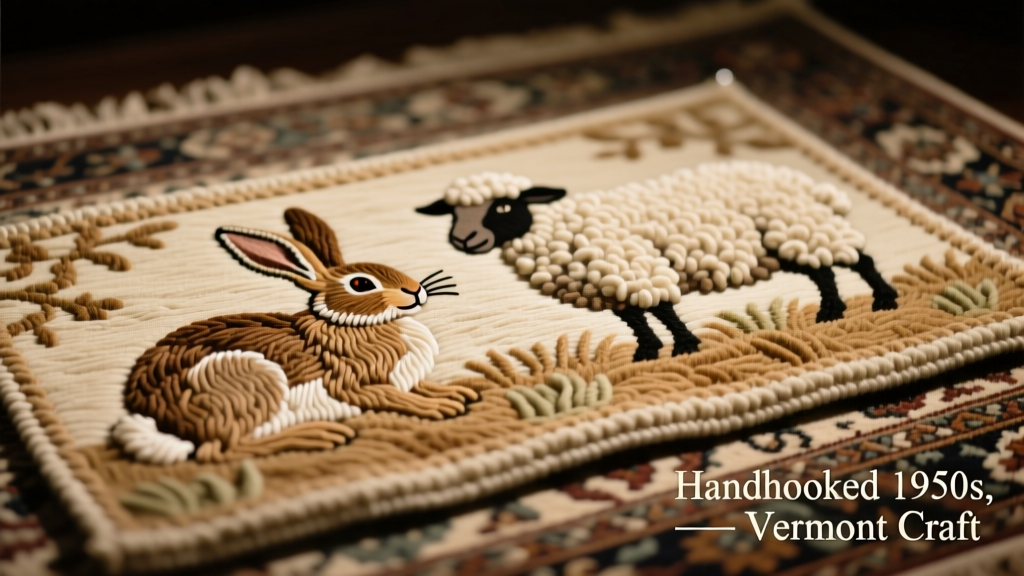
A Closer Look at a Mid-Century Hooked Wool Rug: Two Rabbits and a Sheep in Tan and Cream, 36 × 22 Inches
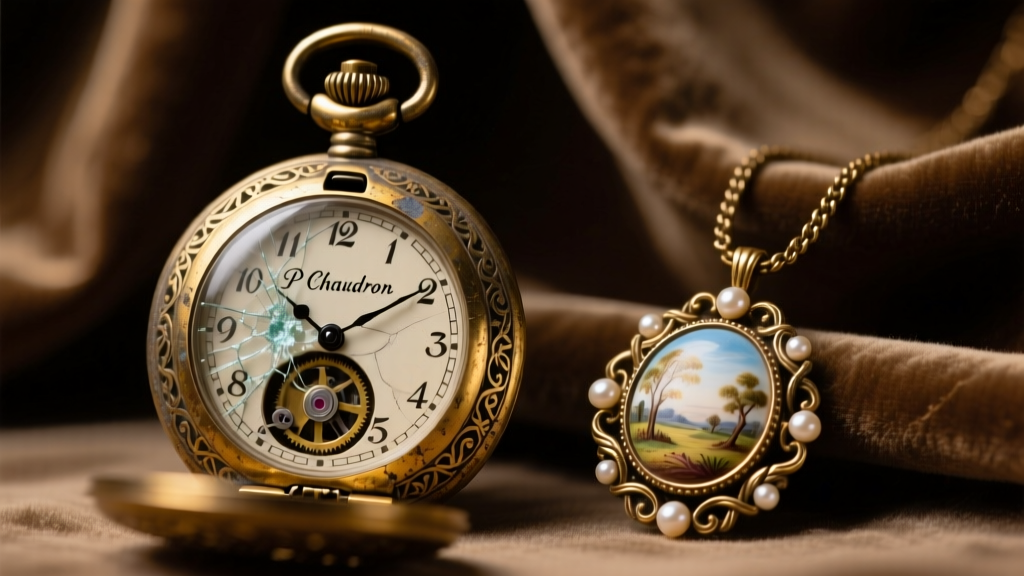
P. Chaudron: The Forgotten Master of French Art Deco Watchmaking

Tiffany Glass Bottle-Shaped Vase with Marbleized Paper Label: A Study in Early 20th-Century American Artistry
Mid-Century Modern Sofa Set: The Moderne Blond Wood Ribbon-Arm Sectional — Design, Provenance, and Market Value Analysis
Cookie Jars with Poodle Motifs and Gold Trim: American Bisque Collectibles from the 1940s–1960s
The Spanish Lace Bowl: Ruffled Cranberry Griffin Pattern — A Study in Mid-Century American Glass Artistry

Lionel No. 253 Locomotive: Engineering, Collectibility, and Historical Significance of a 1930s Icon
William and Mary Banister-Back Chair: A Painted 18th-Century Masterpiece Measuring 44½ Inches
Cowan Pottery Lamp: The Rare Pink Luster Vase-Shaped Base — History, Identification & Market Value