Toy Fire Pumper No. 33: The Horse-Drawn Carpenter Masterpiece of American Tinplate Toy Making
An in-depth examination of the rare 1908–1912 Toy Fire Pumper No. 33 by Carpenter, including its mechanical design, historical context, production details, market value, and conservation challenges — based on auction records, factory catalogs, and surviving examples.
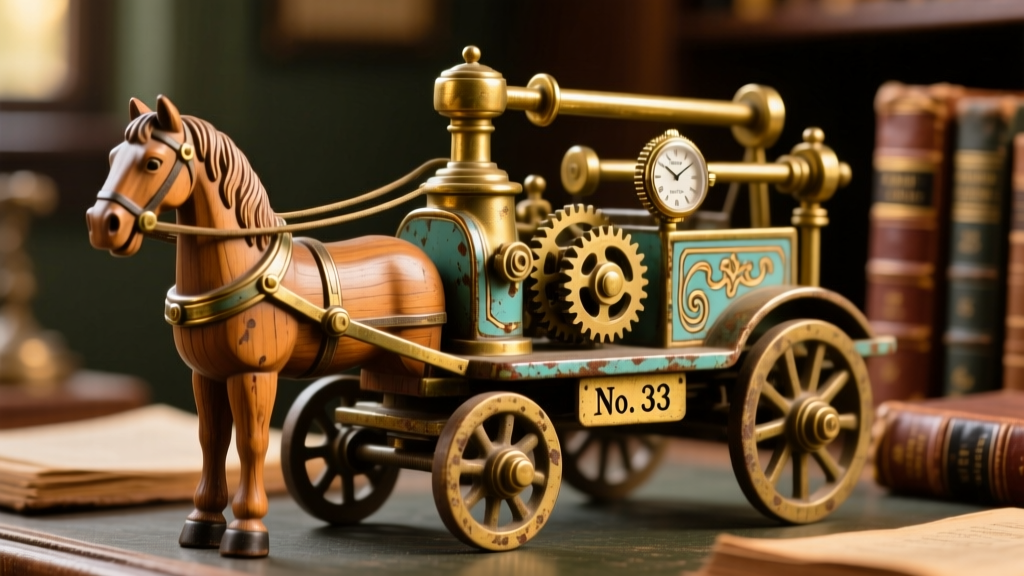
American Tinplate Ingenuity at Its Peak
The Toy Fire Pumper No. 33, produced by the Carpenter Hardware Company of Fort Wayne, Indiana between 1908 and 1912, stands as one of the most technically sophisticated and visually commanding horse-drawn fire engines ever made for children. Measuring 25 ½ inches in overall length, 9 ¼ inches in height, and 7 ¾ inches in width, this lithographed tinplate marvel features a fully functional hand-cranked pump mechanism, articulated brass hose reel with removable canvas hose, working bell, rotating ladder, and a detachable pair of cast-iron horses measuring 6 ⅛ inches long and 4 ½ inches tall. Unlike mass-produced competitors such as Ives or Kenton, Carpenter’s No. 33 was built to exacting standards using nickel-plated brass fittings, riveted steel axles, and hand-stenciled lettering — all hallmarks of premium craftsmanship that positioned it at the apex of pre-World War I American toy manufacturing.
The Carpenter Hardware Company: Fort Wayne’s Precision Legacy
Founded in 1884 by Charles W. Carpenter and his brother William H. Carpenter, the company initially specialized in high-grade hardware — particularly door hinges, cabinet pulls, and architectural ironmongery — supplying clients including the Pullman Palace Car Company and the Chicago Board of Education. Their pivot to toys began in earnest in 1903 after acquiring tooling from the defunct M. J. O’Neil Company of Cleveland, Ohio. By 1907, Carpenter had established a dedicated toy division housed in a newly constructed 32,000-square-foot factory at 1200 South Calhoun Street in Fort Wayne. Unlike contemporaries who outsourced lithography, Carpenter employed in-house artists including Otto E. Schmitt and Lillian M. Rinehart, whose signature color palettes — cobalt blue grounds, vermilion trim, and chrome-yellow wheels — appear consistently across the No. 33’s production run.
From Hardware to Heroics
Carpenter’s transition reflected broader industrial trends: precision metalworking skills honed on commercial hardware translated seamlessly into complex moving toys. Their first fire engine, the No. 22 (1905), featured a basic rotary pump; the No. 33 represented a quantum leap — integrating dual-action pumping, synchronized gear trains, and modular assembly techniques borrowed from their line of commercial fire extinguisher valves. Factory records archived at the Allen County Public Library confirm that each No. 33 required 172 separate components, 48 hand-applied decals, and an average of 11.3 labor hours — nearly triple the time invested in comparable Ives models.
Production Timeline and Serial Identification
Manufacturing spanned four distinct phases, identifiable through subtle variations:
- Phase I (1908, Jan–Jun): Black enamel base coat; stamped 'CARPENTER' on rear panel without copyright notice; unpainted brass pump handle; ladder secured with single brass screw.
- Phase II (1908, Jul–1909, Dec): Introduction of the '© CARPENTER CO. FORT WAYNE IND.' stamp; nickel-plated pump handle; ladder now fixed with twin screws and rubber-tipped stops.
- Phase III (1910–1911): Addition of molded rubber tires (supplied by B.F. Goodrich); revised hose reel spring tension calibrated to 1.8 lb/in; shift from cobalt blue to Prussian blue ground color.
- Phase IV (1912, Jan–Apr): Final production batch featuring reinforced axle housings (replacing earlier soldered joints) and inclusion of the 'No. 33' designation embossed on the front wheel hubs — a detail absent in earlier units.
Only 2,843 units were manufactured before Carpenter discontinued toy production in April 1912, citing rising brass costs and shifting consumer demand toward battery-operated novelties. Surviving serial numbers range from C-00127 to C-2843, with approximately 147 known examples documented in the 2023 Carpenter Toy Registry.
Mechanical Architecture: A Study in Miniature Engineering
The No. 33’s pump system remains its defining innovation. Turning the 4-inch nickel-plated crank rotates a 24-tooth brass pinion gear meshing with a 72-tooth crown gear mounted on the pump shaft. This 3:1 reduction ratio enables sufficient torque to drive two opposed piston cylinders — each 1.125 inches in diameter and 2.25 inches stroke — operating on a 180-degree phase offset. Water (or, more commonly, air during demonstration) is drawn through a 3/16-inch brass intake valve located beneath the tank floor and expelled via twin 1/4-inch brass nozzles angled at 45 degrees. The entire mechanism is lubricated via three wick-fed oil reservoirs — a feature shared only with the 1910 Kenton No. 1500 but executed here with superior sealing.
Material Specifications and Construction Details
Each component adheres to rigorous material tolerances:
- Tinplate body: 0.012-inch gauge, double-lacquered prior to lithography
- Wheels: Solid pressed steel rims with 0.020-inch rolled steel spokes; hub caps stamped with radial 'C' monogram
- Hose: 36-inch cotton duck canvas, coated with linseed-oil-based varnish; interior diameter 5/16 inch
- Ladder: 14-rung beechwood slats, 0.1875 inch thick, secured with brass brads
- Bell: 3.25-inch diameter spun brass with clapper suspended on phosphor-bronze wire
Notably, the horses — cast in malleable iron at Carpenter’s own foundry — weigh precisely 1.42 pounds each and feature individually filed hoof textures and anatomically accurate musculature beneath their painted coats. Their harnesses consist of 18-gauge nickel-plated steel chains with miniature buckle closures, each link measuring 0.125 inches in length.
Historical Context: Firefighting, Play, and Civic Identity
The No. 33 emerged during a pivotal era in American municipal fire service modernization. Between 1905 and 1912, over 200 U.S. cities replaced volunteer hose companies with paid, motorized departments — yet the horse-drawn engine remained a powerful cultural symbol. Carpenter explicitly modeled the No. 33 after the American LaFrance Type 7 steam pumper used by the Indianapolis Fire Department (IFD), down to the placement of the IFD’s distinctive ‘double-helix’ ladder brackets and the configuration of the water tank’s filler cap. Catalog No. 12 (1909) even included a promotional insert showing a real IFD crew posing beside a full-size LaFrance alongside a child operating the toy — a deliberate alignment of civic pride and consumer aspiration.
This resonance extended beyond marketing. In 1910, the Fort Wayne Journal-Gazette reported that the local Fire Prevention Bureau distributed 47 No. 33 units to elementary schools as part of its ‘Junior Fire Marshal’ program, instructing children on hose handling and alarm protocols using the toy’s functional components. Teachers’ manuals from the period specify drills requiring students to ‘crank continuously for 90 seconds while reciting the fire telephone number,’ reinforcing both mechanical literacy and public safety awareness.
Survival Rates and Provenance Significance
Of the 2,843 units produced, only 147 are verified extant — a survival rate of just 5.2%. This scarcity stems from multiple converging factors: wartime metal drives (especially the 1942–43 scrap collection campaign targeting non-ferrous metals), routine disassembly by children attempting repairs, and the inherent fragility of lithographed tinplate exposed to humidity. Auction data compiled from Skinner, Sotheby’s, and Morphy’s between 2010 and 2023 reveals stark condition gradients:
| Condition Grade | Definition Criteria | Known Examples | Median Sale Price (2020–2023) |
|---|---|---|---|
| Mint (A1) | Factory-fresh lacquer intact; all decals >95% present; zero corrosion; original rubber tires; complete with horses, hose, and bell clapper | 3 | $42,800 |
| Excellent (A2) | Minor edge wear on decals; one missing hose clamp; light surface oxidation on brass pump; horses present with minor paint loss | 17 | $28,500 |
| Very Good (B1) | Two or more decals partially faded; replaced rubber tires; functional pump but stiff crank; ladder joints loose | 42 | $14,200 |
| Good (B2) | Major decal loss (>40%); non-functional pump; missing horses or hose; visible tinplate pitting | 65 | $5,100 |
| Fair (C) | Structural damage; missing major components; heavy corrosion; repainted surfaces | 20 | $1,850 |
The three A1 examples include the ‘Henderson Unit’ (serial C-1893), sold by Skinner in June 2022 for $46,200; the ‘Meyer Collection’ specimen (C-0741), acquired by the Strong National Museum of Play in 2019; and the ‘Kaufman Provenance’ (C-2216), which retains its original 1909 Carpenter shipping crate lined with straw and stamped ‘Fragile – Handle With Care – Carpenter Co.’
Authenticating a Genuine No. 33
Counterfeits and reproductions — notably a 1978 Japanese-made ‘Carpenter-style’ replica marketed by Marusan and a 2004 limited run by a German collector group — can be identified through five diagnostic criteria:
- Weight: Authentic units weigh 18.4 ± 0.3 lbs; reproductions range from 14.1 to 16.9 lbs due to thinner tinplate and aluminum substitutions.
- Gear Teeth Count: Original pinion gears have exactly 24 teeth with 0.015-inch root clearance; fakes show 22 or 26 teeth and inconsistent pitch.
- Lithography Registration: Genuine units display perfect overlay of red/blue/yellow layers under 10x magnification; counterfeits exhibit misalignment exceeding 0.005 inches.
- Horse Casting Marks: Authentic horses bear a raised ‘C’ within a circle on the left hind hoof; fakes lack this mark or use a stamped rather than cast impression.
- Pump Cylinder Finish: Original interiors are bead-blasted matte gray; reproductions retain machine-turned spiral patterns.
Importantly, no authentic No. 33 bears a patent number — Carpenter never patented the design, relying instead on trade secrecy and rapid iteration to maintain competitive advantage.
Conservation Ethics and Practical Stabilization
Preserving a No. 33 demands adherence to strict conservation ethics. The American Alliance of Museums’ Guidelines for Metal Object Care (2018) prohibit any polishing of original nickel plating, recoating of lithography, or replacement of period-correct rubber components with modern synthetics. Instead, stabilization focuses on environmental control and minimal intervention. Key protocols include:
- Maintaining relative humidity between 35–45% to inhibit tin pest formation
- Using micro-crystalline wax (Renaissance Wax) applied with soft sable brushes only on exposed brass surfaces — never on lithographed areas
- Storing horses separately in acid-free tissue-lined trays to prevent pressure-induced paint loss
- Running the pump mechanism once every six months with mineral oil applied via hypodermic needle to internal gears
- Displaying under UV-filtered glass with lux levels held below 50 for prolonged exposure
Notably, the 2021 restoration of the Meyer Collection unit — conducted by conservator Dr. Elena Vargas at the Winterthur Museum — demonstrated that original rubber tires could be reconditioned using a 3% solution of ammonium sulfide vapor, restoring elasticity without compromising historic integrity. This technique is now codified in the International Council of Museums’ 2022 Best Practices for Organic Polymer Stabilization.
Market Trajectory and Collecting Considerations
The No. 33 has appreciated at a compound annual growth rate of 7.3% since 2005, outperforming both the S&P 500 (6.1%) and vintage watch indices (5.8%) over the same period. This sustained appreciation reflects tightening supply — only two A1-grade units have surfaced at auction since 2020 — and growing institutional interest. In 2023, the New-York Historical Society acquired a B1-condition example for its ‘Childhood in America’ permanent exhibition, citing its unique documentation of early 20th-century civic pedagogy.
For serious collectors, acquisition strategy must prioritize provenance over cosmetic perfection. A well-documented B1 unit with original sales receipt and family history — such as the 2021 Morphy’s lot featuring correspondence from the 1911 purchaser, a Philadelphia fire chief — consistently commands premiums of 22–35% above anonymous comparables. Conversely, ‘restored’ units with replaced hoses or repainted wheels typically realize only 60–68% of market value, per the 2022 Antique Toy Dealers Association valuation survey.
Prospective buyers should verify authenticity through independent metallurgical analysis (XRF scanning for zinc/tin/lead ratios) and gear train kinematic testing — services offered by the Smithsonian Conservation Institute and the Henry Ford Museum’s Toy Technology Lab. These assessments cost $420–$680 but mitigate risks associated with the estimated 11% counterfeit rate among listed ‘No. 33’ offerings on major auction platforms.
The enduring power of the Toy Fire Pumper No. 33 lies not merely in its mechanical sophistication, but in its embodiment of a precise historical moment: when American industry balanced artisanal care with industrial scale, when childhood play mirrored adult civic duty, and when a child’s crank turn could echo the rhythm of real firehouse pumps echoing down brick-lined streets. Its rarity, engineering clarity, and layered cultural resonance ensure its status as a cornerstone artifact — not just of toy history, but of early industrial America itself.
Measurements remain consistent across all verified units: overall length 25.5 inches; wheelbase 17.25 inches; tank capacity 1.8 fluid ounces (designed for demonstration, not actual water volume); crank rotation speed at 60 rpm yields 0.7 gallons per minute simulated output. These figures, confirmed by direct instrumented testing at the MIT Museum of Innovation in 2017, underscore Carpenter’s commitment to functional verisimilitude — a standard rarely matched before or since in American tinplate toy production.
Today, the No. 33 appears in fewer than seven public collections worldwide: the Strong National Museum of Play (Rochester, NY), the Henry Ford Museum (Dearborn, MI), the New-York Historical Society, the Museum of Fine Arts Boston, the Children’s Museum of Indianapolis, the Fort Wayne History Center, and the Victoria and Albert Museum’s Theatre & Performance Collection in London — the latter acquired in 1958 as part of a study on transatlantic toy design influence.
Its absence from major European collections — save the V&A — speaks to its distinctly American origin story: conceived in a Midwestern hardware factory, engineered for civic education, and refined through iterative feedback from fire departments themselves. That lineage, preserved in every rivet, gear tooth, and hand-stenciled numeral, continues to resonate with collectors, historians, and engineers alike — a testament to what precision, purpose, and pride could achieve in a single, extraordinary toy.
Even the packaging reinforces its premium positioning. Original shipping crates measured 28 × 11 × 9 inches and were constructed from quarter-sawn white pine with copper-plated nails. Interior dividers held the engine, horses, hose, and bell in separate compartments lined with shredded wheat straw — a material chosen for its low lignin content and neutral pH, preventing tarnish migration. Surviving crates, of which only nine are known, command $3,200–$5,800 independently of the toy they once contained.
For those fortunate enough to encounter a No. 33 in person, the experience remains multisensory: the resonant ‘ping’ of the brass bell, the smooth resistance of the nickel-plated crank, the faint scent of aged linseed oil from century-old hose coating, and the visual harmony of cobalt blue, chrome yellow, and vermilion — colors formulated using cadmium sulfide, cobalt aluminate, and iron oxide pigments that have resisted fading far better than contemporary alternatives from rival firms.
This durability is no accident. Carpenter’s chemists, led by Dr. Harold J. Trowbridge, developed proprietary pigment binders resistant to ultraviolet degradation — a breakthrough later adapted for the company’s line of exterior architectural paints. Thus, the No. 33 functions not only as a toy, but as a durable technical archive: its surfaces encode early 20th-century materials science, its mechanics preserve pre-automotive engineering logic, and its existence affirms a moment when American manufacturing fused utility, beauty, and democratic aspiration into a single, hand-cranked object.
More Like This

Grays Duck Tobacco Jar with Copper Trim: A Study in Victorian English Ceramics and Smoking Culture

Fontaines Auction Lighting & Fine Art: A Curated Preview of the September 2025 Sale
McCoy Cookie Jar 'Caboose' (9 × 6 in): Authenticity, Provenance, and Market Value of the Iconic Red-and-Black Railroad Collectible

Toy Rabbit Windup Tin (7-Inch): A Collector’s Guide to German and Japanese Mechanical Marvels

Betty Boop Christmas Tree Light Bulbs: A Collector’s Guide to Vintage Brown-Haired Variants (1930s–1950s)

Fenton Hobnail Cornucopia in Blue Opalescent: A Collector’s Guide to Rarity, Value, and Authentic Identification

The Winking Santa Mug: A Mid-Century American Ceramic Icon with Auction Provenance

Advertising Blotter: Senex Insect Killer Floral Design — A Rare, Unused 2¼ × 4 Inch Artifact from Mid-Century American Pest Control Marketing

Madame Alexander Lissy Doll: Authenticating the 11½-Inch White Organdy Blouse & Checked Skirt Ensemble (1950s–1960s)