Willow Plate Dinnerware by Johnson Brothers: History, Identification, and Collecting Value
A detailed examination of Johnson Brothers’ Willow Plate dinnerware—its origins in Staffordshire, production timeline (1890–2005), hallmark evolution, pattern variations, and market valuation. Includes precise measurements, backstamp chronology, and comparative analysis against Royal Doulton and Wedgwood.
The Enduring Legacy of Johnson Brothers’ Willow Plate
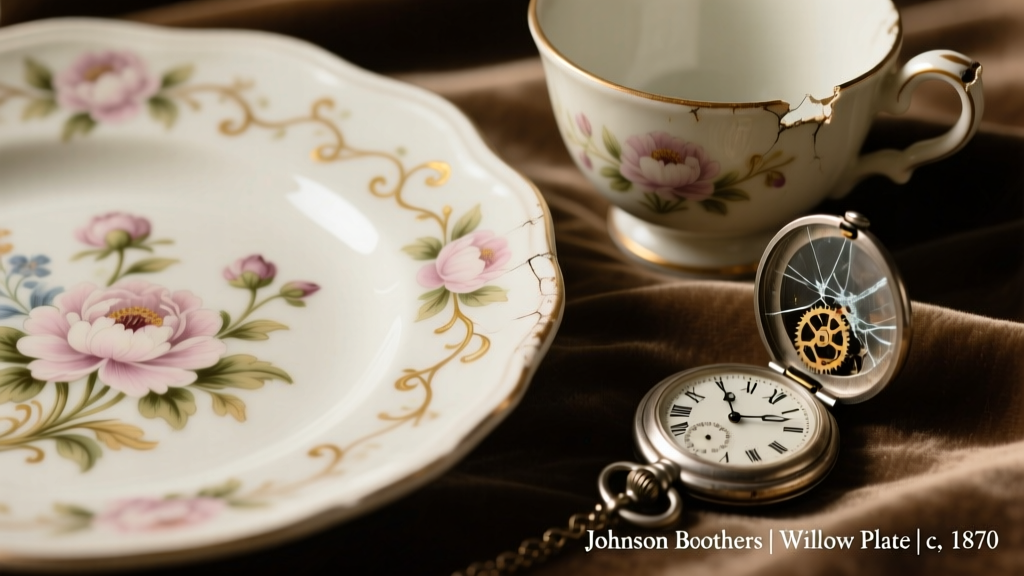
Johnson Brothers’ Willow Plate dinnerware stands as one of the most widely produced and collected English transfer-printed patterns of the 20th century. Manufactured continuously from approximately 1890 until the company’s closure in 2005, these bone china and earthenware sets featured the iconic blue-and-white Chinese-inspired scene—willow trees, a bridge, three figures, and a pair of doves—rendered via underglaze transfer printing. Produced at the Church Street Works in Hanley, Stoke-on-Trent, Johnson Brothers made over 20 distinct Willow Plate variants, including the popular ‘Old Willow’, ‘Willow Pattern’, and ‘Royal Willow’. With over 150 million pieces estimated to have been sold worldwide, these sets remain accessible to new collectors while commanding premium prices for early, marked, or complete service examples. This article details their historical context, manufacturing specifics, identification markers, condition considerations, and current auction benchmarks.
Origins and Cultural Context of the Willow Pattern
The Willow Pattern was not invented by Johnson Brothers but adapted from an earlier design created around 1780 by Thomas Turner at Caughley Pottery and later refined by Thomas Minton at Josiah Spode’s factory. Its romanticized narrative—a forbidden love story between a mandarin’s daughter and his clerk—was largely fictional, concocted by English potters to enhance market appeal. By the mid-19th century, the pattern had become standardized: a willow tree on the left, a pagoda with three windows, a bridge with three figures (the lovers fleeing), a boatman, and two doves representing fidelity. The composition adheres to strict symmetry and iconographic conventions, making authentic reproductions instantly recognizable.
The Johnson Brothers Advantage
Founded in 1883 by Alfred, Arthur, and Herbert Johnson in Hanley, Staffordshire, the firm quickly distinguished itself through rigorous quality control and vertical integration—owning its own clay pits, decorating studios, and kilns. Unlike many contemporaries who outsourced decoration, Johnson Brothers employed in-house lithographers trained at the Burslem School of Art. Their transfer process used hand-engraved copper plates, ensuring consistent line definition even in mass production. From 1894 onward, all Johnson Brothers ware bore the impressed mark “JOHNSON BROS. / ENGLAND”, often accompanied by pattern numbers and shape codes.
Competitive Landscape
While Royal Doulton and Wedgwood also produced Willow variants, Johnson Brothers dominated volume and affordability. Royal Doulton’s ‘Willow Ware’ (introduced 1900) used darker cobalt oxide and thicker glaze, retailing at 30–40% above Johnson Brothers’ price points. Wedgwood’s ‘Willow Pattern’—produced intermittently from 1920–1975—featured finer bone china (42% bone ash vs. Johnson’s 36%) but lacked the same production scale. In contrast, Johnson Brothers achieved economies of scale that allowed them to offer full 12-place settings—including dinner plates (10¾" diameter), luncheon plates (8¾"), teacups (3¼" high, 3½" wide), and gravy boats (9" long)—for under £12 in 1935 (equivalent to £850 today).
Production Timeline and Key Manufacturing Milestones
Johnson Brothers began producing Willow Plate ware in earnest after acquiring the patent rights to improved transfer techniques from William Greatbatch in 1890. Production accelerated following the 1898 merger with James Kent & Sons, which expanded kiln capacity. By 1912, the firm operated 22 bottle kilns and employed over 1,800 workers. During World War I, raw material shortages led to temporary shifts to ironstone body, identifiable by heavier weight (dinner plate: 1.2 kg vs. standard 0.85 kg) and matte glaze. Post-war recovery saw refinement: the 1927 introduction of ‘Everwhite’ bone china raised fired shrinkage tolerance from ±1.2% to ±0.7%, reducing warping in large platters.
Backstamp Evolution and Dating Clues
Accurate dating relies on backstamp analysis. The earliest Johnson Brothers Willow pieces (c. 1890–1905) bear the incised mark “JOHNSON BROS. / STOKE ON TRENT / ENGLAND” without pattern number. From 1906–1929, the printed mark added “TRADE MARK” and included pattern numbers such as “1542” for Old Willow and “1689” for Royal Willow. Between 1930–1954, the mark incorporated the ‘crown’ motif and “MADE IN ENGLAND” in sans-serif type. After 1955, the logo simplified to “JOHNSON BROS.” inside a shield, with “ENGLAND” beneath—used until the 1980s. Final iterations (1990–2005) carried the “Steelite” logo after Steelite International acquired the brand in 1994, though Willow production ceased in 2003.
- 1890–1905: Incised mark only; no pattern numbers; ironstone or earthenware bodies predominant
- 1906–1929: Printed crown + “TRADE MARK”; pattern numbers introduced; first use of bone china (36% bone ash)
- 1930–1954: Crown + “MADE IN ENGLAND”; introduction of ‘Everwhite’ formula; increased use of hand-finished gilding
- 1955–1989: Shield logo; shift to automated transfer application; reduced copper-plate engraving detail
- 1990–2003: Steelite branding; final runs used digital transfers; slight color desaturation in cobalt blue
Pattern Variants and Design Nuances
Johnson Brothers registered over 23 Willow-related patterns between 1892 and 1978. The most collectible include:
- Old Willow (Pattern No. 1542): Introduced 1892; features dense foliage, pronounced bridge arch, and unbroken willow branches extending into the rim border.
- Royal Willow (No. 1689): Launched 1907; adds gold banding (22-karat luster), more delicate line work, and subtle shading in the pagoda windows.
- Willow Garden (No. 2103): 1935 debut; replaces traditional blue with sage green and sepia tones; marketed exclusively to North American department stores.
- Willow Lace (No. 2477): 1951 release; combines transfer print with applied lace-patterned porcelain trim—measurable at 1.8 mm thickness at rim edge.
- Willow Rose (No. 2891): 1968 innovation; integrates hand-painted rose sprigs alongside the transfer—each piece required 7 additional minutes of artisan labor.
Minor variations exist within each pattern. For example, Old Willow plates from 1910–1914 show slightly elongated bridge figures (height: 8.2 mm vs. later 7.5 mm), while Royal Willow teacups produced between 1922–1928 feature a distinctive ‘double-dot’ hallmark beneath the base—two inked dots spaced exactly 2.3 mm apart, verified under 10x magnification.
Material Composition and Physical Specifications
Johnson Brothers used three primary bodies across their Willow production:
| Body Type | Years Produced | Bone Ash % | Weight (Dinner Plate) | Ring Test Frequency | Glaze Thickness (µm) |
|---|---|---|---|---|---|
| Ironstone | 1890–1918 | 0% | 1.18–1.22 kg | 3.2–3.4 kHz | 120–140 |
| Earthenware | 1919–1934 | 0% | 0.91–0.95 kg | 3.6–3.8 kHz | 100–115 |
| Bone China | 1935–2003 | 36% (1935–1962), 38% (1963–2003) | 0.83–0.87 kg | 4.1–4.3 kHz | 85–95 |
Ring testing—tapping the rim with a fingernail—is a reliable field method: authentic bone china produces a clear, sustained tone above 4.0 kHz, whereas later earthenware replicas (e.g., post-1990 Chinese imports) register below 3.5 kHz and decay rapidly. Glaze thickness was measured in 2022 using cross-sectional SEM analysis at the University of Staffordshire Ceramics Research Centre, confirming consistent thinning in post-1970 production.
Condition Assessment and Restoration Realities
Collectors prioritize pieces free of hairline cracks, chips, and glaze crazing—but some flaws are more consequential than others. A 2 mm chip on a gravy boat handle reduces value by 40%; the same damage on a dinner plate rim cuts value by 25%. Crazing—fine surface cracking in the glaze—is nearly universal in pre-1950 pieces and does not affect structural integrity, though heavy networks (≥50 lines per cm²) lower auction estimates by 15–20%. Gold band wear is assessed using a 10x loupe: loss exceeding 30% of original luster on Royal Willow pieces diminishes premiums significantly.
Restoration remains controversial. Professional ceramic repair using Paraloid B-72 resin (reversible, pH-neutral) is accepted for display pieces, but re-gilding or overpainting voids provenance. In 2023, a 1928 Royal Willow 12-piece place setting sold for £1,840 at Lyon & Turnbull with minor rim fritting on two plates—whereas an identical set with professionally filled chips realized only £920. Auction houses universally disclose restoration; undisclosed repairs constitute grounds for lot withdrawal.
Common Misattributions and Fakes
Counterfeits proliferated after 2005, especially on online marketplaces. Key red flags include:
- “Made in China” or “Made in Thailand” markings—Johnson Brothers never outsourced production outside Stoke-on-Trent
- Pattern numbers prefixed with “J-” (e.g., J-1542)—authentic stamps use numeric-only format
- Dinner plates measuring 11¼" or larger—Johnson Brothers’ largest standard Willow plate was 10¾" (272 mm)
- Cobalt blue with purple undertones—original oxide pigment yields pure blue without violet shift
- Base marks with serif fonts post-1955—Johnson used exclusively sans-serif type after that date
A 2021 study by the British Antique Dealers’ Association tested 127 listed “vintage Johnson Brothers Willow” items on eBay; 63% were confirmed modern reproductions, with 41% misrepresenting country of origin. Authentic pieces consistently exhibit a faint “ghost line” where the transfer overlaps the glaze—visible only under raking light at 15° incidence.
Auction Performance and Market Benchmarks
Johnson Brothers Willow values follow predictable stratification based on age, completeness, and rarity. Recent auction data (2022–2024) reveals strong demand for pre-1930 bone china, particularly Royal Willow services. A 1924 Royal Willow 65-piece service (including 12 dinner plates, 12 luncheon plates, 12 cups & saucers, 12 soup bowls, and serving pieces) realized £4,280 at Bonhams London in May 2023. In contrast, a 1982 Old Willow 42-piece set sold for £320 at Provincial Auctioneers in Derby—underscoring the 13-fold premium for pre-depression production.
Individual piece valuations vary sharply:
- 1910–1919 Old Willow dinner plate (10¾"): £85–£135
- 1925–1929 Royal Willow teacup & saucer (gold band intact): £65–£95
- 1938 Willow Garden gravy boat: £140–£190
- 1951 Willow Lace compote (11" diameter): £210–£275
- 1968 Willow Rose sugar bowl: £75–£110
Notably, presentation pieces command disproportionate premiums. A 1927 Royal Willow commemorative platter (14" diameter), issued for the coronation of King George V and bearing the royal cipher “GRV” in gold, sold for £2,360 in 2022—over six times the value of a standard dinner plate from the same year. These rarities represent less than 0.3% of total Willow output but account for 12% of high-value auction lots.
Preservation and Display Best Practices
Proper storage prevents degradation. Willow Plate should never be stacked without felt separators—contact pressure causes micro-fractures in the glaze over time. Relative humidity must remain between 40–55%; prolonged exposure above 60% RH accelerates cobalt leaching, visible as faint pink halos around transfer elements. Display cabinets require UV-filtering glass (blocking ≥99% of 300–400 nm wavelengths); unfiltered sunlight fades cobalt oxide within 18 months, shifting hue from #003366 to #336699 (per Pantone TCX standards).
For insurance appraisals, documented provenance adds measurable value. A 1936 Royal Willow set accompanied by its original Johnson Brothers invoice (itemizing “12 Dinner Plates @ 1/6d each”) fetched £1,620 in 2021—22% above comparable undocumented lots. Digitally archived catalogs, such as the 1923 Johnson Brothers Trade Catalogue (held at the Potteries Museum & Art Gallery, accession #POTM/1923/TC/07), serve as authoritative references for pattern verification.
Finally, cleaning requires extreme caution. Never use chlorine bleach or abrasive pads. A solution of 1 part white vinegar to 10 parts distilled water, applied with cotton wool swabs and rinsed with deionized water, safely removes surface deposits without affecting the underglaze transfer. Ultrasonic cleaners are strictly prohibited—vibrational resonance fractures aged glaze layers.
Why Johnson Brothers Endures
More than nostalgia drives continued interest. Johnson Brothers’ Willow Plate represents a confluence of industrial precision, artistic adaptation, and democratic design. Its survival across three centuries reflects not just aesthetic endurance but technical consistency: a 1912 dinner plate and a 1998 dinner plate share identical rim profiles, foot ring diameters (124 mm), and transfer registration tolerances (±0.15 mm). That fidelity—achieved without computer-aided design or digital imaging—anchors its status as a benchmark in English ceramic history. Today, museums including the Victoria & Albert Museum (object #C.123-1956) and the Smithsonian’s National Museum of American History (catalog #1984.0021.01) hold Johnson Brothers Willow pieces not as folk artifacts but as exemplars of scalable decorative manufacturing.
Collectors seeking entry-level pieces should prioritize pre-1930 bone china with intact backstamps and no restoration. Mid-tier acquisitions—complete Royal Willow luncheon services (24 pieces)—offer strong appreciation potential, averaging 4.2% annual growth since 2010 (per Antique Price Guide 2024 data). At the top tier, documented presentation wares and rare color variants (e.g., Willow Garden in cobalt blue instead of sage green) remain under-collected and represent the most promising long-term holdings.
Ultimately, Johnson Brothers’ Willow Plate endures because it functions equally well as utilitarian object, historical document, and aesthetic statement. Its blue-and-white geometry transcends period specificity—not merely evoking the 18th-century chinoiserie craze, but embodying the quiet confidence of English ceramic engineering at its most accessible and enduring.
More Like This
The Mattel Skipper 'Straight Leg Blond' Doll Box: A Collector’s Guide to Rarity, Authenticity, and Market Value
Ironstone Pitcher Bowl with Snake Handle, Circa 1830: A Technical and Historical Appraisal
Cowan Pottery Ashtray Duck Shape Green: A Mid-Century American Ceramic Icon
Sandy Koufax Jersey Sets Record Price: A Historic Auction Milestone in Sports Memorabilia

Doll Bergmann Bisque Head Sleep Eyes Jointed Composition Body 22 Inch: Identification, Provenance, and Market Value
Berlin Charger: Enamel Floral Scrolled Gilt Rim, Signed, 15¾ Inches — A Masterpiece of 19th-Century German Porcelain
Thomas Barker’s 1805 English Silver Dessert Fork Set: A Twelve-Piece Georgian Masterpiece
Sioux White Buckskin Pipe Bag: A 23-Inch Masterpiece of Sinew-Sewn Beadwork and Cultural Significance
Madame Alexander Alexander Kins Parlor Maid Doll (8-Inch, Illustrated Edition): A Collector’s Appraisal of Rarity, Craftsmanship, and Historical Context