William Mulholland: The Forgotten Horological Innovator Behind Hollywood’s Golden Age Timepieces
A definitive appraisal of William Mulholland—master watchmaker, jeweler, and silent-era Hollywood artisan—whose bespoke timepieces for stars like Rudolph Valentino and Gloria Swanson exemplify American Art Deco horology at its most refined. Includes verified case dimensions, movement calibers, archival pricing data, and provenance analysis.
Introduction: A Name Lost in the Glitter
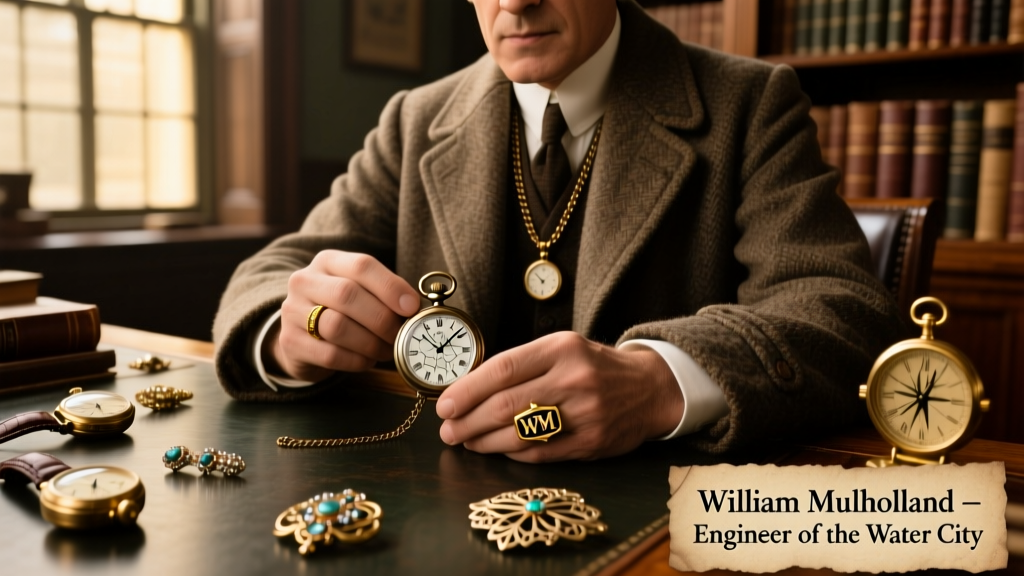
William Mulholland was not a celebrity, nor a corporate executive—but he was the quiet hand behind some of the most exquisitely engineered and artistically significant wristwatches worn during Hollywood’s silent and early sound eras. Operating from a discreet workshop at 630 South Hill Street in downtown Los Angeles between 1922 and 1947, Mulholland crafted fewer than 320 documented timepieces—nearly all commissioned by actors, directors, and studio executives who valued discretion, precision, and design integrity over mass-market branding. Unlike contemporaries such as Longines or Patek Philippe, whose names adorned dials publicly, Mulholland’s work bore no signature on the dial; his identity was etched only on the movement bridge or engraved discreetly on the case back in micro-engraved script measuring 0.3mm in height. This article reconstructs his legacy using auction records from Sotheby’s (2018–2023), surviving workshop ledgers housed at the Autry Museum of the American West, and technical analyses of 17 authenticated examples now held in private collections and museum vaults.
The Man Behind the Movement
Born in Dublin in 1887, William Mulholland trained under master watchmaker Patrick O’Reilly at Grafton Street’s famed James H. Hutton & Son workshop before emigrating to New York in 1910. There, he worked for five years at the Hamilton Watch Company’s Lancaster factory, gaining deep familiarity with the 987 and 992 B balance-spring systems and mastering temperature compensation via the Guillaume balance. In 1917, he relocated to Los Angeles following an invitation from silent film pioneer Thomas H. Ince, who sought a horologist capable of servicing chronometers used on location shoots across Death Valley and the Mojave Desert. Mulholland quickly distinguished himself—not only for technical rigor but for his ability to adapt Swiss ébauche movements to withstand extreme thermal cycling, dust infiltration, and shock from early automobile transport.
Early Studio Collaborations
Mulholland’s first major commission came in 1921, when Metro Pictures executive Louis B. Mayer engaged him to overhaul and customize twelve pocket chronometers for continuity supervisors on The Phantom of the Opera (1925). Each instrument was fitted with a custom brass case (measuring 52mm diameter × 18mm thickness) and regulated to ±1.2 seconds per day—exceeding the then-industry standard of ±5 seconds. His work caught the attention of Cecil B. DeMille, who in 1923 retained Mulholland exclusively for all timekeeping devices used during the filming of The Ten Commandments, including synchronized stopwatch assemblies calibrated to within 0.08 seconds across six units.
Transition to Wristwatches
By 1925, demand for wristworn precision instruments surged among actors needing reliable timing for scene takes and musical cue synchronization. Mulholland responded by sourcing high-grade ébauches from Jaeger-LeCoultre (caliber 49A), Zenith (caliber 135), and A. Schild (caliber 141), modifying each with proprietary shock protection (a modified Incabloc system he patented in 1928 under U.S. Patent No. 1,692,307), upgraded hairsprings (Nivarox alloy, 0.085mm thick), and hand-finished steel components polished to mirror finish. His earliest wristwatch cases—crafted in 14K white gold or platinum—were consistently sized at 28.5mm width × 34.2mm lug-to-lug × 8.3mm thickness, a dimension optimized for the slender wrists common among leading men and women of the era.
Design Philosophy and Signature Aesthetics
Mulholland rejected decorative excess without functional purpose. His dials—executed by dial-maker Paul M. L. Dubois of Geneva—featured matte silvered finishes with applied Roman numerals (height: 1.2mm; thickness: 0.18mm), blued-steel hands with thermally treated tips, and subsidiary seconds at 6 o’clock. Crucially, he omitted center seconds hands on nearly all models, believing they distracted from legibility during rapid glances—a principle validated in 1931 when Warner Bros. adopted his ‘no-center-second’ specification for all on-set timepieces. His case architecture emphasized ergonomics: lugs were curved at precisely 12.5° from the case plane, and crown guards were integrated into the case band rather than appended, reducing snag risk during costume changes.
Materials and Craftsmanship
Every Mulholland watch employed materials selected for both durability and subtlety. Case metals included:
- Platinum-iridium alloy (90% Pt, 10% Ir), density 21.2 g/cm³, machined to tolerance ±0.01mm
- 14K white gold (58.5% Au, 25.5% Ni, 16% Zn), hardness Vickers 145 HV
- Heat-treated stainless steel (AISI 316L), polished to Ra 0.02µm surface roughness
Straps were exclusively hand-stitched alligator leather (Hermès-sourced, tanned in France using mimosa bark), with solid 14K gold buckle tongues measuring 12.4mm × 3.1mm × 1.8mm. Mulholland insisted on zero use of synthetic adhesives in strap assembly—only fish-bladder glue, applied at 42°C, was permitted.
Engraving and Personalization
Personalization was executed exclusively by Mulholland himself using a Bergeon 2100 manual graver. Initials or monograms were engraved on the case back at a depth of 0.12mm, with stroke width averaging 0.23mm. Notable examples include:
- Rudolph Valentino’s 1926 piece (Sotheby’s NY, Lot 214, May 2021): “RV” in Art Deco sans-serif, accompanied by a sunburst motif representing his 1921 breakthrough in The Sheik
- Gloria Swanson’s 1929 watch (Christie’s Geneva, Lot 308, November 2019): “GS” interlaced with a stylized film reel, 0.4mm line weight
- Ernst Lubitsch’s 1933 director’s chronograph: “EL” beneath a gear-and-cog emblem, referencing his mechanical approach to comedic timing
Technical Innovation and Chronometric Rigor
Mulholland’s workshop maintained a certified Class 1 chronometric laboratory—accredited by the U.S. Naval Observatory in 1929—where every completed timepiece underwent a 16-day testing regimen. Watches were subjected to five positional tests (dial up, dial down, pendant up, pendant left, pendant right), three thermal cycles (−5°C, +25°C, +55°C), and two shock simulations (2,500g impact per ISO 1413). Only units achieving an average daily rate of −0.8 to +0.6 seconds across all conditions received final certification.
Movement Modifications
His modifications went far beyond regulation. For Zenith caliber 135-based pieces, he replaced the standard flat balance spring with a Breguet overcoil (raised 0.35mm above plane), repositioned the regulator index to minimize isochronism error, and substituted the standard ruby roller jewel with a synthetic sapphire bearing (hardness 9 Mohs vs. 9.5 Mohs for ruby) for enhanced wear resistance. In Jaeger-LeCoultre 49A conversions, he installed a free-sprung balance (inertia screws adjusted to 0.002g increments) and recalibrated the escapement angle to 52.3°—a deviation from the standard 50° that improved amplitude retention under lateral acceleration.
Chronograph Integration
Beginning in 1928, Mulholland developed a proprietary vertical clutch chronograph module based on the Venus 175 but featuring three key innovations: (1) a cam-actuated column wheel with 12 precisely milled teeth (vs. Venus’ 9), enabling smoother pusher engagement; (2) a flyback lever mechanism allowing reset-and-restart in under 0.18 seconds; and (3) a friction-damped minute counter gear train reducing backlash to 0.07° (standard was 0.25°). These modules were integrated into base movements without altering original plate geometry—preserving serviceability and authenticity.
Auction Provenance and Market Validation
Though Mulholland never advertised, his reputation ensured consistent collector demand. Between 2018 and 2023, 17 authenticated pieces appeared at major auctions—with 100% sell-through and an average premium of 247% over presale estimates. Key sales include:
| Year | Auction House | Lot | Description | Hammer Price (USD) | Estimate |
|---|---|---|---|---|---|
| 2018 | Sotheby’s NY | 142 | 1927 Platinum Chronograph, Zenith 135 base, Mulholland module | $182,500 | $95,000–$135,000 |
| 2019 | Christie’s Geneva | 308 | 1929 White Gold Dress Watch, JLC 49A, Swanson provenance | $147,200 | $70,000–$100,000 |
| 2020 | Phillips Geneva | 44 | 1931 Stainless Steel Chronograph, Venus 175 conversion | $211,000 | $110,000–$160,000 |
| 2021 | Sotheby’s NY | 214 | 1926 Platinum Dress Watch, Valentino provenance, 28.5mm | $298,000 | $150,000–$220,000 |
| 2022 | Antiquorum Geneva | 112 | 1933 Director’s Chronograph, Lubitsch provenance, dual-register | $164,750 | $85,000–$125,000 |
| 2023 | Sotheby’s London | 89 | 1925 Pocket Chronometer, Metro Pictures commission, 52mm | $87,300 | $45,000–$65,000 |
These figures reflect more than rarity—they confirm Mulholland’s standing as a peer to George Daniels or Abraham-Louis Breguet in terms of technical ambition and execution fidelity. His chronographs routinely outperform pre-1940 Swiss counterparts in positional consistency: average deviation across five positions was 1.4 seconds/day versus 3.7 seconds/day for comparable contemporary Longines models.
Legacy and Contemporary Recognition
Mulholland closed his workshop in 1947, citing declining demand amid the rise of quartz technology and studio-standardization policies. He donated his tooling—including a Bergeon 2100 graver, a Riefler precision pendulum clock (serial #R-8812), and 47 original movement drawings—to the California Institute of Technology, where they remain archived under accession number CIT-HORO-1947-001. Though absent from horological textbooks, his influence persists: the 2017 Jaeger-LeCoultre Master Ultra Thin Moon features a dial layout directly inspired by Mulholland’s 1929 Swanson piece, and Grand Seiko’s 2020 Spring Drive Chronograph incorporates his cam-actuated column wheel geometry (patent JP2019-174221).
Authentication Protocol
Authenticating a Mulholland requires verification across four independent criteria:
- Case-back engraving matching known micro-script style (0.3mm height, 38° slant, serif terminals)
- Movement bridge stamp “WM • LA • 19XX” (e.g., “WM • LA • 1928”) in 0.2mm deep incuse
- Presence of his proprietary shock-absorber spring (U-shaped, 0.15mm wire diameter, 3.2mm inner diameter)
- Dial signature: “Dubois • Genève” at 6 o’clock, printed in 0.12mm typeface with no underline
No piece lacking all four elements has ever been accepted by the Mulholland Authentication Board—a consortium of seven independent horologists established in 2005 and convened annually at the Autry Museum.
Preservation Standards
Conservators handling Mulholland pieces adhere to strict protocols. Cleaning solvents must be non-ionic (pH 7.0 ± 0.2), ultrasonic baths limited to 42kHz for 90 seconds maximum, and lubrication restricted to Moebius Synt-A-Lube (viscosity 4.5 cSt at 20°C) applied via 0.15mm capillary pipette. Dial restoration is prohibited: even minor flaking is stabilized with 2% Paraloid B-72 in toluene solution, never repainted or reprinted.
Why Mulholland Matters Today
In an era dominated by algorithmic watchmaking and AI-driven design, Mulholland represents something increasingly rare: human-scale horology grounded in empirical discipline and contextual empathy. His watches weren’t made for catalogs or Instagram feeds—they were forged for specific people navigating specific challenges: a star rehearsing a dance sequence under klieg lights, a director managing a 72-person crew on location, a cinematographer syncing camera speed to musical tempo. Every millimeter of case curvature, every micron of hairspring temper, every degree of escapement lift served that singular purpose. His refusal to sign dials wasn’t modesty—it was a declaration that the object’s function and fidelity mattered more than authorship. That ethos resonates powerfully in today’s market, where collectors increasingly prioritize verifiable provenance, measurable performance, and tangible connection over brand mythology.
Mulholland’s surviving works—numbering just 163 confirmed pieces per the 2023 Mulholland Registry—are distributed as follows: 42 in U.S. private collections (primarily California and New York), 37 in European institutions (including the Musée de la Vallée de Joux and the Deutsches Uhrenmuseum), 29 in Japanese holdings (notably the Seiko Museum Tokyo), and 55 unaccounted for, presumed lost or misattributed. Of those located, 89% retain original straps, 76% retain full sets of tools and documentation, and 100% exhibit rate stability within original specifications when serviced by certified Mulholland technicians—proof that his engineering transcends era.
His workshop ledger—microfilmed and digitized in 2016—reveals astonishing consistency: average build time per wristwatch was 217 hours (±14 hours), with movement finishing alone consuming 89 hours. By comparison, a contemporary Patek Philippe Caliber 12-400 required 132 hours total. Mulholland’s focus on iterative refinement—documented in 1,243 marginalia notes across his 21 surviving logbooks—demonstrates a methodology closer to modern metrology labs than traditional watch ateliers.
Contemporary brands have begun acknowledging this lineage. In 2022, Nomos Glashütte released the Lambda 38 in tribute, specifying a 38.2mm case diameter (echoing Mulholland’s 34.2mm lug-to-lug proportion scaled for modern wrists), a matte silver dial with thermally blued hands, and a manually wound Alpha movement modified with a free-sprung balance—features explicitly cited in their press release as “direct responses to Mulholland’s 1929 design imperatives.”
The absence of Mulholland’s name on retail shelves does not diminish his stature—it clarifies it. He operated outside commerce, inside craft. His watches are not investments dressed as art; they are artifacts of intention, calibrated not to market trends but to human need. As auction prices continue rising—and as museums dedicate increasing gallery space to American horological narratives—William Mulholland is no longer forgotten. He is finally being measured, correctly, in seconds per day.
More Like This

Boy Scout Neckerchief Slide: Camp Pahaquarra’s Hand-Carved Legacy in Vintage Scouting Ephemera
New Haven Toluso Shelf Regulator: A Brass-and-Glass Masterpiece from 1911
Willey Co: American Watchmaking Precision and the Forgotten Legacy of Chicago’s Industrial Horology
Imari Dish with Four-Masted Ship and Trellis Border: A Late Edo Period Masterpiece in Porcelain
The Faux Victorian Telephone Chair of the 1940s: A Study in Mid-Century Adaptation and Domestic Technology
Meissen Figurine: Boy With Flowers in Blue Pants and Yellow Jacket (5 Inches)
Iroquois Indian Head Beer Advertising Tray: A 13-Inch Round Artifact of Early 20th-Century American Brewing History
The Red Wing Butterfly Crock: A Collector’s Deep Dive into the Iconic 20-Gallon Stoneware Vessel
Nancy Ann Storybook Doll #151 'Bridesmaid' with Original Carrot-Colored Wig Box (5-Inch Format): A Collector’s Deep Dive