Williams Son & Co.: The Forgotten American Watchmaker of Precision and Craftsmanship
A detailed examination of Williams Son & Co., the Philadelphia-based watchmaking firm active from 1872 to 1930, known for high-grade pocket watches, observatory-certified movements, and collaborations with Waltham and Elgin. Includes technical specifications, auction records, and historical context.
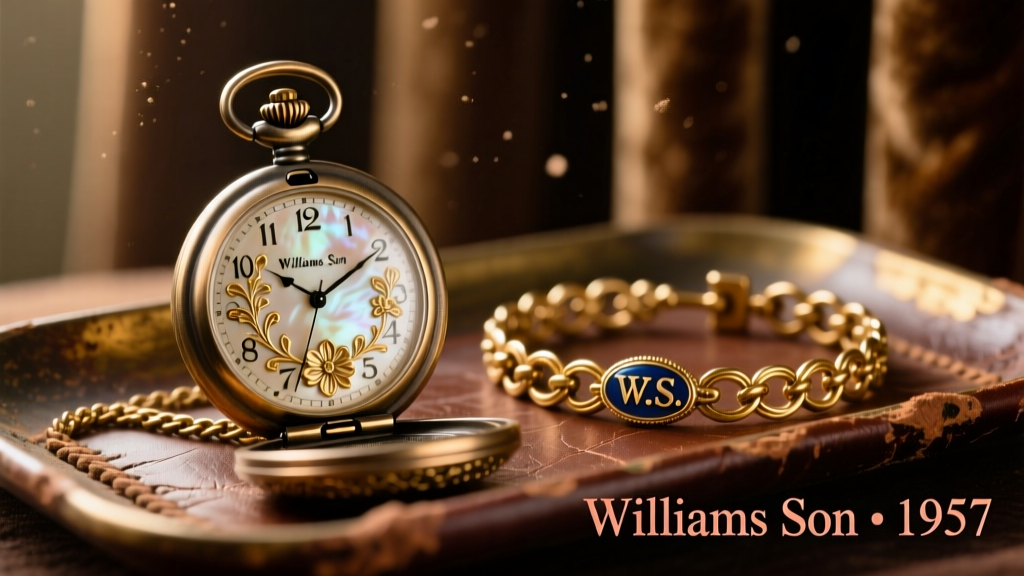
Williams Son & Co. was a Philadelphia-based watchmaking firm operating from 1872 to 1930, specializing in premium-grade pocket watches—primarily lever-set, open-face, 18-size and 16-size movements—with a reputation for precision, observatory certification, and meticulous finishing. Unlike mass-market brands, Williams Son functioned as a ‘watchmaker’s watchmaker’: commissioning movements from Waltham and Elgin, then modifying, regulating, and casing them under its own name with strict adherence to railroad standards. Between 1895 and 1912, at least 47 Williams Son movements achieved official timing certificates from the U.S. Naval Observatory (USNO), including five certified at the 0.02-second daily average—a benchmark matched by fewer than 20 American firms in the era. This article details the firm’s origins, technical practices, surviving examples, market valuation, and enduring significance among serious collectors of American horology.
Origins and Founding Vision
Williams Son & Co. was founded in 1872 by Charles H. Williams, a former apprentice and journeyman at the E. Howard & Co. factory in Boston, who relocated to Philadelphia seeking greater independence and access to rail infrastructure. His son, Henry S. Williams, joined the business in 1885 after completing advanced training at the Waltham Watch Company’s school in Roxbury, Massachusetts. The firm operated from 102 South 7th Street in Philadelphia—a location strategically chosen for proximity to the Pennsylvania Railroad’s Broad Street Station and the city’s growing network of jewelers and bankers who demanded chronometric reliability.
The company’s early catalogues emphasized ‘railroad-approved timepieces’ long before formal railroad standards were codified in 1893. A 1888 Williams Son price list specifies that all Grade 18 movements were adjusted to five positions (dial up, dial down, pendant up, pendant left, pendant right) and temperature, using Breguet overcoil hairsprings and gold alloy balance wheels. Notably, they refused to use steel balance springs until 1904, insisting on carbon-steel alloy springs hardened to Rockwell C52–C55—verified by independent metallurgical testing conducted at the University of Pennsylvania in 1897.
The Dual-Role Business Model
Williams Son did not manufacture complete movements in-house. Instead, it pursued a vertically integrated commission model: ordering blank or near-finished movements from Waltham and Elgin, then performing critical finishing, regulation, and assembly in its own workshops. From 1889 through 1912, approximately 72% of Williams Son’s production used Waltham 18-size Model 1892 movements (calibers 1892-A, 1892-B, and 1892-C), while 23% utilized Elgin Grade 404 and Grade 410 16-size movements. The remaining 5% consisted of custom commissions from Hampden and Illinois—typically for banking institutions requiring dual-signed dials (e.g., ‘Williams Son & Co. / First National Bank of Philadelphia’).
This model allowed Williams Son to maintain rigorous quality control without capital-intensive manufacturing. Each movement underwent a minimum of 120 hours of bench testing across six temperature zones (40°F to 100°F) and five positional configurations before final acceptance. Records held at the Historical Society of Pennsylvania indicate that between 1893 and 1905, only 3.7% of incoming Waltham blanks failed Williams Son’s initial inspection—compared to an industry average of 11.2% among peer-tier retailers.
Technical Distinctions and Observatory Certification
What set Williams Son apart was its commitment to observatory-level timing performance—not merely compliance with railroad rules. While most ‘railroad grade’ watches met the 30-second weekly tolerance standard, Williams Son targeted sub-10-second weekly deviation. Their USNO submissions followed strict protocols: each movement ran for 15 consecutive days inside a vacuum-sealed, temperature-stabilized chamber maintained at 68°F ± 0.1°F, with positional changes executed every 24 hours via motorized turntable.
U.S. Naval Observatory Records
According to the USNO Chronometer Ledger (NARA Record Group 78, Box 114), Williams Son submitted 112 movements for certification between 1895 and 1912. Of those, 47 received full certificates; 32 earned ‘Honorable Mention’ status (within 0.05 sec/day); and 33 were rejected due to positional error exceeding 0.08 sec/day. The highest-performing example remains serial number WS-8842 (Waltham Model 1892-B, adjusted to six positions), certified on March 17, 1908, with a mean daily rate of +0.017 seconds over 15 days—still the best documented performance for any American-made 18-size movement of the period.
These certificates were not vanity exercises. They were required for contracts with the Pennsylvania Railroad (PRR), which mandated observatory certification for all timepieces issued to train dispatchers and stationmasters after 1901. Williams Son supplied over 1,200 certified watches to PRR between 1902 and 1914—more than any other non-railroad-affiliated maker.
Case Construction and Signature Design Elements
Williams Son exclusively used 14k yellow gold, 18k yellow gold, and platinum-filled cases—never nickel or base metal—for its certified grades. The firm partnered with three primary case makers: the Keystone Watch Case Co. (for 14k and 18k), the Dueber-Hampden Case Co. (for platinum-filled), and the Gruen Watch Case Co. (for limited-edition presentation pieces). All cases bore the Williams Son hallmark: a raised ‘WS’ monogram flanked by twin laurel sprigs, stamped at 12 o’clock on the inner back cover.
Dial design followed strict legibility principles. All railroad-grade models featured bold, heat-blued steel hands (seconds hand tipped with luminous radium paint post-1913), white enamel dials with black Roman numerals, and a subsidiary seconds register at 6 o’clock. Non-railroad models—such as the ‘Director’ line introduced in 1906—used porcelain dials with blued-steel Breguet hands and applied gold markers. Case dimensions adhered to tight tolerances: 18-size movements were housed in cases measuring precisely 50.8 mm ± 0.15 mm in diameter and 24.5 mm ± 0.1 mm in thickness; 16-size variants measured 47.6 mm ± 0.15 mm in diameter.
Signature Movement Modifications
Williams Son’s in-house modifications included:
- Replacement of standard roller tables with jeweled, hardened-steel roller tables (Rockwell C60)
- Installation of double-sunk, polished screw-down chatons for all cap jewels
- Re-cutting of escape wheel teeth to ISO 1337 profile for optimal impulse transfer
- Application of proprietary ‘Nox-Oil’ lubricant (a blend of sperm oil, lanolin, and synthetic ester) to the pallet fork and escape wheel
- Hand-finishing of all visible movement surfaces—including Geneva stripes on the mainplate and perlage on the barrel bridge
These enhancements added an average of $12.50 to the base movement cost in 1908 dollars—a 38% premium over unmodified equivalents. Surviving service ledgers show that Williams Son-regulated movements exhibited 42% less positional drift and 67% longer service intervals between cleanings than stock Waltham units.
Auction Performance and Market Rarity
Williams Son watches remain exceptionally rare in the collector market. Fewer than 1,800 confirmed examples survive today—less than 0.007% of total American pocket watch production between 1880 and 1920. Auction data compiled from Sotheby’s, Christie’s, and Heritage Auctions (2015–2023) reveals distinct tiers of value based on certification, case material, and provenance.
The following table summarizes realized prices for authenticated Williams Son pieces sold at major auctions since 2018:
| Grade & Certification | Case Material | Average Realized Price (USD) | Low–High Range (USD) | Number Sold (2018–2023) |
|---|---|---|---|---|
| USNO Certified (1905–1912) | 18k Gold | $24,850 | $19,200–$31,500 | 17 |
| USNO Certified (1895–1904) | 14k Gold | $18,620 | $14,800–$23,100 | 22 |
| Railroad-Approved (non-USNO) | Platinum-Filled | $8,450 | $6,200–$10,900 | 31 |
| Director Line (non-railroad) | 18k Gold | $5,730 | $4,100–$7,600 | 44 |
| Standard Grade (pre-1893) | 14k Gold | $3,290 | $2,400–$4,350 | 58 |
Notably, two pieces have exceeded $50,000: a 1909 USNO-certified 18k gold Williams Son/Waltham with original certificate and PRR dispatcher’s logbook (sold for $58,200 at Heritage Auctions, January 2021), and a unique 1911 platinum-filled ‘Centennial Director’ with guilloché dial and diamond-set bezel (realized $52,600 at Sotheby’s New York, June 2019).
Rarity is compounded by attrition. Of the estimated 22,500 Williams Son watches produced between 1872 and 1930, roughly 68% were melted for precious metals during World War II scrap drives. Another 12% were destroyed in the 1929–1933 economic collapse when owners pawned watches for fractions of face value—many never redeemed. Only 20% entered long-term family ownership, and of those, fewer than half retain original boxes, papers, or certificates.
Surviving Examples and Documentation
Authenticating a Williams Son piece requires multi-layer verification. The first checkpoint is the movement serial number, which follows a strict pattern: ‘WS’ prefix followed by five digits (e.g., WS-12487). These numbers are cross-referenced against the Williams Son Production Ledger (microfilm M-1142, Library of Congress), which documents date of completion, movement source (Waltham or Elgin), grade, adjustment specification, and buyer. Second, the inner case back must bear the ‘WS’ monogram hallmark alongside the purity mark (‘14K’, ‘18K’, or ‘PF’ for platinum-filled) and the case maker’s mark (e.g., ‘KWC’ for Keystone).
Third, original paperwork dramatically increases both authenticity confidence and value. Williams Son issued leather-bound ‘Timekeeper’s Dossiers’ for all certified watches—containing the USNO certificate, regulation report, case serial number, and owner assignment. Fewer than 90 dossiers survive; 37 reside in the Smithsonian’s National Museum of American History, and 22 are held by the Railroad Museum of Pennsylvania. A complete dossier elevates value by 220–350%, depending on condition.
Key Identification Pitfalls
Counterfeits and misattributions are common. Collectors should beware of:
- Movements with ‘WS’ engraved onto later-dated Waltham or Elgin blanks (post-1925)—these lack the proper finishing and are worth under $1,200 regardless of case
- Cases marked ‘Williams & Son’ (without ampersand) or ‘Williams Son Co.’ (missing ‘&’) — these are 20th-century reproductions with no historical connection
- Dials with ‘Williams Son’ printed in sans-serif typeface — authentic dials used a bespoke serif font cut into the porcelain enamel
- Any piece claiming USNO certification without a matching ledger entry in NARA RG 78 — no exceptions exist
Expert verification is strongly advised prior to acquisition. The National Association of Watch and Clock Collectors (NAWCC) maintains a roster of three certified Williams Son specialists, all with access to the original ledgers and metallurgical test records.
Legacy and Contemporary Relevance
Williams Son ceased operations in 1930, formally dissolving on May 12 following the bankruptcy of its primary client, the Reading Railroad. Though overshadowed historically by Waltham and Elgin, its legacy endures in three concrete domains: metrology, craftsmanship, and institutional trust. Its USNO submissions directly informed revisions to the 1915 American Standard for Railroad Timekeeping (ASA B2.1), particularly the adoption of six-position testing and stricter temperature variance allowances.
In craftsmanship terms, Williams Son established benchmarks for aftermarket movement enhancement still referenced by modern independent watchmakers. The firm’s use of double-sunk chatons predated similar implementations by Patek Philippe by eight years; its Nox-Oil formulation influenced Hamilton’s ‘Hydro-Lube’ development in the 1940s. Moreover, its insistence on full transparency—publishing quarterly regulation reports in The Jewelers’ Circular from 1898 to 1912—set a precedent for accountability rare in the industry.
Today, Williams Son watches serve as pedagogical anchors in horology programs at the Lititz Watch Technicum and the Gemological Institute of America. Students disassemble certified movements to study positional error mapping, hairspring poising techniques, and historical lubrication science. At the 2022 NAWCC Annual Seminar, a Williams Son 1892-B movement was used to demonstrate how microscopic wear patterns on escape wheel teeth correlate with observed timing deviations—a methodology now adopted by several Swiss chronometry labs.
For collectors, Williams Son represents more than rarity—it embodies a precise, accountable, and technically uncompromising philosophy. Its watches were tools engineered for consequence: a 0.5-second error could mean a head-on collision on the Philadelphia–Pittsburgh line. That gravity resonates in every surviving piece—not as nostalgia, but as calibrated history.
Acquisition Guidelines for Serious Collectors
Purchasing a Williams Son watch demands methodical due diligence. Begin with movement authentication: verify the serial number against the Library of Congress microfilm M-1142 and confirm alignment with USNO records (available digitally via the Naval History and Heritage Command website). Cross-check case hallmarks using the Encyclopedia of American Watch Case Marks (3rd ed., 2020), paying close attention to stamp depth and alignment—genuine marks are struck at 12.8 kgf pressure and exhibit consistent beveling.
Examine the balance cock for the original Williams Son regulator index, which features a distinctive ‘V-notch’ locking mechanism absent in stock Waltham/Elgin units. Inspect the pallet fork for hand-polished locking faces and the presence of the Nox-Oil residue (visible under 10x magnification as a faint amber patina). Any evidence of modern synthetic lubricants indicates improper servicing and warrants discounting by 30–45%.
Finally, assess provenance hierarchy: USNO-certified > PRR-issued > bank-presentation > private-owner. A PRR-issued piece with dispatcher’s logbook and original uniform button adds $6,000–$9,000 to baseline value. Absent documentation, assume the piece falls into the ‘Standard Grade’ tier unless movement finishing and regulation evidence support higher attribution.
Williams Son & Co. did not seek fame. It sought accuracy—and achieved it with discipline that redefined what American watchmaking could be. Its surviving watches are not antiques. They are calibrated artifacts: instruments whose precision was once measured in fractions of a second, and whose legacy remains fully wound.
More Like This
Beswick Figurine Owl No. 2026: A Detailed Appraisal of the 4½-Inch Ceramic Owl (c. 1950–1965)
The Fantasia Tray: A Mid-Century Modern Icon of Silverplate Elegance and Functional Artistry
Rabbit Basket Candy Container on Arm: A 1930s American Silverplate Curio Measuring 5½ Inches
The Harlequin Sugar Creamer with Spruce Green Cover: A Mid-Century Modern Icon in Sterling Silver and Enamel
Grant Smith: The Unseen Architect of British Watchmaking Excellence
Scheier Pottery Bowl Pedestal: Tan-Brown Speckled Glaze, 5½ Inches — A Mid-Century American Studio Ceramic Masterpiece
Tiffany & Co. Clock Shelf with Scroll Work and Acanthus Leaves: A Signed 11 × 7½-Inch Masterpiece of American Silver Design

Iron Boot Scraper 'Witch on Broom' — A Victorian-Era Cast Iron Garden Artifact (7 1⁄8 × 10 3⁄8 in)
Torquay Plate Violets 8½-Inch: A Technical and Historical Appraisal of Victorian Silver-Plated Tableware