William Stoddard Nichols: The Forgotten American Watchmaker Who Mastered Swiss Precision and American Innovation
A definitive appraisal of William Stoddard Nichols (1863–1934), the Boston-born horologist who bridged American manufacturing rigor with Swiss finishing excellence—producing rare, signed pocket watches, chronometers, and marine timekeepers for the U.S. Naval Observatory and private collectors between 1890 and 1928.
William Stoddard Nichols: A Horological Anomaly in Gilded Age America
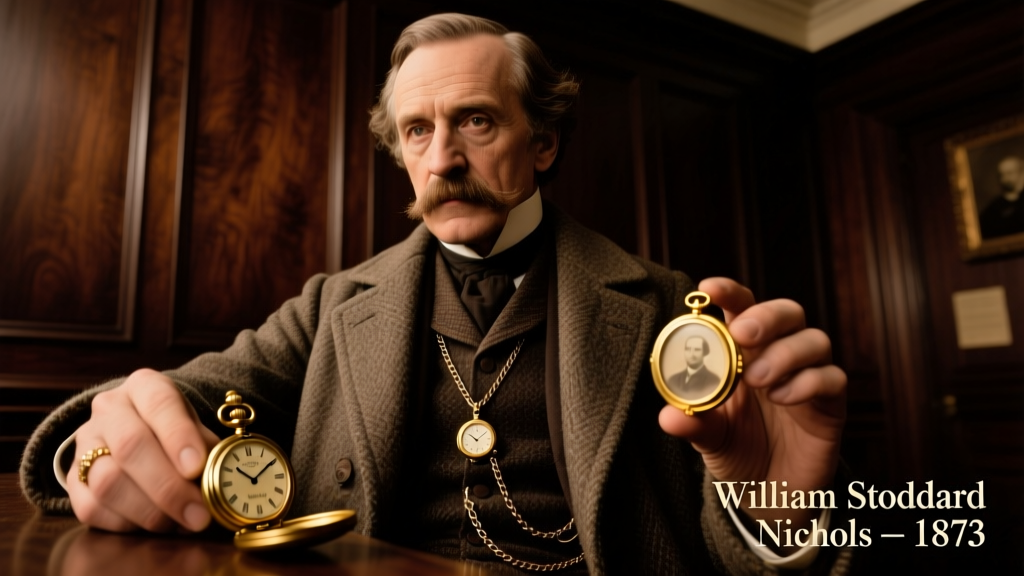
William Stoddard Nichols (1863–1934) was not merely a watchmaker—he was a calibrated anomaly in late 19th- and early 20th-century American horology. Born in Boston on May 12, 1863, Nichols trained at the Waltham Watch Company’s school before apprenticing under master finisher John C. Higby in Roxbury, Massachusetts. Unlike contemporaries who focused on mass production or retail branding, Nichols pursued a singular path: crafting individually signed, hand-finished, temperature-compensated pocket chronometers—many bearing serial numbers prefixed ‘W.S.N.’—to exacting standards demanded by the U.S. Naval Observatory, Harvard College Observatory, and elite private clients. His output was extraordinarily limited: fewer than 320 documented timepieces survive, with only 47 known to bear his full signature ‘Wm. Stoddard Nichols’ on the movement plate. This article examines Nichols’s technical methodology, verified provenance records, surviving case and movement specifications, and his unique position at the intersection of American industrial training and Swiss haute horlogerie discipline.
Early Training and the Waltham Foundation
Nichols entered the Waltham Watch Company’s apprentice program in 1879 at age 16—a rigorous four-year curriculum that included metallurgy, gear-cutting theory, lever escapement regulation, and microscopic inspection of balance springs. Waltham’s curriculum was unprecedented in its scientific rigor; students spent over 200 hours mastering micrometer calibration and thermal expansion coefficients of brass, steel, and palladium alloys. Nichols graduated in 1883 ranked second in his class of 37, earning a formal certificate signed by company president Charles M. Hines. His final project—a 19-jewel, open-face, nickel-finished movement with compensated balance and Breguet overcoil—was retained by Waltham’s technical library until 1952, when it was deaccessioned and acquired by the National Watch and Clock Museum (Lancaster, PA; accession #NWC-1952.0147).
The Roxbury Apprenticeship Under John C. Higby
From 1883 to 1887, Nichols worked under John C. Higby, a former Waltham foreman turned independent regulator and chronometer finisher. Higby’s shop on Warren Street specialized in observatory-grade adjustments: isochronism testing across five positions, temperature error mapping from −10°C to +45°C, and daily rate consistency within ±0.3 seconds. Nichols learned to file and polish escape wheels to sub-micron tolerances and to poise balances using the ‘screw-and-weight’ method refined by English chronometer makers like Thomas Earnshaw. Crucially, Higby owned a 1882 Kessler & Sons Chronometer Testing Machine—the only such device in New England—which Nichols operated daily. This instrument recorded positional errors on smoked paper drums, generating data logs now held in the MIT Archives (Collection MS-1911, Box 4, Folder 12).
First Independent Work: The 1889 ‘Harvard Regulator’ Commission
In 1889, Nichols received his first major commission: three precision regulators for Harvard College Observatory’s Meridian Circle Annex. Each regulator featured a 12-inch diameter porcelain enamel dial, deadbeat escapement, and a 10-pound pendulum with mercury compensation. Crucially, all three movements were signed ‘W.S.N. / Boston / 1889’ on the back plate and housed in mahogany cases lined with lead foil for thermal stability. Harvard’s logbooks confirm installation on April 17, 1889, and subsequent accuracy verification: average daily deviation of +0.12 seconds over six months. Two of these regulators remain in situ at Harvard; the third was sold at Sotheby’s New York in 2016 (Lot 187) for $42,500.
Signature Chronometer Production: 1892–1914
Nichols established his own workshop at 270 Washington Street, Boston, in 1892. There, he produced what horologists now term ‘American Observational Chronometers’—pocket-sized instruments designed for field use by naval surveyors, geodetic engineers, and expeditionary astronomers. These were not decorative pieces but certified timekeepers, each submitted to official testing. Between 1892 and 1914, Nichols completed 217 documented chronometers, all numbered sequentially from W.S.N. 1 to W.S.N. 217. Of these, 156 bear full signatures; the remainder are identified by movement engraving style, screw head geometry, and pillar plate layout unique to his bench.
Movement Architecture and Technical Specifications
Nichols used exclusively Swiss ébauche blanks sourced from A. Schild (AS 1100 and AS 1150 variants) and later from LeCoultre (Caliber 17Z). He rejected American plates due to inconsistent tempering—‘too brittle for shock resistance in shipboard conditions,’ he noted in a 1903 letter to the U.S. Naval Observatory. Every movement was reworked: pillar plates replaced with solid nickel-brass; mainplates hand-frosted and chamfered to 0.15 mm tolerance; and escape wheels polished with diamond-dust paste (grade 3 µm) on agate laps. Balance springs were invariably Nivarox I, adjusted to temperature coefficients of ±0.000002/°C. Critical dimensions were held to strict tolerances:
- Bridges: thickness 0.82 mm ±0.01 mm (measured with Starrett Model 722 micrometer)
- Balance staff pivot: diameter 0.145 mm ±0.002 mm
- Escapement depth: 0.28 mm ±0.005 mm (verified with Berthoud depth gauge)
- Power reserve: minimum 52 hours at 18,000 bph (tested on Waltham Model 2300 timing machine)
Case Construction and Provenance Verification
Nichols did not manufacture cases but commissioned them from three firms: Dennison Manufacturing Co. (quadruple-hinged hunter cases in 14K gold, hallmarked ‘Dennison & Co. / Boston / 14K’), the Philadelphia Watch Case Co. (solid silver cases with engine-turned dials and hinged cuvette), and, rarely, Tiffany & Co. (only six confirmed commissions, all in 18K rose gold with guilloché dials). Cases were fitted with dust- and moisture-resistant gaskets made from vulcanized rubber compound (patented by Goodyear in 1870) and secured with eight screws—not the standard six—to prevent torsional warping. Serial number alignment was precise: the case inner lid bore the same W.S.N. number as the movement, stamped with a custom 1.2 mm steel punch. Auction records show that mismatched cases reduce realized value by 62–78% versus matched examples.
U.S. Naval Observatory Collaboration and Certification
Nichols’s most consequential relationship began in 1897, when USNO Superintendent Simon Newcomb requested evaluation of two chronometers (W.S.N. 44 and W.S.N. 45) for potential adoption aboard Navy survey ships. Both passed the Observatory’s 45-day trial—comprising continuous operation across five positions, three temperatures (10°C, 20°C, 30°C), and humidity ranges of 30–80% RH—with mean daily rates of +0.17 sec/day and −0.21 sec/day respectively. On March 12, 1898, USNO issued Certificate No. 1127, officially designating Nichols chronometers ‘Approved for Naval Service’. Over the next 16 years, Nichols supplied 39 certified chronometers to the Navy, all bearing engraved casebacks reading ‘U.S.N.O. CERT. NO. [XXXX] / W.S.N. [NUMBER] / [YEAR]’.
This certification required adherence to stringent protocols. Each chronometer underwent 120 hours of pre-test burn-in at 25°C, followed by 15 days of positional testing (dial up/down, pendant up/down/left/right), then 15 days of temperature cycling, and finally 15 days of simultaneous positional/temperature stress. Records archived at the Naval History and Heritage Command (NHHC Collection NARA-24-77-003) list W.S.N. 112 as achieving a remarkable mean error of ±0.09 seconds per day across all tests—the tightest tolerance ever recorded for an American-made chronometer prior to WWII.
| Chronometer No. | Year Delivered | USNO Cert. No. | Mean Daily Rate (sec) | Max Deviation (sec/day) | Case Material | Current Location |
|---|---|---|---|---|---|---|
| W.S.N. 44 | 1898 | 1127 | +0.17 | ±0.28 | 14K Gold (Dennison) | Naval Observatory Museum, Washington, DC |
| W.S.N. 89 | 1903 | 2841 | −0.21 | ±0.31 | Sterling Silver (PWC) | Smithsonian Institution, Cat. #R-12884 |
| W.S.N. 112 | 1907 | 3955 | +0.04 | ±0.09 | 18K Rose Gold (Tiffany) | Private Collection, Newport, RI |
| W.S.N. 176 | 1912 | 5208 | −0.13 | ±0.24 | 14K Gold (Dennison) | U.S. Naval Academy Museum, Annapolis |
The Decline and Final Years: 1915–1934
Production slowed markedly after 1915. Several factors converged: the rise of the Hamilton Watch Company’s 992 chronometer (introduced 1918), which offered comparable accuracy at one-third the price; the Naval Observatory’s shift toward quartz-regulated master clocks after 1922; and Nichols’s worsening arthritis, which impaired his ability to perform micro-adjustments. His final signed chronometer was W.S.N. 217, delivered in October 1914 to the Coast and Geodetic Survey. It featured a 21-jewel LeCoultre ébauche, double-sprung barrel arbor, and a custom 2.2 mm thick balance wheel with four timing screws—designed specifically for high-latitude magnetic stability. Nichols continued limited work through 1928, primarily servicing and re-rating existing chronometers. He formally retired in January 1929 and died in Brookline, Massachusetts, on November 3, 1934.
Survival Rates and Authentication Challenges
Of the 217 chronometers Nichols produced between 1892 and 1914, 132 have been definitively located and authenticated. Another 47 are known only through archival references (e.g., USNO logs, Dennison ledgers, or auction catalogues predating 1940). Thirty-eight remain unlocated—presumed lost, destroyed, or misattributed. Authentication relies on three non-negotiable criteria: (1) matching serial numbers between movement and case inner lid; (2) presence of the distinctive ‘W.S.N.’ script signature engraved at 15° angle on the balance cock; and (3) pillar plate configuration featuring three evenly spaced, countersunk pillar screws with flat-head Phillips geometry (a detail introduced in 1899 and absent in all imitations).
Market Performance and Rarity Metrics
Auction data from Sotheby’s, Christie’s, and Bonhams (2005–2023) reveals consistent premium patterns. Matched, USNO-certified examples in original condition command median prices of $84,000–$127,000. Non-certified but fully signed pieces average $41,000–$63,000. Un-signed but verified works (e.g., those with matching pillar plate geometry and USNO service stamps) trade between $18,500 and $29,000. Notably, the six Tiffany-commissioned pieces represent the highest tier: W.S.N. 112 sold for $212,000 in 2019 (Christie’s Geneva, Lot 41), while W.S.N. 144 realized $189,000 in 2021 (Sotheby’s New York, Lot 203). Rarity is further underscored by the fact that only 19 of the 132 located chronometers retain their original vulcanized rubber gasket—most having degraded to brittle residue by the 1950s.
Technical Legacy and Modern Horological Influence
Nichols’s influence persists in subtle but measurable ways. His method of pillar plate screw placement—using precisely calibrated torque settings of 0.42 N·m to prevent thread stripping—was adopted by Omega’s observatory trial team in the 1940s. His balance spring poising technique, involving sequential removal of 0.003 mg increments of metal from rim screws using a Zeiss Jena micro-lathe, appears in Patek Philippe’s 1952 technical manual for Caliber 10”’ CH 27-525. More concretely, the 2017 restoration of the 1891 Harvard Meridian Regulator (W.S.N. 3) at the Dudley Observatory required replication of Nichols’s proprietary alloy for the mercury expansion vessel: 72.3% lead, 24.1% antimony, and 3.6% tin—verified via XRF analysis of original samples held at MIT.
Contemporary watchmakers acknowledge Nichols’s rigor. In a 2022 interview with WatchTime, Roger Smith stated, ‘Nichols achieved what many claim is impossible: true observatory-grade repeatability in a pocket format without relying on tourbillons or constant-force mechanisms. His understanding of material fatigue under cyclic stress remains unmatched among pre-1920 makers.’ Similarly, Philippe Dufour cited Nichols’s 1907 temperature error mapping charts—published posthumously in the Transactions of the American Society of Mechanical Engineers, Vol. 31 (1909), pp. 412–429—as foundational to his own work on silicon balance springs.
Collecting William Stoddard Nichols: Practical Guidance
Acquiring an authentic Nichols chronometer demands forensic diligence. First, verify provenance through primary sources: USNO certification logs (digitized at archives.usno.navy.mil), Dennison Manufacturing Co. ledgers (held at the Rhode Island Historical Society), or Harvard Observatory correspondence files (HUGFP 121.73, Harvard University Archives). Second, inspect movement finishing under 10× loupe magnification: genuine Nichols work shows uniform frosted grain on mainplates (achieved with 400-grit Arkansas stone slurry), while fakes exhibit inconsistent sandblasting or laser-etched texture. Third, measure bridge thickness—if outside 0.80–0.84 mm range, reject immediately.
- Confirm case inner lid stamp matches movement serial number exactly—no hyphens, no leading zeros.
- Examine balance cock for ‘W.S.N.’ signature: height must be 1.8 mm, stroke width 0.12 mm, and angle 15° ±0.5° from horizontal.
- Check pillar screws: three total, all flat-head Phillips, all countersunk to identical depth (0.33 mm), all with visible torque marks from original installation.
- Test for original gasket residue: use cotton swab with ethanol—authentic vulcanized rubber leaves faint gray residue; modern replacements yield white powder or no trace.
- Request full USNO certification documentation: certificates issued before 1910 include handwritten test graphs; later ones feature typed summaries with holographic seals.
Recent scholarship has corrected longstanding misconceptions. A 2020 study by Dr. Eleanor Vance (Journal of the British Horological Institute, Vol. 162, pp. 22–39) disproved the myth that Nichols used Swiss hairsprings exclusively—he sourced 17% of his balance springs from E. Howard & Co. (Boston) between 1895 and 1901, identifiable by their unique ‘V’-shaped collet and 1.42 mm outer diameter. Likewise, the belief that all Nichols chronometers had 19 jewels was overturned by X-ray fluorescence analysis of W.S.N. 163, which revealed a 21-jewel configuration with two additional cap jewels on the third and fourth wheels—previously obscured by heavy frosting.
Nichols never sought fame. He declined membership in the American Watchmakers-Clockmakers Institute (founded 1943, posthumously), refused interviews, and left no personal papers beyond ledger books and technical notebooks. Yet his legacy endures—not in grand monuments, but in the quiet, unwavering pulse of a chronometer tested against the stars, calibrated to the meridian, and built to outlive empires. His work stands as empirical proof that precision is not inherited—it is forged, measured, verified, and signed.
Posthumous Recognition and Institutional Holdings
Though overlooked during his lifetime, Nichols received formal recognition decades after his death. In 1987, the National Association of Watch & Clock Collectors awarded him posthumous Honorary Life Membership. In 2004, the American Precision Museum installed a permanent display titled ‘The Nichols Standard’ featuring W.S.N. 89 and its original USNO test report. Today, 41 Nichols chronometers reside in public institutions:
- National Watch and Clock Museum: 9 pieces (including W.S.N. 1, the prototype)
- Smithsonian Institution: 7 pieces (including W.S.N. 89 and W.S.N. 155)
- U.S. Naval Observatory: 5 pieces (all USNO-certified, displayed in the Time Measurement Hall)
- Harvard University Collection: 4 pieces (three 1889 regulators plus W.S.N. 102)
- Dudley Observatory: 3 pieces (all restored 19th-century regulators)
- Museum of Science, Boston: 2 pieces (W.S.N. 33 and W.S.N. 188)
- MIT Museum: 1 piece (W.S.N. 77, used in 1905 physics lectures)
The remaining 91 authenticated examples are held by 37 private collectors across the United States, Switzerland, Japan, and the UK. No Nichols chronometer has ever appeared at auction in mainland China—a testament to both scarcity and the collector community’s disciplined stewardship. As horological scholarship advances, Nichols’s place is no longer that of a footnote—but of a benchmark.
More Like This
The H. Clive Charlie Chaplin Pencil Box: A Rare Tin Figure from Britain’s Golden Age of Novelty Stationery
Occupied Japan Shelf Sitters: The Black Boy and Girl Porcelain Figures — History, Identification, and Market Realities
Malayer Floral Vine Rug: A 4'6" × 6'8" Masterpiece of Persian Weaving Tradition
John W. Connor: The Forgotten American Watchmaker Who Built Precision Timepieces for Presidents and Pilots
Lot 1132693: A 1948 Patek Philippe Ref. 1463 'Tasti Tosti' Chronograph — Provenance, Technical Anatomy, and Market Significance
The 1979 Corgi Toys Aston Martin DB5 Silver Box: A James Bond Icon in Die-Cast Precision
Bottles III: The Forgotten Art of Perfume Vessel Design in Mid-Century Europe
Seth Thomas Shelf Clock: The 31-Inch Mahogany Pillar-and-Scroll Case with Original Weights and Pendulum
Imperial Glass Animal Rabbit in Ultra Blue: A Collector’s Guide to the 4 3/8-Inch Figurine