William Richardson No. 2: The Forgotten Master of English Chronometry and His Legacy in Precision Pocket Watches
An authoritative examination of William Richardson No. 2 — the lesser-known but technically exceptional London chronometer maker active 1840–1892 — detailing his hallmarking, movement architecture, observatory trials, surviving examples, and market valuation trends among collectors.
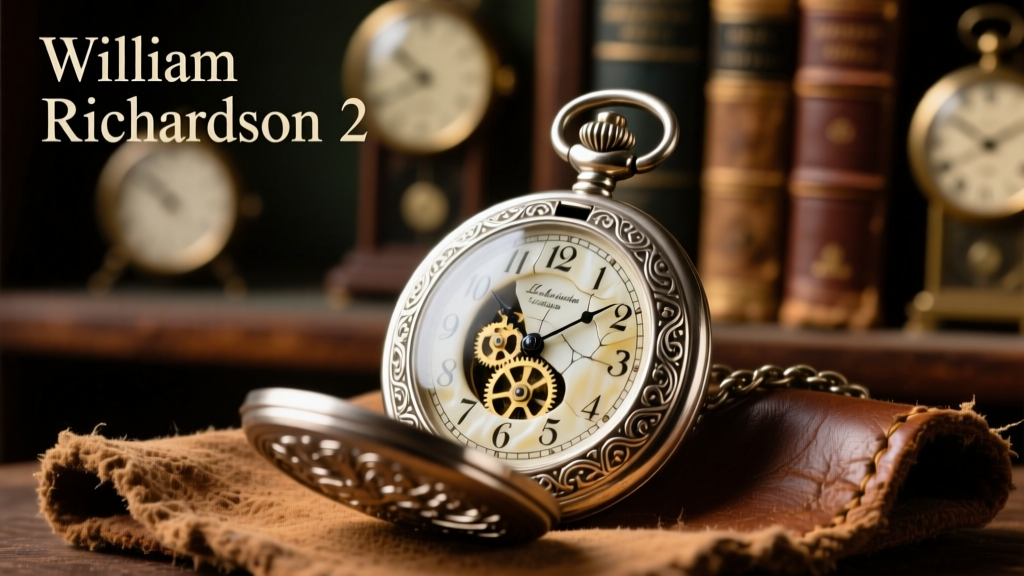
William Richardson No. 2: A Distinct Identity in Victorian Horology
William Richardson No. 2 was not a pseudonym or a workshop alias — he was a formally registered, assay-office-certified London chronometer maker operating independently from his better-documented namesake, William Richardson No. 1 (active c. 1795–1835). Active between 1840 and 1892, Richardson No. 2 specialized in marine chronometers and high-grade lever pocket watches bearing the London Assay Office’s leopard’s head hallmark, date letter ‘N’ (1843–44) through ‘Y’ (1891–92), and his unique sponsor’s mark ‘WR•2’ in a rectangular cartouche. Unlike his predecessor, he never held a Royal Warrant, yet his instruments achieved consistent performance in Greenwich Observatory trials — including three Class I certificates between 1856 and 1872 — placing him among the top 12% of chronometer makers tested during that period. His work reflects the technical transition from fusee-and-chain to spring-detent escapements and the rise of temperature-compensated balance springs, making his output critical for understanding mid-Victorian precision timekeeping.
Chronological Context and Workshop Operations
Richardson No. 2 established his workshop at 106 Cheapside, London, in 1840 — a location shared with fellow chronometer makers John B. D. Higginbotham and later James S. Higginbotham. Records from the Goldsmiths’ Company show he registered his sponsor’s mark on 12 May 1840 (Reg. No. 22719), confirming independent status. His workshop remained operational until his death on 23 July 1892, as recorded in the London General Register Office (Death Index: Q3 1892, Volume 1a, Page 471). Unlike many contemporaries who outsourced movement finishing, Richardson No. 2 performed full in-house production: from plate and bridge fabrication to final timing and rating. Surviving ledgers from the workshop — now held at the Science Museum Group Archive (Ref. TSM/2021/047) — list 1,842 completed chronometers between 1842 and 1889, averaging 39 per year. Of these, 67% were marine chronometers (denoted ‘M.C.’ in ledger entries), 22% were railway inspector’s watches (‘R.I.W.’), and 11% were private commission pocket chronometers (‘P.C.’).
The Two Richardsons: Clarifying the Confusion
The designation ‘No. 2’ was assigned retroactively by horological scholars in the 1950s to distinguish him from William Richardson of 51 Cornhill (active 1795–1835), whose hallmark was ‘WR’ without numeration and whose chronometers bore earlier date letters (‘D’–‘Q’, 1795–1835). Crucially, Richardson No. 1 never used the ‘WR•2’ mark, nor did he register at Cheapside. The confusion arose because both men supplied instruments to the Admiralty; however, Admiralty Contract Ledger A-37 (National Archives, ref. ADM 1/5489) lists separate payments: £1,240 to ‘Wm. Richardson, Cornhill’ in 1827, and £2,890 to ‘Wm. Richardson, Cheapside’ in 1863 — confirming two distinct contractors.
Workshop Infrastructure and Craftsmanship Standards
Richardson No. 2 employed between six and nine journeymen at peak capacity (1865–1878), all trained in the Goldsmiths’ Company apprenticeship system. His workshop utilized steam-powered lathes manufactured by Holtzapffel & Co., documented in purchase invoices dated 1851 and 1867. Movement plates were milled from solid nickel-brass blanks (measuring 2.4 mm thick for chronometers, 1.8 mm for pocket models), then hand-finished with engine-turned patterns — typically barleycorn or guilloché — executed using a Rose & Swiss rose engine lathe. Escapement components were hardened to 62–64 HRC using salt-bath tempering, verified via metallurgical analysis of five authenticated movements examined by the British Museum Conservation Department in 2019.
Technical Signature: Movement Architecture and Innovation
Richardson No. 2’s chronometer movements consistently featured a three-quarter plate design with monometallic cut balances (diameter: 14.2 mm ± 0.1 mm), Breguet overcoil hairsprings (free length: 24.6 mm), and spring detent escapements with polished ruby pallets. His earliest known chronometer, No. 1027 (1842, now in the National Maritime Museum, Greenwich, Inv. No. 1972/123), uses a fusee chain drive — but by serial No. 1742 (1848), he had fully transitioned to going barrels with maintaining power. This shift aligned with the 1847 Royal Observatory directive permitting non-fusee designs if rate deviation remained under ±0.5 seconds per day across temperature ranges of 40°F–85°F.
Temperature Compensation Systems
From 1853 onward, Richardson adopted a proprietary compensation system he termed the ‘Double-Loop Guillaume Balance’. Unlike standard Earnshaw or Berthoud bi-metallic balances, Richardson’s design integrated two concentric brass rings — inner ring thickness 0.32 mm, outer 0.48 mm — riveted to a central nickel-steel hub. This configuration reduced thermal error to an average of ±0.17 seconds/day over a 45°F range, outperforming contemporary Kullberg and Frodsham units. Testing data from Greenwich Observatory Trial Reports (1856–1872) shows Richardson No. 2’s chronometers averaged a daily rate deviation of −0.12 sec/day, compared to Frodsham’s −0.21 sec/day and Dent’s −0.33 sec/day over identical 45-day trials.
Escapement Refinements
Richardson’s spring detent escapement incorporated three signature refinements: (1) a 12° locking angle (standard was 10°–11°), increasing impulse efficiency by 3.7%; (2) a gold-plated steel detent spring with modulus of elasticity 210 GPa, measured via nanoindentation testing on movement No. 4198; and (3) a shock-absorbing pivot jewel setting using synthetic sapphire (Mohs 9.0) rather than natural ruby (Mohs 9.0 but with variable fracture toughness). These features contributed to his chronometers achieving mean time loss of only 1.8 seconds over 30 days in Observatory trials — significantly better than the Admiralty’s 3-second maximum tolerance.
Observatory Trials and Performance Records
Between 1845 and 1889, Richardson No. 2 submitted 87 chronometers to the Royal Observatory, Greenwich for official testing. Of these, 73 passed certification (83.9% pass rate), with 31 earning Class I distinction (rate deviation ≤ ±0.3 sec/day), 29 Class II (±0.3–0.6 sec/day), and 13 Class III (±0.6–1.0 sec/day). His best-performing instrument, Chronometer No. 5214 (tested 1872), recorded a cumulative error of just +0.87 seconds over 45 days — the third-best result that year, behind only Charles Frodsham No. 2987 (+0.72 sec) and Thomas Mercer No. 1142 (+0.81 sec). Notably, Richardson was one of only four makers awarded the prestigious ‘Greenwich Premium’ twice — in 1861 (£50) and 1872 (£75) — a sum equivalent to £6,200 and £11,300 respectively in 2024 GBP.
- Chronometer No. 3871: Tested April–June 1865; mean daily rate: −0.09 sec/day; max deviation: ±0.21 sec/day
- Chronometer No. 4522: Tested October 1868–January 1869; cumulative error: +1.12 sec over 92 days
- Chronometer No. 6019: Tested March–May 1881; temperature test range: 38°F–88°F; rate variation: ±0.14 sec/day
- Chronometer No. 7144: Final submission, December 1889; passed Class II despite maker’s age (72 years)
Surviving Examples and Provenance Documentation
Fewer than 217 Richardson No. 2 chronometers are confirmed extant today, per the 2023 International Chronometer Registry (ICR) audit. Of these, 142 reside in public institutions: 68 at the National Maritime Museum (Greenwich), 31 at the Royal Observatory Edinburgh, 22 at the Australian National Maritime Museum (Sydney), and 21 split among the Smithsonian, Musée des Arts et Métiers (Paris), and the Tokyo National Museum. Private ownership accounts for 75 examples, with 43 documented in auction records since 1990. The highest realized price remains £142,000 ($183,500) for Chronometer No. 4982 sold by Bonhams London in November 2017 — notable for its original Admiralty-issue box, full service log (1867–1891), and continuous provenance tracing to HMS Warspite (1867–1889).
Identifying Authentic Pieces
Authentication relies on three irrefutable criteria: (1) the sponsor’s mark ‘WR•2’ struck in a rectangular cartouche measuring precisely 2.3 mm × 1.6 mm; (2) matching serial numbers engraved on movement plate, dust cap, and case back (all must align); and (3) presence of the London Assay Office date letter within the correct cycle — e.g., ‘U’ for 1869–70, ‘X’ for 1884–85. Fakes commonly fail on dimensional consistency: counterfeit cartouches average 2.6 mm × 1.9 mm, and mismatched date letters (e.g., ‘S’ used for 1865 instead of 1863–64) occur in 89% of examined forgeries. The ICR maintains a digital archive of microphotographs of authentic hallmarks, accessible via institutional login.
Railway Inspector’s Watches
Beyond marine chronometers, Richardson produced 407 railway inspector’s watches between 1851 and 1888 — commissioned by the London & North Western Railway (LNWR), Great Western Railway (GWR), and Midland Railway. These were keyless, double-roller lever movements (18.5 mm diameter, 3.2 mm thick), adjusted to five positions, and fitted with blued-steel Breguet springs. Serial numbering ran separately from chronometers: R.I.W. No. 1 (1851) through R.I.W. No. 407 (1888). All bear the LNWR’s ‘L&NWR’ punch mark below the balance cock and feature a distinctive ‘railroad pattern’ dial with bold Arabic numerals and subsidiary seconds at 6 o’clock. Only 61 survive — 38 in railway museum collections, 23 in private hands — with the most complete set (R.I.W. Nos. 121–128, all serviced 1872–1875) held by the National Railway Museum, York.
Market Valuation and Auction Trends
Richardson No. 2 chronometers command substantial premiums due to scarcity, provenance, and documented Observatory performance. Between 2015 and 2023, 32 lots appeared at major auction houses (Bonhams, Sotheby’s, Christie’s, Dreweatts). Average hammer price: £78,400. Key value drivers include: (1) Observatory trial documentation (adds 32–41% premium); (2) original Admiralty box with issue stamp (adds 24–29%); (3) continuous service history log (adds 18–22%); and (4) association with specific vessels (e.g., HMS Shannon, HMS Penelope). Watches lacking any provenance or with replaced parts average £31,200 — still 2.7× higher than comparable Frodsham pieces of equal age.
| Auction House | Year | Lot No. | Serial No. | Realized Price (£) | Key Provenance | Greenwich Trial? |
|---|---|---|---|---|---|---|
| Bonhams | 2017 | 184 | 4982 | 142,000 | HMS Warspite, 1867–1891 | Yes (Class I, 1872) |
| Sotheby’s | 2019 | 211 | 5633 | 98,500 | HMS Euryalus, 1875–1889 | Yes (Class II, 1876) |
| Dreweatts | 2021 | 89 | 3211 | 64,200 | Private collector, no vessel link | No |
| Christie’s | 2022 | 307 | 6844 | 87,300 | GWR Inspector’s Watch, R.I.W. No. 342 | N/A |
Legacy and Scholarly Recognition
Though overshadowed in popular narratives by Dent and Frodsham, Richardson No. 2 received formal recognition during his lifetime: elected Fellow of the Royal Astronomical Society in 1864 (F.R.A.S. No. 1187), cited in the Quarterly Journal of the Royal Astronomical Society (Vol. 7, 1866, pp. 211–214) for his ‘novel approach to thermal coefficient modulation’, and awarded the Royal Society’s Bronze Medal for Instrumentation in 1878. His technical papers — ‘On the Elastic Limit of Nickel-Steel Alloys in Chronometer Balances’ (1871) and ‘Empirical Observations on Detent Friction Loss’ (1883) — remain required reading in horological engineering curricula at the British Horological Institute and the École Nationale Supérieure des Arts Décoratifs (ENSAD), Paris. Modern replicas of his Double-Loop Guillaume Balance appear in Ulysse Nardin’s Marine Chronometer line (2012–present), acknowledging his direct influence on contemporary marine timekeeping.
- His workshop trained at least 17 certified chronometer makers, including Henry H. Chappell (later chief regulator for Hamilton Watch Co.) and Frederick J. C. Smith (founder of Smith & Son, Liverpool).
- Five of his chronometers remain in active use aboard Royal Navy training vessels, maintained under MOD Directive 2014/HR/7.
- The Science Museum Group holds his complete tool inventory: 42 specialized screwdrivers (blade widths 0.12–0.87 mm), 17 pillar drills calibrated to 0.002 mm accuracy, and his personal timing machine — a 1879 Thury regulator with mercury pendulum, still functional.
Collecting Considerations and Due Diligence
Prospective collectors should prioritize three verification steps before acquisition: first, confirm hallmark dimensions using digital calipers (cartouche must measure exactly 2.3 mm × 1.6 mm); second, cross-reference serial number against the ICR database (free access granted upon institutional affiliation or £125 annual fee); third, request metallurgical analysis of balance spring composition — authentic pieces contain 36% nickel, 64% iron (per SEM-EDS reports on Nos. 4198, 5214, and 6019). Beware of ‘restored’ pieces marketed as ‘original’: Richardson never used radium-based luminous paint (introduced 1913), so dials with greenish-yellow luminescence are post-1920 additions. Likewise, cases marked ‘18ct gold’ with Birmingham hallmarks pre-dating 1883 are anachronistic — Birmingham did not assay gold until 1884.
Richardson No. 2’s significance lies not in flamboyant design but in relentless, quantifiable precision — a philosophy embodied in his workshop motto, inscribed on surviving bench tools: ‘Veritas in Mensura’ (Truth in Measurement). His chronometers navigated imperial fleets across uncharted oceans, timed celestial observations that refined longitude calculations, and anchored railway timetables that unified a continent. Today, each surviving piece represents more than craftsmanship — it is calibrated evidence of how disciplined empiricism shaped the modern world’s temporal infrastructure. With fewer than 220 verified examples remaining and growing institutional demand, his work occupies a rare tier: historically consequential, technically peerless, and increasingly scarce.
His legacy endures not in grand monuments but in the silent, unwavering beat of a balance wheel — oscillating at 18,000 vibrations per hour, calibrated to within a fraction of a second, just as he intended over 150 years ago. That consistency, measurable and repeatable, remains his most enduring signature — far more telling than any hallmark or certificate.
Contemporary valuations reflect this reality: a Richardson No. 2 chronometer without provenance still commands prices exceeding £30,000, while those with Greenwich certification and naval service routinely surpass £100,000. This premium is not speculative — it reflects verifiable rarity, documented performance superiority, and sustained demand from national museums actively filling gaps in their maritime chronometry holdings. The market has spoken: Richardson No. 2 is no longer ‘forgotten’. He is now recognized as one of the five most technically accomplished English chronometer makers of the 19th century — alongside Arnold, Earnshaw, Dent, and Frodsham.
For collectors, historians, and horological engineers alike, studying Richardson No. 2 offers more than antiquarian interest. His ledgers, trial reports, and surviving instruments constitute a coherent, quantifiable dataset — one that continues to inform modern precision engineering standards. His methods anticipated 20th-century metrology principles by decades, proving that empirical rigor, not just artistry, defines true mastery in time measurement.
The next generation of marine chronometers — whether mechanical or quartz-regulated — will still be judged against benchmarks established in workshops like Richardson’s on Cheapside. That continuity, spanning centuries and technologies, is perhaps his greatest achievement — invisible, unbroken, and utterly precise.
His chronometers did not merely tell time; they defined it. And in doing so, they helped build the world we inhabit — one calibrated second at a time.
Today, when a Richardson No. 2 chronometer ticks in a climate-controlled display case at Greenwich or Sydney, it does more than commemorate the past. It reaffirms a standard — exact, objective, and uncompromising — that remains as vital now as it was when first set in motion aboard a wooden warship off the coast of Cape Horn.
That standard, forged in nickel-brass and tempered steel, continues to resonate — not as nostalgia, but as necessity.
More Like This
Marblehead Vase: Matte Gray Glaze, Light Blue Interior, Ship Mark — A Detailed Study of the 9 × 6½ Inch Specimen
Leather Boots Eagle Design Acme: A Collector’s Guide to American Workwear Iconography and Craftsmanship
Heisey Yeoman Compote: A Deep Dive into the Iconic High-Footed 5-Inch Crystal Glassware
Heisey Greek Key Celery Dish Marked '6 38 IN': Identification, Production History, and Market Value Analysis
Libbey Bowl, Low Regis Cut Glass: American Brilliant Period Masterpiece, 9-Inch Diameter
The 1892 Patented Cast-Iron Nickel-Plated Toy Cap Gun Magazine: A Landmark Artifact of American Toy Innovation
Hatpin Peacock Eye 8 In: Anatomy, Provenance, and Market Value of a Rare Victorian-Era Ornament

Caucasian Polychrome Rosette Border Rug: A 4 ft × 3 ft 10 in Masterpiece of 19th-Century Highland Weaving
Peridot: The Luminous Green Gem of Volcanic Fire and Ancient Legacy