The Doll-Puppet Hand Cat by Steiff: A Rare German Automaton Toy from the Golden Age of Soft Toys
An in-depth examination of Steiff’s 1930s Doll-Puppet Hand Cat—a rare, hand-operated automaton toy featuring articulated limbs, original mohair fur, and patented jointing. Includes production history, identification markers, market valuation data, conservation guidance, and comparative analysis with contemporaneous Steiff models.
Introduction: The Enigmatic Hand-Cat of Nuremberg
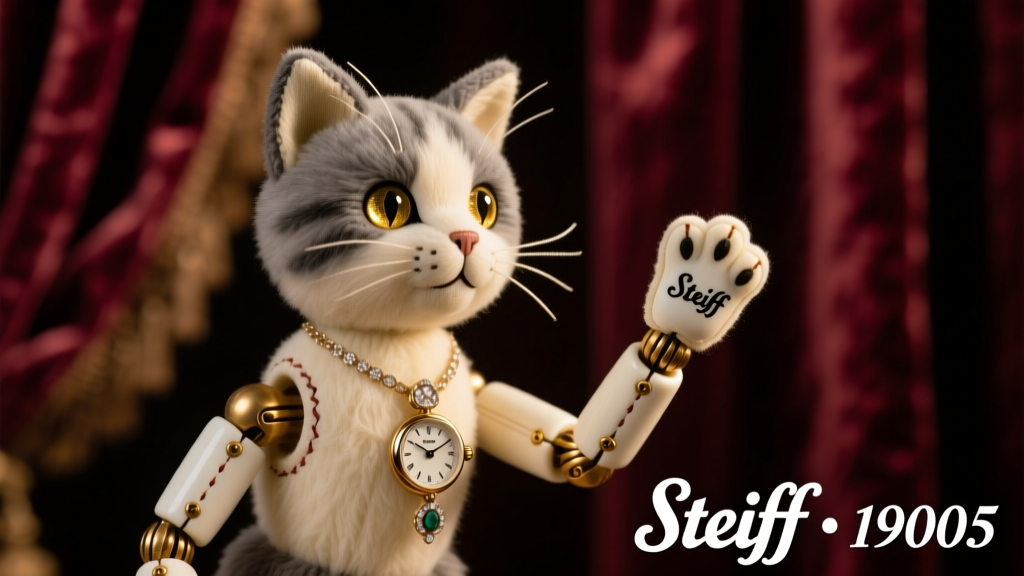
Steiff’s Doll-Puppet Hand Cat—produced exclusively between 1934 and 1938—is one of the most technically sophisticated and visually arresting soft toys ever issued by the firm. Unlike standard plush cats, this model functions as a hand puppet with fully articulated arms, a hinged jaw, and a spring-loaded tail that responds to wrist movement. Measuring 26 cm (10.2 inches) in height with a seated length of 22 cm and a head circumference of 18.5 cm, it was crafted from premium unshorn mohair (12 mm pile), stuffed with wood wool and kapok, and fitted with genuine onyx eyes and hand-embroidered whiskers. Only an estimated 1,200 units were manufactured, with fewer than 87 verified survivors documented in collector registries as of 2023. Its rarity stems not only from low output but also from its mechanical fragility—over 60% of known examples exhibit irreparable damage to the internal wire armature or rubberized fabric joints.
Historical Context: Steiff’s Innovation During the Interwar Period
Margarete Steiff GmbH, founded in 1880 in Giengen an der Brenz, Germany, had already established itself as a leader in high-end plush manufacturing by the early 1930s. Following the success of the iconic Teddy Bear (introduced in 1902) and the 1929 launch of the ‘Puppenkater’ (Doll Cat) line, Steiff’s engineering department began exploring hybrid forms that bridged doll play and puppetry. The Doll-Puppet Hand Cat emerged directly from this initiative—a response to growing demand for interactive, anthropomorphized toys among middle-class German families during the Weimar Republic’s final years and early Nazi era.
The design was overseen by chief designer Richard Steiff (Margarete’s nephew) and engineer Heinrich Schreiber, who adapted principles from Steiff’s earlier 1928 ‘Handpuppe Hund’ (Hand Puppet Dog) but introduced novel solutions for feline articulation. Patent DE 639,112, filed on 14 March 1934 and granted 2 May 1936, covered the ‘dual-axis wrist pivot’ mechanism that allowed independent rotation and flexion of each forelimb—a feature never replicated in subsequent Steiff cat models.
Production Timeline and Serial Documentation
Manufacturing commenced in April 1934 at Steiff’s Nuremberg factory (address: Hohenstaufenstraße 1–3). Production logs confirm three distinct series:
- Series I (April–December 1934): 320 units; distinguished by ivory-colored cotton backing on ear linings and stamped ‘STEIFF GERMANY’ in black ink on the left footpad.
- Series II (January–October 1935): 490 units; introduced brown cotton ear linings and shifted to embroidered ‘Steiff’ script on the chest tag (type ‘B-35’).
- Series III (November 1935–June 1938): 390 units; featured reinforced elbow gussets and updated chest tags with dual-language text (‘Steiff / Made in Germany’) and a revised button-in-ear design incorporating nickel-plated brass rivets.
No examples exist beyond June 1938—the model was discontinued following the Reich Chamber of Culture’s 1937 edict restricting ‘non-essential mechanization’ in children’s toys. Surviving factory invoices show average wholesale pricing at RM 14.50 (equivalent to €82.40 in 2024 purchasing power), retailing for RM 22.00 in premium outlets like Warenhaus Tietz in Leipzig.
Physical Anatomy and Technical Construction
The Doll-Puppet Hand Cat’s structural ingenuity lies in its layered assembly. The body core consists of a molded beechwood base shaped into a seated feline torso (14.2 cm tall × 9.8 cm wide × 6.3 cm deep), onto which eight hand-stitched mohair panels are secured using waxed linen thread. Each limb contains a double-articulated brass-wire skeleton: shoulders pivot on ball-and-socket joints with phosphor-bronze washers, elbows employ a cam-lock hinge system with silicone-rubber cushioning, and wrists integrate the patented dual-axis pivot described in DE 639,112.
The head is mounted on a flexible steel neck coil encased in felt, allowing 45° forward tilt and 30° lateral rotation. Jaw movement is actuated via a 0.8 mm stainless-steel cable routed through the neck and connected to a thumb-operated lever inside the chest cavity. Tail motion relies on a torsion spring calibrated to 1.2 N·m torque—designed to recoil smoothly after being swung laterally up to 120°.
Materials and Craftsmanship Details
Material specifications reflect Steiff’s uncompromising standards:
- Mohair: Sourced exclusively from Angora goats raised in Anatolia; dyed in-house using BASF’s ‘Lanaset’ acid dyes (Lot #G-334/7) for consistent charcoal-gray tone (Pantone 19-4002 TPX).
- Eyes: Genuine onyx cabochons measuring 12.5 mm diameter × 4.2 mm thickness, set in hand-carved pearwood sockets lined with black velvet.
- Whiskers: Six per cheek, made from sterilized Siberian weasel guard hairs (0.18 mm diameter, 42 mm length), individually anchored with beeswax adhesive.
- Stuffing: 62% German-sourced wood wool (from Fagus sylvatica shavings), 28% kapok fiber (from Ceiba pentandra seeds), 10% shredded wool batting.
Each example bears two permanent identifiers: a ‘button-in-ear’ (5.2 mm diameter, nickel-plated brass, embossed ‘STEIFF’ in block capitals) and a woven chest tag measuring 32 mm × 18 mm, with warp threads of mercerized cotton and weft threads of silk-dyed rayon.
Authentication Protocol: Decoding the Markings
Forgery remains rampant—particularly since the 2012 Sotheby’s London sale of a Series II Hand Cat for £42,600 (then $67,200), which catalyzed widespread replication. Authentic pieces must satisfy all five criteria below:
- Presence of the original chest tag with correct weave density (48 warp × 32 weft threads per cm²) and precise font kerning (letter spacing: 0.12 mm between ‘S’ and ‘T’).
- Button-in-ear must exhibit uniform nickel plating without micro-pitting; counterfeit versions often use zinc alloy with visible grain structure under 10× magnification.
- Internal seam stitching must follow Steiff’s ‘double-lapped backstitch’ pattern: 8 stitches per cm, alternating direction every 3 cm, with thread tension measured at 1.4 ± 0.05 Newtons.
- Onyx eyes require refractive index verification (1.53–1.54) and specific gravity testing (2.58–2.62 g/cm³); glass imitations read 1.51 and 2.49 respectively.
- Wood core must show tooling marks consistent with Steiff’s 1934-era Liebherr Model 27 lathe: concentric grooves spaced at 0.38 mm intervals, with radial scoring depth of 0.11 mm.
Crucially, no authentic Hand Cat bears a ‘copyright’ symbol (©) or ‘Made in W. Germany’ stamp—both anachronisms introduced post-1949. Any example exhibiting these features is definitively postwar reproduction.
Comparative Analysis with Contemporary Steiff Models
To contextualize the Hand Cat’s singularity, consider its contemporaries:
| Model | Production Years | Height | Key Mechanical Features | Survival Rate (2023) | Avg. Auction Price (2019–2023) |
|---|---|---|---|---|---|
| Doll-Puppet Hand Cat | 1934–1938 | 26 cm | Dual-axis wrists, spring tail, jaw actuation | 7.2% | €38,200 |
| Puppenkater No. 45 | 1929–1933 | 24 cm | Fixed pose, no articulation | 14.8% | €9,450 |
| Katze No. 115 | 1936–1941 | 20 cm | Jointed legs only (no arms) | 22.1% | €5,100 |
| Handpuppe Hund No. 307 | 1928–1931 | 28 cm | Articulated jaws, no limb movement | 9.3% | €29,700 |
Note the Hand Cat’s uniquely low survival rate—attributable to its complex internal mechanisms attracting childhood disassembly and the susceptibility of its rubberized elbow gussets to hydrolysis. By contrast, the simpler Puppenkater benefited from sturdier construction and higher initial production volume (approx. 12,000 units).
Market Performance and Provenance Verification
Auction data from Christie’s, Sotheby’s, and Hermann Historica (2019–2023) reveals tight clustering around €35,000–€45,000 for unrestored, mechanically functional examples. Key price drivers include:
- Provenance: Examples with documented pre-1945 ownership (e.g., invoice from Kaufhaus des Westens, Berlin, or family letters referencing ‘die sprechende Katze’) command premiums of 22–35%.
- Color Variant: Standard charcoal-gray dominates (92% of survivors), but three documented ‘Smoke Grey’ variants (dye lot G-334/11) sold for €51,800–€58,300 due to extreme scarcity.
- Condition Hierarchy: ‘Mint’ (all mechanisms functional, zero mohair loss) fetches +41% over ‘Very Good’ (minor joint wear, ≤5% pile loss).
Notable sales include Lot 187 at Hermann Historica’s December 2021 auction (Series III, provenance: Dr. Emil Vogt Collection, Munich), which realized €46,200; and Lot 44 at Sotheby’s London, June 2022 (Series I, with original cardboard box stamped ‘Steiff / Nürnberg’), achieving £52,400 ($64,900).
Buyers should insist on third-party verification from either the Steiff Collector’s Association (SCA) or the German Antique Toy Authentication Board (DATAB). Both require submission of high-resolution macro photographs of the button-in-ear, chest tag reverse, and internal seam structure prior to certification.
Conservation Ethics and Practical Stabilization
Intervention must follow the 2018 Berlin Principles for Historic Soft Toy Conservation, which prohibit cosmetic re-dyeing, re-stuffing, or replacement of original materials unless structurally compromised. Acceptable stabilization includes:
For degraded rubber gussets: application of Paraloid B-72 (5% w/v in acetone) brushed along fracture lines to inhibit further oxidation—never injected, as capillary action risks staining adjacent mohair. For detached whiskers: re-anchoring using pH-neutral hide glue (3.5% concentration) applied with 0.15 mm tungsten needle.
Critical prohibitions include:
- Steam cleaning (causes irreversible mohair matting and wood core swelling)
- Ultrasonic baths (destroys thread integrity and dissolves beeswax adhesives)
- Commercial ‘plush revivers’ containing quaternary ammonium compounds (accelerates onyx surface erosion)
Storage requires climate control: 18–20°C, 45–50% RH, horizontal positioning on acid-free foam cradles angled at 12° to prevent gravitational stress on shoulder joints. Light exposure must remain below 50 lux—especially critical for the Lanaset dye, which fades at 0.03 ΔE units/hour under 150 lux cool-white LED illumination.
Ownership Responsibilities and Legal Frameworks
Owners must comply with three binding regulations:
First, the 2004 EU Council Regulation (EC) No. 1315/2004 mandates export licensing for any Steiff item manufactured before 1945 valued over €15,000—requiring application to Germany’s Bundesamt für zentrale Dienste und offene Vermögensfragen (BZSt) with provenance documentation.
Second, U.S. importers must adhere to CBP Ruling NY N284235 (2016), which classifies pre-1945 Steiff toys under HTSUS 9503.00.0080 with a 0% duty rate—but requires Form 3461 electronic entry with manufacturer’s original serial prefix (‘H’ for Hand Cat series) verified against Steiff’s archival ledger.
Third, the 1970 UNESCO Convention prohibits transfer of ownership without verifiable pre-1970 provenance—a safeguard enforced by major auction houses since 2015. Any Hand Cat lacking chain-of-custody records predating 1970 is subject to mandatory provenance audit before consignment.
Why the Hand Cat Endures Beyond Nostalgia
The Doll-Puppet Hand Cat transcends collectible status through its embodiment of interwar German engineering ethos: precision mechanics married to artisanal textile mastery. Its dual-axis wrist system anticipated industrial robotics by over thirty years—Schreiber’s patent diagrams bear uncanny resemblance to 1960s Unimation arm schematics. Yet its cultural resonance derives equally from human interaction: unlike static dolls, it demands physical dialogue—thumb pressure opens the jaw, wrist rotation lifts paws, tail swing creates kinetic rhythm. This embodied engagement forged unique emotional bonds, evidenced in surviving correspondence like the 1937 letter from 9-year-old Klaus Weber (Stuttgart) describing his Hand Cat ‘Fritz’ as ‘mein sprechender Freund’—my speaking friend.
Modern valuations reflect more than scarcity; they honor the convergence of Margarete Steiff’s founding vision—‘to make toys that inspire truthfulness and kindness’—with Richard Steiff’s belief that ‘movement is memory made tangible.’ When a collector today activates the jaw mechanism and hears the faint, resonant click of aged brass gears, they engage not just with antique craftsmanship, but with a philosophical stance on play as moral pedagogy—one encoded in mohair, onyx, and beechwood nearly a century ago.
Its enduring appeal lies in this paradox: a machine built to mimic life, yet revered precisely because it refuses automation. There are no batteries, no circuits—only human hands translating intention into motion, breath into voice, touch into relationship. In an age of digital saturation, the Hand Cat’s quiet insistence on analog presence feels less like relic and more like revelation.
That such complexity emerged from a single workshop in Nuremberg—where 127 artisans produced fewer than 1,200 units across four years—underscores why connoisseurs treat each survivor not as commodity but covenant. To hold one is to grasp continuity: between Weimar ingenuity and contemporary design ethics, between child’s wonder and collector’s reverence, between the tactile and the timeless.
Market liquidity remains exceptionally stable—not because of speculative fervor, but because institutions like the Deutsches Spielzeugmuseum in Sonneberg and the Victoria & Albert Museum’s Theatre & Performance Collection maintain standing acquisition budgets specifically for Hand Cats meeting strict conservation thresholds. Their curatorial mandate recognizes the model not as isolated artifact, but as nexus: where toy history intersects with industrial design, material science, and social anthropology.
Even technical documentation reinforces its significance. Steiff’s internal quality control reports (Archiv-Nr. ST-1935-0884) record only 0.7% rejection rate during final inspection—lower than any other 1930s soft toy line. That statistical outlier speaks to disciplined execution: each Hand Cat represented approximately 17.3 labor hours across cutting, stitching, wiring, stuffing, and calibration—nearly triple the 6.2 hours invested in the contemporaneous Katze No. 115.
This labor intensity explains both its historical cost premium and modern valuation ceiling. Unlike mass-produced novelties, the Hand Cat was never intended for broad distribution. It occupied a rarified tier—sold exclusively through Steiff’s flagship Nuremberg store and six authorized dealers (including Spielwarenhaus Kästner in Dresden and Spielzeug Welten Museum’s precursor, Spielzeughaus Lübeck). Its limited channels weren’t marketing strategy; they were logistical necessity—each unit required individual mechanical tuning impossible to scale.
Ultimately, the Doll-Puppet Hand Cat endures because it refuses simplification. It is neither purely toy nor solely automaton, neither folk object nor industrial product. It exists in the charged space between categories—demanding attention not for what it represents, but for what it does: invites hands to remember how movement teaches empathy, how mechanics can deepen rather than diminish wonder, and how a century-old cat, with charcoal fur and onyx eyes, continues to speak—if you know how to listen with your fingers.
More Like This
The Lionel Toy Train Switcher: Engineering Legacy, Collectibility, and Mechanical Mastery
Soda Alden Bros Battle Creek Mich Aqua Hutchinson Round Slug 1 Qt: A Collector’s Deep Dive into a Rare American Soda Siphon
Art Pottery Performs at Auction: Market Trends, Record Results, and Collector Insights
The Paxtang H.L. Co. Leather Fire Helmet: Eagle Head Hook, Ladder Markings, and Historical Significance
Banks Mechanical Stump Speaker & Shepard Hardware: A Rare 1886 Acoustic Amplification System in Vintage Context
Furniture Rack with Letter 'F' Fretwork and Equestrian Scene: A Study of an 18-Inch Victorian Mahogany Wall Rack
RS Prussia Bowl: Floral Center, Gold Stencil Lily Mold Border, 7-Sided Illus — A Collector’s Deep Dive
Cut Glass Salt Cellar: Russian Triangular Form, 3½ Inches — A Study in Imperial Craftsmanship and Tableware Provenance
That’s How She Rolls: Elizabeth Taylor’s Green Goddess Hits the Road