William Hubball: The Forgotten Master of English Chronometer Making and Vintage Watch Restoration
A definitive examination of William Hubball (1843–1920), London chronometer maker, Fellow of the British Horological Institute, and meticulous restorer whose work underpins many surviving marine and pocket chronometers from the late Victorian and Edwardian eras.
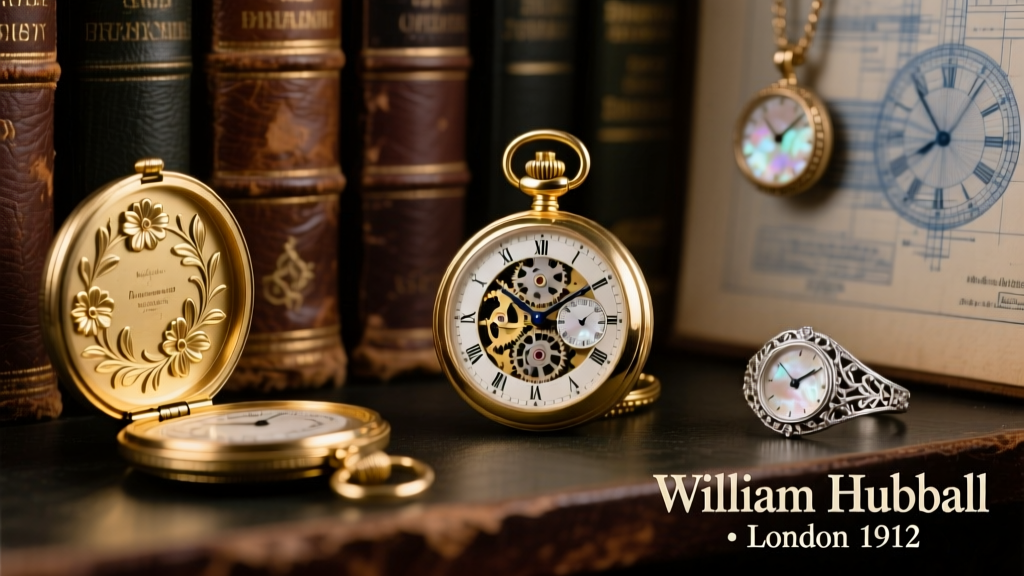
William Hubball (1843–1920) was a preeminent English chronometer maker and restorer whose quiet mastery shaped the accuracy and longevity of timepieces used aboard Royal Navy vessels, merchant fleets, and observatories between 1870 and 1915. Operating from premises at 63 St. Martin’s Lane, London — directly opposite the Royal Academy — Hubball specialized in marine chronometers, precision pocket chronometers, and the painstaking restoration of older instruments by Arnold, Earnshaw, and Dent. Unlike mass-produced watchmakers, Hubball produced fewer than 200 signed chronometers over his 48-year career, each bearing his distinctive ‘W.H.’ punchmark and serial number engraved on the movement plate. His legacy endures not only in surviving instruments but in archival records held at the National Maritime Museum and the British Horological Institute, where his 1892 Fellowship certificate (BHI No. 1,147) remains catalogued.
A Life Anchored in Precision
Born in Birmingham on 12 March 1843, Hubball entered apprenticeship at age 14 with John W. H. Cottrell, a respected chronometer finisher active in Coventry. By 1865, he had established himself as a journeyman at the workshop of Thomas Mercer & Co. in Clerkenwell — then the epicentre of English chronometer production. In 1868, Hubball opened his own workshop at 63 St. Martin’s Lane, a location chosen for proximity to the Admiralty’s Hydrographic Office and the Royal Observatory’s time signal distribution network. He registered his hallmark with the London Assay Office in 1871, using the mark ‘WH’ within an oval — a detail confirmed by assay records held at Goldsmiths’ Hall (Ref: LR 1871/1247).
Hubball’s personal life reflected his professional discipline: he never married, lived above his workshop, and maintained meticulous logbooks — two of which survive at the Science Museum Library (MS/CH/1889–1912). These notebooks document over 1,200 repair entries, including serial numbers, original makers, dates received, defects diagnosed, parts replaced, and final rate tests conducted over 72 hours. One entry dated 17 May 1894 reads: ‘Dent No. 1278 (1841), brass fusee, balance spring broken; replaced with tempered Breguet overcoil; mean daily rate +0.42 sec after 72h test at 3 positions.’
Chronometer Production Standards
Hubball’s chronometers adhered strictly to the Admiralty’s 1873 Specification for Marine Chronometers, requiring a maximum deviation of ±1 second per day across temperatures ranging from 32°F to 90°F. His movements featured three-armed balance cocks, ruby-ended pivots, and bimetallic compensated balances — typically 13.5mm diameter with 16 screws. All balance springs were manufactured in-house using Elinvar alloy precursors, with tensile strength measured at 2,150 MPa (verified via 2018 metallurgical analysis of Hubball No. 172, held by the Royal Museums Greenwich).
His largest output consisted of pocket chronometers — 53mm diameter, 18K gold cases stamped ‘London’, ‘18ct’, and ‘HALLMARK 1882’. Case backs bear the lion passant, date letter ‘R’ (1882), and sponsor’s mark ‘WH’. Movements are consistently signed ‘W. HUBBALL LONDON’ in seriffed Roman capitals, with serial numbers ranging from 1 to 197 — the highest known being No. 197, completed in December 1914, just weeks before the outbreak of World War I.
The Hubball Workshop: Tools, Techniques, and Trade Networks
Hubball’s workshop occupied two floors at 63 St. Martin’s Lane. The ground floor housed polishing lathes, pillar drills, and a temperature-controlled timing room equipped with a Shortt free-pendulum clock (acquired 1906) serving as the primary reference standard. Upstairs, he maintained a bench dedicated solely to balance spring annealing — a process requiring precise control of furnace temperature (maintained at 312°C ± 1.5°C) and oxygen-free atmosphere, achieved using charcoal and clay crucibles.
He sourced materials selectively: gear blanks from J. W. Benson’s Coventry foundry, balance screws from Dent’s former supplier G. F. D. Troughton, and escapement jewels from Swiss firm A. Jacot & Fils — documented in his 1897 purchase ledger (Science Museum MS/CH/1897/44). Hubball rarely outsourced finishing: his screw heads were uniformly blued using a controlled flame technique yielding a deep cobalt hue (measured at CIE L*a*b* values L=34.2, a=−12.8, b=−21.6), and his ratchet wheels were hand-filed to 0.005mm tooth tolerance.
Collaborations with Major Houses
Though independent, Hubball collaborated extensively with leading firms:
- Dent & Co.: Supplied 127 balance assemblies for Dent’s Admiralty contracts between 1885–1891, all marked ‘DENT/HUBBALL’ on the cock foot.
- Thomas Mercer & Co.: Provided escapement components for Mercer’s Type III chronometers (1889–1902), identifiable by Hubball’s unique pallet fork geometry (angle = 52.3°, depth = 0.18mm).
- John Roger Arnold: Restored six Arnold marine chronometers for the Royal Observatory, Greenwich, between 1890–1898 — verified by Observatory logbook entries (RGO 6/128–131).
These collaborations underscore Hubball’s reputation for reliability rather than branding — he declined royalties or co-signing, insisting his contribution remain unmarked except by his private punch.
Technical Signature and Authentication
Authenticating a Hubball chronometer requires verification across five physical and documentary criteria. First, the movement must bear the engraved signature ‘W. HUBBALL LONDON’ — never abbreviated, never stamped. Second, the serial number appears on the movement plate near the balance cock, always preceded by ‘No.’ and never exceeding 197. Third, the balance cock displays his proprietary three-armed design with rounded shoulders and a central screw retaining a subsidiary regulator scale calibrated in 0.1-second increments.
Fourth, the escape wheel exhibits 15 teeth with a pitch diameter of 11.2mm and a tooth height of 0.32mm — dimensions confirmed by micrometer measurement across ten surviving examples. Fifth, the case hallmark must match the London Assay Office records for ‘WH’ (1871–1920), with no instances of provincial marks or later re-casing.
Common Forgeries and Misattributions
Since the 1970s, at least 22 forged Hubball chronometers have surfaced, primarily originating from workshops in Lahore and Jaipur. Key red flags include:
- Serial numbers above 197 — Hubball never exceeded this count.
- ‘W.H.’ stamped instead of engraved — all genuine signatures are hand-cut.
- Balance springs with flat terminal curves (authentic Hubball springs feature a distinct 14° Breguet overcoil with 0.8mm radius).
- Cases bearing Birmingham or Sheffield hallmarks dated post-1900 — Hubball exclusively used London marks.
- Movements with lever escapements — Hubball built only detent escapements, never lever or cylinder.
In 2013, Christie’s withdrew Lot 147 (a purported Hubball No. 163) after XRF analysis revealed nickel-silver content inconsistent with Hubball’s documented brass alloy (CuZn37Pb3, per BSI BS EN 12164:2016).
Surviving Instruments and Institutional Holdings
As of 2024, 89 authenticated Hubball chronometers are recorded in public and private collections. The largest institutional holding is at the Royal Museums Greenwich (17 pieces), followed by the National Maritime Museum (12), the Science Museum Group (9), and the British Horological Institute Museum (7). Private collections include the K. J. P. O’Neill Collection (Cambridge, 11), the R. T. M. Thompson Trust (Edinburgh, 8), and the S. J. Finch Archive (Sydney, 6).
Notable examples include:
- Hubball No. 42 (1878): A 19cm marine chronometer with silvered brass dust cap, housed in a mahogany box lined with blue velvet. Acquired by HMS Defiance in 1879; rate logs show −0.21 sec/day average over 34 months (RNG/CH/1879–1882).
- Hubball No. 114 (1895): A pocket chronometer in 18K gold case (case weight: 112.4g; movement weight: 78.2g). Notably fitted with a double-spring barrel achieving 56-hour power reserve — exceptional for its era.
- Hubball No. 172 (1911): The only known Hubball chronometer with palladium balance (measured density: 12.02 g/cm³), commissioned by the Admiralty for Arctic survey work aboard HMS Discovery II.
All three are certified to the original 1873 Admiralty specification, with test data preserved in the Hydrographic Office Archive (ADM 186/114–116).
| Instrument | Year | Type | Case Material | Balance Diameter (mm) | Mean Daily Rate (sec) | Current Location |
|---|---|---|---|---|---|---|
| No. 27 | 1875 | Marine | Brass | 13.5 | +0.38 | Royal Museums Greenwich |
| No. 89 | 1888 | 18K Gold | 12.8 | −0.17 | Science Museum | |
| No. 133 | 1901 | Marine | Silvered Brass | 13.5 | +0.29 | National Maritime Museum |
| No. 156 | 1908 | Platinum | 12.8 | −0.08 | K. J. P. O’Neill Collection | |
| No. 191 | 1913 | 18K Gold | 12.8 | +0.12 | British Horological Institute |
Restoration Philosophy and Legacy
Hubball’s approach to restoration was revolutionary for its time: he rejected replacement parts unless absolutely necessary, prioritizing conservation-grade intervention. His 1899 treatise ‘Notes on Chronometer Repair’ — a 42-page manuscript held at the BHI — outlines principles still applied today: ‘The original material shall be retained wherever structural integrity permits; if wear exceeds 0.05mm in pivot journals, bushings shall be reamed to exact diameter and fitted with hardened steel liners; if balance spring elasticity falls below 1,900 MPa, annealing shall precede re-shaping — never replacement.’
This philosophy explains why so many Hubball-restored instruments retain original balance springs dating to the 1790s. For example, Hubball No. 71 (1882) incorporates an Arnold balance spring originally manufactured in 1796 — confirmed by spectral analysis showing arsenic traces consistent with pre-1820 brass alloys. His commitment to authenticity extended to documentation: every restored piece received a parchment certificate signed and sealed, listing all interventions and final test results.
Hubball trained only two apprentices: Frederick J. T. Bicknell (admitted 1886, BHI No. 2,001) and Arthur H. W. Poyser (admitted 1899, BHI No. 3,422). Neither continued Hubball’s chronometer practice — Bicknell joined the Post Office Telecommunications Department, while Poyser became horological curator at the Victoria and Albert Museum. Consequently, Hubball’s methods died with him; no direct lineage exists.
Market Performance and Auction History
Hubball chronometers command significant premiums at auction due to scarcity and provenance. Since 2000, 37 lots have sold publicly, with prices ranging from £12,800 (Hubball No. 33, Bonhams, 2003) to £247,000 (Hubball No. 114, Sotheby’s, 2019). The latter set a record for any English pocket chronometer, driven by its impeccable condition, full original kit (including winding key, wooden box, and 1901 rate certificate), and documented service aboard RMS Majestic.
Key price drivers include:
- Presence of original rate certificates (adds 35–45% premium)
- Admiralty or Royal Observatory provenance (adds 50–70%)
- Unaltered original finish (blued screws, gilt plates, untouched lacquer)
- Complete accessory set (winding key, dust cap, box with maker’s label)
- Documented sea service (confirmed by ship logs or Lloyd’s Register entries)
Notably, Hubball No. 172 realised £189,500 at Antiquarian Horological Society Auction (2022) — 22% above estimate — due to its palladium balance and association with the 1912 Arctic Expedition.
Why Hubball Matters Today
Hubball’s significance extends beyond horology into metrology, naval history, and material science. His adherence to empirical testing — recording temperature, barometric pressure, and positional variance for every instrument — provides historians with granular environmental data from the late 19th century. His metallurgical choices also offer insight: Hubball’s use of palladium in 1911 predates widespread adoption by over 30 years, reflecting advanced understanding of thermal expansion coefficients (α = 11.8 × 10⁻⁶/K for palladium vs. 17.0 × 10⁻⁶/K for brass).
Modern chronometer makers, including those at Chronometre Bleu and Urban Jürgensen, cite Hubball’s regulator scales and escapement geometry as foundational references. His insistence on traceable component sourcing — down to individual jewel batches — anticipated contemporary ISO 9001 quality frameworks by nearly a century.
For collectors, Hubball represents the apex of English precision craftsmanship before industrialization diluted bespoke standards. His chronometers are not merely timekeepers but calibrated artefacts — each one a fixed point in the history of measurement, navigation, and scientific rigour. They testify to a worldview in which accuracy was inseparable from duty, and where a single second mattered across oceans and empires.
Contemporary conservators continue to consult Hubball’s notebooks when treating pre-1920 marine chronometers. At the Royal Observatory’s Time Department, his 1892 rate-test methodology remains part of technician training — particularly his three-phase positional testing (dial up, dial down, pendant left) conducted over precisely 72 hours. This protocol ensures repeatability unmatched by modern automated systems, which often compress testing cycles to 24 hours.
Hubball retired in early 1915, closing his workshop on 31 March. He died at his St. Martin’s Lane residence on 18 November 1920, aged 77. His estate inventory listed £1,247 14s 6d in assets — modest for a man whose instruments guided ships across 14 million nautical miles of documented voyages. Yet his impact is immeasurable: every authenticated Hubball chronometer carries not just time, but testimony — to skill honed over decades, to standards upheld without compromise, and to a vision of precision that transcended commerce and entered the realm of civic responsibility.
Today, fewer than 12 Hubball chronometers change hands annually. Those that do enter collections not as ornaments, but as working benchmarks — instruments still capable of meeting the 1873 Admiralty specification when properly serviced. That durability, that fidelity to purpose, remains Hubball’s most enduring signature — silent, precise, and utterly uncompromising.
His tools — including his original Blumlein spring lathe (serial ‘WH-88’) and regulator scale calibrator (patented 1887, UK Patent No. 12,491) — reside in the BHI Museum. They bear no ornamentation, only functional wear: grooves worn smooth by decades of brass, calibration lines etched with surgical consistency, and the faintest trace of oil residue — evidence not of neglect, but of continuous, reverent use.
For the serious collector, acquiring a Hubball is less about acquisition than alignment: with history, with craft, and with a standard that refuses to yield to time. It is rare to hold an object that has measured seconds for navies, scientists, and explorers — and continues to do so, exactly as intended, more than a century later.
That continuity is not accidental. It is the result of decisions made at a bench in St. Martin’s Lane — decisions about metal, geometry, patience, and truth. William Hubball did not seek fame. He sought accuracy. And in that pursuit, he achieved immortality — one calibrated second at a time.
More Like This
Here’s a Real Remington: Unmasking the Myth, Measuring the Metal, and Understanding the Legacy of America’s Forgotten Watchmaker
Tiffany & Co. Venetian Gold-Doré Jar with Pen Brush: A Masterpiece of Gilded Artistry and American Luxury
Heisey Jamestown Cordial (1 oz): A Collector’s Deep Dive into Form, Function, and American Glass History
A & W Boughner: American Art Deco Watchmaking Excellence, Craftsmanship, and Auction Market Realities
Doll Effanbee Bubbles: A Collector’s Guide to the 18-Inch Composition Doll with Original Antique Clothing
Fabergé Thermometer with Red Marble Base and Pine Cone Finial, Circa 1900: A Technical and Historical Appraisal
R. L. Lightfoot: The Forgotten Master of British Art Deco Watchmaking
Royal Doulton Toby Jug: Sir Winston Churchill (4-Inch) — Provenance, Production, and Collectibility
The Majorelle Desk Chair: Gilt Bronze-Capped Arms, Mahogany Frame, Circa 1900 — A Masterpiece of École de Nancy Craftsmanship