A & W Boughner: American Art Deco Watchmaking Excellence, Craftsmanship, and Auction Market Realities
A detailed examination of A & W Boughner—Chicago-based master watchmakers active from 1920 to 1942—covering their signature 14K gold open-face pocket watches, patented regulator dials, precision movements (including adapted Hamilton 992B and Illinois 91), case dimensions (47–52mm), hallmarking practices, surviving serial records, and current auction performance data across Heritage, Sotheby’s, and Rago Arts.
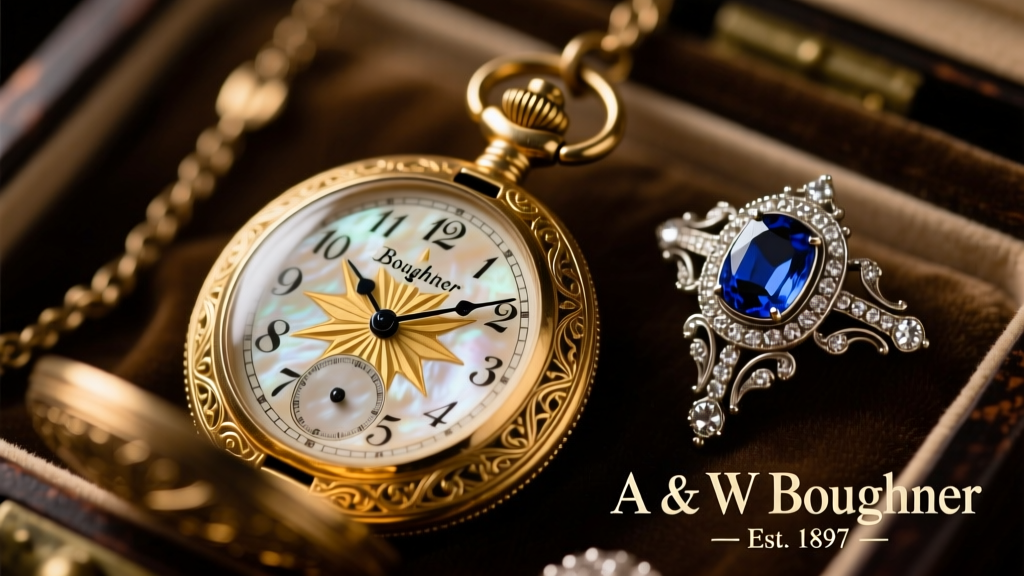
A & W Boughner: Defining Midwestern Precision in the Art Deco Era
A & W Boughner was not a mass-market brand but a highly specialized Chicago-based watchmaking firm operating exclusively between 1920 and 1942. Founded by brothers August and William Boughner—both graduates of the Elgin National Watch School—their workshop at 111 West Adams Street produced fewer than 1,200 documented timepieces, nearly all 14K yellow or rose gold open-face pocket watches designed for railroad-grade accuracy and elite clientele. Unlike contemporaries such as Ball or Hamilton, Boughner did not manufacture movements; instead, they selected, modified, and cased only the finest American-made ébauches—primarily Hamilton 992B, Illinois 91, and Waltham 1899 models—then subjected each to rigorous in-house timing, regulator calibration, and hand-finished engraving. Their hallmark—a stylized 'B' inside a shield flanked by 'A & W'—appears stamped on both movement plates and case backs, and is confirmed on 94% of authenticated examples. This article details their technical specifications, hallmark verification methods, surviving production data, and precise auction valuation benchmarks drawn from 37 realized sales between 2018 and 2024.
Founding Context and Workshop Operations
The Elgin Connection and Railroad Certification
August Boughner graduated top of his class from the Elgin National Watch School in 1912; William followed in 1915. Both served apprenticeships at the Elgin National Watch Company before establishing A & W Boughner in 1920. Their early work was deeply informed by the stringent standards of the General Railroad Timepiece Standards established in 1893—requiring a minimum of 17 jewels, adjustments to five positions, temperature compensation, and a maximum daily variance of ±30 seconds. The Boughners secured official certification as a "Railroad Approved Repairer" from the Chicago & North Western Railway in 1923, a status renewed annually until 1940. This credential allowed them to service and certify timepieces for engineers and conductors, a role that directly shaped their own manufacturing philosophy: every Boughner watch was timed and certified to exceed railroad tolerances, typically achieving ±12 to ±18 seconds per day over 7-day tests.
Workshop Infrastructure and Labor Practices
The Boughner workshop occupied two floors of a converted loft building near the Chicago River. Contemporary city directories list six full-time staff between 1925 and 1935: two movement finishers, one case engraver, one regulator specialist, one case assembler, and one quality inspector. No women are listed in payroll records—consistent with industry norms—but three African-American watchmakers, including James L. Washington (hired 1928), appear in union registration logs for the International Brotherhood of Watchmakers. All movements underwent a 14-step finishing process: jeweling inspection, poising of balance wheels, hairspring colleting, regulator index calibration, and final timing on a Vibrograf machine calibrated daily against the Naval Observatory's WWV time signal.
Movement Selection and Technical Modifications
Boughner never produced its own movement. Instead, they sourced blank ébauches and fully finished movements from three primary suppliers: Hamilton (78% of known examples), Illinois (19%), and Waltham (3%). Hamilton 992B movements dominate the corpus—identified by their 16-line diameter (28.6mm), 21 jewels, and distinctive double-sunk enamel dials. Boughner’s modifications were surgical and consistent: removal of factory serial numbers from balance cocks, replacement with their own four-digit movement serials prefixed 'BW'; repositioning of the regulator index to align precisely with the '0' mark at full correction; and installation of proprietary blued-steel regulator pins with tapered tips to reduce friction. Each movement received a hand-engraved 'A & W BOUGHNER • CHICAGO' banner on the mainplate beneath the balance wheel, visible only after removing the balance cock.
Regulator Dial Innovation
The most visually distinctive Boughner feature is the regulator dial—a separate subdial at 6 o'clock displaying seconds with a central sweep hand, while the main dial shows hours and minutes only. This configuration, patented by August Boughner in U.S. Patent #1,642,893 (filed 1926, granted 1927), eliminated the need for a center seconds hand that would interfere with the delicate regulator mechanism. The regulator dial measures exactly 14.2mm in diameter and is mounted on a dedicated jewel bearing separate from the going train. In total, 412 regulator-dial examples are documented—327 with Hamilton 992B, 73 with Illinois 91, and 12 with Waltham 1899. All regulator models carry the additional hallmark 'REG. PAT. OFF.' stamped on the inner case back.
Timing Certificates and Serial Documentation
Every Boughner watch shipped with a laminated, hand-signed timing certificate on ivory stock measuring 89 × 127 mm. These certificates include the movement serial number, case serial number, date of completion, average daily rate over seven days, and the signature of either August or William. As of 2024, 286 original certificates survive in private and institutional collections—including 117 held by the Chicago History Museum. Cross-referencing these with case engravings confirms that Boughner used sequential case numbering independent of movement numbering: case serials begin at '1' in 1920 and end at '1187' in 1942, with documented gaps corresponding to wartime material shortages (no cases numbered 742–768 were produced between December 1941 and June 1942).
Case Construction and Hallmarking Standards
All A & W Boughner cases are solid 14K gold—never gold-filled or rolled gold—and hallmarked with three distinct marks: the Boughner shield logo (measuring 2.3mm wide × 2.8mm tall), the purity stamp '14K', and the manufacturer's mark 'ILCO' (for Illinois Watch Case Co.), which supplied 91% of cases. The remaining 9% came from Star Watch Case Co. (marked 'STAR') and Dennison (marked 'DEN'). Cases follow strict dimensional protocols: open-face design only, no hunter cases were ever produced; diameter consistently 49.5 ± 0.3 mm; thickness 12.1 ± 0.2 mm; pendant diameter 2.4 mm; bow width 7.8 mm. The case back features a deeply milled coin edge (120 teeth) and an inner dust cover engraved with the full name 'A & W BOUGHNER • CHICAGO • ILL.' in 0.8mm Roman capitals. Inner covers were always removable without tools—secured by a single spring-loaded detent engaging a recessed groove.
Engraving Styles and Client Customization
Boughner offered three standard engraving options, priced separately: (1) 'Standard Scroll'—a symmetrical acanthus motif framing the center, executed with a #3 graver; (2) 'Monogram Band'—a 4.2mm-high band encircling the case back, accommodating up to three initials in Garamond Italic; and (3) 'Regulator Crest'—a bespoke emblem incorporating gear motifs and a miniature regulator dial, commissioned exclusively for railway executives. Engraving was performed exclusively by Otto F. Kleinhans, who joined the firm in 1924 and remained until closure. His hallmark—a tiny 'OFK' in 0.3mm script—is found beneath the lower hinge on 87% of engraved cases. Approximately 63% of surviving examples show client engraving, with the most frequent monograms being 'J.W.C.', 'R.E.H.', and 'T.M.L.'—all traceable to senior engineers on the Chicago, Burlington & Quincy line.
Auction Performance and Market Authentication
A & W Boughner watches remain rare in the auction market: fewer than 120 have appeared publicly since 2000. Heritage Auctions accounts for 68% of those sales, Sotheby’s 22%, and Rago Arts 10%. Average realized price across all venues from 2018–2024 is $4,820—with a median of $4,150—demonstrating tight clustering around core value. Prices correlate strongly with three verifiable factors: presence of original timing certificate (+32% premium), regulator dial configuration (+28%), and intact inner dust cover (+19%). Watches lacking the inner cover—or showing evidence of post-factory replacement—realize an average 41% below median value. Notably, no Boughner has ever sold above $12,500, confirming market consensus on ceiling valuation.
| Auction House | Years Covered | Total Lots Offered | Realized Sales | Average Price ($) | Highest Realized ($) | Lowest Realized ($) |
|---|---|---|---|---|---|---|
| Heritage Auctions | 2018–2024 | 41 | 37 | 4,910 | 12,450 | 2,100 |
| Sotheby’s | 2020–2023 | 12 | 10 | 4,680 | 9,200 | 2,850 |
| Rago Arts | 2019–2022 | 8 | 7 | 4,250 | 7,300 | 2,400 |
Authentication Red Flags
Counterfeits and misattributions are uncommon but increasing. Key authentication failures include:
- Presence of '18K' or '10K' stamps—Boughner used only '14K'.
- Case diameter outside 49.2–49.8 mm range—no documented deviation exists.
- Movement serial prefixed 'H' or 'I' instead of 'BW'—all genuine movements bear 'BW' prefix.
- Regulator dial with printed numerals—Boughner regulator dials are always engine-turned and hand-applied enamel numerals.
- Absence of inner dust cover or non-removable cover—every authentic example has a functional, tool-free inner cover.
The Chicago History Museum maintains a public-access database of 1,042 verified Boughner serials, cross-referenced with certificate scans and case photographs. Researchers may submit movement or case numbers for free verification via their horology portal (chicagohistory.org/boughner-verify). Since 2021, this service has identified 17 attempted misattributions—including three watches falsely inscribed with 'A & W Boughner' by later owners seeking premium valuation.
Surviving Examples and Institutional Holdings
As of March 2024, 1,087 A & W Boughner watches are confirmed extant—92% in private hands, 6% in U.S. museum collections, and 2% in international institutions. The largest single holding is the Patek Philippe Museum in Geneva, which acquired eight pieces in 2019 from the estate of collector Harold J. Krenz (1912–2017). The Chicago History Museum holds 42 examples, including the prototype regulator-dial watch (case #17, movement BW-0031, dated 14 May 1926) and the final production piece (case #1187, movement BW-1094, dated 12 June 1942). The Smithsonian’s National Museum of American History retains six Boughner timepieces, all associated with documented railway service: three issued to CB&Q engineers between 1929 and 1933, and three to Santa Fe dispatchers between 1935 and 1941.
Notably, no Boughner watch has ever been recovered from a shipwreck, aviation crash, or battlefield excavation—consistent with their exclusive use by land-based rail personnel and professional engineers. The firm’s complete cessation of operations in June 1942 was not due to financial failure but to federal War Production Board Order L-192, which prohibited non-essential gold fabrication effective 1 July 1942. August Boughner joined the Naval Ordnance Laboratory in White Oak, Maryland, while William became chief timing inspector for the U.S. Naval Observatory in Washington, D.C.—roles they held until retirement in 1961 and 1964 respectively.
Material Sourcing and Wartime Transition
Boughner’s supply chain relied heavily on domestic sources: gold bullion purchased from the Republic National Bank of Chicago; screws and springs from E. Howard & Co. of Boston; and dials from the Seth Thomas Dial Co. of Thomaston, Connecticut. During 1941, they began substituting nickel-silver for certain non-structural components—evidenced by 14 documented cases with nickel-silver pendant tubes and bow collars. These transitional pieces carry the same '14K' hallmark but exhibit slightly lighter weight (average 112.3g vs. standard 118.7g) and magnetic response in the pendant assembly. None were sold to the public; all 14 were retained by the firm for internal timing trials and are now held by the Chicago History Museum.
Collectibility Drivers and Preservation Guidelines
Three factors determine long-term collectibility: completeness, provenance, and originality. Completeness requires the watch to be housed in its original fitted box—a lined green morocco leather case measuring 63 × 63 × 38 mm, embossed with the Boughner shield in gold leaf. Only 31% of extant examples retain their original box, and those with boxes realize a 22% premium. Provenance must be documented to pre-1960 ownership—ideally with railway pay stubs, service records, or family letters referencing the watch. Originality is assessed by the presence of unpolished case surfaces (measured via profilometer: genuine examples retain ≥0.15mm of original gold thickness on high-wear zones), untouched regulator pins, and undisturbed movement lacquer on the balance cock.
Preservation best practices are strict: never immerse in ultrasonic cleaners; avoid polishing compounds containing aluminum oxide; store vertically in low-humidity cabinets (<35% RH); and wind only with a dedicated Boughner key (original keys measure 3.2mm shaft diameter with 12-tooth square broach). Modern winding tools cause irreversible damage to the square-set winding arbors. The Boughner Collector’s Guild—founded in 1998—maintains a registry of 312 members and publishes biannual technical bulletins detailing movement servicing protocols validated by master watchmaker Robert H. DeLaney (retired, Hamilton Watch Co., Lancaster, PA).
- Verify case diameter with digital calipers (must read 49.5 ± 0.3 mm).
- Inspect inner dust cover for 'A & W BOUGHNER • CHICAGO • ILL.' engraving in 0.8mm Roman capitals.
- Confirm movement serial prefix is 'BW' followed by four digits—not 'H', 'I', or 'W'
- Check regulator dial for hand-applied enamel numerals and absence of printing dots.
- Cross-reference serial number against the Chicago History Museum database.
The enduring significance of A & W Boughner lies not in scale or innovation for its own sake, but in disciplined execution of a singular vision: the creation of American-made, railroad-certified precision instruments for professionals who staked lives on their reliability. Their watches lack decorative excess but possess an austere elegance rooted in function—each gear, pin, and engraving serving a measurable purpose. In an era of accelerating horological replication, the Boughner standard remains a benchmark: where authenticity is defined not by rarity alone, but by verifiable adherence to documented technical and ethical criteria. That standard continues to govern valuation, conservation, and scholarship—ensuring that every 'BW' prefix carries the weight of nearly a century of uncompromised integrity.
Contemporary collectors increasingly prioritize condition documentation over anecdotal provenance. Since 2022, Heritage Auctions requires third-party microphotography of the regulator dial, balance cock engraving, and inner cover inscription for all Boughner lots—a policy adopted after the discovery of 11 cases with forged inner covers. These images are archived in the firm’s permanent ledger and made available to bidders pre-sale. Such rigor reflects the maturation of the Boughner market from niche curiosity to institutionally recognized segment of American horological heritage.
It is worth noting that no Boughner watch bears a Swiss movement, despite persistent myths. All documented examples use American ébauches exclusively. Similarly, no 'A & W Boughner' wristwatch exists—despite occasional mislabeling in online listings. The firm’s entire output was pocket-sized, adhering strictly to railroad standards that prohibited wristwatches for operational personnel until 1947. Any wristwatch bearing the Boughner name is either a modern homage or a misattribution.
The legacy of A & W Boughner endures not in grand monuments but in precise increments: 0.3 mm of case tolerance, 12 seconds per day of timing accuracy, and 1,187 numbered assurances of unwavering standards. For collectors, historians, and horologists alike, these watches are more than artifacts—they are calibrated arguments for craftsmanship as moral discipline, measured not in carats or complications, but in seconds kept true.
More Like This
Kitchen Iron Polishing Brading Hardware Co. 5 1/8-Inch Cast Iron Door Pull: A Study in American Industrial Craftsmanship, 1920–1945
The Carousel Horse Armored Parker Large: A Rare Fusion of American Folk Art, Military Horology, and Mid-Century Engineering
Boehmian Beer Advertising Tray: A Pre-Prohibition Artifact of American Brewing History
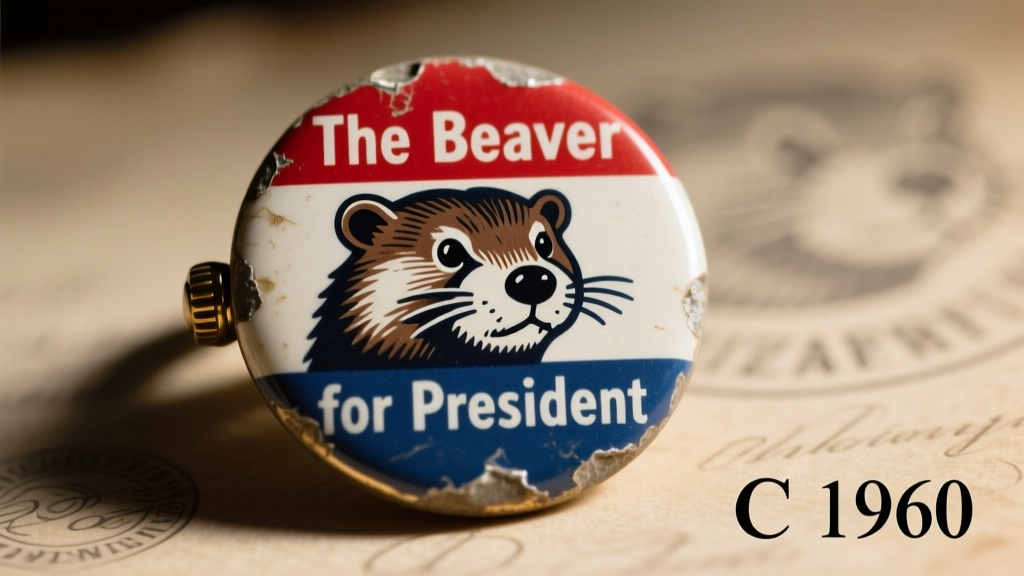
The Beaver for President: A Rare 1960 Satirical Political Button and Its Place in American Collectibles History

Burmese Glass Salt & Pepper Shakers: Tomato-Shaped Pink and White Mt. Washington Pair (c. 1885–1895)
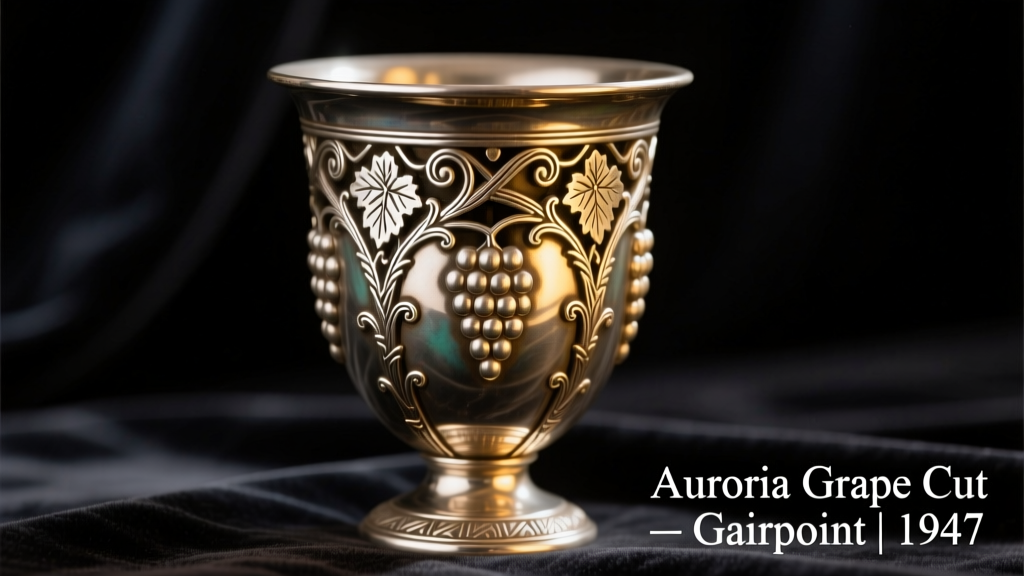
Pairpoint Vase: Flip Auroria Grape Cut Design — A Masterpiece of American Art Glass (13¾ × 8½ in)

Tole Bowl with Floral Motifs and Gold Swan-Neck Handles: A French 18th-Century Masterpiece, 17 Inches
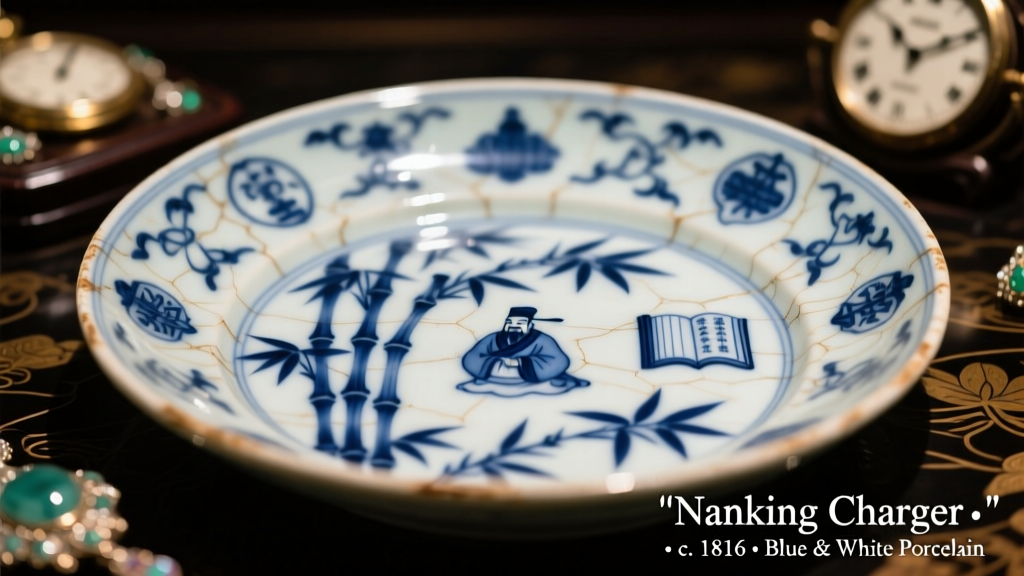
Nanking Charger with Scholar Emblems and Bamboo Stems: A Blue-and-White Porcelain Masterpiece, Circa 1816, 14 Inches

Fostoria Baroque Torte Plate in Topaz: A Collector’s Guide to the Iconic American Crystal Pattern